Whenever a child deals with adversity, whether a developmental delay, friend group tumult, any especially challenging crisis, parents tend to think the world is ending. This myopia is born of love. Parents just want the very best for their children. Always. They can’t bring themselves to trust that things will be okay, eventually.
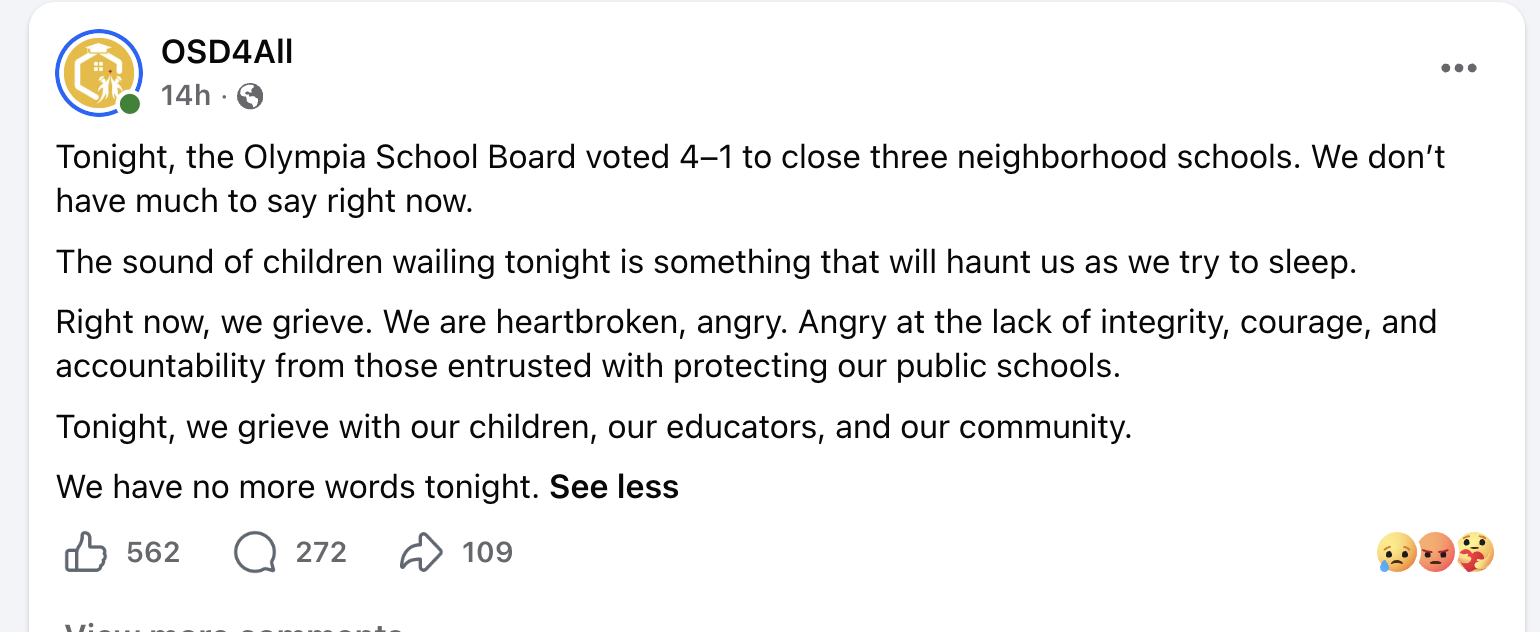
Fast forward to last night and the Olympia School Board’s 4-1 vote to close three elementary schools. Here’s the statement from the parent group that opposes the plan to consolidate Olympia’s elementary schools.
As population growth slows, this conflict is playing out in many communities. In Olympia, it feels like it’s 10% technical and 90% emotional. The technical part lies in competing interpretations of the budget details. I have not studied the budget, but suspect property taxes go farther in fewer medium-sized schools than in more numerous small ones. But to me, that’s the less interesting angle.
The more interesting aspect of this case study is how people talk right past one another when emotions are red hot. Take that last sentence as an example. If the OSD4ALL parents came across it, they’d say, “Feck you egghead, this isn’t a case study or blog fodder, it’s my child’s life!”
When Lynn and I were actively parenting our school-aged children, I remember coming across someone who suggested posting a very simple message on the refrigerator or someplace even more central where one couldn’t help but see it several times a day. The message—THIS TOO WILL PASS. When one of my daughters struggled with spelling in early primary school, I was sure she was destined for a woebegone life. And imagine what that would do to my social status?! When I asked Kyle, my early childhood expert colleague what Lynn and I could or should do, he smiled and explained that it would work itself out as she read and wrote more. His professional advice? Chill. Of course, he was right.
I would not be so brazen to the tell the OSD4ALLs to chill. But I would suggest that they consider something that they might not fully realize. And that is that kids are way more resilient than we give them credit for. One aspect of my work with preservice teachers was super predictable. When student teaching, they would come to my weekly seminar convinced they were so bad that they were ruining their students’ lives. To which I’d say, “LOL”. Not really, that’s more recent shorthand. I would ask them a rhetorical question. Had they ever had any teachers who were maybe, or maybe not, finding their way through subpar lessons? Then I’d point out that MOST of our K-12 teachers were deeply flawed, and lo’ and behold, look how amazing we turned out?!
I had another go-to-move when teaching first year writing to students who were uber anxious about their career paths. Which almost always translated into serious grade anxiety. I’d ask them to imagine our class having a ten-year potluck dinner/reunion at my house. They’d be 29 years-old. Some would be married (giggles). Some would have children (more giggles). And no one would talk about their undergraduate or graduate grade point averages. Or their Graduate Record Exam scores. Or what kind of car they drive. Oh, undoubtedly, we would be judgey, but positively. We’d be assessing . . . Who listens especially well? Who has a sense of humor that lightens things? Who parents their children with tender loving care?
It’s a completely different perspective. One which requires replacing “the world is ending” zoom lens with a wide-angle “this too shall pass” one.
Consider the McKenny Elementary fourth grader who is ten-years-old. She has to go to Pioneer or Centennial with some of her old friends, but a lot of new ones. Some of her old teachers and some new ones. She might have to leave five minutes earlier and travel a mile or two further. But in 2036, when that fourth grader is 20 years-old and either halfway through college or running an AI-based business, will she be any worse off as a result of what happened in September 2027?
I feel for the parents who think the world is ending for their children; however, it’s ridiculous to question the courage of the Superintendent and Board. Maintaining the status quo would’ve been the much easier route. Given the intensity of feelings in the community, they’re probably weighing the pros and cons of the Witness Protection Program.
So my unsolicited* OSD4ALL advice, know that your children are taking their cues from you. So breathe. And pace yourselves. Think of this as practice, because trust me, there are more equally or greater challenges forming on the horizon.
*always muy peligroso


Parents can also run for school board positions. If they want to be heard, this is the best way. However, oftentimes, those who get on school boards for a single issue are usually surprised when their service is more difficult than they thought. I served for 12 years and no, I didn’t always get “my way.” But to me, that’s what service is- looking at the big picture and then making the best decisions I could make for our community and most especially for kids. Closing schools is a hot topic. Sadly, teaching and learning is sometimes an afterthought. I had a superintendent tell me that communities mostly care about beans, basketball and buses. I would add school closures and changing attendance boundaries as well. I feel very strongly that parents with school-aged children get involved with their local school boards.
Yes, and…parents need to lament the loss of the future they tried to create for their child(ren). Hopefully, after some good grief, they will be able to discover the upside of necessary changes.
Excellent point, Steve. Thanks.