
The New York Times reports, “Older Adults Are No Longer Staying in ‘Empty-Shell’ Marriages“.
Key stat.
“Rates of ‘gray divorce’ — splits among those 50 and older — have risen sharply in the United States, doubling between 1990 and 2010. Though those rates have stabilized since the pandemic, nearly 40 percent of divorces today occur between people 50 and older.”
Key definition.
“‘Empty-shell marriages’ are ones in which there is no real connection or vitality, where one or both partners are not happy. . .”
The key reasons according to Justin Garcia, the executive director of the Kinsey Institute in Bloomington, Ind., and the author of The Intimate Animal: The Science of Sex, Fidelity, and Why We Live and Die for Love.
“’We as a species are in longer relationships than our ancestors ever were,’ he said. ‘Lifelong monogamy maybe meant a few decades.’ Now, though, there are couples who have been together for 50, 60 or even 70-plus years.
‘That is evolutionarily unprecedented for our species,’ Dr. Garcia said.
At the same time, societal expectations for what marriage can or should be have changed. Baby boomers who got married relatively young — in part because that was simply the norm — are now living through a time when marriage is seen as a vehicle for love and self-actualization, said Claire Kamp Dush, a professor of sociology at the University of Minnesota.
‘We’re not just partnering based on this idea that someone’s going to be the breadwinner and someone’s going to be the homemaker,’ she said. It is possible, she added, that our collective tolerance for staying in just a so-so relationship ‘is going down.'”
RX from the Bay Area, commented, “. . . it’s mostly because women are over it.”
Three other top commenters point to an uneven and unfair division of labor as a key catalyst for calling it quits after decades of being together.
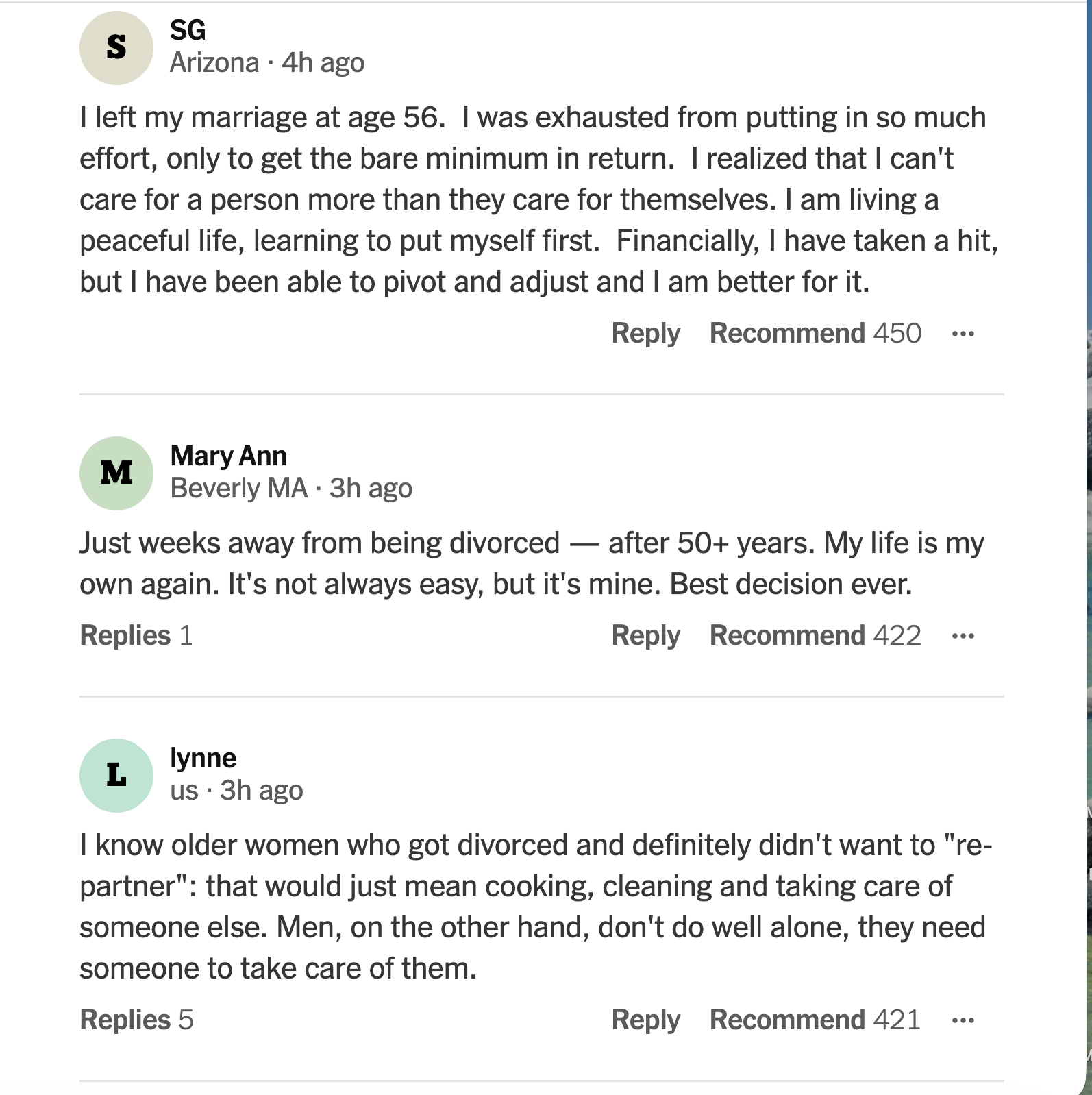
Because the author of the piece only used heterosexual examples, and the author and top commenters focused almost exclusively on unfair workloads, we end up with what feels like a relatively simplistic understanding of “gray divorce”.
For example, the author of the piece references, and the top commenters repeatedly emphasize, that women want to finally be free of caring for their male partners while men who divorce tend to remarry, often quite quickly, because “men need to be taken care of”.
Classic painting with a broad brush. “Some” men, even “many men” would be a much better way to word that.
Let’s consider a counter example. Your fave blogger. At first glance, your fave blogger’s decision to begin dating someone three months after his beloved wife died, after 38 years together, might be further proof of men being woefully dependent upon someone to cook and clean for them. Because, as the female author and top commenters seem to think, men can’t cook and clean for themselves.
Sigh. I don’t know how much depth to go into here, with respect to sharing with you dear reader my rationale for deciding to date before learning it was way, way before my daughters were ready for it. But suffice to say, my rationale had nothing to do with being taken care of. Nothing. Nada. Zilch. Not to brag, but I can hold my own in the kitchen and I will out clean you. Just sayin’.
How ’bout a four-word summary of what could be a four thousand word explanation. I began dating because I sought emotional connection. Which is one word more than it takes to say I was lonely. Weirdly, the concept of emotional intimacy is completely skirted around in the article and top comments.
A friend and I have been sparing a bit on the topic of the patriarchy. Often while hiking. This will surprise no one. I’m losing. She runs circles around me on the topic because she thoughtfully articulates the negative consequences of the patriarchy on men. A key point that too many feminists gloss over. In particular, she correctly points out that entrenched patriarchal norms make it very difficult for men to develop much, if any, emotional intelligence. Without which, emotional intimacy is a non-starter.
Despite some countervailing evidence, most men can learn to vacuum and load and unload dishwashers. And pick up their underwear. Much, much more easily than they can learn to communicate about their inner lives. And much, much more easily than they can learn to tap into their partner’s innermost thoughts and feelings.
I am not an expert and any reader of the female persuasion correct me if I’m wrong about what follows.
I have a strong hunch that many women would like to have their partners do a load or ten of laundry and make them dinner and clean up afterwards, but what every woman would love, especially in empty-shell marriages, is the opportunity to talk about each other’s inner lives in as vulnerable and patient and regulated a manner as possible. So as to feel safe, to feel seen, to feel loved unconditionally. And then to reciprocate. Over and over. For however many years are left.
 Pressing Pause
Ron, regarding that last paragraph, I can assure you that 100% of the women I know would read that and feel seen/heard. The workload of a typical marriage still leans toward the wife keeping things together at the home and the husband keeping things together outside of the home, even when that’s JUST outside of the home (think yard work, car maintenance, etc.) for couples in our age range. The younger couples might be setting up their lives differently, and balance is a big word these days.
Back to that last paragraph, most of my female friends who are in a long-term relationship feel the loss of emotional intimacy and dedicated time. Everybody has heard the saying “Happy Wife; Happy Life”, right? Seriously, people, how hard is it to give your partner a hug a couple times a day? Touch them briefly as you walk by? Or have an actual discussion, not an argument? I say “DO IT!”; it won’t hurt you a bit and the rewards are likely more than worth the effort.
Just to be fair, I believe that everyone should be this way, men and women, in all committed relationships, but that wasn’t the subject at hand.
Thanks so much for such a thoughtful reply.
I’ve been meaning to reply all these months. Now lessons have ended and grading begins.
I am very glad for you that you have started a new relationship. I am sorry your daughters are pained, but I trust time will heal those wounds and bring about reconciliation.
Ken