Recall the shortest possible answer. “Feeling loved”. That resonants with me.
After Lynn died, I pressed pause, for not nearly as long as my grieving daughters would’ve liked, but I reflected on my life to this extremely sad and disorienting turning point and had an epiphany.
My default tends to be optimism, confidence, and happiness because I’ve been so damn lucky in love.
And as the authors of the aforementioned book explain, feeling loved isn’t just a romantic thing. Why does a parent who gets a tender note of appreciation from their young adult child immediately attach it to their refrigerator? Because it’s a constant reminder that they are loved. Today, two friends who I’m not in regular contact with, both out of the blue, asked me how I’m doing. Making me feel like I matter a wee bit more. Loved, if you will.
Most fundamentally, from the beginning, my mom’s unconditional love convinced me I mattered. That I was lovable. Her affection for me was the single most important source of my well-being until the middle of high school when I fell in love for the first time. After 3.5 years, Cindy dropped kicked me, and shortly thereafter Sally did the same. WAIT, I’m detecting a pattern!
More seriously, I had this overwhelming sense of being loved by my mom, then Cindy, then Sally, then there was, in the grand scheme of things, an incredibly short period of maybe eighteen months where I was adrift, unsure that I was loved much before meeting Lynn who deeply loved me for four decades.
So, for those keeping score at home, I’ve known I’m loved about 97.7% of my life.
The authors of “Feeling Loved” might say that’s less lucky than me being attentive, kind, and caring enough to family, friends, and romantic partners that love has almost always been reciprocated. A boomerang effect.
Both/and I suspect. I have tremendous gratitude for everyone that has loved me and is loving me currently. I will continue doing my best to hold up my end of the seesaw by striving to be more attentive, kind, and caring, so that, in the end, love and well-being prevail.
Listening to a Spotify “Acoustic Chill” playlist while decluttering files and reliving the past is not a great combo. Word of the day . . . melancholy. . . a deep, quiet, and lasting feeling of sadness or thoughtful sorrow. It often comes without a single clear cause and can be mixed with a sense of nostalgia, longing, or calm reflection.
Trick question, of course, because there’s no right answer. The most common one is that there’s as many ways to grieve as there are people grieving. Because it’s imminently idiosyncratic.
Some turn to “talk therapy”. Others to nature. Others to literature about the impermanence of things. Others to Buddhism or Christian scriptures and prayer or meditation. Still others to varied combinations of those and other forms. What do you do?
Sporadically, waves of sadness born of layered losses hit me. Instrumental music, especially the soundtrack I created for Lynn’s final months, routinely melts my heart. As does cycling by my daughter’s cottage.
This morning, a friend said maybe I should try grieving more deliberately. What, like set a regular day and time aside for it? That’s crazy talk. Kidding of course. I liked the idea, and thought to myself, why not start today.
My go to, beyond music, are photos and videos of Lynn, almost all pre-MSA. Almost all the short videos are of her taking her glasses off and entering mountain lakes or the Salish Sea. Celebrating. Smiling. Absolute peak happiness.
While deliberately leaning in today, an epiphany of sorts. I wonder how Lynn’s legion of friends are dealing with their loss? I’ve been so overwhelmed by mine, I haven’t thought about theirs nearly enough.
Sam Miller, a comedian from my hometown, Olympia, WA, has lived a few lives. As a comic, he has a lot of momentum, performing before increasingly large crowds.
Speaking of momentum, no family ever sits still. Families are organic, every single one always with some degree of momentum, either positive or negative, based upon the adults’ collective decisions. Often, the momentum is barely perceptible. In Sam Miller’s family’s case, it’s plain as day.
Today, online, he wrote this. I’m guessing he pounded it out, not overthinking it. But lo’ and behold, it couldn’t be more profound.
“One time my dad picked me up and threw me off a dock into the cold waters of the Strait of Juan de Fuca. There was no warning. Before I realized what was happening, I was airborne. I hit that water, and even though I was a good swimmer, it was hard to peel my elbows from my side. I wanted to stay curled up in a ball but I also wanted to breathe and so I swam back to the dock. My dad’s hand came down and pulled me out. I don’t remember what time of year it was, but I just looked it up. Temperatures in the strait of Juan de Fuca hover between 41 and 54°.
He told me he did it because we spent a lot of time fishing the Straits. He wanted me to know what it would be like to fall off the boat or off the dock. That way I would know what that water felt like and I wouldn’t panic.
I thought I did something wrong. I thought he was angry. He told me he wasn’t. I believed him then. I don’t believe it now. I think he got angry and he lost control and he threw me off that dock because my dad was really bad at dealing with his emotions.
I bring this up because I just spent 8 days with my kids and my mom on a vacation/comedy tour. There were multiple moments where I became incredibly frustrated. There was a couple moments where I was just downright angry. I feel like I had really good reason to be angry a couple times.
I’m really proud to report that I did not yell or scream or pick anybody up and throw them.
I know it’s not true, but I used to think me and my family was cursed. My dad died when I was a kid. I don’t know too much about how he grew up because he didn’t talk about it that much but I know my grandma on my dad’s side had schizophrenia. When my dad and his brother were kids, she drove them to Long Beach, California from Salem, Oregon and just dropped them off in the middle of nowhere. My dad had to hitchhike back while taking care of his kid brother. Pretty sure my dad was 12 or 13 when that happened.
What I’m getting at is this…
I have such an opportunity today to do better and I’m so grateful that I have the tools to keep trying.
I’m a pretty good dad, I’m a pretty good husband, and I’m even a pretty good son now. It’s hard but it feels really good. There are times I wish I could throw people off docks.
but…
I don’t think I ever would. It’s not fair to them and it’s not fair to me. Whatever curse my family had, I’m going to try to keep doing the work to make it stop with me. I owe it to the people that I love and most of all I owe it to myself.”
“I’m going to try to keep doing the work to make it stop with me.” Amen, brother.
“Rates of ‘gray divorce’ — splits among those 50 and older — have risen sharply in the United States, doubling between 1990 and 2010. Though those rates have stabilized since the pandemic, nearly 40 percent of divorces today occur between people 50 and older.”
Key definition.
“‘Empty-shell marriages’ are ones in which there is no real connection or vitality, where one or both partners are not happy. . .”
The key reasons according to Justin Garcia, the executive director of the Kinsey Institute in Bloomington, Ind., and the author of The Intimate Animal: The Science of Sex, Fidelity, and Why We Live and Die for Love.
“’We as a species are in longer relationships than our ancestors ever were,’ he said. ‘Lifelong monogamy maybe meant a few decades.’ Now, though, there are couples who have been together for 50, 60 or even 70-plus years.
‘That is evolutionarily unprecedented for our species,’ Dr. Garcia said.
At the same time, societal expectations for what marriage can or should be have changed. Baby boomers who got married relatively young — in part because that was simply the norm — are now living through a time when marriage is seen as a vehicle for love and self-actualization, said Claire Kamp Dush, a professor of sociology at the University of Minnesota.
‘We’re not just partnering based on this idea that someone’s going to be the breadwinner and someone’s going to be the homemaker,’ she said. It is possible, she added, that our collective tolerance for staying in just a so-so relationship ‘is going down.'”
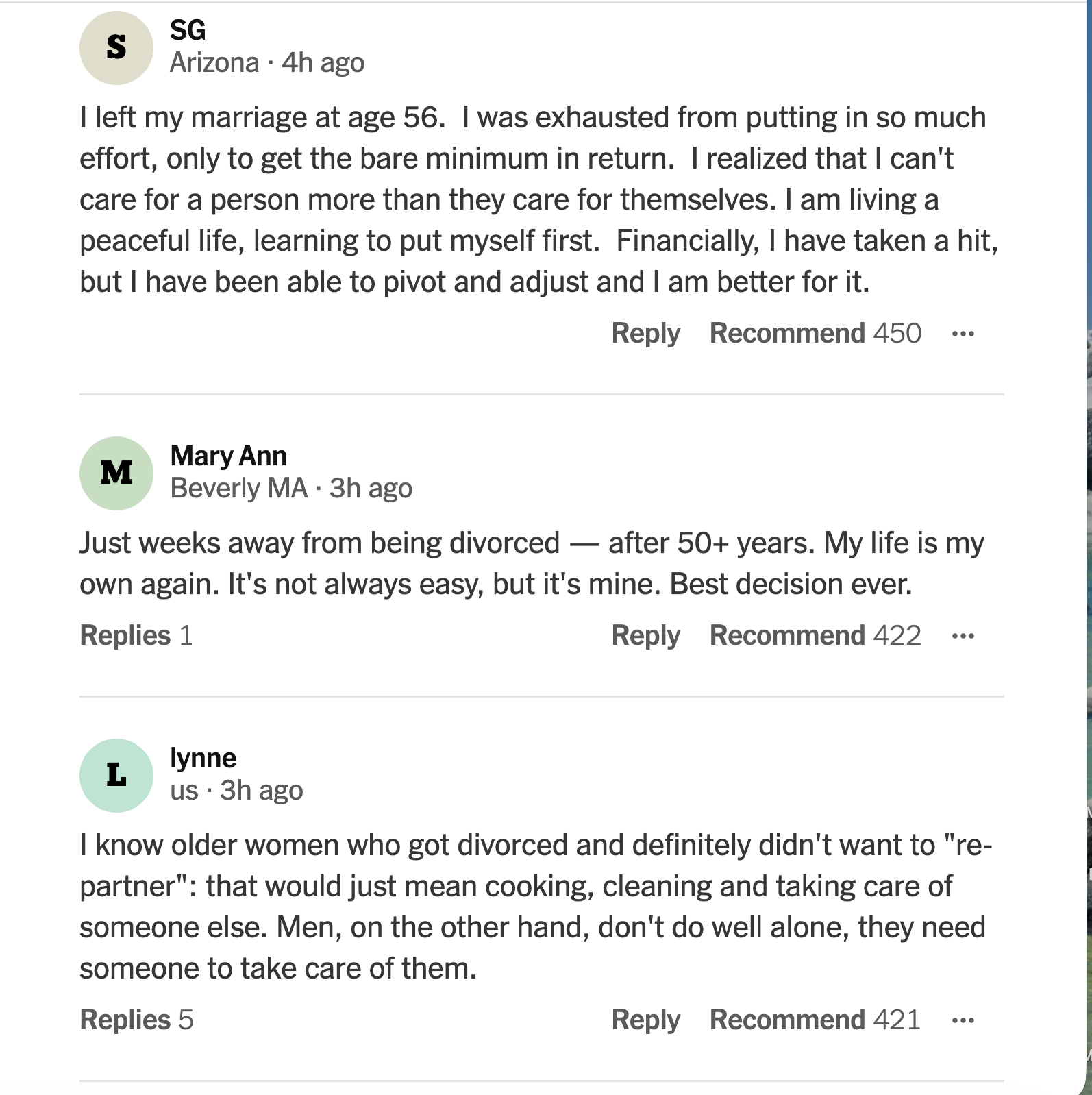
RX from the Bay Area, commented, “. . . it’s mostly because women are over it.”
Three other top commenters point to an uneven and unfair division of labor as a key catalyst for calling it quits after decades of being together.
Because the author of the piece only used heterosexual examples, and the author and top commenters focused almost exclusively on unfair workloads, we end up with what feels like a relatively simplistic understanding of “gray divorce”.
For example, the author of the piece references, and the top commenters repeatedly emphasize, that women want to finally be free of caring for their male partners while men who divorce tend to remarry, often quite quickly, because “men need to be taken care of”.
Classic painting with a broad brush. “Some” men, even “many men” would be a much better way to word that.
Let’s consider a counter example. Your fave blogger. At first glance, your fave blogger’s decision to begin dating someone three months after his beloved wife died, after 38 years together, might be further proof of men being woefully dependent upon someone to cook and clean for them. Because, as the female author and top commenters seem to think, men can’t cook and clean for themselves.
Sigh. I don’t know how much depth to go into here, with respect to sharing with you dear reader my rationale for deciding to date before learning it was way, way before my daughters were ready for it. But suffice to say, my rationale had nothing to do with being taken care of. Nothing. Nada. Zilch. Not to brag, but I can hold my own in the kitchen and I will out clean you. Just sayin’.
How ’bout a four-word summary of what could be a four thousand word explanation. I began dating because I sought emotional connection. Which is one word more than it takes to say I was lonely. Weirdly, the concept of emotional intimacy is completely skirted around in the article and top comments.
A friend and I have been sparing a bit on the topic of the patriarchy. Often while hiking. This will surprise no one. I’m losing. She runs circles around me on the topic because she thoughtfully articulates the negative consequences of the patriarchy on men. A key point that too many feminists gloss over. In particular, she correctly points out that entrenched patriarchal norms make it very difficult for men to develop much, if any, emotional intelligence. Without which, emotional intimacy is a non-starter.
Despite some countervailing evidence, most men can learn to vacuum and load and unload dishwashers. And pick up their underwear. Much, much more easily than they can learn to communicate about their inner lives. And much, much more easily than they can learn to tap into their partner’s innermost thoughts and feelings.
I am not an expert and any reader of the female persuasion correct me if I’m wrong about what follows.
I have a strong hunch that many women would like to have their partners do a load or ten of laundry and make them dinner and clean up afterwards, but what every woman would love, especially in empty-shell marriages, is the opportunity to talk about each other’s inner lives in as vulnerable and patient and regulated a manner as possible. So as to feel safe, to feel seen, to feel loved unconditionally. And then to reciprocate. Over and over. For however many years are left.
What has the post-‘rona world wrought? People connecting. Hell yeah.
Patricia Marx in The New Yorker:
“When my editor asked whether I’d be interested in writing about the growing trend of friends getting together to tackle to-do lists, I thought, “Sounds about as fun as a group root canal.” I e-mailed back, “YES!” It was February; I hate the cold; the research would take place indoors. Also, I figured, it might take a village to make me get that comptroller form notarized, memorize the map of South America (don’t ask), and write my will—an item on my list for eighteen years. (As for to-do-list items that never die, thirty-three years ago, the agenda of a friend of mine included: No. 1, get my figure back; No. 2, dance lessons . . . No. 8, figure out if I should break up with Tim; No. 9, leave Tim. Not his real name, because my friend is still wondering about divorcing him.)
Everyone, it turns out, has a lot of shit to do, and many find the drudgery easier to slog through in the presence of company and snacks. Over the course of two months, I sat in on eight Admin Nights, as these gatherings are often called. (“Are they, like, fossils of extinct mollusks?” a hedge-fund guy at a dinner party asked me, thinking of ammonites.) There was a meetup of young mothers who had a lot of children’s birthday parties to organize, a group of Gen Z-ers whose morning session had a live soundtrack provided by a d.j., and a group of people with A.D.H.D., based mostly in Australia, who meet regularly on Zoom. At the Women in Games get-together, a seven-year-old attendee, brought by her mother, marvelled that grownups have homework, too.”
This morning, on the way to Masters swim practice at the Y, I saw three women running shoulder to shoulder on the Henderson Rd sidewalk by Olympia High School. They were not fast, at all, but that’s irrelevant. They had found each other, agreed to meet up, and were clearly vibbing, talking through who knows what. Simultaneously improving their physical and mental health.
And props for your introverted humble blogger for livening up Masters by asking the women in Lane 3, “Do you know the Masters swim team secret?” Looking perplexed, they repeated, “Masters swim team secret?” “Yeah, this lane has the best technique.” They were touched and proudly added their lane was also the most jovial. Five women connected, happier together, living fully.
Maybe I shoulda started this out by writing . . . some people connecting. Social anxiety shows no sign of abating. And we’re way less likely to see our lonely, socially anxious neighbors struggling to find connection. Because often, they can’t even leave their homes.
Here’s to celebrating connection while continuously extending the circles of friendship we’re lucky enough to enjoy.
“Before MacKenzie Scott signed the Giving Pledge and started on her path to give away her $36 billion net worth, she went looking for a paragraph in a book she’d marked up during her college years.
She opened her Giving Pledge letter with a memory of pulling Annie Dillard’s The Writing Life off a shelf of her old college books, where she found a passage that she had ‘underlined and starred.’ Dillard’s advice to writers was to not hoard your best material for some later chapter.
‘The impulse to save something good for a better place later is the signal to spend it now,’ Dillard wrote, warning that otherwise, ‘you open your safe and find ashes.’ Scott took the writing advice literally and applied it to her massive fortune.
For the past six years, Scott has remained committed to emptying her safe, so to speak. She’s donated more than $26 billion across more than 2,700 gifts through her philanthropic organization, Yield Giving. Her marquee year was in 2025 when she donated an eye-popping $7.2 billion. (That’s more than Bezos and his wife, Lauren Sánchez Bezos, have given over their entire lifetimes, according to Forbes estimates). The publication also named Scott the third-most generous philanthropist in the world this year, noting she has given away 46% of her net worth.
True to the Dillard ethos, she gives fast and lets go. Her philanthropic style is stroking unrestricted checks with no applications, no progress reports, and almost no press.”
Absolutely certain it doesn’t mean anything to MacKenzie Scott to be named the “third-most generous philanthropist in the world” this year. In fact, I’m pretty sure if she had her way, pieces like this one would never appear in print. What a role model.
Don’t hoard. Don’t find ashes. Annie Dillard with one of the most amazing assits of all-time.
Three weeks after ejecting from my roadbike and skimming across Center Street, I feel somewhere between two-thirds to three-fourths of the way back depending upon how much I’m asking of my bod. I don’t cry when choking on pistachios anymore. And I’m walking a lot, cycling a little, and I ran all of two miles yesterday even though I couldn’t breath very deeply at all. And I’m hoping to get the gills wet Monday at Masters swimming. Thanks to everyone who has checked in. Your texts and calls have meant a lot. They have made me feel a lot less alone.
More importantly, how is my soul five months after Lynn’s passing?
The second hardest adjustment has been the near complete loss of the connectedness to everyone who showed up for Lynn so consistently until the very end. Everyone, of course, quickly returned to their normal lives. I understand that, but it has still been disorienting. The house is so dang quiet.
However, the single hardest adjustment has been the loss of Lynn’s constant love, which as it turns out, I grew more dependent upon than I realized. As an introvert who digs solitude, I always fancied myself as fairly independent and resilient. LOL. In the immediate aftermath of her dying, I felt like the guy in the opening of MadMen.
Despite MSA’s slow motion devastation, I was unprepared for what, at the very end, felt like the pulling of a trap door. Which compelled me, two months ago, to go on a couple of dates which really upset my daughters whose well-being is as important to me as my own. And so now, as a result, I am disconnected from them. So disconnectedness upon disconnectedness.
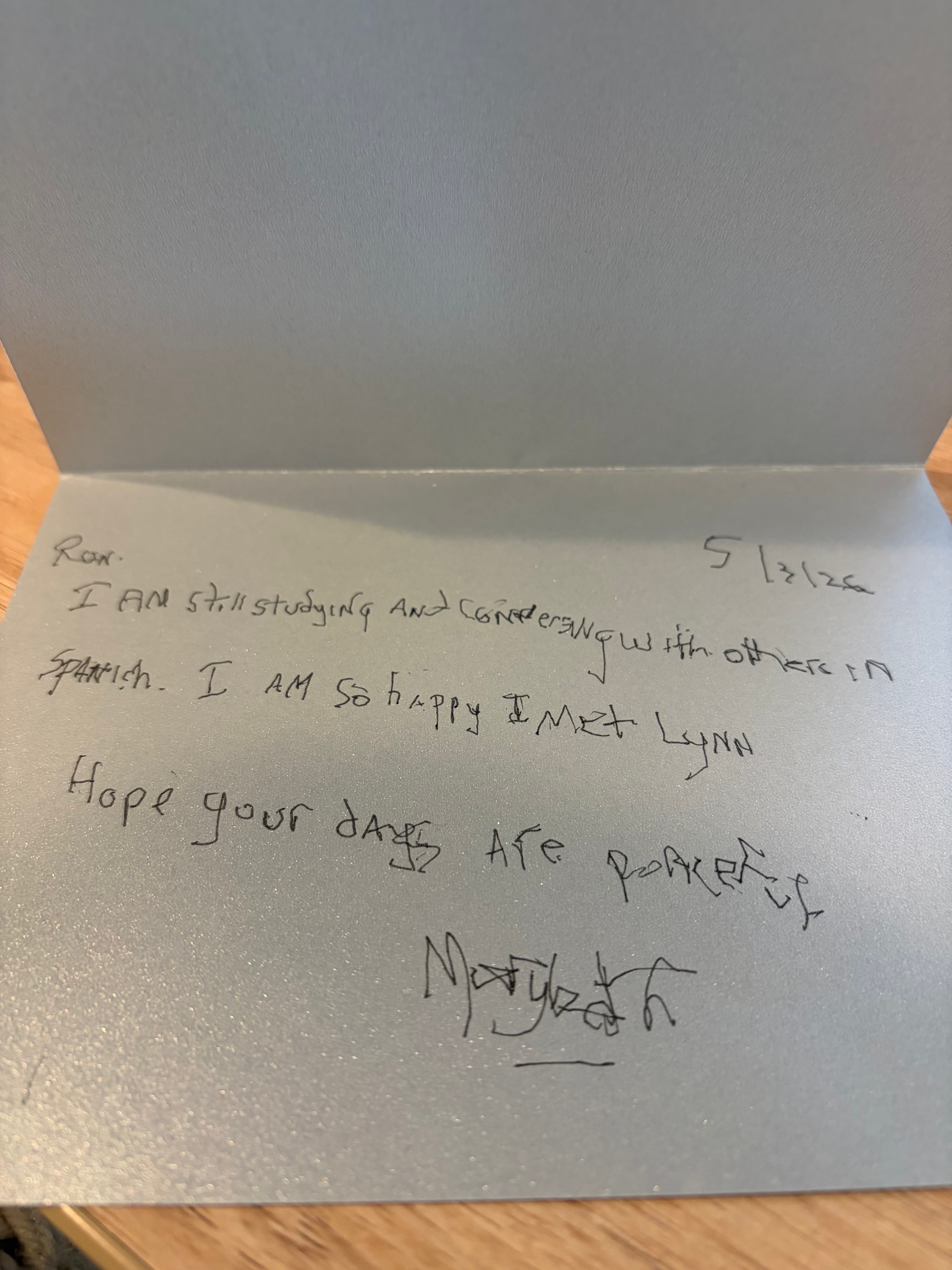
Within that larger context, there have been what we in the Pacific Northwest call “sunbreaks”. Moments in the week, when the clouds separate just enough for warm, healing light to briefly shine through. When Steve calls during one of his Camino training walks to see how I’m doing. When Kevin calls. When MARN calls. When Lou, from high school, reaches out. When Mark invites me to walk. When Kris reaches out and comes over and listens to me ramble like the wonderful counselor she is. When Lil’ Chris sends a heartfelt card and note and invitation to a community event. When the college roommates write to see how we’re doing. When Marybeth sends this card.
Damn, that’s what everyone said, “I’m so happy I met Lynn.” I miss the KChrises, the roommates, Marybeth. Lynn’s people.
More sunshine than a sunbreak, I am not dating anymore because I’ve met someone special. Someone incredibly sensitive to my grieving and the family’s. Someone who watched Lynn’s memorial service on YouTube and said, “I wish I had known her.” Someone who gives me confidence that I will be alright. Especially when my daughters can accept my free falling self and we reconnect.
Sunday, Mother’s Day will be especially hard for A and J. Here’s what I want them to know. I turned on Lynn’s phone recently and there were 99 text messages. One dated 12/16/25, the day after she died, was piercing. Lisa, her boxing coach texted, “I love you Lynn. No more pain. Rest in peace.” Followed by a purple heart and strong arm emoji.
I want them to find solace in their mom’s legacy. So many people loved her. So deeply. We were very fortunate to be among them for as long as we were.
“God did not ordain Donald Trump to rescue the American church, or revive the American church, or redeem the American church. God ordained Donald Trump to test the American church. And the American church has failed.”


 Pressing Pause