
‘Women Are Over It’

The New York Times reports, “Older Adults Are No Longer Staying in ‘Empty-Shell’ Marriages“.

Key stat.

“Rates of ‘gray divorce’ — splits among those 50 and older — have risen sharply in the United States, doubling between 1990 and 2010. Though those rates have stabilized since the pandemic, nearly 40 percent of divorces today occur between people 50 and older.”

Key definition.

“‘Empty-shell marriages’ are ones in which there is no real connection or vitality, where one or both partners are not happy. . .”

The key reasons according to Justin Garcia, the executive director of the Kinsey Institute in Bloomington, Ind., and the author of The Intimate Animal: The Science of Sex, Fidelity, and Why We Live and Die for Love.

“’We as a species are in longer relationships than our ancestors ever were,’ he said. ‘Lifelong monogamy maybe meant a few decades.’ Now, though, there are couples who have been together for 50, 60 or even 70-plus years.

‘That is evolutionarily unprecedented for our species,’ Dr. Garcia said.

At the same time, societal expectations for what marriage can or should be have changed. Baby boomers who got married relatively young — in part because that was simply the norm — are now living through a time when marriage is seen as a vehicle for love and self-actualization, said Claire Kamp Dush, a professor of sociology at the University of Minnesota.

‘We’re not just partnering based on this idea that someone’s going to be the breadwinner and someone’s going to be the homemaker,’ she said. It is possible, she added, that our collective tolerance for staying in just a so-so relationship ‘is going down.'”

RX from the Bay Area, commented, “. . . it’s mostly because women are over it.”

Three other top commenters point to an uneven and unfair division of labor as a key catalyst for calling it quits after decades of being together.
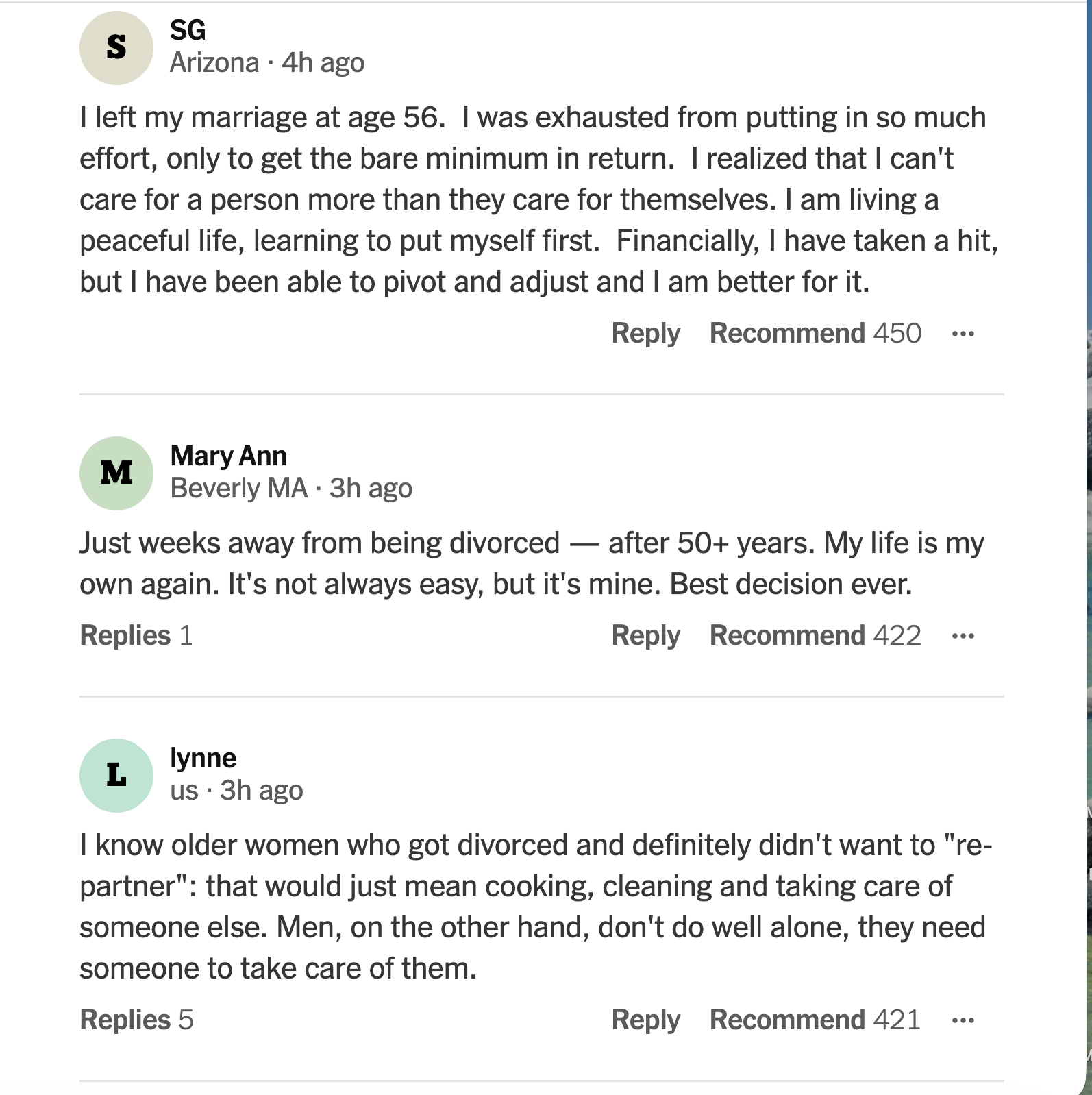
Because the author of the piece only used heterosexual examples, and the author and top commenters focused almost exclusively on unfair workloads, we end up with what feels like a relatively simplistic understanding of “gray divorce”.

For example, the author of the piece references, and the top commenters repeatedly emphasize, that women want to finally be free of caring for their male partners while men who divorce tend to remarry, often quite quickly, because “men need to be taken care of”.

Classic painting with a broad brush. “Some” men, even “many men” would be a much better way to word that.

Let’s consider a counter example. Your fave blogger. At first glance, your fave blogger’s decision to begin dating someone three months after his beloved wife died, after 38 years together, might be further proof of men being woefully dependent upon someone to cook and clean for them. Because, as the female author and top commenters seem to think, men can’t cook and clean for themselves.

Sigh. I don’t know how much depth to go into here, with respect to sharing with you dear reader my rationale for deciding to date before learning it was way, way before my daughters were ready for it. But suffice to say, my rationale had nothing to do with being taken care of. Nothing. Nada. Zilch. Not to brag, but I can hold my own in the kitchen and I will out clean you. Just sayin’.

How ’bout a four-word summary of what could be a four thousand word explanation. I began dating because I sought emotional connection. Which is one word more than it takes to say I was lonely. Weirdly, the concept of emotional intimacy is completely skirted around in the article and top comments.

A friend and I have been sparing a bit on the topic of the patriarchy. Often while hiking. This will surprise no one. I’m losing. She runs circles around me on the topic because she thoughtfully articulates the negative consequences of the patriarchy on men. A key point that too many feminists gloss over. In particular, she correctly points out that entrenched patriarchal norms make it very difficult for men to develop much, if any, emotional intelligence. Without which, emotional intimacy is a non-starter.

Despite some countervailing evidence, most men can learn to vacuum and load and unload dishwashers. And pick up their underwear. Much, much more easily than they can learn to communicate about their inner lives. And much, much more easily than they can learn to tap into their partner’s innermost thoughts and feelings.

I am not an expert and any reader of the female persuasion correct me if I’m wrong about what follows.

I have a strong hunch that many women would like to have their partners do a load or ten of laundry and make them dinner and clean up afterwards, but what every woman would love, especially in empty-shell marriages, is the opportunity to talk about each other’s inner lives in as vulnerable and patient and regulated a manner as possible. So as to feel safe, to feel seen, to feel loved unconditionally. And then to reciprocate. Over and over. For however many years are left.


It’s Happened

A large part of the rationale for the move to the Adult Family Home three months ago was that I could recover, and therefore Lynn and I could heal and get in sync, and spend whatever time is left as positively and peacefully as possible.

I am not in a good place, but a much better one. Way, way less stress. FuFu, Alison, and Jeanette, among many others, have saved me.

As a result, for the last two months, Lynn and I have enjoyed my visits. We look at photo albums. We listen to music. I tell her about my day. We loop the hood.

Most of all, we touch. I hold her hands and massage her calves. She hugs me tightly as if she’s not going to let go. We press our foreheads against each other. I caress her head as she falls asleep. We kiss.

It’s how we communicate.

I’ve never partnered with someone who is dying, so I’m improvising. All the time. What to say?

Last week I kneeled on the floor next to her hospice bed as she cried before napping. I told her I loved her and that she was okay, which of course, was untrue. Then I told her how sorry I was for what she’s experiencing. And that she’s been fighting it every minute she’s been awake for a few years and that was why she was completely exhausted. And that I wanted her to Rest even if that meant being alone. I told her how much I am going to miss her. More tears.

Then I told her she wasn’t alone and wouldn’t be alone. That she is bearing the fruit of having built such a caring and loving family.

We have had a much more intense relationship than you would probably guess. Intensely good most of the time, intensely bad some of the time.

I told her I was skimming an old Apple Note I wrote from when we were in marriage counseling five or six years ago. And how my one regret is all the time we wasted being mad at each other. I asked her to forgive me for being so stubborn and selfish. More tears.

I suspect she wanted to say something similar, but I was okay with her not being able to because I wanted to take most of the responsibility for our epic, sporadic struggles.

Even though we wanted to at times, I told her we never quit, and that was something.

In hindsight, we probably wasted 10% of our time together being too mad at each other to thoughtfully interact. Even though we learned to repair things, 10% of 38 years is almost four years! What we would do to have four years back.

More than Lynn, I accepted that we were never going to coast conflict free like some couples seemingly do. That the heartache was part and parcel of the intense intimacy. Again, in hindsight though, I wish we had far fewer, less intense conflicts. Fewer days where we couldn’t even talk to one another.

My unsolicited advice. Don’t take whatever committed relationships you’re in for granted. Be as proactive as you can. Trust one another enough to talk about what lies below the surface so that resentments don’t build up. Learn to listen and get more comfortable probing your partners’ feelings. If possible, by yourself, or together, enlist the help of a professional to learn to have fewer, less intense conflicts.*

Most of all, don’t assume you have many years and decades left, because you may not.

*LOL, I’m gonna get slammed for that wee bit of hypocrisy. :)

A Surprise Swing Dance For The Win

A very good friend of mine has been “unlucky” in marriage. Three divorces. Although the first was so short, and he was so young, he doesn’t count it. A mulligan if you will. So, for all intents and purposes, twice divorced.

Of course, you and I both know luck has nothing to do with whether committed relationships endure.

After his last divorce, about five years ago, he looked in the failed relationship mirror, and really didn’t like what he saw, negative patterns of his own doing.

In no time at all, he fell hard for partner four. So hard, he turned to a therapist to avoid sabotaging it.

No dude in the history of dudes has ever told another dude everything they talk about with their therapist. But my friend has confided in me a bit about his therapeutic journey including his initial question of “Am I an asshole?” I could have saved him a lot of time and money by simply saying “No, you aren’t an asshole. Not even close.” But his initial question was his way of asking, “What’s wrong with me?” Which lead to, “What work do I need to do to avoid fucking up this relationship?”

Relationship Four really warms my heart. I asked him what explains his positivity and joy in this new relationship and without hesitating, he said, “We have fun together.” I herby submit that as a litmus test for any committed relationship.

I don’t know anyone over fifty who has pivoted as much as my friend. The key ingredients as I understand them—introspection, humility, vulnerability, and self-compassion. Inspiring stuff.

Fast forward to a text he sent this morning. And I quote, “And then to top the evening off, I showed M how I had spent the last five weeks secretly learning to swing dance to surprise her for her 50th birthday. Yes, that’s as much as I can manage after five weeks. I can’t dance! And I’m a slow learner.”

The low res video nearly brought me to tears. Just the two of them, swing dancing in front of a big ass swing band in a New York City club. It’s so beautiful. Because it represents so much damn growth. He’s prioritizing her happiness. And so the happiness comes back to him.

On my run this afternoon, I kept returning to the vid in my mind. And all the innumerable podcasts I’ve listened to and “think pieces” I’ve read that lament the problem of boys, and how to raise men, and how to teach masculinity.

My friend’s surprise swing dance is the most manly, most masculine thing imaginable. Because it’s the result of all the intrapersonal work he’s done.

I firmly believe the “boy-man-masculinity” discussion is completely pointless. Instead of asking, “What does it mean to be a man?”, we should ask, “What does it mean to be a decent human being?” Instead of obsessing about getting masculinity just right, we should shift our focus to the personal attributes we want all young people to embody, irrespective of their gender identities.

Especially how to be caring, kind, and selfless. I am incredibly proud of my friend for piecing together an equation that fosters those exact attributes.

Introspection + humility + vulnerability + self-compassion.

Trying To Keep It Real

Newish ritual. When Abigail comes at 8p during the week, I take advantage of the evening light and walk towards the co-op and then down the Garfield Nature Trail, popping out on West Bay and up West Bay back to basecamp. A serene 2k. All while whittling down the podcast queue. Since starting this ritual my sleep score has risen a bit. Cowinkydink?

The last “evening walk” pod was an interview with a male family therapist who explained men don’t learn to be vulnerable. Dude, not an original insight, but one that trigged one in me. While listening to him it dawned on me that The Good Wife wasn’t being vulnerable with me about her worsening condition and finite time. At all. And that, as a result, I wasn’t feeling very connected to her. Just the guy who helps her in and out of bed and the wheelchair. The bloke who cooks, cleans, and keeps her calendar.

And so I told her that, and said, “What gives?” And she deflected, saying I wasn’t being vulnerable, which was humorous because I had just defied my gender and communicated a heartfelt feeling. And I told her that too. And she was silent for awhile. And then.

She talked about my first marathon back-in-the-day which went by our street at mile 21 and how I had dropped out and didn’t even make it to there. And how I felt so bad for failing A and J. That it was a perfect opportunity to model toughness and I blew it. And how my beating myself up stuck with her. And she said I always praised her for any toughness she showed. And that if she’s tough now maybe she’ll slow down the disease’s inevitable progression.

Ah shit. Any chance of rewinding the tape? Of a do-over?

I told her I didn’t think toughness would slow down the atrophy, but that it most certainly would make it more difficult for us to connect.

Then she went deeper. Talked about being afraid of dying. About questioning lifelong religious assumptions. About specific anxieties tied to what will happen to her body upon dying.

Which allowed me to return to the old familiar fold of closest confidant and best friend.

I thanked her for her honesty and encouraged her to think about dying as a natural process that happens to her beloved plants, animals, all aspects of nature. To think of it as falling asleep, but not having to wake up.

I said it would be unbearably sad alone, but that she’ll be surrounded by people who love her dearly. People who are much better off having known her.

Right now, I’m the oldest and wisest I’ve ever been, so I don’t expect any of those words to ameliorate her end-of-life anxieties and fears.

But maybe, hopefully, a little.

Commas Are Killing Your Relationships

It took a long time, 56 years to be exact, but I have mastered human relationships. Picture me taking a bow.*

Harmony depends upon your ability to apologize to whomever you offend or hurt. When in the wrong, which in my experience is most of the time, there are two ways to apologize, one wrong, one right.

The wrong way is to say, “I’m sorry I hurt your feelings, but . . . ” The “but” completely cancels out the original sentiment.

To the other person, everything that follows sounds like Charlie Brown’s teacher or an unintelligible foreign language. Commas are sly bastards which we wield to say, “You’re overreacting.”

To review, when you say “I’m sorry I hurt your feelings, but whah, whah, whah,” what you’re really saying is “I’m sorry I hurt your feelings, but you’re overreacting.”

Always choose periods over commas.”I’m sorry I hurt your feelings.”

*somewhere, The Good Wife just spit her tea all over her screen :)

The Relationship Conundrum

A few months ago I wrote that everyone in a committed intimate relationship annoys their partner in differing ways to differing degrees. Annoyance is a natural, common thread. Forget the “committed intimate” adjectives, people in relationships eventually end up annoying one another.

There are two contrasting approaches to this reality. 1) Change the person’s behaviors. Continually remind them to turn off the lights, teach them to listen more patiently, insist that they drive just like you. Or 2) Accept their differences. Come to grips with the fact that they’re most likely never going to change and that some of their behaviors are probably always going to be annoying.

I’m an educator so I’m predisposed to believe in the power of reason and the potential for change. But my experience muddies the water. For example, I’ve nagged Fifteen about turning off the lights in our house for years to zero effect. I finally threw in the towel a year or so ago, so now I just turn them off myself. A person complains that her partner doesn’t fully appreciate her Herculean efforts to work, take care of the house, and co-raise the children. Similarly, he feels she doesn’t fully appreciate his contributions to the family’s well-being. They’re playing the most dangerous of relationship games, the no-win “I’m out appreciating you” competition.

I vacillate between one and two depending on the conflict and the day, but if I had to choose, I believe “accepting their differences” mode holds more promise for minimizing interpersonal conflict.