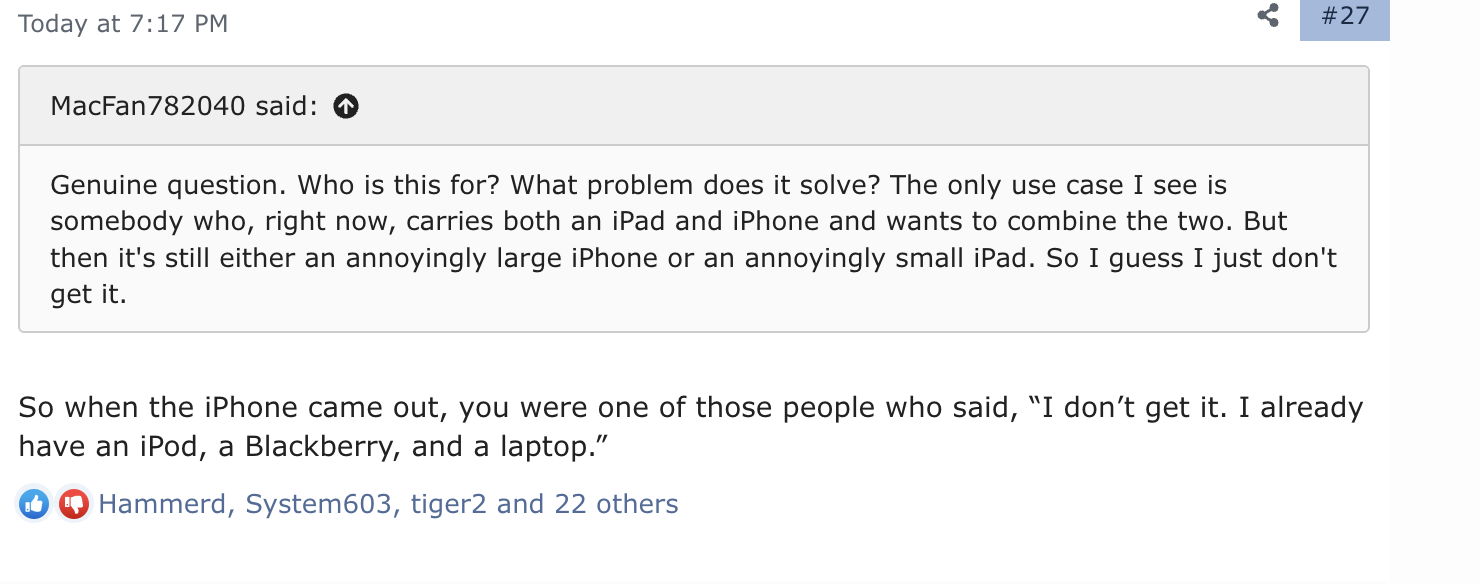
Sipping coffee, reading this. Already watched some initial impression vids. I know what’s going to happen. So does “ChromeAce” who started his day by dunking on MacFan782020.
People are complaining mightily about the price. But they will buy it. Because it will be aspirational and it will signal success. If it makes my iPad superfluous, I might Duo myself. However, I will wait for the dust from a few key reviewers to settle before deciding.
And good news. Mine will be free. Because your buying it will raise the price of my shares. Thank you in advance.
Scott Galloway was two years behind me at UCLA. Never met him which is no surprise given the size of the student body and the fact that he was in a fraternity and I was in Powell Library.
I listen to most of his podcasts and would like to know him. He’s super funny, profane, whip smart, a dedicated father, and leans into his emotions in ways one rarely sees in the male species. Also, he describes his 18 year old self as “unremarkable” and still has tremendous gratitude for the Regents of the University of California taking a gamble on him. That sentiment always hits hard with your humble blogger. I see you and raise you SG. I was probably more “unremarkable” than you. I don’t know what prompted the Regents of the UC to gamble on me, but I too will be forever grateful. But unlike you, I doubt Gavin Newsom will ever appoint me to be a Regent.
Despite all the love I have for SG, he sporadically expresses some views, about gender especially, that make me shudder.
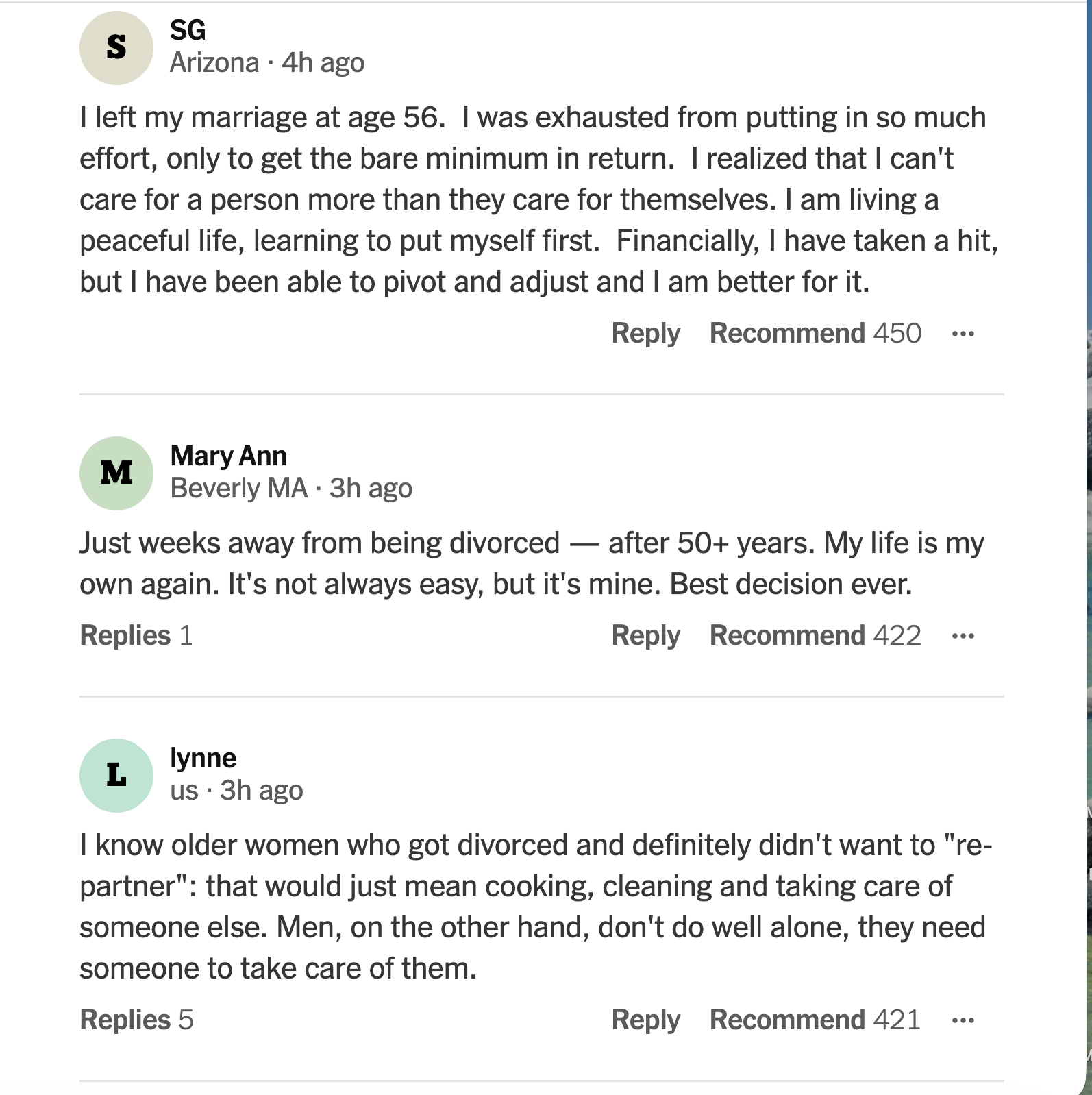
Double mic drops. To his credit, SG unplugs for August. Completely. When he resurfaces in September on his pods, I expect him to address these most thoughtful and recommended comments and others like them. Why? Because he’s a Bruin and that’s the way we roll.
Alexis, from Michigan, was in college studying to be a welder when she found out she had metastatic spinal cancer. To cover her medical bills, she created an OnlyFans page. Her first day, she made six hundred dollars. “That was absolutely life-changing,” she says. “Like—I called my mom.” Nowadays, as Alexis XJ, she brings in half a million dollars annually posting videos of herself in a bikini fixing cars. She says that she once made twenty-five thousand dollars in tips for live-reading a textbook on diesel-engine mechanics: “One guy said, ‘I’m learning something.’ ”
I need a new saying. I always say, never underestimate the male ego. Update. Never underestimate the male libido. Both and.
“Rates of ‘gray divorce’ — splits among those 50 and older — have risen sharply in the United States, doubling between 1990 and 2010. Though those rates have stabilized since the pandemic, nearly 40 percent of divorces today occur between people 50 and older.”
Key definition.
“‘Empty-shell marriages’ are ones in which there is no real connection or vitality, where one or both partners are not happy. . .”
The key reasons according to Justin Garcia, the executive director of the Kinsey Institute in Bloomington, Ind., and the author of The Intimate Animal: The Science of Sex, Fidelity, and Why We Live and Die for Love.
“’We as a species are in longer relationships than our ancestors ever were,’ he said. ‘Lifelong monogamy maybe meant a few decades.’ Now, though, there are couples who have been together for 50, 60 or even 70-plus years.
‘That is evolutionarily unprecedented for our species,’ Dr. Garcia said.
At the same time, societal expectations for what marriage can or should be have changed. Baby boomers who got married relatively young — in part because that was simply the norm — are now living through a time when marriage is seen as a vehicle for love and self-actualization, said Claire Kamp Dush, a professor of sociology at the University of Minnesota.
‘We’re not just partnering based on this idea that someone’s going to be the breadwinner and someone’s going to be the homemaker,’ she said. It is possible, she added, that our collective tolerance for staying in just a so-so relationship ‘is going down.'”
RX from the Bay Area, commented, “. . . it’s mostly because women are over it.”
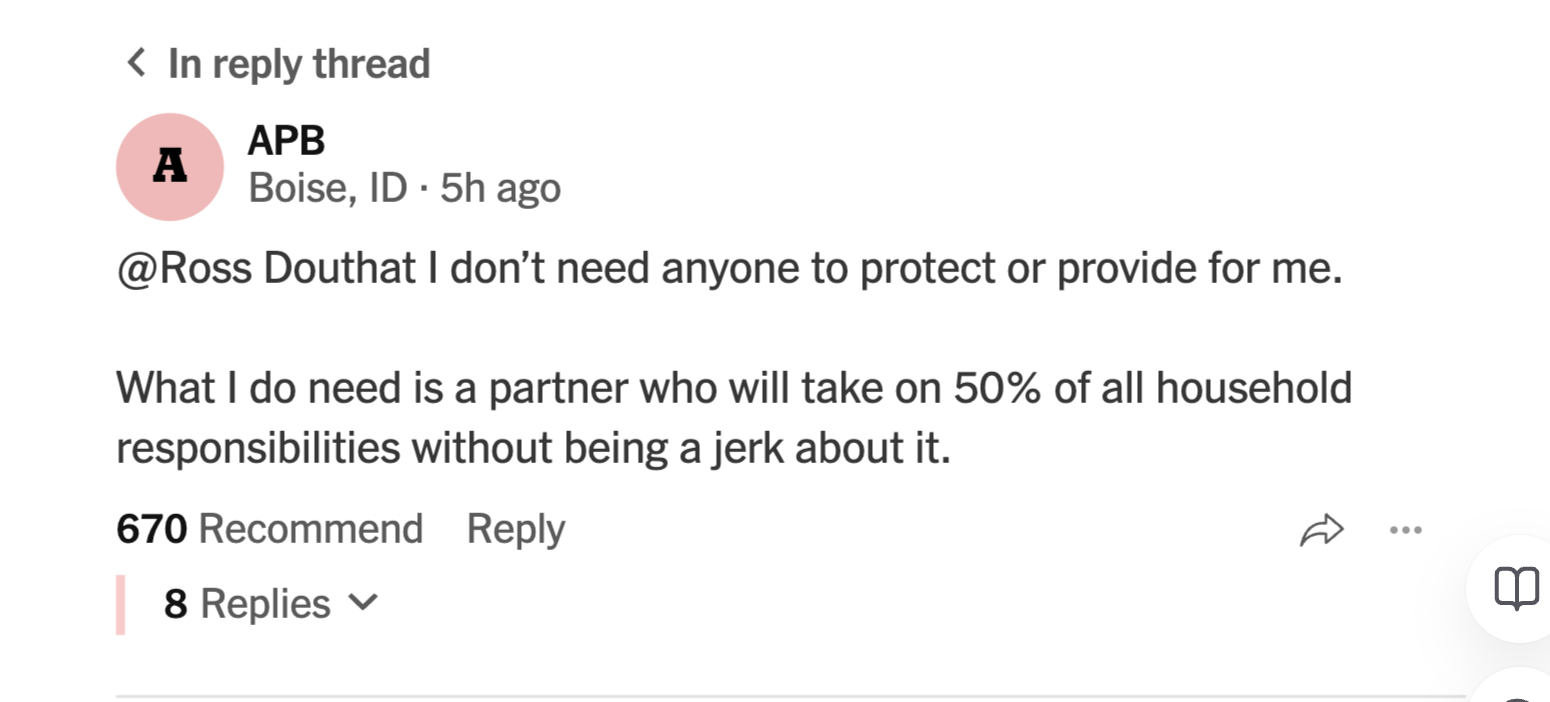
Three other top commenters point to an uneven and unfair division of labor as a key catalyst for calling it quits after decades of being together.
Because the author of the piece only used heterosexual examples, and the author and top commenters focused almost exclusively on unfair workloads, we end up with what feels like a relatively simplistic understanding of “gray divorce”.
For example, the author of the piece references, and the top commenters repeatedly emphasize, that women want to finally be free of caring for their male partners while men who divorce tend to remarry, often quite quickly, because “men need to be taken care of”.
Classic painting with a broad brush. “Some” men, even “many men” would be a much better way to word that.
Let’s consider a counter example. Your fave blogger. At first glance, your fave blogger’s decision to begin dating someone three months after his beloved wife died, after 38 years together, might be further proof of men being woefully dependent upon someone to cook and clean for them. Because, as the female author and top commenters seem to think, men can’t cook and clean for themselves.
Sigh. I don’t know how much depth to go into here, with respect to sharing with you dear reader my rationale for deciding to date before learning it was way, way before my daughters were ready for it. But suffice to say, my rationale had nothing to do with being taken care of. Nothing. Nada. Zilch. Not to brag, but I can hold my own in the kitchen and I will out clean you. Just sayin’.
How ’bout a four-word summary of what could be a four thousand word explanation. I began dating because I sought emotional connection. Which is one word more than it takes to say I was lonely. Weirdly, the concept of emotional intimacy is completely skirted around in the article and top comments.
A friend and I have been sparing a bit on the topic of the patriarchy. Often while hiking. This will surprise no one. I’m losing. She runs circles around me on the topic because she thoughtfully articulates the negative consequences of the patriarchy on men. A key point that too many feminists gloss over. In particular, she correctly points out that entrenched patriarchal norms make it very difficult for men to develop much, if any, emotional intelligence. Without which, emotional intimacy is a non-starter.
Despite some countervailing evidence, most men can learn to vacuum and load and unload dishwashers. And pick up their underwear. Much, much more easily than they can learn to communicate about their inner lives. And much, much more easily than they can learn to tap into their partner’s innermost thoughts and feelings.
I am not an expert and any reader of the female persuasion correct me if I’m wrong about what follows.
I have a strong hunch that many women would like to have their partners do a load or ten of laundry and make them dinner and clean up afterwards, but what every woman would love, especially in empty-shell marriages, is the opportunity to talk about each other’s inner lives in as vulnerable and patient and regulated a manner as possible. So as to feel safe, to feel seen, to feel loved unconditionally. And then to reciprocate. Over and over. For however many years are left.
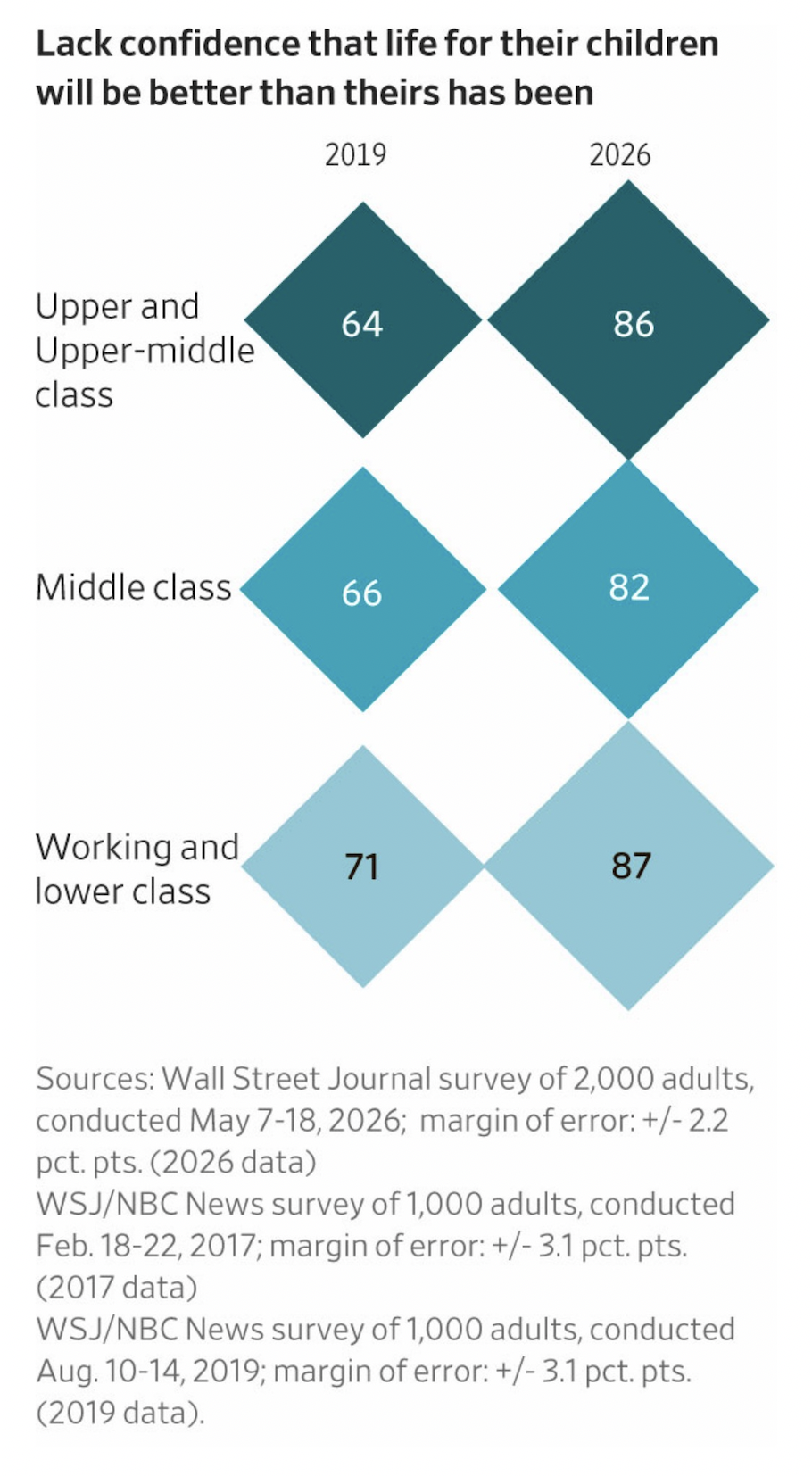
If you are a parent in the (dis)United States, recent research suggests you are worrying more and more about your children’s futures.
These numbers blow my mind. Even the 2019 baseline represents a serious break with the post- World War II past when parents assumed their children’s lives would be better than their own. Now, that has completely flipped.
The most cited culprits include the rising cost of higher education, the utter lack of affordable housing, rising health care costs, a gerontocracy that continuously games political and economic systems in their favor, and a tax code that favors investors who tend to be older. It’s no wonder so many young people choose not to vote, thus creating another hurdle.
A picture I took this weekend of an old, solitary tree. I wonder if it worries about its seedling’s futures.
What has the post-‘rona world wrought? People connecting. Hell yeah.
Patricia Marx in The New Yorker:
“When my editor asked whether I’d be interested in writing about the growing trend of friends getting together to tackle to-do lists, I thought, “Sounds about as fun as a group root canal.” I e-mailed back, “YES!” It was February; I hate the cold; the research would take place indoors. Also, I figured, it might take a village to make me get that comptroller form notarized, memorize the map of South America (don’t ask), and write my will—an item on my list for eighteen years. (As for to-do-list items that never die, thirty-three years ago, the agenda of a friend of mine included: No. 1, get my figure back; No. 2, dance lessons . . . No. 8, figure out if I should break up with Tim; No. 9, leave Tim. Not his real name, because my friend is still wondering about divorcing him.)
Everyone, it turns out, has a lot of shit to do, and many find the drudgery easier to slog through in the presence of company and snacks. Over the course of two months, I sat in on eight Admin Nights, as these gatherings are often called. (“Are they, like, fossils of extinct mollusks?” a hedge-fund guy at a dinner party asked me, thinking of ammonites.) There was a meetup of young mothers who had a lot of children’s birthday parties to organize, a group of Gen Z-ers whose morning session had a live soundtrack provided by a d.j., and a group of people with A.D.H.D., based mostly in Australia, who meet regularly on Zoom. At the Women in Games get-together, a seven-year-old attendee, brought by her mother, marvelled that grownups have homework, too.”
This morning, on the way to Masters swim practice at the Y, I saw three women running shoulder to shoulder on the Henderson Rd sidewalk by Olympia High School. They were not fast, at all, but that’s irrelevant. They had found each other, agreed to meet up, and were clearly vibbing, talking through who knows what. Simultaneously improving their physical and mental health.
And props for your introverted humble blogger for livening up Masters by asking the women in Lane 3, “Do you know the Masters swim team secret?” Looking perplexed, they repeated, “Masters swim team secret?” “Yeah, this lane has the best technique.” They were touched and proudly added their lane was also the most jovial. Five women connected, happier together, living fully.
Maybe I shoulda started this out by writing . . . some people connecting. Social anxiety shows no sign of abating. And we’re way less likely to see our lonely, socially anxious neighbors struggling to find connection. Because often, they can’t even leave their homes.
Here’s to celebrating connection while continuously extending the circles of friendship we’re lucky enough to enjoy.
Think of it as the flip side of “woke mind disease”. Suburban moderates in Greater Seattle, and especially right wing nutters, love nothing more than complaining about all things Seattle. It gives their lives purpose. More specifically, the leftist politicians in charge, homelessness, decaying public spaces, and lax policing.
Major props to Carly Dykes and the Seattle Times for restoring some balance and so poignantly reminding us that our Big City, despite real challenges, has redeeming qualities too.
Last night I went for a beautiful sunset run. West Bay, Tugboat Annie’s flyby, and back to Cap Lake for a short out and back. I unplugged and started walking at the base of the sidewalk ramp beside the Fifth Street Bridge. And that’s where our story begins. A story I could use your help processing.
Halfway up the first switchback, just above Deschutes Parkway, a women was lying on a blanket seemingly going through her bedtime routine. All sorts of accessories were spread across her blanket which covered the entire width of the sidewalk. As I approached, she said, “You can go around the other way.” Haha, I thought to myself, I’m not taking the unnecessarily long route tonight.
So your intrepid reporter stepped over and around her with one of my dogs landing smack dab on her blanky. Which set her off a bit. “I’m going to say you raped me.” Unable to process that, I kept walking. And then, “Faggot.” That got me to u-turn and engage. Feel free to deduct points at this point.
What I should’ve said is “Homophobic much?” Instead, I asked a question, “Why don’t you think people should be able to walk on this public sidewalk?” Brown skinned, maybe even indigenous, she said, “Because it’s my land.” To which I said, “Well, thank you for letting me use it tonight.” Close curtains.
Come on, you have to give me back the points you previously deducted for the smoothish ending.
This story is either a run-of-the-mill anecdote or an important case study about class differences, urban life, and how we will or won’t get along. Or something in between, I’m not sure.
The only thing I know for sure is that I don’t know my neighbor’s story. Nothing could explain away what she said, but I’m disinclined to castigate her more generally for being troubled and impoverished since I have no idea how she ended up going to sleep on the sidewalk ramp above Deschutes Parkway.
Charlotte Alter on X writes, “Want to hear a horror story?”
My very sweet husband emailed me a couple dinner options for our anniversary coming up. He listed a couple different restaurant/picnic options and asked which I preferred. I started replying to his email and that’s when I noticed…That Gmail AI had the gall to DRAFT MY ANSWER FOR ME, the audacity to select a restaurant on my behalf.
It picked badly. It picked the restaurant that is most well reviewed. I want to go to the place that is special for us because we’ve had lots of nice memories there.
But the AI wouldn’t know that. Because it isn’t me, it hasn’t been married to my husband for 7 years, and it doesn’t know what we’ve been through recently and why I would want to go to our spot.
Which is why it should stay the fuck out of my email and my marriage.”
“Different restaurant/picnic options”?! The “very sweet husband” for the win.
The Feed, whose motto is “Food for Athletes”, is a newish, trendy, growing biz where more and more endurance sports kids are getting their fuel.
And if there’s any chance I might be a wee bit cool by association, I’m going to conform. So today, I received a text message from The Feed saying my most recent order of carbohydrate drink mix, energy gels, and engery chews had arrived.
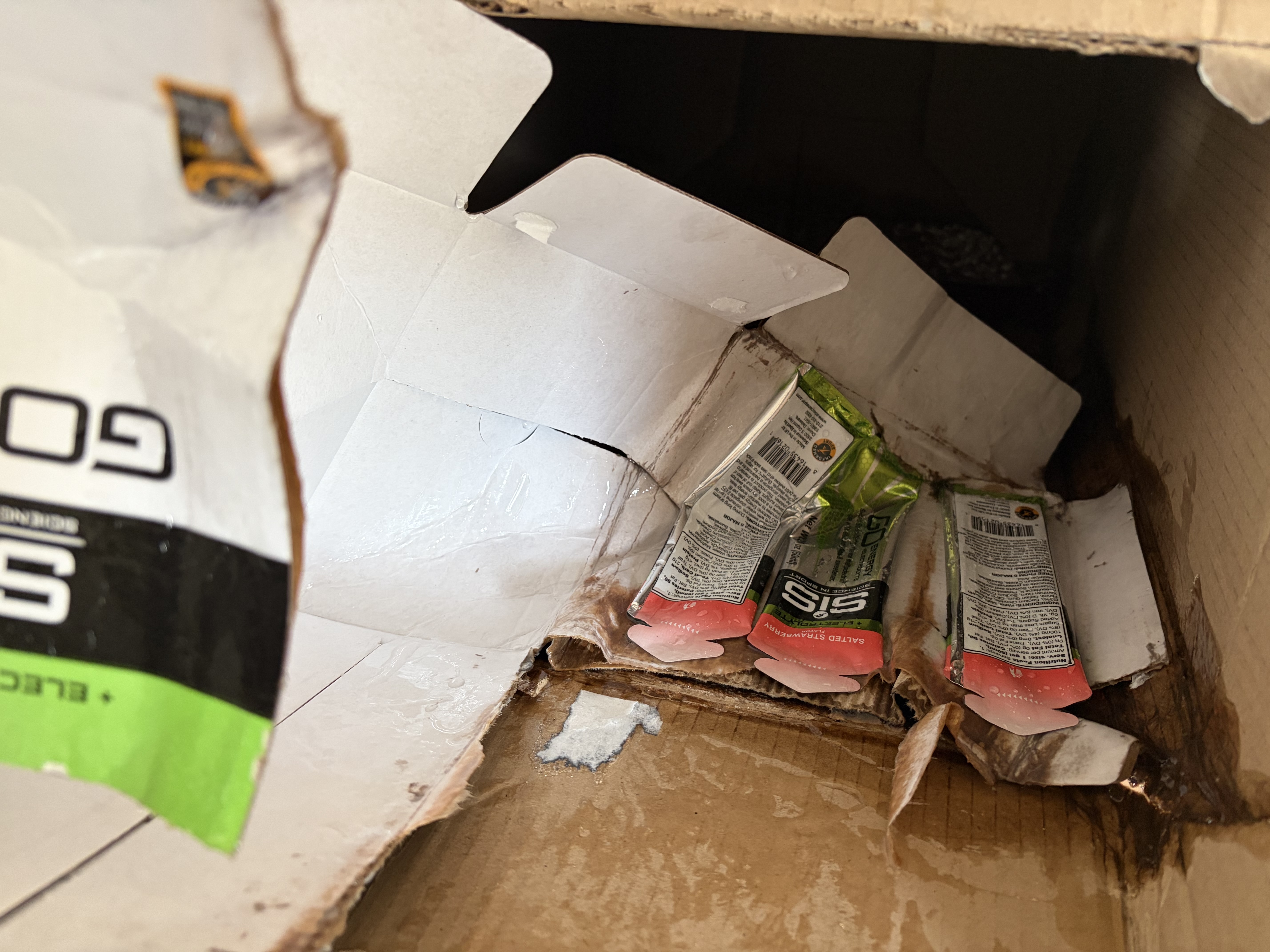
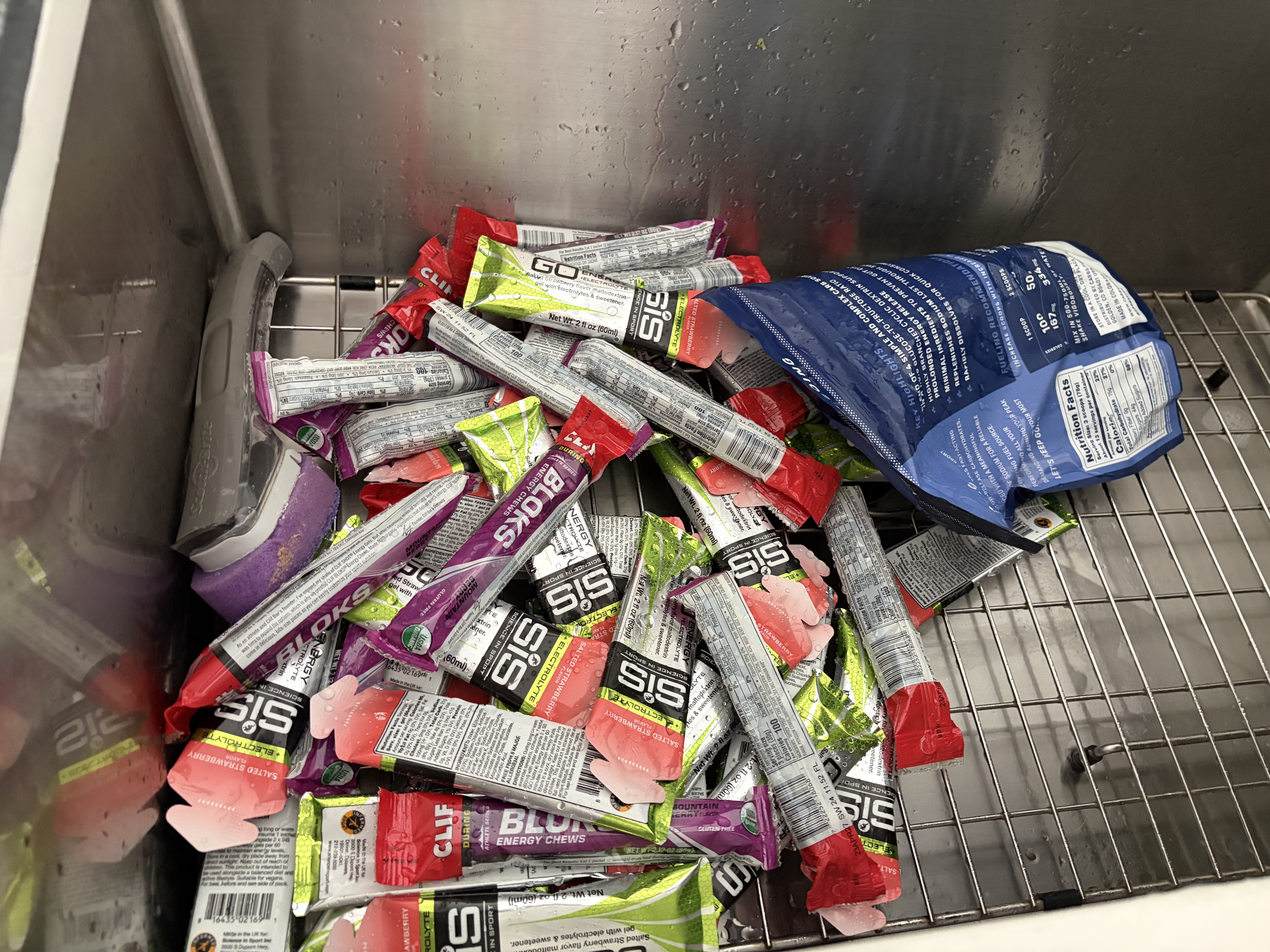
Lo and behold, when I opened the front door, the big ass box looked like it had been chewed completely open by a colony of beavers. Even worser, the smaller box of 30 gels was also opened. And somehow three of the large gels had opened and were all over everything in the box. Resulting in one very large, very gooey mess.
Somewhere, there’s a colony of beavers absolutely ready to rip some trees apart and drag them into a stream. Right now, everything I ordered is in the kitchen sink waiting to be rinsed and dried.
No, this is not remotely equivalent to the challenges you’re dealing with today. I’m not seeking sympathy for what is ultimately an inconvenience. This is a story about the future having arrived too soon. Or more specifically, about how shit early AI customer service is.
I emailed The Feed. Told them what happened. Shared the pics for emphasis. Asked for a new box of gels. Seemed reasonable.
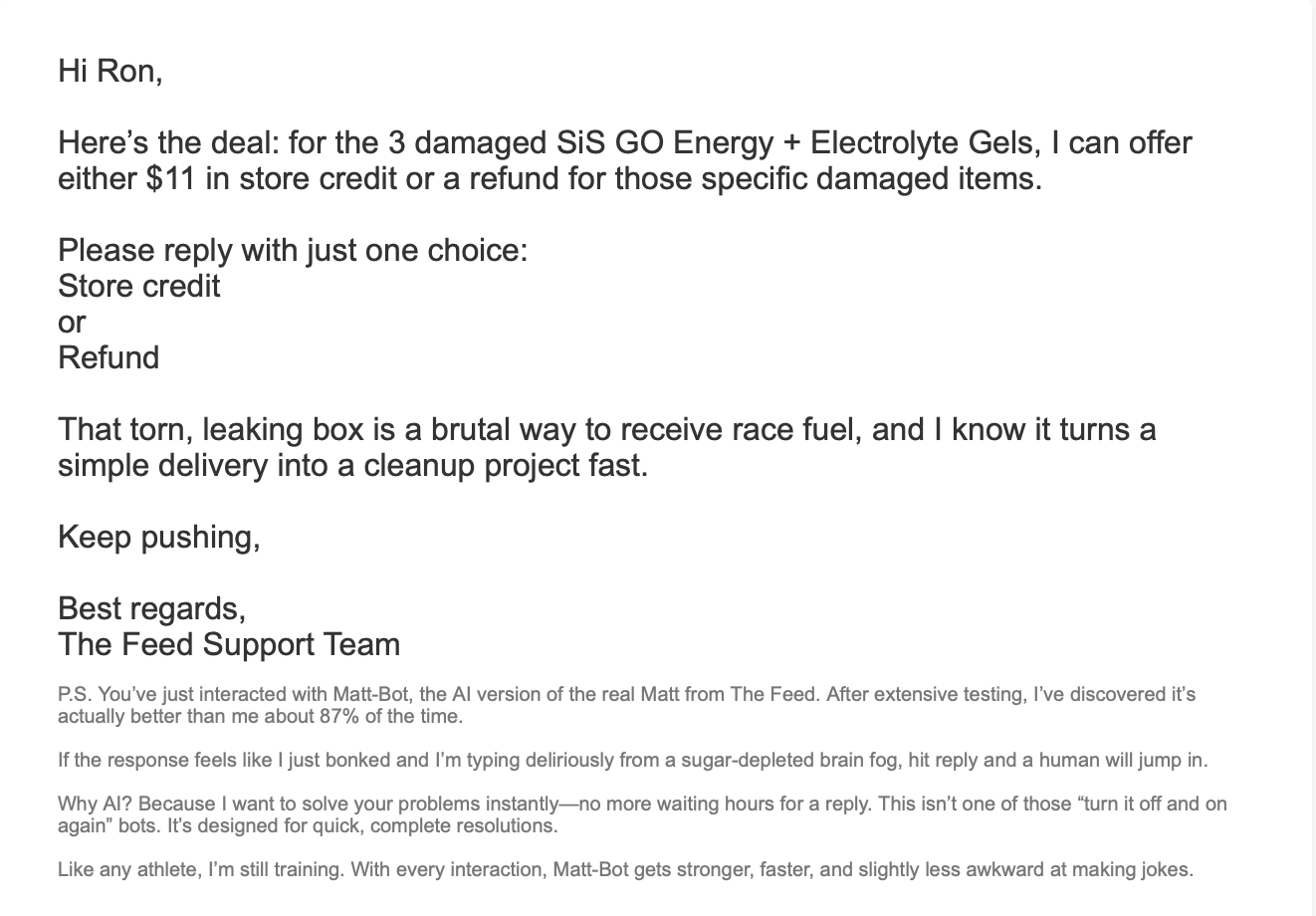
A minute later, “Matt-bot” replied:
The P.S. says Matt-Bot is better than a real live human being 87% of the time. LOL. The response I received falls squarely in the 13%. When they write that Matt-Bot is “designed for quick, complete resolutions” what they mean is we can employ far fewer people, lower our overhead, and increase profit margins for our shareholders’ benefit. At least in theory.
My fave part of the reply is the braindead closing, “Keep pushing”. Brah, all I was looking for was a run of the mill, “Very sorry for the inconvenience.” Well, and maybe a, “We’re committed to making it right. . .”
I switched from emailing an AI bot that strangely uses personal pronouns to emailing a human being. I wrote, “Really disappointing impersonal reply to my email and pictures about the gels arriving opened and getting over all the contents of the torn/opened big box.”
I have not heard back yet. Which is okay because I’d much rather have a slow, but thoughtful human reply than one from an uber-fast, weirdly impersonal AI customer service bot. I’m afraid, that in relatively short order, more deliberate, thoughtful, and humane responses may be a thing of the past.