Beautifully Sad

College drop off one is in the books. How was it? Beautifully sad. After the final hugs, we finally boarded the airport shuttle bus. Eighteen made it especially tough because she wouldn’t walk away. She just waited and watched, never budging. I guess I should have known that was coming, but Fifteen had to inform me that Eighteen’s always stood frozen in time watching whatever conveyances take her loved ones away. Points off for not knowing that.

I was surprised by the GalPal’s relative calmness. Later she informed me she’d been crying quite a bit in private over the last few weeks. Her spirituality made all the difference. Her epiphany? Ultimately, Eighteen belongs to God. We’ve just been taking care of her the last eighteen years. She’s also convinced the distance will prove instrumental in Eighteen assuming adult responsibilities.

Lots of thoughts were swirling around in my head on the shuttle bus ride to the airport. The overarching one was how beautifully sad the separation was. I suppose some parents are glad when their young adult children finally leave the nest. That, in my mind, would be sad sad.

It was a reminder that in life whenever we choose intimacy (by partnering with someone for long stretches of life or by choosing to reproduce), we inevitably increase the risk of painful separation brought about by human fallibility and/or the natural passage of time.

Another thought was how nice it was that I didn’t have to give the final pep talk I had tentatively planned titled, “Work Even Harder, Honor your Grandparents, Don’t Eat Too Many Chocolate Cocoa Puffs, and Be Sure to Get Enough Sleep” because we spent four days together, days marked by dinners out where I told a few college and life parables that communicated everything I had wanted to. I know her well, she listened carefully, I felt no need to elaborate.

The weirdest thing about the four days was how comfortable Eighteen was in her own skin, even when surrounded by her sometimes annoying sister, mother, (and always) annoying father. Day four, after moving in to her dorm room, I suggested she go to the dorm’s dining hall for lunch and “meet us back here” by the student store cafe. “No, I’d rather eat with you guys.” It wasn’t the decision of a shy, anxious, introverted first year, but that of a young woman who appreciates her family and wanted to enjoy our visit to the very end. Despite the antics of her perpetually silly family, there was never a hint of embarrassment, just a mix of fondness and gratitude.

A silver lining of the trip was the thoughtful way Fifteen seemed to process a visit to a neighboring college, her dad’s dinnertime parables, and her sister’s first day of college orientation. She’s always done well in school, but now I think she’s even more motivated to do her best.

The first five-six days at home have been different, but nice. Last week I bought a smaller piece of halibut, only half a gallon of chocolate milk, and the GalPal and I have had enjoyed more time alone.

And the inevitable, natural passing of time marches on.
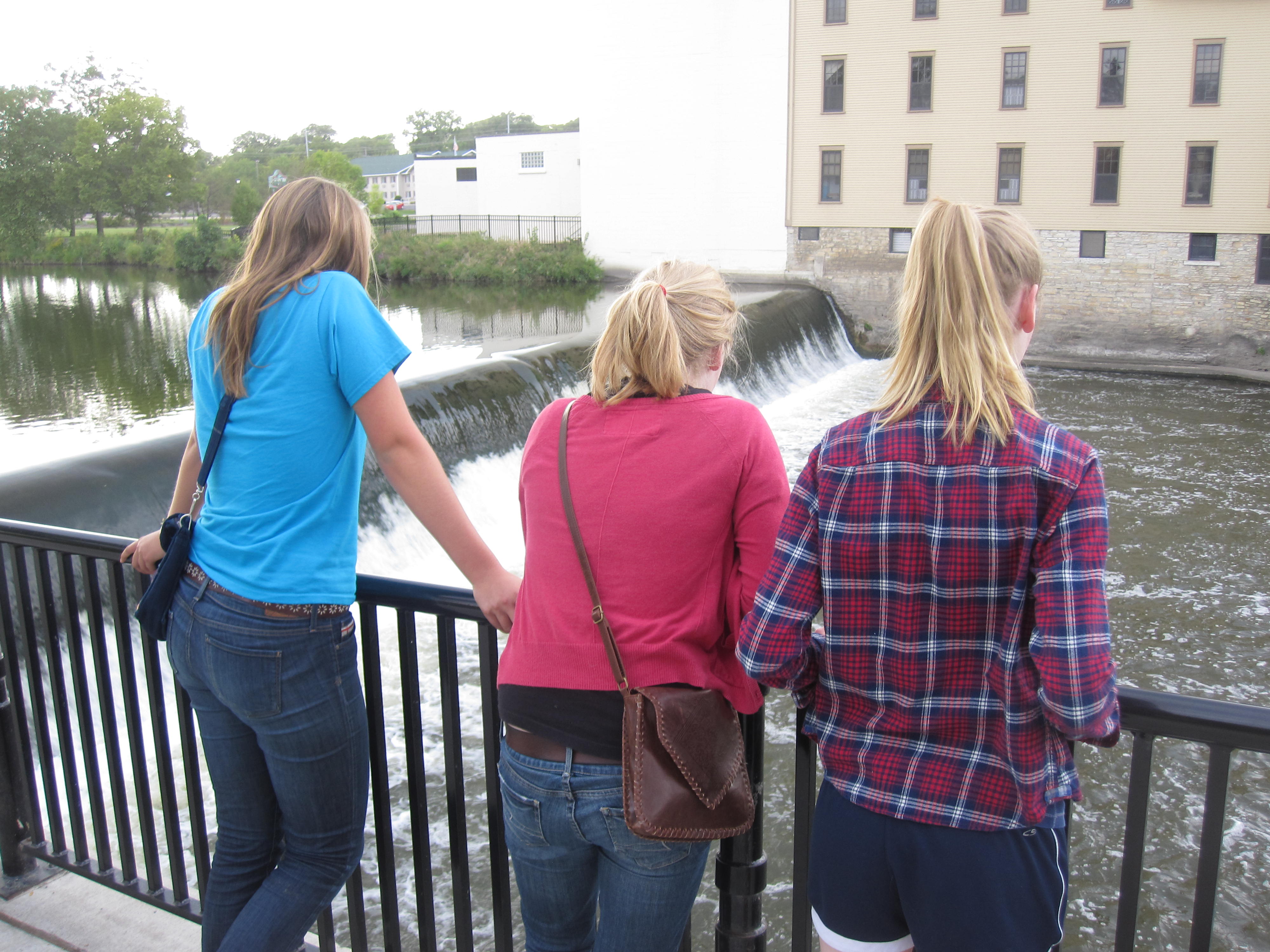
Left to Right. . . Two College Women and a High Schooler Ponder Their Future

Fly Little Bird

Man enough to admit it. Tearing up listening to Eighteen playing the piano and singing downstairs. Thinking how much I’ll miss that. I’ve been suppressing how much I’m going to miss her daily presence when she leaves for college because the galpal has probably been emotional enough for both of us.

Tired of compensating.

Like the labradoodle, Eighteen is nearly always a positive presence. She was absent from school the day they distributed the “How to be a Surly Adolescence” guidebook. She learned early on to roll with my sarcasm (and return serve). Yesterday she said, “I didn’t know you’re going to Florida next week, I thought you were going to Yakima.” “That’s because you’re a self-absorbed teen, you’re really not expected to know those things.” Warm smile.

I’m going to miss her friends who poured in this week as a wisdom teeth extraction support team. I got them to eat leftover birthday cake and suggested they wash it down with chocolate milk so that they “could just get the freshmen fifteen over with”. Not stopping there, I suggested they go home and set their scales on 15lbs to ease the “psychological transition”. Of course I could only kid because they really could use a few more lbs.

Eighteen never seemed TOO embarrassed by me. She may have even enjoyed having me guest teach in her elementary classrooms and help coach her high school swim team (at least in 9th and 10th grade).

Come on man, toughen up. It’s a part of the natural cycle of life and it sure beats the alternative of being stuck at home without much vision. She’s going to kill it at college and in life. Couldn’t be more proud.

The silver lining is I’m going to savor Fifteen’s next three years. Center of attention. Groovy friends too who are at the age where they sometimes enjoy and always tolerate my antics.

Don’t even want to think about three years from now when she starts charting her own course.

Thinking in Decades

Seventeen, who will be eighteen shortly, grew up playing soccer. She was usually one of the weaker players on one of the better teams. Probably the fault of my genetics. Also, soccer was first and foremost social, so she hardly ever played between organized practices and games.

Her uneven play never bothered me because the effort was there, she usually enjoyed it, and she learned how to compete. At the beginning of high school, she applied those lessons to a new sport, swimming, and continues to improve in the water as a result.

This summer some of her former teammates and her formed a recreation team for one final run before they head off to different colleges. No practices, just two games a week. Last night was the final game so I thought I better turn up.

Arriving late, I see the opposing team’s forward streaking down the field all alone set to go in for an easy chip shot. But wait, Seventeen has the angle and she’s FLYING and she disrupts the girl’s momentum just in the nick of time. Is that my daughter? Amazing. A parent tells me she had rolled her ankle pretty badly a few minutes earlier.

I detect a slight limp, but she’s a gamer, loving every minute of it. No pressure, playing with great friends, for FUN. She’s a different player than I’ve ever seen, relaxed, confident, making smart pass after smart pass, checking girls, face red, sweating, focused, animated, just plain getting after it.

Parents, teachers, all adults who work with young people often suffer from “present tense myopia”. We get mired in young people’s physical and social awkwardness without any sense of their more physically and socially competent future selves.

I remember when Seventeen was in second or third grade and was making lots of simple spelling errors (yeah, yeah, probably the fault of my genetics). An elementary education colleague suggested “chilling” because it would naturally improve given her love of reading. He was right.

Parents should prominently display a “This too shall pass” sign somewhere in their kitchen as a reminder that children are constantly evolving.

In the end, it’s far less important how capable a seven or eight year old is in football, baseball, basketball, golf, soccer, swimming, spelling, reading, writing, or math than a seventeen or eighteen year old.

What a kick (pun intended) watching Seventeen last night. Nurture and support the young and then expect them to surprise you too.

Adolescent Literacy

Felt nostalgic for Europe I guess and took the train to PDX for a workshop on adolescent literacy. I WANT to be a train person, but Amtrak is making it hard. It’s bad enough the train takes longer than driving. My Squeeze and I planned on eating an early dinner in the big city and then returning on the 6:15p. Workshop ended an hour early and so we decided to take the 4:20p and eat at home. Headed to the iMax at 3:40p. At the train station we learned the 4:20p was delayed about an hour.

Long story short, it never arrived, something about a tree on the track. Instead of a romantic dinner, we took a walk and then sat in front of the station reading in the setting sun eating pistachios. The 6:15p originates in PDX so it would have to leave on time. . . right? Longer story shorter, we walked off the train at 7:40p, exactly four hours after leaving the hotel for home. Something about a broken brake line they couldn’t fix. The man sitting in front of us asked if we wanted a lift home, he was bailing on the train, taking the iMax to his car in Clakamass. He had a morning business meeting in Seattle. What a life, or at least, nightsaver.

But I digress.

Stanford research prof was the main presenter. Excellent researcher I’m sure, but how can I put this nicely, his presentation skills were not as well developed. Here’s what Dr. Stanford Expert and his co-presenter, a much better teacher from The U of Utah, recommended.

1. Strengthen adolescent reading fluency, vocab, and comprehension through scientifically researched (read quasi-experimental and other quantitative studies) teaching strategies that have been proven to be effective including explicit vocabulary instruction and classroom discussion of texts.

2. Explicit instruction involves three steps: I do it (modeling). We do it (guided practice). You do it (independent practice). If teaching a complex literacy skill like summarizing, the three steps may take an entire week. Teachers inevitably rush the steps.

3. There are three elements to classroom discussion of texts: 1) efferent (the who, what, where, and why of what was read. . . what did the writer say); 2) analysis and interpretation; and 3) evaluation. . . how did you feel about it, how convincing was the argument or engaging/illuminating the narrative. Research suggests teachers slight part one which low achieving students benefit the most from. Dr. SE made it clear he had “absolutely no interest” in evaluation/students’ opinions.

It was alternatingly interesting and exasperating. Throughout the day there was no discussion of the purposes of literacy; there wasn’t a single reference to digital, electronic, or multimedia texts; nor was there a single reference to the societal curriculum. Nevermind that adolescents are in school 22-23% of the time and outside it 77-78%.

Here’s an alternative, admittedly less scientific, more sociological perspective.

Immerse children and young adults in rich literary environments for long periods of time. Surround them by interesting reading material. Unplug more and read in front of them. Talk about what you’re reading. Demonstrate a love of reading in your daily life. Repeat year after year.

Here’s a related math literacy, or “numeracy” example. One Sunday morning, when seventeen was two or three, she crawled into bed and snuggled in between mom and dad. Dad started counting. “One.” She squeaked, “two.” And thus began Sunday morning math. Overtime, we counted by twos, threes, fours, whatever we felt like. We never called it multiplication. My hunch that my daughter’s success in math is in part explained by those Sunday mornings would not impress Dr. SE one bit.

I was impressed with how candidate Obama talked eloquently about parents being their childrens’ first and most important teachers. I wonder why he’s abandoned the Bully Pulpit.

The teachers and school leaders in the workshop politely and passively accepted the “literacy and numeracy as a teacher-centered science” way of thinking as if there are no alternatives. Few probably realized with that paradigm comes a narrow emphasis on technical skills, test scores, and national economic competitiveness.

Research and what happens in school matters, but magic can happen when young people are immersed in rich literary environments where word and number play are daily activities.

Rollercoaster

Teaching high school taught me that adolescents can be living, breathing rollercoasters, up one day, down the next. After awhile, I learned not to take the inevitable dips personally.

Which takes us to the other day and my facebooking seventeen year old. “Why are you trying to talk to me?” she asked staring at her laptop. My bad, I’m an awful dad for being interested in last night’s field trip to Seattle.

Fast forward a day. . . the rollercoaster standing in the kitchen, studying page four of my Tacoma Broadway Center for the Performing Arts pamphlet. Gaelic Storm.

I throw caution to the wind. “Wanna go?” “Yeah!”

Surprisingly, she doesn’t get any better offers during the week.

We hit traffic, arrive five minutes late, run through downtown T-town together, and buy two of the last tics.

For the next three hours nagging, tension, and adolescent angst were replaced with clapping, laughing, and singing. Irish music has always moved me in inexplicable ways and seventeen is a talented violinist on a piano playing tear. She was transfixed by Jesse Burns the group’s fiddler who shredded from beginning to end.

Wonderful concert made better by the company.

Cultivating Passion

From The Global Achievement Gap by Tony Wagner.

“Michael Jung. . . believes that ‘there are only three reasons why people work or learn. There’s push, which is a need, threat or risk, but this is now a less plausible or credible motivating force [in the industrialized countries] than it has been, even for the disadvantaged. There’s transfer of habits—habits shaped by social norms and traditional routines. But this, too, is becoming weaker now, because of the erosion of traditional authority and social values. That leaves only pull—interest, desire, passion.’ I understand Jung to be talking about three kinds of human motivation. Physiological need is one—the need for food and shelter and so on. But he suggests that with high rates of employment and government safety nets, this is less of a motivational force in many young people’s lives than it once was. The desire to adhere to social norms is another human motivation that is weaker than it used to be, because traditional sources of authority, religion and family, have less influence on young people today. Jung believes that it is the third motivational force—interest, desire, and passion—that increasing numbers of young people are seeking and responding to in school and at the workplace.”

We tend to be products of our environments so I wouldn’t describe the transfer of habits/adherence to social norms argument quite like Jung and Wagner. The influence of significant others, for better or worse, is still there. My clearest childhood memories of my dad are of him pacing the house as he memorized his sales presentations.  Five or six at the time, the impact was indelible. Every family has momentum, whether positive or negative. Because of my parents, ours was positive which is not synonymous with perfect. If a critical mass of adults in a young person’s life aren’t working and planning for a better future, we can’t expect that young person to care much about school work, continuing their education, or making a positive difference in the world.

If we agree that young people are mostly motivated by interest, desire, and passion, as I’m inclinded to do, we need to rethink teaching, coaching, and parenting. In his book, Wagner tells Kate’s story, a senior in high school. “Kate suffered from too much of the wrong kind of adult authority,” Wagner writes. “She was overmanaged for success—success being narrowly defined as getting into a college her parents and teachers considered to be top-notch and having a high paying job.”

What good are high standardized test scores and good grades if a student lacks specific interests, desires, and passion? What if they learn to “do school” but fail to become passionate about anything?

The seventeen and eighteen year-olds that I know are striving to get into the best colleges possible. But what makes one college better than another? US News and Report offers pseudo-empirical answers based upon numbers colleges get good at manipulating, but there’s more art to educational excellence than science. Maybe the best college is the one where faculty and staff help students discover their interests and desires. They advise and teach passionately; consequently, students become more passionate about writing, or a language, a culture, an environmental challenge, a historical period, a social movement, global politics, law, or medicine. I’d like to see USN&R measure staff and faculty passion for advising and teaching.

If I did a focus group with my daughter and her twelfth grade friends, I suspect all of them could identify things they like, but only a few could explain in any detail what they are most passionate about and why. And surely those few that are ahead of the curve need guidance on how to turn their passions into purposeful vocations. My wish for my daughter and her friends is that over the next four or five years they become more passionate and begin translating their passions into meaningful, rewarding work.