
Housing Prices

The conversation turned to real estate on a recent Saturday run when I shared my opinion that many sellers in our community were slow to grasp the correction as evidenced by their overpriced houses languishing on the market for six months to a few years.

You would have thought I suggested we extend our 10 miler another 16.2 just for the fun of it. The right wing nutters immediately jumped on me for assuming I knew more about free markets and home values than the actual homeowners themselves. And more importantly, who did I think I was, homeowners have the right to price their houses however they want.

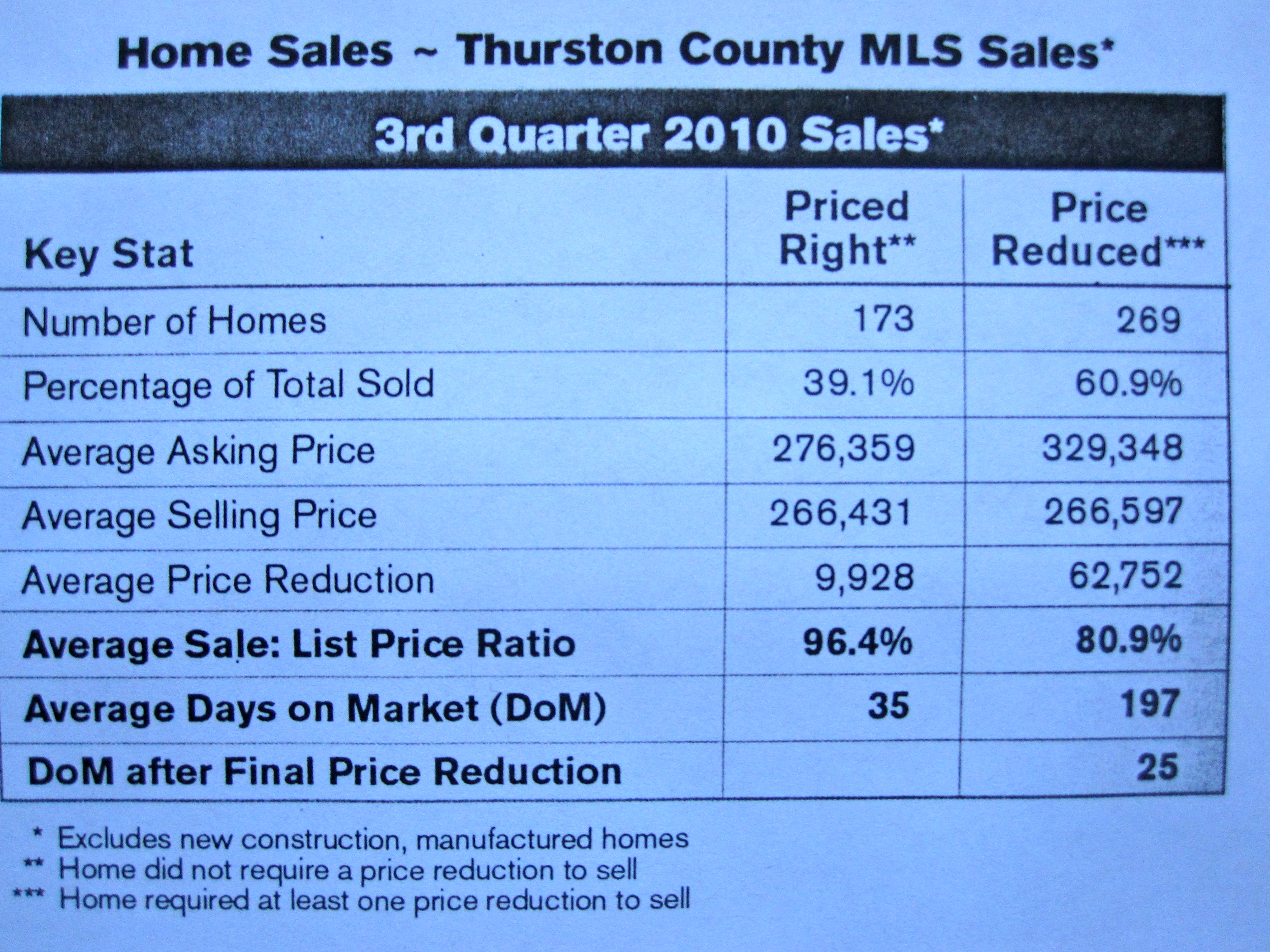
Of course they do just like they have the right to be irrational and waste money more generally. Check out this chart:
credit—Jodi Ashline Newsletter

In the end, the average “priced right” and “priced reduced” home sell for the same price, but the “price reduced” home is on the market an extra 162 days. If “price reduced” homeowner has $100k in equity, and that equity was invested for 162 days @ 5%, they passed on earning $2,219. That’s the cost of exercising your constitutional right to overprice your home.

Around here at least, it appears that the larger and more expensive the home the greater the tendency to overprice it. That’s counterintuitive if one assumes, on average, the most well-to-do homeowners are the most business savvy, but I digress. We can also assume a much smaller pool of prospective buyers (I know it only takes one) and therefore the “average days on market” I suspect is far greater than 197, but for consistency sake we’ll stick with that.

Let’s consider a waterfront home that is four times the average at $1,317,392. Ultimately, after 197 days, overpriced sellers have to reduce their price $251,008 ($62,752 x 4). Let’s compensate for the too short “average days on market” by assuming that our waterfront sellers own their home outright. If “expensive price reduced” homeowner has $1,066,384 (the final sale price) in equity and had invested that for the too short 162 days @ 5%, they passed on earning $23,665.

To which the nutters might say, “That’s waterfront sellers right.” Which again, of course is right, just irrational.

Since I’m on math fire, and the nutters are down for the count again, one related thought. One oft repeated housing axiom is that housing corrections don’t matter if you’re buying and selling into the same down market. That’s only true in one of three possible scenarios—buying and selling similar priced homes. It doesn’t hold for buying a more or less expensive home than sold.

For example, consider the case of buying a more expensive home. Imagine you could sell your existing home for $300k or $100k less than its peak 2007 valuation. You buy a home for $1m or $250k less than its peak 2007 valuation. Had you made that move in 2007, it would have cost $1,250,000-$400,000 or $850,000. Today, the equation is $1m-$300,000 or $700,000 for a savings of $150k.

The opposite is also true. As a result of the correction, it’s more expensive to move down. Imagine you could sell your existing home for $600k or $200k less than its peak 2007 valuation. You buy a home for $300k or $100k less than its peak 2007 valuation. Had you made the move in 2007, you would have pocketed $400k, $800k sale price-$400k purchase price. Making that move today you would only pocket $300k, $600k sale price-$300k purchase price.

So assuming one has the resources, it makes more sense to move up in down markets and down in up markets.

School’s out nutters. Do they give out Economics Nobels for this stuff?

Three Changes

Life in the U.S. will be considerably different in twenty years as result of three changes that few people think about much at all. While we watch “reality television,” obsess about celebrities, follow sports as if which team wins really matters in the grand scheme of things, and shop til’ we drop, these changes will remake the United States in profound, yet unknowable ways.

1) Young women are running circles around young men in secondary schools and in colleges and universities. I’ve written about the implications of this before.

2) The world’s economic power is shifting to the east.

3) The earth is warming much more rapidly than anticipated.

What specific, symbolic, yet tangible changes might wake people up to these fundamental shifts? This example is far too subtle, but still worth noting. With respect to the first change, last year, for the first time ever, women earned more Ph.Ds than men. Another more dramatic example I anticipate happening sometime in the next twenty years, the first female President of the United States.

The second change isn’t as worrisome to me as to citizens whose identities are primarily national in orientation. I reject the zero sum assumptions of the global economic race metaphor. I celebrate the fact that hundreds of million impoverished, rural Chinese and east-Indians, fellow human beings, are experiencing markedly improved qualities of life.

Number three is the most vexing because reducing C02 emissions will require international cooperation on a level never before demonstrated by the world’s governments.

Like waking from a collective slumber, twenty years from now many will wonder when and how women became so much more influential than men, when and how three billion Chinese and east-Indians became so much more influential than 400-500 million Americans, and when and how we made such a mess of the natural world.

Empathy Impaired

The New York Times’ commentators have been writing a fair amount about how to revive our moribund economy and related issues like consumer and government spending, taxes, and unemployment. Sometimes I find the readers’ “recommended comments” more interesting than the essays themselves. They’re liberal and decidely cynical about life in the U.S. today. Their most common rallying cries are corporate greed, class warfare, out-of-touch politicians, and right-wing media.

Recently, they’ve been most fired up about members of Congress being out-of-touch with ordinary citizens, many who have been laid off, and too many that appear to be entering into permanent unemployment.

The question I haven’t seen asked is how does one, whether a member of Congress, or a college professor, develop empathy for the under-employed or short, medium, or long-term unemployed? The best answer of course is direct personal experience, but giving up one’s job in the interest of greater empathy doesn’t make much sense.

There have to be better ways, whether documentaries, essays, novels, photographs, music, and plays, that can help humanize the out-of-touch among us. The arts seem especially well suited to this task. I wish The Times’ irate, cynical commentators would each choose an art form and begin telling their stories with the out-of-touch Congress as their primary audience.

Globalization’s Trade-Offs

As a result of economic globalization, goods and services—whether tax returns, x-rays, math tutorials, or credit card or airline reservation-related phone calls—are being digitized and then sent via coaxial cables under the oceans back and forth to India, China, and other developing countries where people are willing to work for far less than Amerians because the cost of living in their countries is considerably less.

Additionally, just like in major league baseball and the NBA, labor pools are much more international. Recently in the U.S., we’ve hired lots of nurses from South Africa and the Philippines, computer scientists from India and Pakistan, and according to Bureau of Labor statistics, in 2009 there were 185,234 foreign born doctors working in the United States representing 127 countries. Twenty-four percent of all medical school classes include foreign-born students.

If national borders are fences of sort, the fences are coming down.

At the same time, U.S. citizens are increasingly angry and outspoken about outsourcing and the exporting of American jobs, a sentiment exacerbated by politicians, including the president, playing to cameras. All you have to do to understand how wildly inconsistent most people are on this topic is visit the closest Wal-Mart. Few U.S. citizens have connected the outsourcing, global economic dots.

They want their jobs protected from foreign competition, but at the same time want continued access to inexpensive toys, clothes, and toothbrushes from China and other developing countries. One study asked U.S. homeowners applying for home equity loans if they would like their loans processed by a U.S. firm in twelve days or a foreign firm in ten and the vast majority opted for the foreign firm.

Arizona’s anti-immigrant law is another case in point. Many undocumented workers are willing to work difficult, minimum wage jobs that few U.S. citizens are, thereby lowering the cost of living for everyone.

Advocate for protectionist economic and more strict immigration policies if you must, but be honest about the economic costs and also insist that legislators pass a 15%-20% insourcing VAT.

No Guarantee

The start of a  lecture I’m giving to faculty and students at Buena Vista University in Storm Lake, Iowa in a few weeks. Get your tickets before it sells out.

The Makings of a 21st Century Education

Consider the first and last sentences from a January Wall Street Journal article titled “Even-In-A-Recovery-Some-Jobs-Won’t-Return”. “Even when the U.S. labor market finally starts adding more workers than it loses, many of the unemployed will find that the types of jobs they once had simply don’t exist anymore. Harvard’s Mr. Katz warns that past experience suggests. . . conjecture is likely fruitless. ‘One thing we’ve learned is that when we attempt to forecast jobs 10 or 15 years out, we don’t even get the categories right,’ he says.”

Let that sink in.  The Harvard expert admits, “we don’t even get the categories right”. So what are college students to do? And what are faculty to do? How should faculty design curriculum, teach courses, and advise students in a “we don’t even get the future job categories right” world?

The Limits of Self Interest

The new Civil War. Foreign automakers based in southern states versus American automakers based mostly in Michigan. Southern Republican members of Congress were the key bloc that succeeded in defeating the proposed $14b loan to the OBT (Once Big Three).

The theoretical underpinnings of Congress seemingly parallel those that undergird free market capitalism.

Market fundamentalists like Milton Friedman believe that from a business and economic standpoint, it is only when each of us acts in our own self-interest that society advances. Applied to Congress this means the best interests of the United States are achieved when each member of Congress pursues his or her constituents’ self-interest. 

But is that true? Is individual self interest, absent some shared concern for the public commons and  some government involvement, a magic catalyst for the greater good? What if within our home, my wife, our two children, and I each pursue our own individual interests? Will our family advance without some agreed upon values, overlapping purpose, and common vision for the future?

A Congressman or woman would say they have to put their constituents first in order to get reelected. But isn’t that how we end up with bridges to nowhere and wasteful pork that benefits a few at the expense of the many. Is it completely unrealistic for me to think that someday citizens might pressure their members of Congress to also consider “What’s in the best interest of the country and world?” 

What does this mean in the context of  automobile manufacturing? Regionalism trumps nationalism. Given that reality, are we better or worse off? This saga also illustrates the subjective nature of patriotism. Some people are inspired by the history of the labor movement and take pride in the accomplishments of the United Auto Workers. Others are ahistorical and blame the UAW for the OBT’s lack of competitiveness. 

How do we get the officials we elected to take a longer, more national, and even international view? More specifically, how do we get the people of South Carolina to think not just about what’s best for BMW, and by extension, their job security, but also the job security of the Michigan autoworker? And how do we get the people of Michigan to think not just about government loans and their job security, but global environmental issues?