Denial Is Not a River In Egypt

Except when it comes to the Seattle Mariners, I’m not normally a “glass half empty” guy, but I’m worn down by the President’s, Michael Medved’s, and some of my friends’ continuing, knee-jerk insistence that we’re the “greatest country in the world”, which increasingly sounds like Stuart Smiley trying to convince himself that “I’m good enough, I’m smart enough, and doggone it, people like me!”

Some facts from Nicholas Kristof’s current piece in the New York times “The Best-Case Outcome for the Coronavirus, and the Worst”.

  • The United States has still done only a bit more than 10 percent as many tests per capita as Canada, Austria and Denmark.
  • . . . one can argue that the U.S. is not only on the same path as Italy but is also less prepared, for America has fewer doctors and hospital beds per capita than Italy does — and a shorter life expectancy even in the best of times.
  • . . . the C.D.C. has posted official guidance advising that doctors and nurses ‘might use homemade masks (e.g., bandanna, scarf) for care of patients with Covid-19 as a last resort.’
  • the United States is in a weaker position than some other countries to confront the virus because it is the only advanced country that doesn’t have universal health coverage, and the only one that does not guarantee paid sick leave. With chronic diseases, the burden of these gaps is felt primarily by the poor; with infectious diseases, the burden will be shared by all Americans.

The True Believers will not only refute these facts, they will never change their view that the (dis)United States is the greatest country in the world. That notion is essential to their sense of self. And yet, their myopia will not do anything to reverse our steady slide. Their self-congratulatory insistence that we’re the greatest country in the world will only grow more delusional over time.

 

Higher Education Teeters

Every sector of the economy is going to be severely tested by pandemic closings and related fallout.

As one example, the pandemic will test every college and university and could be a deathblow to some of the growing number of economically distressed colleges and universities. Here are a few of the pandemic’s probable ripple effects:

  • fewer campus visits of prospective students, leading to a decline in applications
  • far fewer international student applications
  • reduced yields of accepted students because families will be unable to afford even deeply discounted tuition, room and board
  • a loss of good will as upset families seek refunds from March-May tuition, room and board
  • shrinking endowments meaning less “passive income” to pay salaries, keep the lights on, and maintain campus facilities*
  • reduced alumni giving due to widespread loss of income and wealth
  • due to a spike in unemployment, graduates will struggle even more to find white collar jobs that pay a “livable wage” and provide benefits, further complicating the sine qua non of higher education

Educational institutions change slowly, but the pandemic is likely to accelerate The Great Contraction. The most distressed institutions will close shop. Others will seek partners with whom to merge. Every college and university has to become much clearer about the two or three things they do especially well. Even if they successfully refine their missions and curricula, a growing number of faculty, administrators, and staff will lose their jobs.

Tough times indeed.

*the total amount of deferred maintenance is an excellent indicator of relative fiscal health


Trusting The Base Will Forget

From the New York Times.

WASHINGTON — For weeks, President Trump has minimized the coronavirus, mocked concern about it and treated the risk cavalierly. On Tuesday he took to the White House podium and made a remarkable pronouncement: He knew it was a pandemic all along.

“I felt it was a pandemic long before it was called a pandemic,” Mr. Trump told reporters.

Here is what Mr. Trump actually said from the beginning of the pandemic.

Jan. 22, asked on CNBC whether he was concerned about a global pandemic: “No, not at all,’’ Mr. Trump said. “We have it totally under control. It’s one person coming in from China, and we have it under control. It’s going to be just fine.”

Feb. 26, at a White House news conference, about the number of reported cases of the virus: “We’re going down, not up. We’re going very substantially down, not up.”

Feb. 27, at a White House meeting: “It’s going to disappear. One day — it’s like a miracle — it will disappear.”

March 7, seated next to President Jair Bolsonaro of Brazil at Mar-a-Lago, his Palm Beach, Fla., club: “I’m not concerned at all.” (At least three members of the Brazilian delegation and one Trump donor at Mar-a-Lago on March 7 later tested positive for the virus.)

March 16, in the White House briefing room, warning that the outbreak would last until summer and then suddenly disappear: “So it could be right in that period of time where it, I say, wash — it washes through. Other people don’t like that term. But where it washes through.”

Daniel Dale describes it as “. . . another of Trump’s brazen attempts to rewrite a history that played out in public view.”

https://www.cnn.com/2020/03/17/politics/fact-check-trump-always-knew-pandemic-coronavirus/index.html

If I Could Only Follow One Person on Twitter

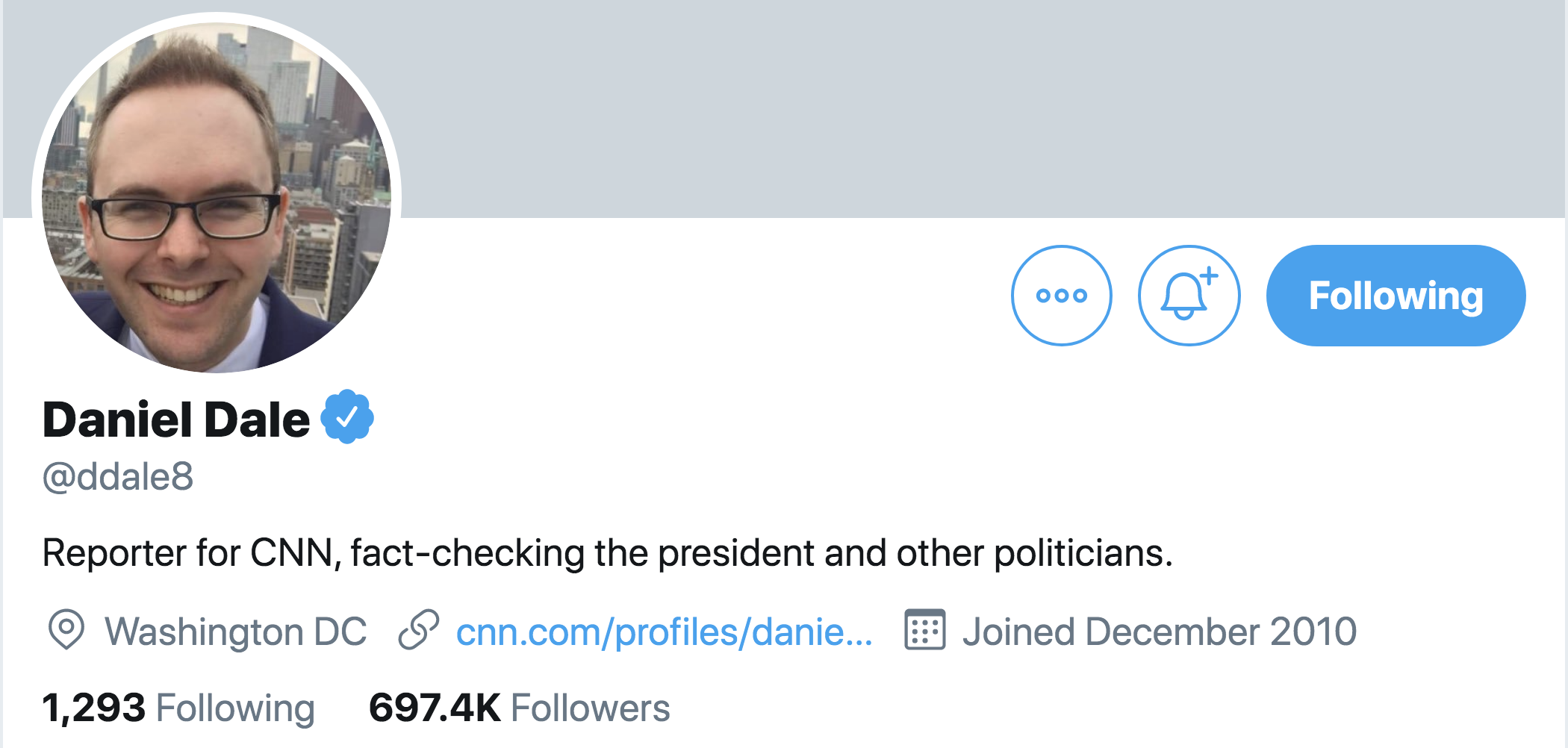
Normally, my favorite people on Twitter tend to be intellectuals or comedians, but these days, if I could only follow one person it would be Canada’s gift to the (dis)United States, Daniel Dale. He does an incredible job of repeating exactly what the President says almost in real time and then dispassionately explains all of his fabrications. Highly recommended. I expect him to be at 700k followers in short order.

In related news, for whatever reasons, I can’t get any traction on Twitter. I’m only about 697,350 followers behind D2. When you follow him, follow me too so that little gap doesn’t grow more vast.

Screen Shot 2020-03-17 at 9.23.19 AM.png