Organize Victory
Reply


Dig this exchange of commenters on a review of Apple’s new Vision Pro.
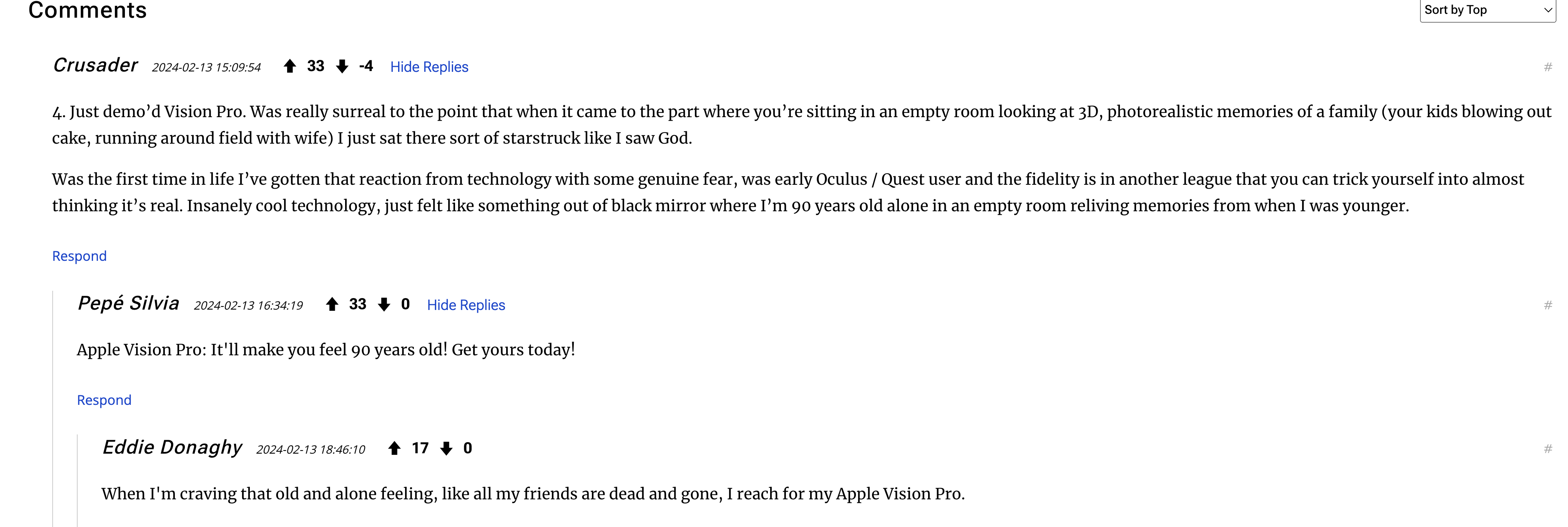
The Earlies are all a flutter. Meanwhile the Lates are loading their empty Bic pins with spit balls and taking dead aim at them.
As an investor, I’m heartened by the Earlies’ enthusiasm; but more personally, I’m down with the Lates’s cynicism.
One group of friends doesn’t know and doesn’t care. They have a wonderfully whacky Super Bowl tradition that appeals greatly to the nonconformist in me. Each year they compete to see who can go the longest without knowing the outcome. Especially in a year like this one where I don’t have a rooting interest and the Dad and Daughters Club has committed February 11th to watching “Killers Of The Flower Moon.”
Truthfully, I am too plugged in to do very well. I mean, it’s kind of hard to find out who won the golf tournament without stumbling upon the Super Bowl winner.
Alison says when she doesn’t want to know the score of a Chelsea women’s game, she goes “full Amish”. That is prob what it takes. Who is in with me?
May the most Amish among us win.
Everything exists on a continuum. For example, while running down San Vicente Blvd in Santa Monica last week I marveled at the amount of money a fair number of West Los Angelenos spend on cars. Why do they do that I wondered? I concluded, rightly or wrongly, it was because they’re vain. Porsche, Mercedes, and Range Rover make bank on people’s vanity.
Just as I was starting to feel really superior I caught myself. Glancing at my watch, I saw my average pace for the run was 9 minutes and some seconds. Prompting me to pick up the pace in order to avoid uploading a 9 minute per mile run to Strava.* Why you’re asking yourself. See above paragraph. Granted, more subtle and nuanced, but same concept. The only difference, the degree of vanity.
What does this have to do with Apple’s new Vision Pro you’re wondering. Well, I’m here to connect those seemingly disparate dots.
Maybe the mostly likely reaction to the Vision Pro is to fear for a future where tech laden introversion obliterates interpersonal relations even further. But when I walk into the Plum Street Y weight room almost everyone is already listening to their own music and/or podcasts making spontaneous meetings and convo highly unlikely. Including me.** Same on subways and lots of other public spaces. People are already using smart phones, head phones, and related personal tech to tune out the outside world, including the people they are damn near rubbing elbows with.
Steve likes to talk to me whenever he sees me at the pool or in the weight room. In the weight room, when I see him approaching, I pop out one of my AirPods. Easy-peasy. This is what came to mind when watching this Casey Neistat’s review of the Vision Pro.
Just watch from the 7+ minute mark. The first seven minutes are ridiculous, dystopian, depressing, pick your most negative adjective. But let’s do what Casey does at the end of his review and fast forward to a future where Vision Pro-like products are way way lighter, less obtrusive, and less dorky.
Something like eye glasses that morph into sun glasses in the sun seems likely. It would be easy to sit alone on a bench in New York City and switch seamlessly from being alone in your own multimedia world and then either resting the glasses on top of your head or letting them dangle around your neck whenever someone sits down next to you.
There’s no putting this personal tech toothpaste back in the tube, but my tribe, the introverts, will not roam the world alone, figuratively or literally. There will still be a normal distribution of extroverts. And we will still talk to one another even after the Vision Pro becomes semi-affordable and reaches critical mass.
Vain people will even continue expanding their circle of friends, and sometimes even fall in love, and sometimes even have children.
*Fail.
**Love me my AirPods. You can pry them from cold, dead hands.
That could’ve been the title of Rob Copeland’s gripping inside look at Ray Dalio’s hedge fund, Bridgewater Associates.

Cults seem to have a few things in common including leaders who combine delusions of grandeur with atypical charisma. In the Bridgewater Associates cult, Ray Dalio combined delusions of grandeur with unfathomable wealth which he used to maintain a loyal following. Many Bridgewater employees sacrificed their morals, mental health, and general well-being for the prospects of striking it rich.
The gap between Dalio’s public persona as an investing and human relations genius and Copeland’s portrait of an insecure, simple-minded, self-centered, and cruel bully, is a searing indictment of the financial press.
After reading The Fund, one can’t help but be skeptical, if not hopelessly cynical about anybody with a glowing public persona. With no end in sight, we continue to buy what the rich and famous are so desperately selling.
Almost like we’re in a cult.
Vision Pro. John Gruber, of Daring Fireball, is the rare “Elements of Style” writer who says things simply and succinctly. Vision Pro’s importance is evident in what may be his longest post ever.
Quite literally, for AAPL investors, here’s the money paragraph.
“But I can recommend buying Vision Pro solely for use as a personal theater. I paid $5,000 for my 77-inch LG OLED TV a few years ago. Vision Pro offers a far more compelling experience (including far more compelling spatial surround sound). You’d look at my TV set and almost certainly agree that it’s a nice big TV. But watching movies in the Disney+ and TV apps will make you go “Wow!” These are experiences I never imagined I’d be able to have in my own home (or, say, while flying across the country in an airplane).”
Fast forwarding to Gruber’s final paragraphs:
“Spatial computing in VisionOS is the real deal. It’s a legit productivity computing platform right now, and it’s only going to get better. It sounds like hype, but I truly believe this is a landmark breakthrough like the 1984 Macintosh and the 2007 iPhone.
But if you were to try just one thing using Vision Pro — just one thing — it has to be watching a movie in the TV app, in theater mode. Try that, and no matter how skeptical you were beforehand about the Vision Pro’s price tag, your hand will start inching toward your wallet.”
If you know Gruber’s work, you know it’s not hype. However, the question Gruber and his fellow tech analysts never seem to get around to is whether it will improve our quality of life. Based on Gruber’s review, maybe it will if what’s keeping you from living a more fulfilling life is the unsatisfying quality of your home television and movie watching experience.
“I only need $83.3 million.”
It’s been Old Home Tour this week. Ventura, LA, Orange Counties.
I would’ve gone with “History is Selective” and/or “History is Contested”, but who am I to argue with her.

Speaking of history, here is where I took my first college history class, “Western Civilization A” with Geoffrey Symcox in the fall of 1980. The Neolithic Revolution, Hammurabi’s Code, Gilgamesh. May sound cliche, but life changing.

Fave “Western Civ” memory. One winter day in “Western Civ B” our whip smart,Turkish Ph.D. student discussion section leader got so disgusted with our lack of preparation, he suddenly announced, “You guys haven’t read! There’s no point in continuing. Class is cancelled!” And then proceeded to pack his leather shoulder bag and walk out. Badass to the core. It’s a real shame I’ve never honored his memory by doing the same.
Speaking of history, last night the GoodWife and I had dinner with SWright, KBabb, and CBabb in suburban Irvine (redunant). After a wonderful dinner and desert, KBabb busted out some Cypress High School memorabilia including the 1979 Varsity Water Polo Team stat sheet.
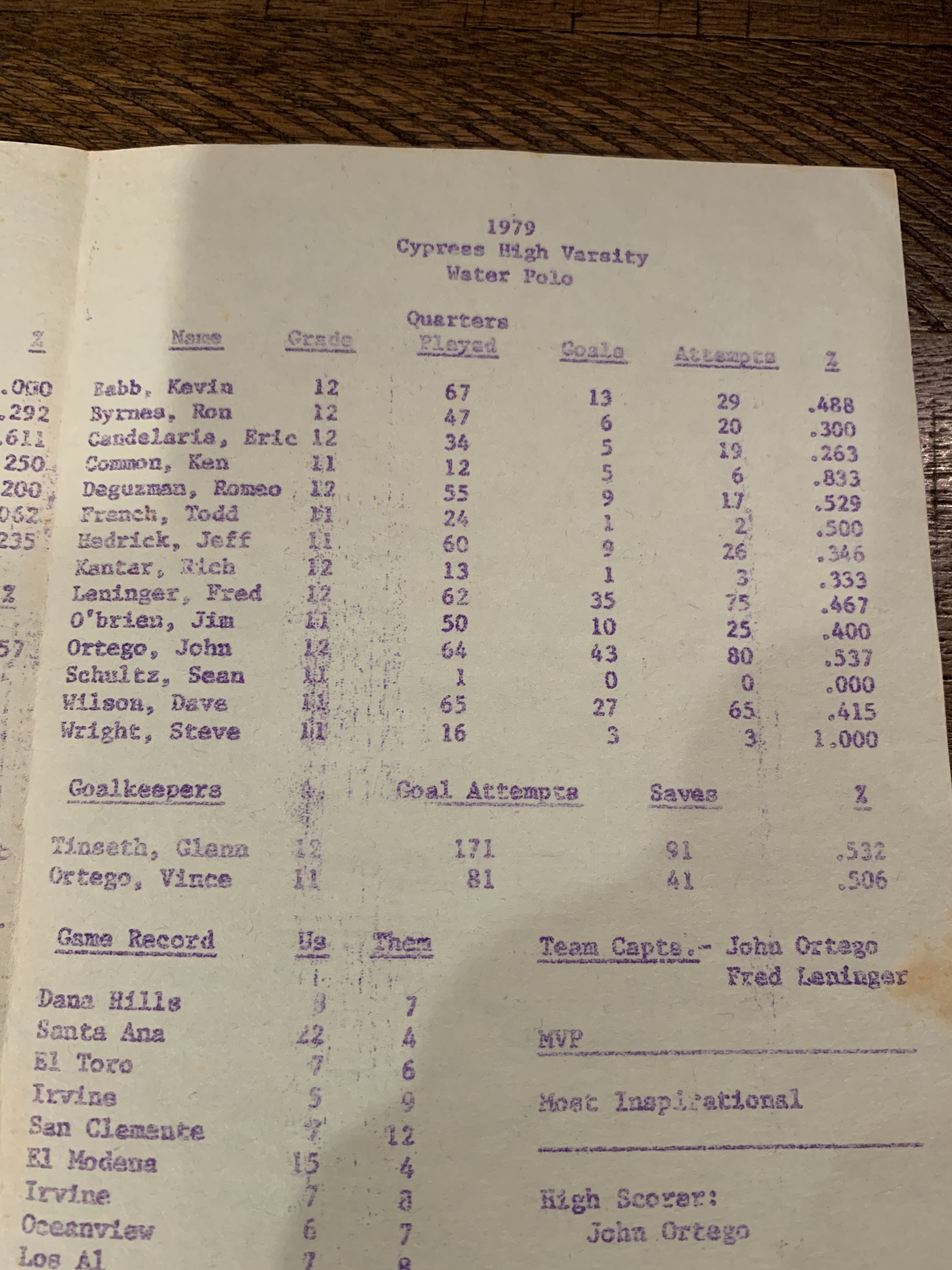
I coulda sworn I scored more goals at a higher clip, but the history in my head is myth. It will come as no surprise to RZ and other PressingPausers who know me best that I rocked the second-to-last shooting percentage on the team. Major props to Eric Candelaria for having a slightly worser shooting percentage and saving me from bringing up the absolute rear.
To Dan, Dan the Retired Transpo Man and everyone else laughing at me right now, get back to me on how easy it is for you to dominate in the water and on the golf course at damn near the same time.

 Pressing Pause