
Tuesday night, while the Good Wife and I slept, our checking account was ransacked by the Internal Revenue Service. This is where our (personal) record amount of federal taxes will eventually end up.
The Internal Revenue Service needs reinventing. Could there be a worse name? It sounds like something from an Eastern Bloc dystopian novel. How about the Public Commons or the Public Commons Service? Now the most dreaded sentence in the English language will be, “Hi, I’m from the Public Commons Service.”
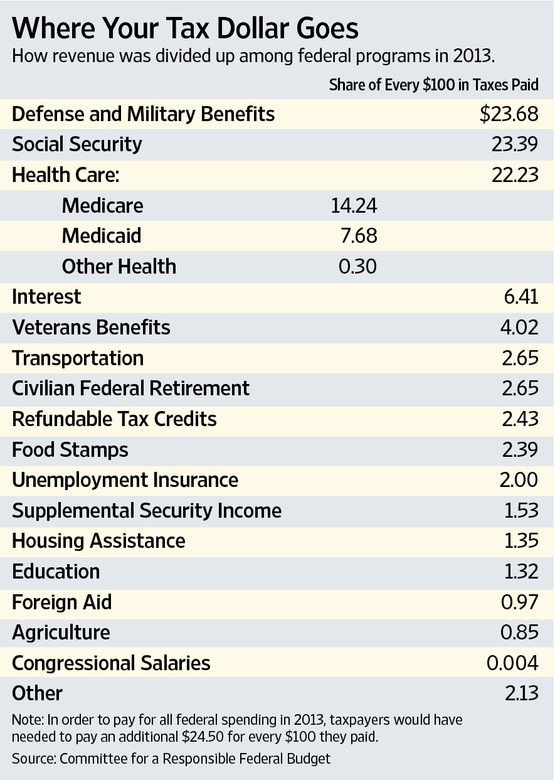
Granted, that’s barely scratching the surface of what’s wrong with the PCS. The main problem with our tax system is once our checking account is raided, we have next to no say over where our federal tax dollars go (apart from voting for two senators and a congressional representative). For example, despite being anti-war educators, 27.7% of our federal taxes go to the military (defense and military benefits + veteran benefits) while 1.32% goes to education. We’re forced to help purchase drones, when we’d much rather help purchase improved teacher salaries.
At the same time, our hawkish neighbors might compensate for our military stinginess by designating far more than their 27.7% for the Pentagon. And of course, our other neighbor, Dan, Dan, The Transportation Man, would significantly increase his 2.65% transportation contribution.
A few significant improvements would result from this experiment in direct financial democracy. 1) Complaining about tax rates would decline. 2A) Government departments and programs would have to explain to the public why they’re deserving of a greater percentage of the total revenue available. And 2B) The more they could demonstrate fiscal responsibility, the more support they’d gain.
Admittedly, these ideas won’t slow the accelerating gap between the Haves and Have Nots. On April 15th, I listened to a panel of tax experts discuss tax reform on the Diane Rehm Show. I was much more intrigued by the tone of the discussion than the details of their ideas. The tone was, “Our tax system is so complex that improving it by simplifying it is impossible, but I’m happy to play along with your national audience anyways.”
As anyone who has tried to improve K-12 schooling, reduce global warming, reduce money’s influence in politics, or eradicate drugs and crime from their community will tell you, those who have a vested interest in the status quo benefit greatly from a sense of overwhelming complexity. Reformers, whether tax or otherwise, can’t wrap their arms around the whole problem, and therefore, don’t know where to begin making changes. Eventually they try piecemeal reforms. Before those reforms take hold, people’s patience runs out. Gradually, everyone and everything reverts back to “normal”. With each passing year or decade, what’s viewed as “normal” becomes more deeply entrenched, making significant change even more difficult.
Tax reformers have lots of good ideas including deductions they’d tweak or eliminate altogether. But they can’t see the forest because of the trees. Their ultimate challenge is to convince the public that simplifying and improving our tax system is possible.
 Pressing Pause