Number One Is In The Back Yard

Or is it the front yard?

From the WSJ:

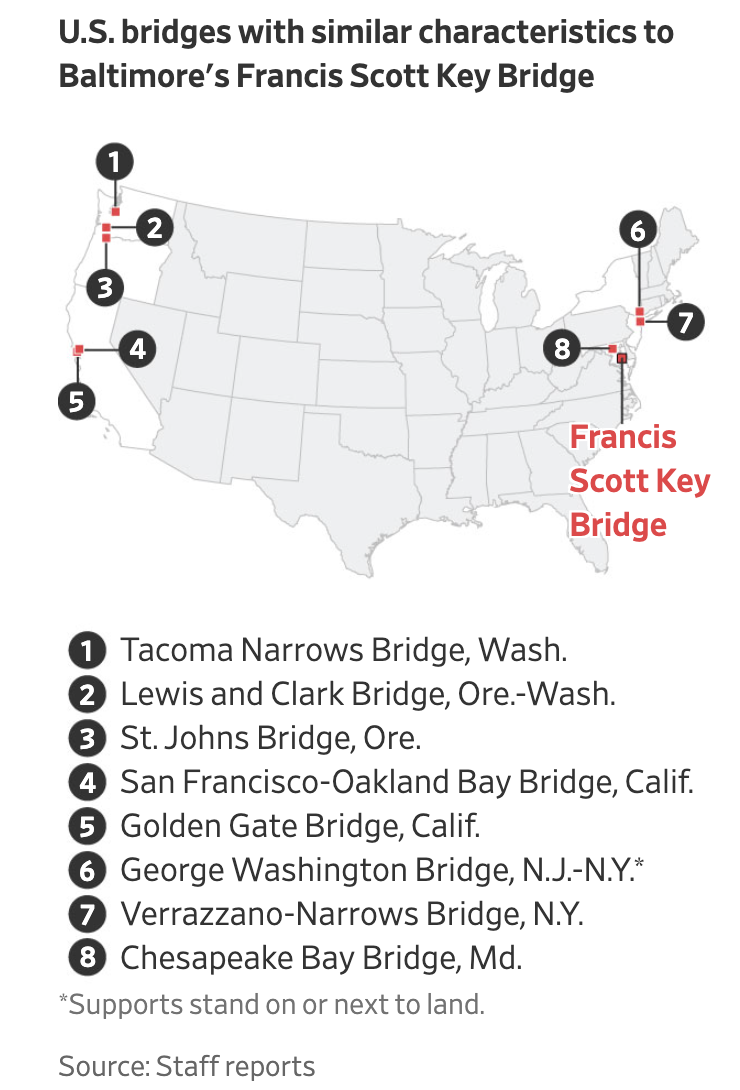
“Fewer than 10 bridges in the U.S. have the clearance of the Francis Scott Key Bridge in Baltimore, the 1,200-foot span that collapsed after a supersize containership slammed into one of its vertical supports. All of them have a vulnerability where the failure of even a single steel component in tension along the span could cause a collapse. 

The National Transportation Safety Board flagged this condition in the Key Bridge after it fell early Tuesday morning—but the hit that destroyed the Key wasn’t a blow to one of those crucial steel components. Rather, it was the devastating strike taking out one of the bridge’s concrete vertical supports, known as a pier, that caused the massive structure to cascade into the water below. 

Any span of that size suffering a comparable loss could tumble, according to engineers, making bridges that can accommodate giant ships particularly at risk.”

Infrastructure Y’All

As reported by Anthony Macuk of KGW:

“The Interstate Bridge Replacement Program (IBR) has secured its first big tranche of federal funding, marking a major milestone for the effort to replace the aging twin bridges that carry Interstate 5 over the Columbia River.”

$600million of $6billion. I think that’s ten percent.

Everything You Wanted To Know About U.S. Bridges

But were afraid to ask.

TL/DR . . . “bridges in the US are getting more ‘average’ over time. We have fewer excellent bridges, but we also have many fewer bridges in poor condition. We’re fixing our worst bridges, rather than spending money keeping bridges looking sparkling and new. Because the difference between a poor quality bridge and an ‘average’ bridge is much larger than an average and an excellent bridge (since a poor quality bridge is at risk of collapse), this means that bridge infrastructure is getting safer over time, even as it gets older and handles more traffic.”

The Greatest Country In the World

Neglected interstate bridges seek billions in infrastructure funds.

“Much of the nation’s transportation infrastructure is in need of rehab or replacement, and bridges are a top concern. An annual infrastructure report card by the American Society of Civil Engineers last year calculated the nation’s bridge repair backlog at $125 billion with 46,000 U.S. bridges in poor condition.”

And in the Upper Left Hand Corner. . .

“Officials in Oregon and Washington have been working together since 2019 on a revived Interstate (Columbia River) Bridge replacement plan, after a previous effort failed in 2013. Cost estimates have ballooned from $3.4 billion almost a decade ago to closer to $5 billion today.”

Inertia-inspired inflation makes it harder to work through the backlog.

The United States In Free Fall

One to two hundred years from now, historians will point to the end of the Twentieth Century and the first half of the Twenty First as the time that the United States ceded its global leadership to China and a menagerie of other nations. Basically, the timeline of my life.

Why? Because we’re losing economic momentum and China and other countries are gaining it. It’s only a matter of time before the “X” and “Y” axes cross.

And with our loss of economic momentum, people and institutions are under ever greater pressure. Economic anxiety compels more and more people to prioritize their self interests to the detriment of the common good.

For the first time in a long time, parents worry that their children will not live as comfortably and securely as them. Add to that the recent damage done to our political institutions which were integral to our Twentieth Century rise. Peaceful transitions of power can’t be assumed any longer. Legislators cannot compromise to invest in green energy and physical and social infrastructure.

Consequently, our roads are rutted and many, many international airports lap our own aging ones. At the Winter Olympics, China showed off it’s new bullet trains that go 217 mph, not quite up to Japanese speeds, but give them time.

Don’t interpret this as idealizing China, because there’s a lot more to quality of life than economic growth. There’s a sense of safety, freedom of speech, freedom of movement, freedom to protest, equal opportunities, a healthy natural environment, physical and mental well-being, and support for the most vulnerable. China fails on many of those fronts. Increasingly, the U.S. does too.

Apart from our failing infrastructure, we imprison a larger percentage of our population than anyone. Our response to Covid has been “worst in the world” especially when adjusted for our economic status. Many use alcohol and drugs to escape and more and more of our children suffer from anxiety disorders and depression.

For the historically astute, this shouldn’t come as a surprise. Greatness has always been fluid. Tides rise and tides fall. Our aristocracy, the top ten percent who are thriving economically, don’t realize a lower tide lowers all boats. That it is in their enlightened self interest to reduce the income and wealth gap. To reduce the vulnerability of the least fortunate among us.

Our problem is we don’t think in terms of generations or hundreds of years. The aristocracy thinks they’ll be fine and they work tirelessly to make sure the same is true of their children. Talk of environmental degradation and climate change, is mostly just that, talk.

I’m not immune from that self-centered myopia. I think to myself, if I can just keep running in Priest Point Park, keep cycling on Mount Rainier, keep swimming in Ward Lake, keep eating healthy food, keep drinking craft beers with good friends, all is good. Which does nothing to slow the country’s decline.

But then again, history suggests the decline is inevitable.

The take-away for my international friends? If you have the United States on any sort of pedestal, update your thinking. If we ever were a light upon a hill, we are not now.
Thursday’s Required Reading

1. Back to Church, but Not, Let’s Hope, Back to Normal.

“One way to think about this pause in our lives is as a rare—likely a once-in-a-lifetime—opportunity for a reset. We actually stopped, the one thing our societies have never heretofore done. Things ground to a halt, offering us the chance to examine our lives and our institutions. And now, if we want it, we have a chance to rearrange them.”

2. Stop Building More Roads. Dan, Dan, The Transportation Man has been saying this for years. Who knew he knew what he was talking about? For some reason, the authors fail to mention that the President has sporadically talked about investing in infrastructure, but not followed through at all.

3. Japan auto companies triple Mexican pay rather than move to US. I’ll take “What the President Won’t Talk About” for $500.

“Consumers will ultimately pay the price for inefficient production and increased component flow. U.S. research agency Center for Automotive Research estimates that 13% to 24% of all cars sold in the U.S. will be subject to tariffs. If automakers pass these costs on, prices will rise by $470 to $2,200.

The center also said U.S. car sales will drop by up to 1.3 million units annually due to the Trump administration’s trade policy — including sanctions on China. It estimates that 70,000 to 360,000 jobs will be lost, leading to a $6 billion to $30.4 billion reduction in gross domestic product.”

4. Two Chefs Moved to Rural Minnesota to Expand on Their Mission of Racial Justice. Such a hopeful story about social infrastructure. Great pictures on top.

5. This vertical farm could be the answer to a future without water. New Jersey isn’t the only place where farms of the future are starting to bloom.


Happy Birthday USA?

In the (dis)United States, we’re living in historic times, not just an every 50 year Civil Rights movement seeking racial and economic justice for people of color, but a slow and steady decline in our quality of life relative to other developed countries. Even though we’re too close to see it and too proud to acknowledge it, we’re a couple decades into a seismic, century long shift in our relative position.

Here are the numbers for those in denial like Michael Medved and Michael you know who.

The U.S. Is Lagging Behind Many Rich Countries. These Charts Show Why.

In today’s New York Times, David Brook’s explores our “crisis of the spirit” in “The National Humiliation We Need”.

He believes:

“Our fixation on the awfulness of Donald Trump has distracted us from the larger problems and rendered us strangely passive in the face of them. Sure, this was a Republican failure, but it was also a collective failure, and it follows a few decades of collective failures.

On the day Trump leaves office, we’ll still have a younger generation with worse life prospects than their parents had faced. We’ll still have a cultural elite that knows little about people in red America and daily sends the message that they are illegitimate. We’ll still have yawning inequalities, residential segregation, crumbling social capital, a crisis in family formation.”

I agree.

Thursday Assorted Links

1. Why kids love garbage trucks. There are a lot of theories. Not just kids though.

“. . . Toubes and I immediately agreed that garbage trucks can also be pretty mesmerizing to adults because what they do is so visually unusual. Toubes is himself the father of a onetime garbage-truck aficionado: “My second son was sort of obsessed, and when we asked him what he wanted to be when he grew up, he said a garbage truck,” he told me. “We were like, ‘You want to drive a garbage truck?’ And he was like, ‘No, I want to be the truck.’” And when his son ran to the picture window to watch the garbage pickup, “I’d go to the window and watch along with him,” Toubes remembered. ‘Like, Actually, that is interesting.”

2. How much should teachers talk in the classroom? Much less.

Therese Arahill, an instructional coach in New Zealand:

“I join their discussion, … answering their questions. It’s an attitude. Moving away from teacher ego, toward student voice, student agency.”

3A. Cut from the same cloth. Artist Myfanwy Tristram was irritated by her teenage daughter’s extreme fashions — until she took an illustrated journey into their origins.

3B. What do Gen Z shoppers want? A cute, cheap outfit that looks great on Instagram. This can’t be good for their mental health. Can it?

4. Is your city infrastructurally obese? If you live in Gary, Indiana, yes, most definitely.

5. The best documentaries of the 2010’s.