I Recommend

• My new personal favorite money blog—Mr. Money Mustache. MMM started in April 2011 and he’s killing it. The DIY (Do It Yourself) Colorado bicycle riding blogger writes well and employs a nice mix of confidence, humor, disgust at the status quo, and personal finance insight. His alternative approach to life is resonating with lots of readers. Recently he’s added case studies based upon readers’ lives. Check this recent one out. Favorite excerpt, “Every young adult should be able to comfortably sleep on somebody’s floor, drive an old manual-transmission car with rust holes to a concert, and eat leftover pizza for breakfast. Without complaining.”

• Groovy post by The Minimalist Mom.

• Provocative and timely essay on Chronic Traumatic Encephalopathy (CTE) and what the end of football might look like.

• “Glee is an Immoral Television Show and It’s Time to Stop Watching It.” Trenchant critique by a young, smart, prolific blogger.

• Errol Morris documentary film, Tabloid, about Joyce McKinney, an unstable woman with a criminal disposition. Sex, religion, crime, all mixed together. The one Netflix viewer who wrote, ” She does not need a movie made about her. She needs some real help” is correct. On the other hand, deviance is often interesting because it provides contrast. See Grizzly Man and Take Shelter. I found the most fascinating character to be a minor one, a British tabloid journalist whose total lack of conscience was harrowing.

• Badass video—6 minutes.

Women Make Better Money Managers

If you’re of the male persuasion, slowly step back from the check book or computer, and find a woman to take over your financial decision making.

According to Ronald T. Wilcox, a growing body of research reveals distinct differences in how married men and women approach money and investing. Because men tend to be overconfident, they trade stocks and bonds more actively because they think they know what the next market movement will be. As a result, they incur various transaction costs associated with trading but don’t pick assets any better than women. They’re also less likely to listen to financial advice.

Women are less confident than men about their financial abilities, switch investments less often, and are more likely to listen to financial advice. As a result, they generate risk-adjusted returns superior to those of men.

The Wall Street Journal summarizes Wilcox’s findings thusly, “Men may think they know what they are doing when it comes to investing but often do not. Women may think they don’t know what they are doing but often do.”

Truth be told, you can plug in anything you want for “investing” in the last paragraph. Now if you’ll excuse me, the market is about to close and I have some trades to make.

Bonus link—a couple that has figured out how to enjoy a better quality of life despite making considerably less money.

My “not motivated by money” award nomination double bonus link—and favorite 2012 US Olympian and favorite youth sport parents—Missy Franklin, Dick Franklin, and D.A. Franklin.

Housing Prices

The conversation turned to real estate on a recent Saturday run when I shared my opinion that many sellers in our community were slow to grasp the correction as evidenced by their overpriced houses languishing on the market for six months to a few years.

You would have thought I suggested we extend our 10 miler another 16.2 just for the fun of it. The right wing nutters immediately jumped on me for assuming I knew more about free markets and home values than the actual homeowners themselves. And more importantly, who did I think I was, homeowners have the right to price their houses however they want.

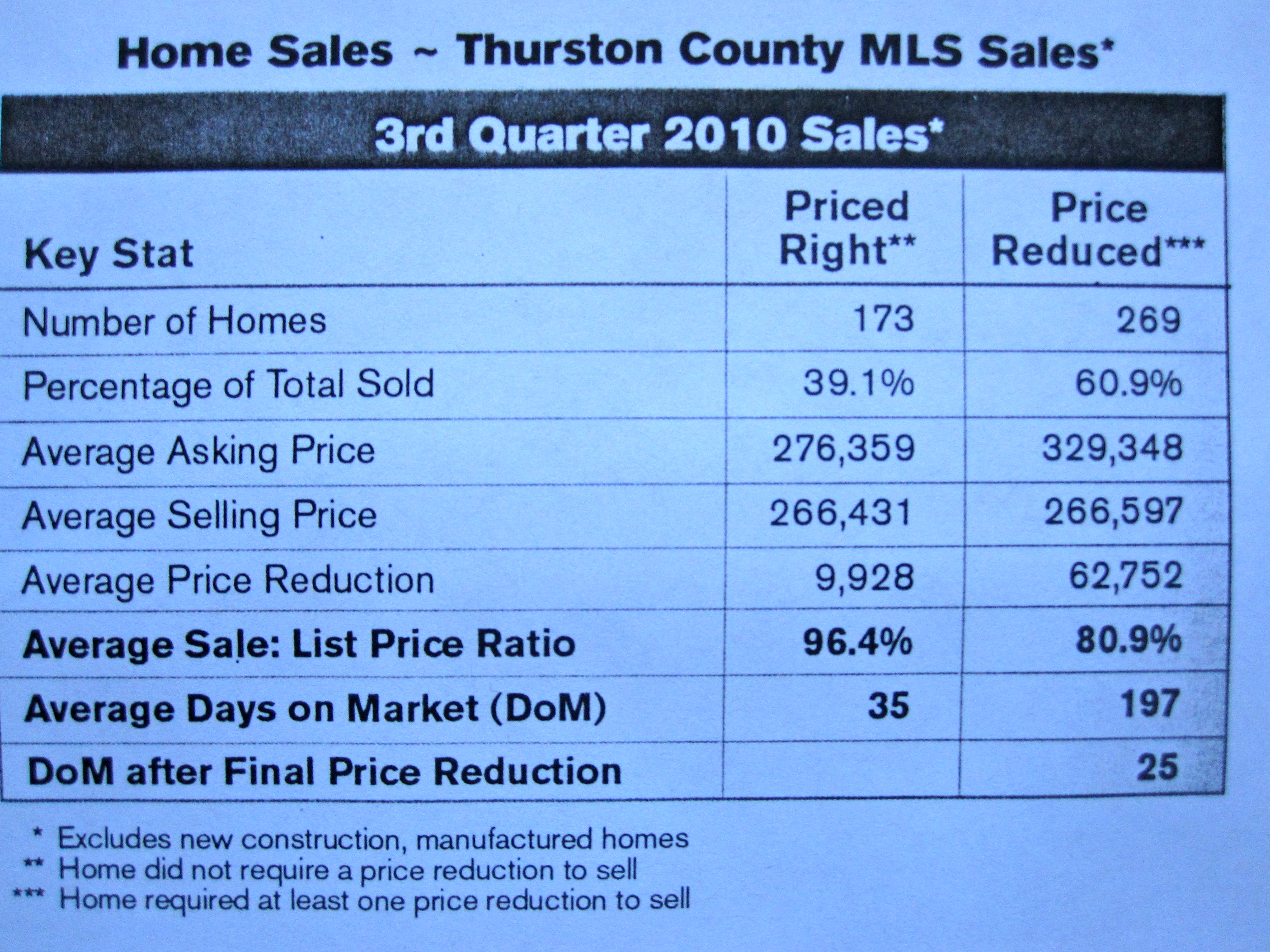
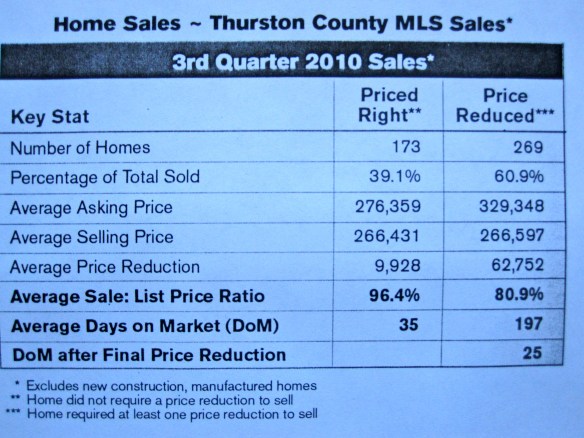
Of course they do just like they have the right to be irrational and waste money more generally. Check out this chart:
credit—Jodi Ashline Newsletter

In the end, the average “priced right” and “priced reduced” home sell for the same price, but the “price reduced” home is on the market an extra 162 days. If “price reduced” homeowner has $100k in equity, and that equity was invested for 162 days @ 5%, they passed on earning $2,219. That’s the cost of exercising your constitutional right to overprice your home.

Around here at least, it appears that the larger and more expensive the home the greater the tendency to overprice it. That’s counterintuitive if one assumes, on average, the most well-to-do homeowners are the most business savvy, but I digress. We can also assume a much smaller pool of prospective buyers (I know it only takes one) and therefore the “average days on market” I suspect is far greater than 197, but for consistency sake we’ll stick with that.

Let’s consider a waterfront home that is four times the average at $1,317,392. Ultimately, after 197 days, overpriced sellers have to reduce their price $251,008 ($62,752 x 4). Let’s compensate for the too short “average days on market” by assuming that our waterfront sellers own their home outright. If “expensive price reduced” homeowner has $1,066,384 (the final sale price) in equity and had invested that for the too short 162 days @ 5%, they passed on earning $23,665.

To which the nutters might say, “That’s waterfront sellers right.” Which again, of course is right, just irrational.

Since I’m on math fire, and the nutters are down for the count again, one related thought. One oft repeated housing axiom is that housing corrections don’t matter if you’re buying and selling into the same down market. That’s only true in one of three possible scenarios—buying and selling similar priced homes. It doesn’t hold for buying a more or less expensive home than sold.

For example, consider the case of buying a more expensive home. Imagine you could sell your existing home for $300k or $100k less than its peak 2007 valuation. You buy a home for $1m or $250k less than its peak 2007 valuation. Had you made that move in 2007, it would have cost $1,250,000-$400,000 or $850,000. Today, the equation is $1m-$300,000 or $700,000 for a savings of $150k.

The opposite is also true. As a result of the correction, it’s more expensive to move down. Imagine you could sell your existing home for $600k or $200k less than its peak 2007 valuation. You buy a home for $300k or $100k less than its peak 2007 valuation. Had you made the move in 2007, you would have pocketed $400k, $800k sale price-$400k purchase price. Making that move today you would only pocket $300k, $600k sale price-$300k purchase price.

So assuming one has the resources, it makes more sense to move up in down markets and down in up markets.

School’s out nutters. Do they give out Economics Nobels for this stuff?

The Intrapersonal Conundrum

Recently I advocated accepting and adapting to people’s irritating behaviors rather than trying to change them. But what about our own irritating behaviors? How do we know when to accept them versus when to commit to trying to change them?

Of course, not everyone is introspective; as a result, some people lack self understanding. Ask them which of their behaviors most irritate the people they’re in relationships with and they draw a complete blank. I’m probably too reflective for my own good, regularly engaging in self-assessment. One limitation I’m keenly aware of is an aversion to personal networking. Closely related to that, I suck at self-promotion.

Among other ripple effects, this blog has a small readership and my professional successes exist mostly within my classrooms. A colleague of mine is the opposite, a brilliant networker and self-promoter. A mediocre teacher, she’s developed a national reputation as an expert in a very specific sub-category of education. She travels all the time and speaks to large groups for lots of money.

Am I envious? Not on a personal level, but maybe professionally. I would enjoy more consulting opportunities than the one or two a year I average. But not enough to change. I understand that there’s a perfect correlation between my lack of networking initiative and the number of consulting gigs I get.

Even though social and professional networking skills are more important than ever, I’m perfectly content not being a networker or self promoter. In fact, I don’t want to get better at networking or self promotion. I’m an educator, so I’m not anti-social, I just have no patience for the phoniness on which so much of it seems to rest. “Here’s my card.” “Who cares.”

Another limitation I’m keenly aware of is a deeply rooted counter-cultural propensity for saving. My dad grew up during the Depression, and it left an indelible mark on him, and so I blame his hyper-frugal modeling. But unlike my aversion to personal networking, this is a limitation I want to change.

Here’s one of millions of examples of my often irrational economic behavior. One day in Chengdu, China I argued at length with a Carrefour manager about socks I purchased. Despite being on sale, the socks were rung up at the regular price. Our language differences, the store’s employee hierarchy, and my stubbornness made for a combustible, and in hindsight, hilarious combination.

In this area of my life, I want to act more rationally, so I’m working on loosening up.

What explains my markedly different way of thinking about these two personal limitations?

I’m not sure.

Winning Personal Finance 2

I’ve been successful for several reasons: 1) most importantly, my parents’ work ethic, saving habits, and frugality have been deeply imprinted in me; 2) second most important, I chose to marry someone who wants to live a similar lifestyle as me; 3) I’ve educated myself reading and studying lots of material; 4) I found Vanguard early on which has saved me a lot in investing costs; 5) I’ve come to enjoy managing money so I set aside a few hours every week to continue learning and make decisions; and 6) I almost always avoid impulse purchases.

What might one and two mean for you? When it comes to family history and partner, I’m a personal finance +/+. The gal pal and I have probably had as many financial arguments as the next couple, but they’ve ebbed in number and intensity over time, and ultimately, our personal financial values are very similar. What if you’re a personal finance -/+ or the dreaded -/-? While it’s impossible to completely undo a “losing personal finance” family history, financial counselors can help minimize the damage and your time and resources are probably best spent working with them on minimizing the effects of negative role modeling before turning to asset allocation, minimizing taxes, and the like. Similarly, if your partner and you aren’t in sync, financial/couples counseling is probably more important than technical financial advising. Proactively, the more premarital counseling focused on each person’s financial history, values, and goals, the better.

What about reasons three, four, and five? How much time do you set aside each week to educate yourself about saving, investing, minimizing taxes, and related personal finance topics, not counting paying bills and balancing your check book? Put differently, how much time do you spend thinking about the forest that is you or your family’s financial well-being? My guess is, on a weekly basis, the average person spends very little time thinking about where they’ve been, where they are, and how to reduce expenses. Quiz. What was your net worth, assets minus debits, on 12/31/09? Will you recalculate it at the end of this month and then every quarter? If my assumption is right, is it any surprise that so many people are unsatisfied with their personal financial situation?

Reason six leads to tip five or experiment one, don’t buy anything that hasn’t been on your “To Buy” list for at least a week. Personal example. Three plus years ago I bought eight pairs of $120 running shoes for $60 a piece. Running shoe companies “update” their shoes regularly, every year or so. As far as I can tell, “updating” shoes means “we changed the colors”. If you’re savvy, you can pick up the “old” model at half price. When the big box of eight shoes arrived, it blew the daughters away. “Dad, you saved $480!” “Tru dat.” Fast forward, I’m halfway (250 miles) through pair eight so I’ve started to shop for a similar deal. No luck until last week. I found my Mizuno Wave Creations, model 10, for $65. Model 11, $135. Only two sizes were available, one was mine. Darn if the website would only let me buy two pairs, so I called them. They said they’d investigate and get back to me. Long story short, they found a third pair and all three are in transit. Normal cost for three pairs at $135 and 8.5% taxes, $439.42. After thanking the salesperson I said, “I saw something on-line about a Costco or Triple A discount.” “Yes, what’s your Triple A number?” Cost went from $201.50 ($6.00 shipping) to $181.50. Let’s see you do that on your fancy pants iPhone with the barcode application.

Now my $9,000 loss is a mere $8,742.08.

Winning Personal Finance 1

Everyone is hocking financial advice so how does one decide whose to follow? For example, why on earth should anyone pay any attention to the personal financial advice I offer below? What makes one advisor more credible than another, credentials, their popularity, their marketing savvy, something else? Credentials are nice in that they create a floor with respect to technical knowledge, but they don’t tell you much about the person’s ethics, integrity, or track record. Ultimately all credentials tell you is they succeeded in passing exams.

If I was looking for a financial advisor I’d look for someone that managed their own money well and emphasized saving, investing simply, and had other values that jived with my own. But how do you know if someone manages their own money well when we’re loathe to talk about our personal finances?

Tip one. Ask anyone wanting to manage your money to prove that they’ve managed theirs well. That will probably reduce the pool from which to choose in at least half. Take me for example, I have managed my family’s money well, but for privacy reasons, I won’t provide details except to say that for every ten financial decisions I make, I tend to make seven or eight good ones. Were I in the biz, I would completely understand if that lack of specificity caused potential clients to walk away.

Tip two. Ask any potential financial advisor about some of the mistakes he or she has made and what they learned from them. Last year I made a $9,000 mistake. I repeat, last year I made a $9,000 mistake. It was a brutal, self-inflicted wound that took time to shake. My goal is not to be perfect, but to consistently make more good decisions than bad. Look for a humble advisor who acknowledges complexity and doesn’t over promise. That will probably reduce the pool of potential advisors by at least another half.

Tip three. Even if you find a financial advisor that meets all of those criteria, don’t decide to work with him/her without first looking at yourself in a mirror and repeating several times, “No one will ever care about my financial well-being as much as me.”

Tip four. Never accept any financial advice passively. Instead educate yourself and recognize that no one will ever care about your personal financial well-being as much as you. More specifically, become your own financial advisor. That’s the best financial advice I’ll ever offer. Become your own financial advisor.

Well, the best advice until Part Two.