Season six is good. Seasons 1-5 were great. This Jason Okundaye piece is a smart explanation of its meaning and appeal.
Paragraph to ponder:
“The show has never been about revealing anything new. Instead, it has resurfaced what the royal family would most like us to forget. “The Crown” has, over six seasons, spoken to several furtive British truths: the public perception of the monarchy, the self-preservation strategies of a family preoccupied with becoming irrelevant and the family’s rigorous quashing of internal dissent. The glossy dramatization of these truths is partly why the popularity of “The Crown”has endured, finding an audience in Britain even among people who want to end the monarchy or are indifferent to it.”
It’s nice knowing I’m not the only “end the monarchy” proponent who digs the show.
Because I’m amazing, this time of year I provide an amazing service to family and friends. I assign personalized New Year’s Resolutions. Even if they don’t always show it, I know, deep down, my family loves off-loading the resolution making to me! Here’s just one example of my genius. This is the year The GalPal is going to load the dishwasher from back to front.
This year I’m streamlining things and providing the only New Year’s resolution you need. Repeat after me, “I hereby resolve to not let an artificial moment in time make me feel like I’m not enough. Next year, I will not lose any weight, I will not save more money, and I will not exercise more. Instead, I will strive to change one thing about me. To be more accepting of my unique self, including all my imperfections, and to practice self-compassion.”
“Former President Donald J. Trump is planning an aggressive expansion of his first-term efforts to upend America’s trade policies if he returns to power in 2025 — including imposing a new tax on “most imported goods” that would risk alienating allies and igniting a global trade war.”
The Former Guy is such a successful businessperson, and so rich, we should probably just trust that he knows what he’s doing.
The New York Times has the temerity to disagree with my assessment. They write:
“Evaluating the merits of Mr. Trump’s trade vision is complex because there could be multiple ripple effects, and he is seeking long-term changes. But many economic studies concluded that the tariffs he imposed as president cost American society more than the benefits they produced.
Research from economists at the Federal Reserve and the University of Chicago found that tariffs Mr. Trump imposed on washing machines in 2018 created about 1,800 jobs while raising the median prices consumers paid for new washers and dryers by $86 and $92 per unit. That spending added up to about $817,000 per job.”
Wait a minute. If the Former Guy is mistaken about tariffs, what else might he be getting wrong?
In the 2022 film, Banshees of Inisherin, Colm Doherty’s motivation may not have been fully appreciated amidst the story’s intensity. Doherty wanted to avoid smalltalk at any cost because he realized he had become old and the end was near, so if he was going to leave any meaningful legacy, he had to focus exclusively on his musicianship.
I wonder if we avoid questions of legacy out of a fear of being forgotten. Will anyone remember? If so, who? And what will they remember? And for how long?
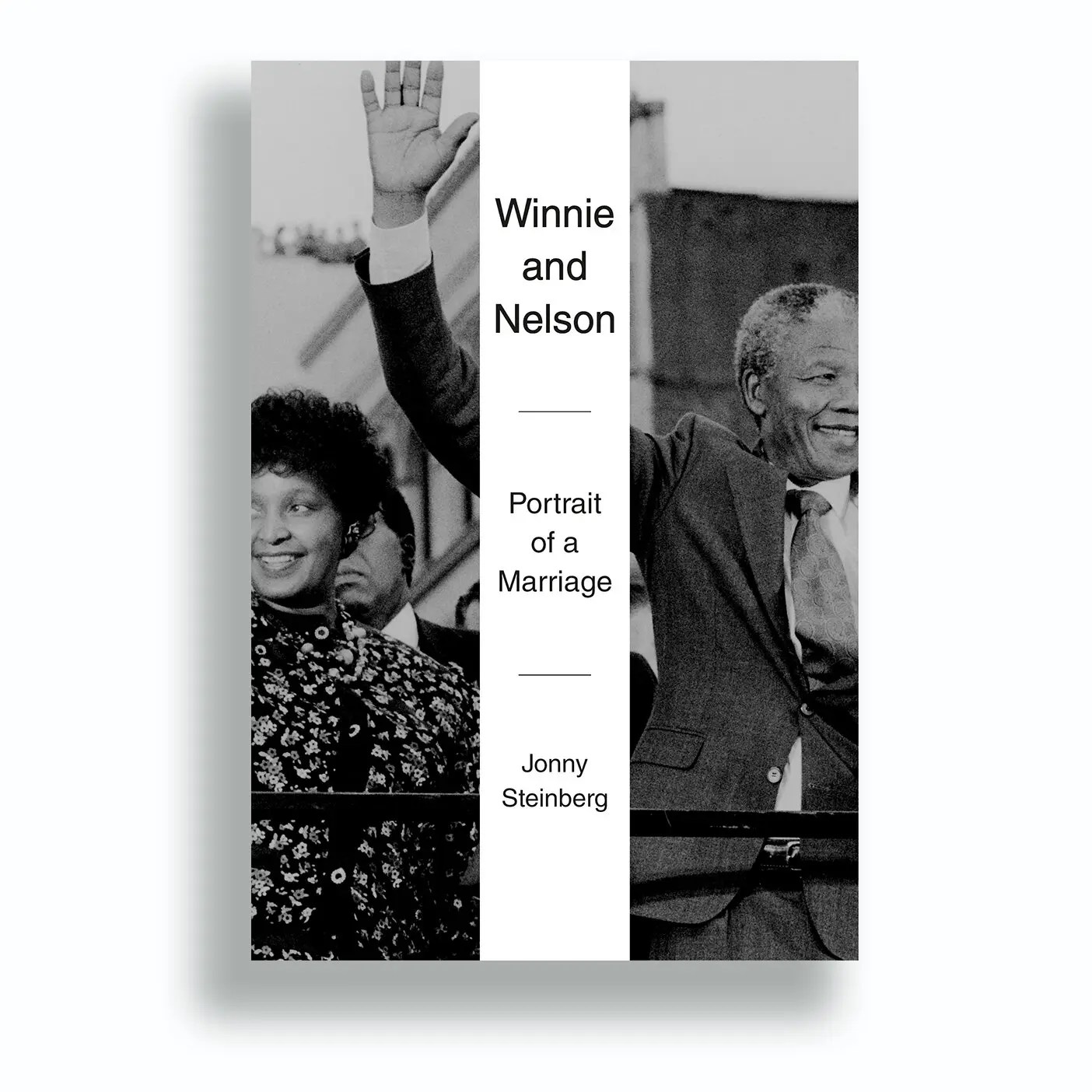
Enter Jonny feckin’ Steinberg, author of Winnie and Nelson: Portrait of a Marriage. I predict Steinberg’s book will be the go-to source for understanding the end of apartheid for hundreds of years. I read it because I followed the anti-apartheid struggle closely in my twenties and I wanted to learn more about two of the central characters. And not knowing much about their marriage, I suspected there would be some salacious details.
Almost immediately though, I got distracted by Steinberg’s brilliance, constantly wondering how he managed telling such a complex and intimate story in the most intelligent way imaginable. Surgical is the word that springs to mind. Steinberg, working mostly from a 15,000 page file illegally held on to by one of the government’s top security officials, repeatedly takes readers inside the Mandela’s relationship, into Nelson’s Robben Island prison cell, inside the African National Congress’s machinations, and onto the streets of the Soweto uprising.
The descriptive writing is good, but what’s most exceptional about the book is Steinberg’s masterful interpretation of documents and events. It’s an ingenious example of historiography or how history should be written. Sometimes Steinberg opts for humility and uses tentative language such as “Although we can never know for certain, . . .” At others, he fearlessly calls into question both central characters’ veracity, especially Nelson’s. Most of the time though, he’s helpfully splitting the difference, thoughtfully offering a particular interpretation based upon the precise historical context and the preponderance of evidence. Very early on, Steinberg’s brilliant interpreting and reasoned judgement caused me to conclude that he was the most credible of narrators.
Steinberg’s acknowledgements reveal that he had eight editors across three publishing houses. And he’s generous in crediting his research assistant, several archivists, and numerous readers of his drafts. Writing may be a solitary endeavor, but publishing a seminal work of this nature, clearly is not.
In terms of the story itself, first and foremost, one can’t help but be overwhelmed by the scale of the government’s persistent human rights abuses and violence, but also the black-on-black violence it engendered.
Another lasting lesson is that the media places individuals on pedestals, whether Barack Obama, Angela Merkel, or Volodymyr Zelenskyy by limiting coverage of their failings, both personal and political. For if we get too close, we will always find, just like with Nelson and Winnie, the famous aren’t just fallible, they’re extremely flawed.
There are many other take-aways. While an imperfect analogy, I came to think of Nelson as a Martin Luther King like thinker and activist and Winnie as a female Malcom X. This tension begs important questions including how does social change happen, nonviolently or violently, slowly or quickly? And if changing a violent regime requires its own violence, how do the survivors turn off that spigot?
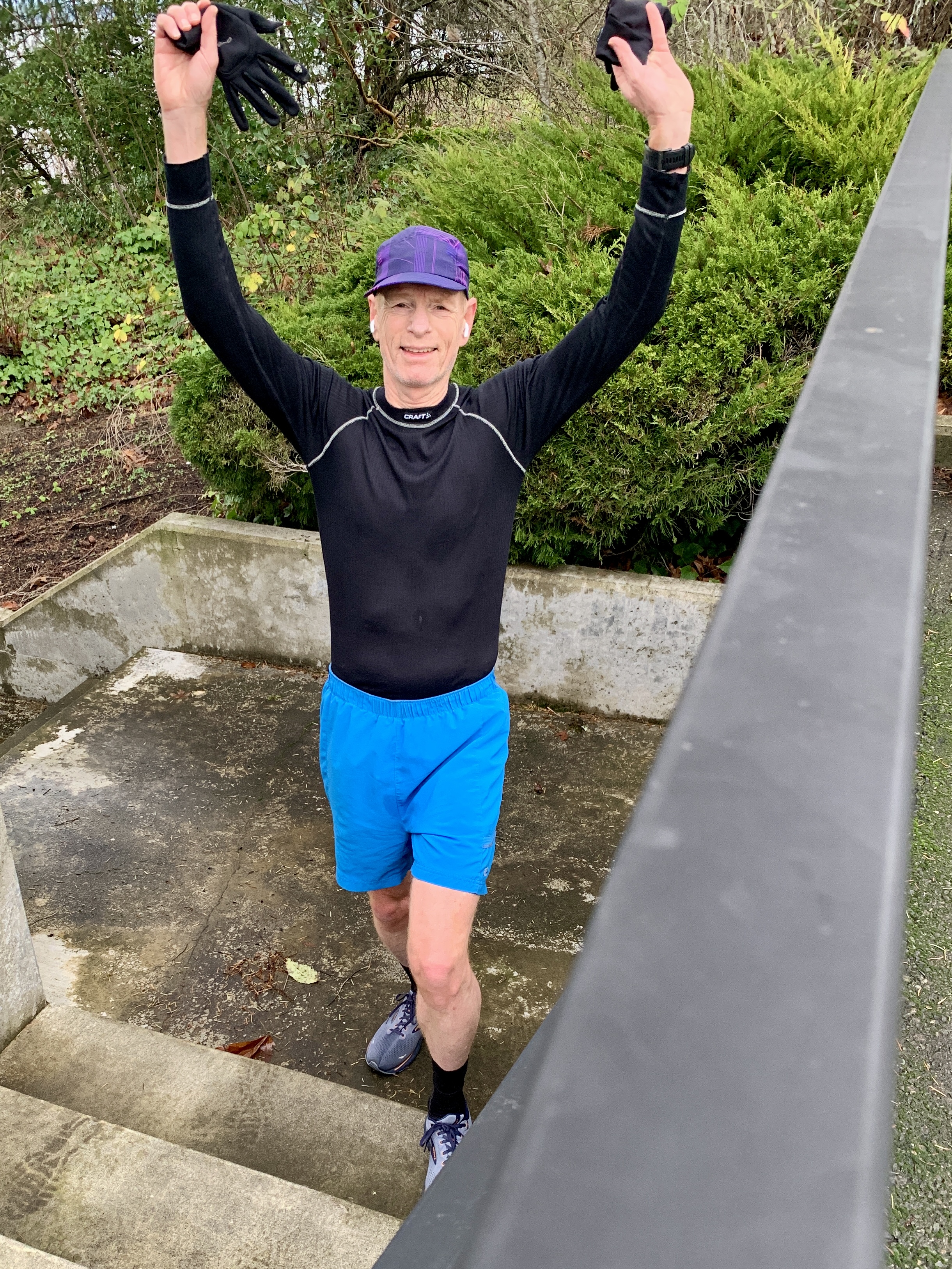
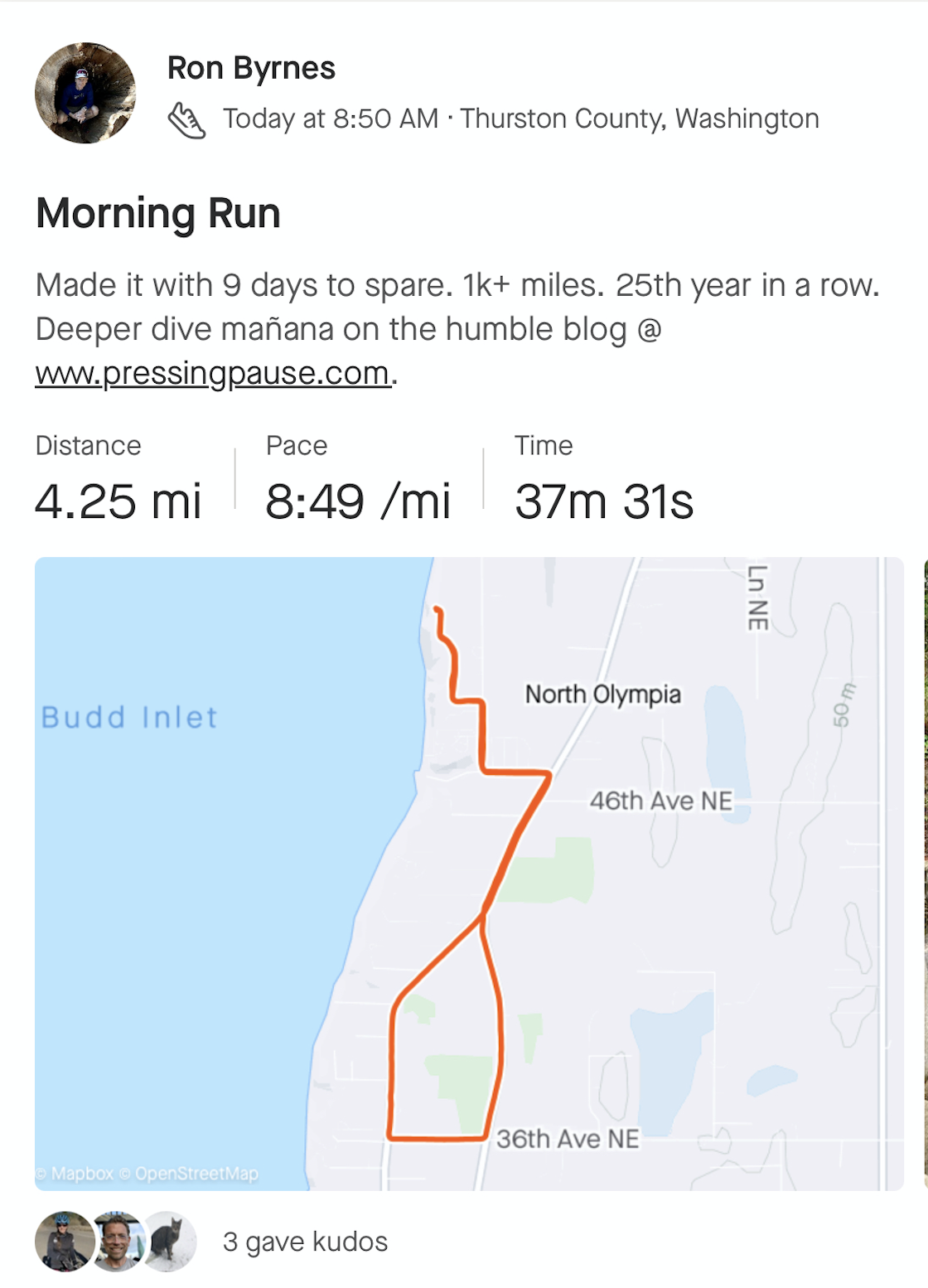
As a result of running 4.2 miles yesterday morn, I maintained my now twenty-five year long streak of running at least 1,000 miles a year. On Gull Harbor Road, at mile 999, I thought to myself, what if that oncoming car just drifts over the fog line and takes me out? Of course, I still have the lateral movement of an elite punt returner.
For the record, the streak continued at the intersection of 47th Ave NE and Boston Harbor Rd as I turned the corner with TSwift, Bon Iver, and Evermore.
This one was was tough, especially after dealing with blood clots in early August and then chronic achilles tendonitis which I haven’t managed smartly.
Bagging a thousand used to be easy, especially when doing half marathons, marathons, and/or triathlons. Hitting four digits was just a routine annual byproduct of being ready to race decently. Now that I’ve retired from competition, the lengthy streak itself is the only motivation. And being fit and enjoying life more as a result of improved physical, mental, and spiritual vitality.
On top of the running, I’ve swam just over 200 kilometers and rode just over 5,000 miles this year, so a decent bit of cross training.
I enjoy swimming and cycling a little more than running these days because they’re less difficult. To continue the streak, I have to sublimate my ego, and let go of pace. I suppose, as I run shorter and slower, I will contribute to the common good that is Strava endurance athletes who can feel better about their relative performance.
I don’t know how long I can or want to keep it going. The key to extending it will be doing a better job of listening to my body in terms of how often, how far, and how “fast” to run. More specifically, I suspect I will need to run shorter, even slower, and more often to extend it.
Thanks to my ace training partners for their continued inspiration and company most Saturdays. MARN, who decided to take up marathoning in his sixth decade. The Byeson, who is a marvel at 5+ years older than me. The Pal, who is somehow getting faster in his fifth decade. And the undefeated University of Washington Husky who effortlessly rows, cycles, and runs right past you.
Thanks especially to the GoodWife for stirring my inner-athlete the most this year. Despite serious health challenges, she is channelling her father’s spirit and is displaying real grit, regularly walking, swimming, and cycling. Watching her pick her way up, down, and around Natches Peak trail in early October was inspiring beyond words.
If I stay healthy and can be half as tough as her next year, the streak will continue.
Like many of you, I loved me the late 70s and 80s Dodgers. Steve Garvey was a nice first baseman, but political scientists have found no correlation between hitting a curve ball and representing constituents well.
Just say no to nostalgia, because at 75, he’s too old to be your next Senator.*
Wait a minute, that picture is from 2019?! When Garv was 71? Looks a lot younger. Maybe I’m just jelly of the hair, and of course the forearms, but I digress.
I know you have a soft spot for octogenarian Senators, so I’m probably wasting my time. Hell, you’re probably thinking Garv could serve two terms and still not be in DFeinstein territory.
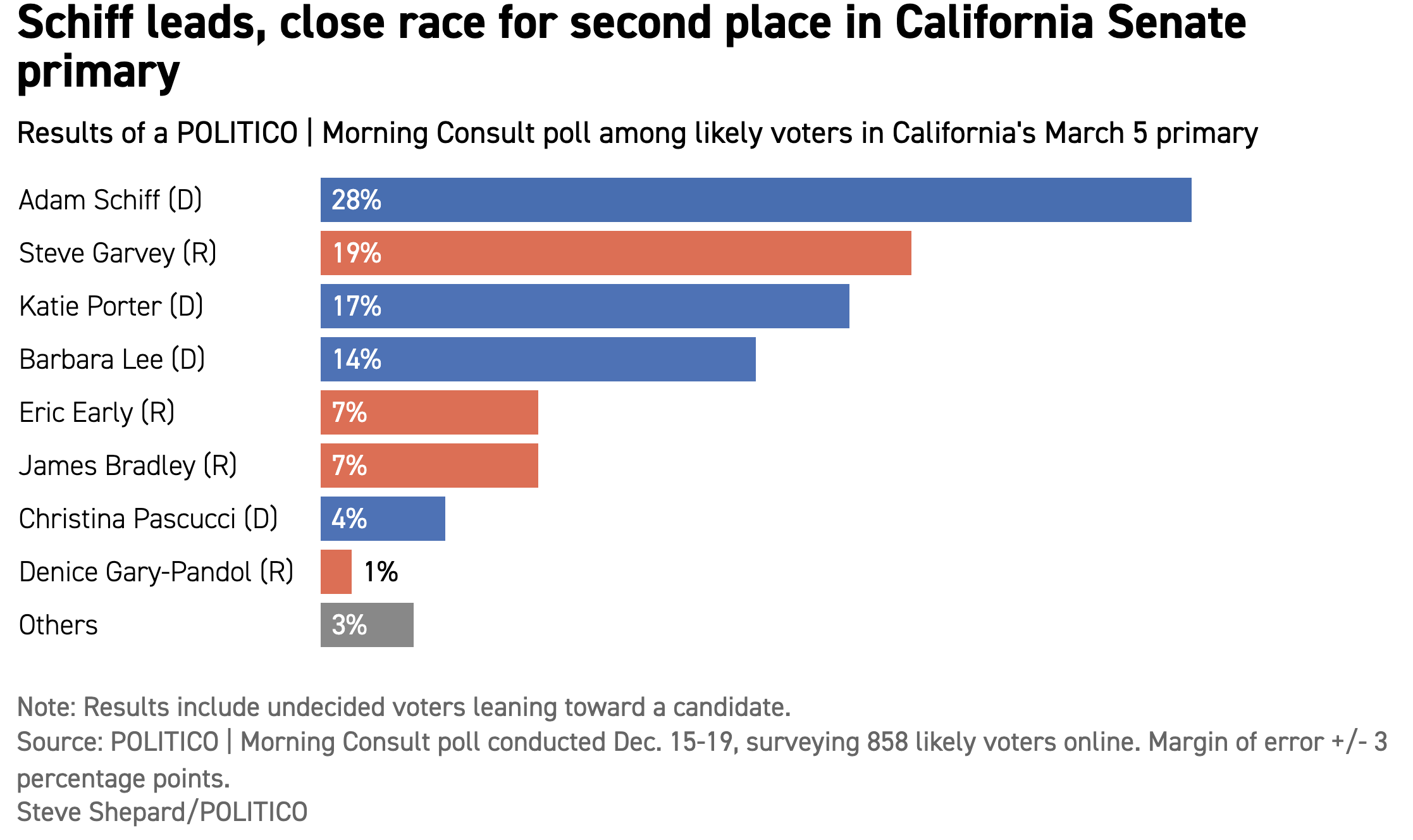
Garvey is ahead of Porter and he doesn’t even use a whiteboard, so his candidacy is no joke. As a former son of the Golden State, I’ve done what I can to turn the election. My work here is done. Now, to quote today’s youth, whatevs. You’re on your own.
Ron
*Please note Dan Dan The Retired Transpo Man, the nonpartisan ageism.
This Olympia, WA data from the Weather Underground leaves me equal parts perplexed and distressed. Today is the winter or hibernal solstice. Meaning the shortest day of the year. Tomorrow is supposed to be longer. I NEED tomorrow to be longer. And yet, as you can see, tomorrow is going to be “0 minutes 1 second shorter”.
The Olympia, Washington School District has a $13.9 million budget deficit. A big number for a smallish community.
The talk has turned to school closures. Parents, students, and other community members are upset and pushing back.
Here are two sample public statements, the first mindlessly conspiratorial; the second, thoughtful and cogent.
“The superintendent and the board members who voted yes to start the 90-day process do not care about the concerns our community has voiced. It is clear that there is a biased agenda happening behind closed doors since the only option they are willing to present is school closures.”
“Our students are not a classroom, they are not data points, they are not funding dollars—they are children. And behind each one of our children, there is a family, there is a story, and there are emotions.”
Lots of emotions.
Most of the protesters say they want to work with the district to find alternatives to closures. That spirit is nice, but I don’t see any counterproposals that result in a sustainable, balanced budget.
I suspect there’s only one alternative to increasing efficiencies through school closures. Increasing property taxes.




 Pressing Pause