Due to the extreme heat, Oregonians can pump their own gas until midnight tonight. Here’s a how-to video https://t.co/LVu0S41R43 pic.twitter.com/kCVV6lUmtg
— The Oregonian (@Oregonian) July 30, 2021
How Hot Is It?
Reply

I miss the best dog ever.
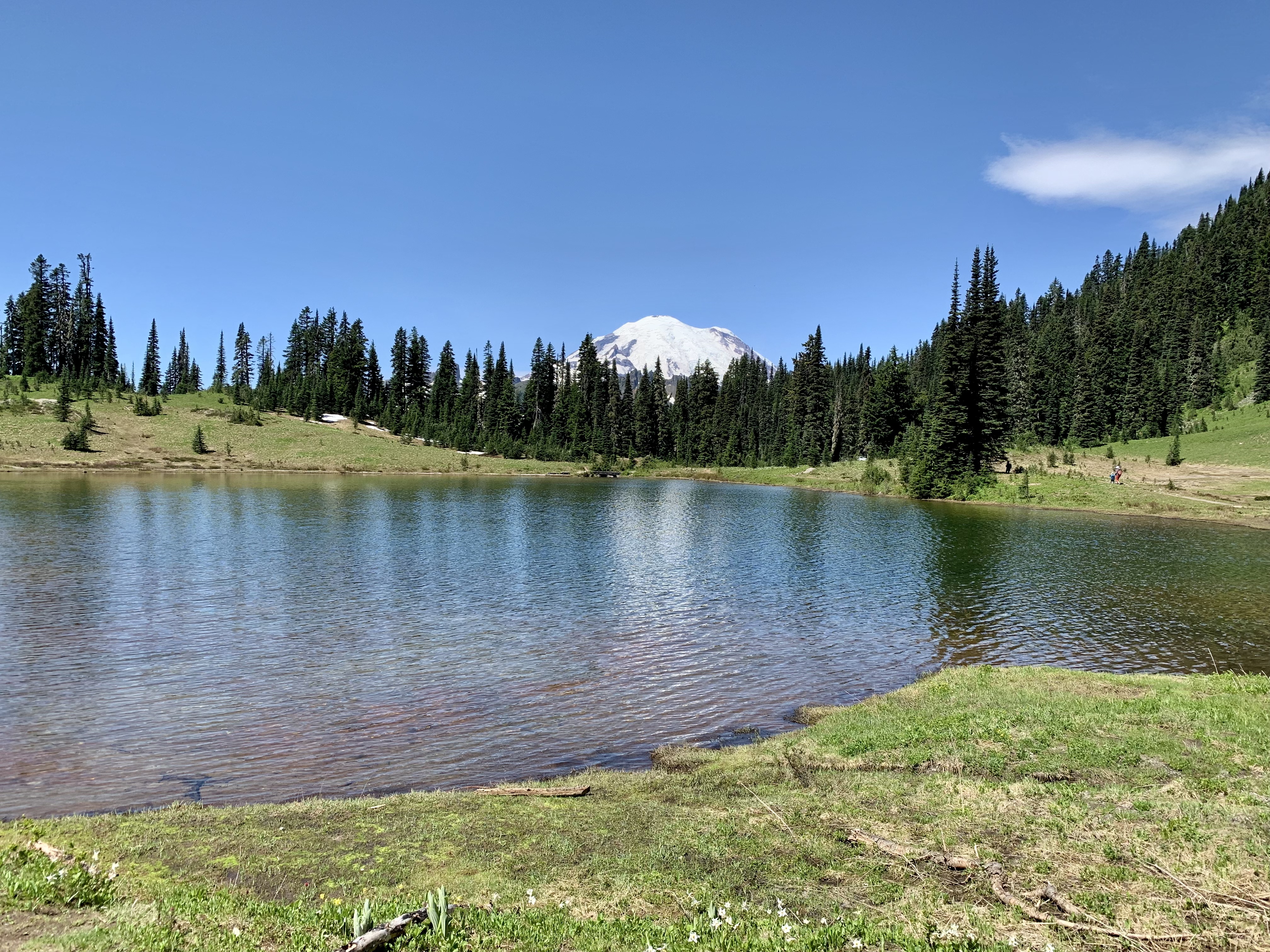
Mount Rainier Anniversary Hike—Tipsoo Lake.

Mount Rainier Anniversary hike. 34 years. Still smiling.

A friend invited me to the U.S. Olympic Trials in Eugene on a beautiful June day. Old rickety Hayward Field had a rich history, but the plush new seats and ample leg room in the brand new stadium make me more amenable to gentrification.

Bonus pic. Gentrification with environmentalism on top. I threw Rosa in the car and rode to and from the shuttle lot. Is there a nicer four word phrase than “Free Valet Bike Parking”?
You can suffer from marriage burnout and parent burnout and pandemic burnout partly because, although burnout is supposed to be mainly about working too much, people now talk about all sorts of things that aren’t work as if they were: you have to work on your marriage, work in your garden, work out, work harder raising your kids, work on your relationship with God (‘Are You at Risk for Christian Burnout?’ One Web site asks. You’ll know you are if you’re driving yourself too hard to become an ‘an excellent Christian.’) Even getting a massage is ‘bodywork’.
Jill Lepore, It’s Just Too Much, The New Yorker, 5/24/21

A quintessential Pacific Northwest phenomenon. I drive side-by-side with these bad boys almost daily. This batch is headed somewhere on the Pacific Rim via Olympia’s port. Extra points for the observant for detecting another quintessential Pacific Northwest phenomenon in the background.
I like and respect my students, but we cannot be friends. I need to enforce rules, hold them to deadlines, and give them grades. If your friend Steve gave you a D you’d be angry, but if Prof. Lake gave you a D then he’s just doing his job.
The title is needed also to keep a degree of formality in our relationship. This is as much for me as for them. I need to do what is best for them, which is not necessarily what they would want. Thinking of them as peers would leads to a temptation not to challenge them, to be the ‘cool’ teacher instead of the good one.
I also suspect it helps in other ways to maintain this formality. I have only heard of a couple of cases of professors behaving inappropriately with students, but in both cases they were the kind of professors who went by first names.
Besides, I am not at all convinced that the seemingly egalitarian idea of first names is actually egalitarian. Formality makes it easier for those unfamiliar with a culture to navigate it. Being informal just hides the rules and may actually make it harder for those from disadvantaged groups to understand what is expected of them.
My students can call me Steve when they graduate.”
Comment 2. “One thing I’ll add to this excellent post: I am slightly autistic, and one of the ways that manifests in me is that I find rules of social behavior unintuitive. If you put me in a highly egalitarian spontaneous order situation, I don’t really know how to act or how to talk to people. What I need are clearly defined social rules, scripts if you will. Formal, hierarchical relationships like teacher-student or colonel-major make me comfortable because there is a clear script for me to follow.”
Comment 3. “I always ask my students to call me David, but Steven makes a good point that I hadn’t previous considered that formality is easier to navigate – especially given the international nature of the student body.
Nonetheless, I have always found that colleagues that insist on being called Professor or Doctor (or use the titles on Twitter) are almost always insufferable in person.”
Stop Calling Professors ‘Professor’. Nicely argued.
I’ve always asked my students to call me Ron. Partly because my first college teaching gig was at a Quaker institution which tried to be egalitarian. Mostly though because I’m wired to be informal.
Some students are down with it from the get-go, for others it takes getting used to. They’re almost disappointed, as if they want me to be a know-it-all. It doesn’t take me long to disabuse them of that notion.
One of my first high school students in Los Angeles called me a “tough, young buck from UCLA”. That was cool, but don’t use any of my nicknames like Slip or HD (Heavy Duty), that’s a bridge too far. Oh, except one nickname is fine, Birdie*. You can use that one whenever you’d like.
*Compliments of Lou Matz in high school. Sigh, these days on Western Washington links, I’m known as Bogey Byrnes.
Given a resurgent ‘rona, the rise in extreme weather-related deaths, the intransigence of global poverty, and the related and desperate plight of Haitians and Cubans, why am I writing about Cornel West’s resignation letter?
Because it’s relatively small and oh so familiar. And because one doesn’t have to have taught at Harvard to have a feel for self-important academics.
West has succeeded in drawing attention to his anger at Harvard for denying him tenure, but I haven’t seen anyone call attention to the oddest of personal details he injects near the end of his letter.
“When the announcement of the death of my Beloved Mother appeared in the regular newsletter, I received two public replies. . . .”
As a check on me taking this one sentence too much out of context, skim the whole letter, it’s not long.
Two oddities:
Given his obvious ego, West had to be a challenging colleague. Maybe if he was more selfless and didn’t conflate the professional and the personal so much, he still wouldn’t have been granted tenure. Maybe black scholars are unfairly held to higher expectations at Harvard. Maybe we owe West thanks for illuminating the structural racism embedded in the most prestigious educational institution in the country.
Or maybe he failed to get along with enough people and we shouldn’t extrapolate from his case at all.
 Pressing Pause