A longer answer. My favorite phrase. . . “dangerous Q-marinated nutters”.
What Happened?
Reply

A longer answer. My favorite phrase. . . “dangerous Q-marinated nutters”.
I have a bunch of excuses for why I’ve let you down with a dearth of book recommendations this year.
I’ve been reading student papers. I’ve been reading periodicals. I’ve been distracted by the seeming end-of-the-world.
I didn’t say they were good excuses.
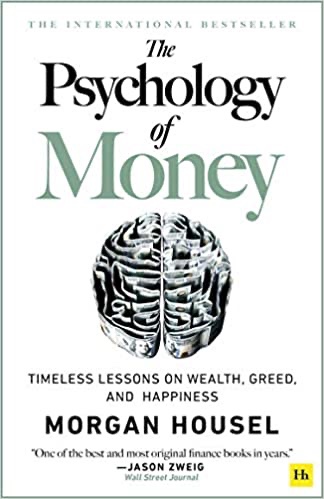
Today I’m finishing one of the best personal finance books I’ve read in a long time, The Psychology of Money: Timeless Lessons on Wealth, Greed, and Happiness by Morgan Housel.
Housel, a true outlier in the personal finance universe, eschews technical descriptions of how to invest in exchange for key concepts. His insights are original and clearly worded. So much so, I will remember them for a long time, no small feat given my pea brain.
Housel convincingly argues that economic security and financial independence rests more on your heart than your head. If you’re someone who would never normally read a book about money, consider giving this one a whirl.
A New York Times primer for anyone who doesn’t know MacKenzie Scott, the eighteenth wealthiest person in the world.
“Ms. Scott, who was formerly married to the Amazon founder Jeff Bezos, the world’s richest person, has pledged to give away most of her wealth. Her shares in Amazon were valued at about $38 billion last year but would have gained value during the coronavirus pandemic.”
Scott isn’t letting the pandemic stop her from making true on her pledge. Quite the opposite. Last week she revealed she was “the one behind the donations to dozens of colleges and universities, part of nearly $4.2 billion she had given to 384 organizations in the last four months.”
As impressive as the amount Scott’s given away is is how her team did it.
“The money came after weeks or months of hush-hush conversations in which Ms. Scott’s representatives reached out to college presidents to interview them about their missions, several of the presidents said on Wednesday. When they learned who was behind the effort, it was a surprise to them, too. But it could not have come at a better time — when the pandemic was hitting their student bodies hard, they said.
‘I was stunned,’ Ruth Simmons, president of Prairie View A&M University, a historically Black college in Prairie View, Texas, said of learning that Ms. Scott was giving $50 million, the biggest gift the university had ever received. She thought she had misheard and the caller had to repeat the number: ‘five-zero.'”
Scott is the antithesis of most ultra wealthy philanthropists who almost always give to their alma maters, most of which are already flush with nine or ten figure endowments.
“Ms. Scott’s latest gifts bring her charity to almost $6 billion this year, an extraordinary amount. In another unorthodox touch, she announced them in a Medium post on Tuesday. ‘This pandemic has been a wrecking ball in the lives of Americans already struggling,’ she wrote. ‘Economic losses and health outcomes alike have been worse for women, for people of color, and for people living in poverty.'”
Experts on philanthropy were surprised to see Scott associate herself with institutions that were “much more humble and, indeed, needy.”
“To these institutions, a $20 million donation was the equivalent of several times that to a Harvard or Yale, and could have a disproportionate impact.
‘One of the things that’s so incredible about this massive grouping of gifts is that she does not have a personal connection to most, if any, of these universities,’ said Kestrel Linder, chief executive of GiveCampus, a fund-raising platform that works with colleges and universities.
Ms. Scott made gifts to more than a dozen historically Black colleges and universities, as well as community and technical colleges and schools serving Native Americans, women, urban and rural students.”
Dare to be different. And hella generous.

1. What if the Great American Novelist Doesn’t Write Novels? I need to see a lot more of Wiseman’s work, but the little bit I have seen makes me think that question is not at all hyperbolic.
“The fact that Wiseman’s half-century-long project is a series of cinéma-vérité documentaries about American institutions, their titles often reading like generic brand labels — ‘High School,’ ‘Hospital,’ ‘The Store,’ ‘Public Housing,’ ‘State Legislature’ — makes its achievement all the more remarkable but also easier to overlook. Beginning with ‘Titicut Follies’ (1967), a portrait of a Massachusetts asylum for the criminally insane that remains shocking to this day, Wiseman has directed nearly a picture a year, spending weeks, sometimes months, embedded in a strictly demarcated space — a welfare office in Lower Manhattan, a sleepy fishing village in Maine, the Yerkes Primate Research Center at Emory University, the flagship Neiman Marcus department store in Dallas, the New York Public Library, a shelter for victims of domestic violence in Tampa, Fla., a Miami zoo — then editing the upward of a hundred hours of footage he brings home into an idiosyncratic record of what he witnessed. Taken as a whole, the films present an unrivaled survey of how systems operate in our country, with care paid to every line of the organizational chart. They also represent the work of an artist of extraordinary vision. The films are long, strange and uncompromising. They can be darkly comic, uncomfortably voyeuristic, as surreal as any David Lynch dream sequence. There are no voice-overs, explanatory intertitles or interviews with talking heads, and depending on the sequence and our own sensibility, we may picture the ever-silent Wiseman as a deeply empathetic listener or an icy Martian anthropologist.”
2. Why Are Great Athletes More Likely To Be Younger Siblings?
“The roots of the little sibling effect may lie in the way younger siblings strive to match their older siblings on the field. This was the case with Michael Jordan, the youngest of the three Jordan boys and the fourth of the five Jordan children. When the siblings were growing up, Larry — who was born 11 months before Michael — was considered a better basketball player and regularly bested Michael in one-on-one games.
‘I don’t think, from a competitive standpoint, I would be here without the confrontations with my brother,’ Michael recalled in the ESPN documentary’ The Last Dance.’ ‘When you come to blows with someone you absolutely love, that’s igniting every fire within you. And I always felt like I was fighting Larry for my father’s attention. …
‘I want that approval. I want that type of confidence. So my determination got even greater to be as good, if not better than, my brother.'”
Alas, did not apply in my family. Oldest Brother routinely whipped my ass on golf courses and tennis courts alike. And Older Brother was a much better swimmer and water polo player.*
3. Amanda Seyfried Finally Stakes Her Claim. How to be wonderfully grounded, against the odds. Buy a farm.
4. Why Andy Mukherjee is losing hope in India. Given it’s impact on the planet, anyone who is not East-Indian owes to themselves to learn a lot more about India. This is an excellent start.
*that’s why this athletic accomplishment was so gratifying
There has been a steady stream of stories of entrepreneurs bailing on California. Here’s one example of a 30-year old YouTube multimillionaire high tailing it to Henderson, Nevada. This week some guy named Elon Musk made news for relocating to Texas. Vegas; Austin; Bend, Oregon are the new Los Angeles.
My family moved from Ohio to Southern California in 1973. Once my swimmer-platform diving daredevil brother experienced the beach scene, he never left. Today, his posse is filled with successful entrepreneurs, so I asked him if this outward migration was legit. He confirmed it is.
“One of my coffee buddies is looking at AZ or Nevada. Tough when they have a network or friends and family. One of the issues that most of these guys face is having investments in CA that are hard to move. Even if they move, they still have to pay CA taxes. In conversations, it’s not the amount of taxes that they pay, but the way they are used. The waste and lack of financial control that public servants use, is consistently frustrating.”
An exact echo of the video story.
So where does this end? Is the Golden State done? A year from now, will it be the Silver State? A decade from now, the Bronze State?
My guess is this is a lull. What makes California such a special place to live? Near constant sunshine, the Pacific coastline, the Redwoods, the Sierra Nevadas, being able to visit my childhood home, UCLA basketball. Those things remain (relatively) unaffected by high taxes and a declining quality of life.
What’s another major issue that often makes California an exasperating place to live? Population density and it’s ripple effects—clogged freeways, jammed parking lots, exorbitant housing prices, long lines at Space Mountain.
With each business departure, the Golden State is a touch less crowded. Meaning there’s slightly less traffic, slightly less demand for housing, slightly more tee times available. Of course, there’s even less tax revenue too. Which could lead to one of two things, either Sacramento figures out how to use the revenue that’s left a lot more efficiently or they raise taxes on The Leftovers.
One thing I know for sure. After 48 years, my brother is starting to get comfortable in California. He’s a kite surfing, paddle boarding machine with sand in his house and a year round tan that’s really annoying. He’s not going anywhere.
EDUC 205. Fall 2020. Take-home Final Exam. Due by 10a.m. Tuesday, December 15th.
Context: “The difference between past and present calls for racial equity is that advocates, such as in Evanston, are demanding that Americans choose sides: Are you racist or antiracist?”
Congratulations, you’ve been hired as Dean of Culture and Climate by the Evanston Illinois School District (six-figure salary). In that role, you are expected to advise the School Board, the Superintendent, and the district’s principals on the following types of questions:
The Board and Superintendent do not expect you to answer all of these questions in great detail. Rather, they have asked you to provide the district’s principals and K-8 classroom teachers with a list of “Antiracist Guiding Principles for Evanston’s School Leaders and Teachers.” These “Guiding Principles” should help them answer these questions and similar future ones that will inevitably surface over time. What essential multicultural education knowledge, skills, and/or key concepts should guide their decision-making?
Because these principals and teachers are so busy, you’ve been asked to keep your “Antiracist Guiding Principles for Evanston’s School Leaders and Teachers” document to no more than two pages single-spaced with one line between paragraphs like this document. Keep in mind that the principals and teachers will better understand your principles if you provide them with a few examples of how to apply them in the context of a few of the aforementioned questions.
Your district document will be evaluated on how thoroughly and thoughtfully you apply our course content in crafting your guiding principles. More specifically, how well you synthesize what you’ve learned from reflecting on your own K-12 school experience, Sara Ahmed’s writing, my teaching, your classmates’ contributions to discussions, and everything else you read, watched, and listened to this semester. While there isn’t one correct set of guidelines, some guidelines will ease the districts decision making more than others because of their rich substance, practical insights, and clear wording.
Two to three months of not running due to injury now feels like two to three years as I seek to return to my previous level of mediocrity. On Saturday’s long run, I found myself eavesdropping in the back of the pack as two friends commiserated about how markedly their respective work cultures have changed. In simplest terms, an underlying “whose most ‘woke’ competition” has broken out in both their workplaces.
The diversity leaders are attempting to teach their colleagues to respect differences, accept everyone’s social identities, and subvert traditional power dynamics. The participants are learning not to say how they really feel, lest they unwittingly stray from the liberal progressive path laid out before them.
Because the diversity leaders are focused on outcomes and not process, they’re plodding ahead completely unaware of the “go along to get along” self censorship that their work is whipping up. A phenomenon that makes meaningful change nearly impossible.
As a long-time discussion leader, I’ve gotten very good at understanding this dynamic. And disassembling and reassembling it in my classrooms. But as an educator and fallible human being, I’ll never get that challenging work just right. At best, it’s always two steps forward and one back. Just like last week in one of my undergraduate classes. I flailed around a bit and then a student had the courage, and made the time, to enlighten me.
In class, I suggested that as a country maybe we needed to recognize our limits and take some time to lower the temperature on conversations about politics and race, class, gender, and sexual orientation. “Pass the ball backwards” I suggested, before advancing up the pitch again.
My student gave me permission to share most of what he wrote me shortly after class ended. His fourth paragraph makes me think I did not communicate my message as clearly as I could have, but that does not take away at all from his overarching message:
“My takeaway from the conversation was that in the end, politics are simply politics, and one’s views reflect their level of education. This does apply in certain situations, but it is not applicable to basic human rights. As a white cishet (cisgender heterosexual) man, you do not experience these issues and therefore need to do more work to understand them. An important thing to remember is that the burden of your education on an issue does not fall onto those affected by it. As we have discussed in this class, most educators are white. I have had a very slim number of queer educators as well. Because of this, existing in these spaces made for white cishet people is exhausting. I am constantly expected to perform and have these conversations for people to convince them that I should be allowed to exist. Fighting constantly to be permitted to simply exist takes a heavy toll and as an ally in a privileged position it is your responsibility to do research and educate yourself on these topics rather than expect minorities to do the labor of educating you because for those minorities, those conversations can be dangerous.
As a white cishet man, you can have these conversations with certainty that you are safe. As a queer AFAB (assigned female at birth) person these discussions can put me at serious risk.
Furthermore, you need to understand how much more drastic this is with our current administration. Almost immediately after Trump came into office in 2017, his administration removed the official pages on civil rights and LGBTQ+ rights from the official White House website. Earlier this year, the Trump administration removed nondiscrimination protections in healthcare for LGBTQ+ people. Even more recently, with Amy Coney Barrett’s appointment to the Supreme Court, there has been new potential for marriage equality to be taken away. This is only an incredibly short list of ways that the Trump administration has directly impacted my rights. These conversations are so sensitive and are not as simple as disagreeing. If I meet someone who disagrees with my basic human rights, I am meeting someone who thinks that I do not deserve healthcare as a trans person and as an AFAB person. In a more extreme situation, as is with our vice president Mike Pence, someone disagreeing with me could mean that they believe I should be in a conversion therapy camp or worse. I do not have the privilege of agreeing to disagree because that disagreement can mean the loss of my life.
The human rights that do exist in our country today did not come from accepting or dismissing bigotry. The Americans with Disabilities (ADA) Act of 1990 came to be because of disabled people protesting and restricting access to federal buildings, public transport, and other such things. The civil rights movement consisted of endless protests, sitting in the front of busses, and countless other acts. Women’s suffrage was fought for with protests and marches. Child labor laws came to be because of people fighting for children’s rights and safety. In Martin Luther King Jr.’s words, a riot is the language of the unheard. The expectation to be silent and accept mistreatment in hopes that we will be kindly gifted our rights and safety is ridiculous. This is why these conversations are not as simple as disagreement. I cannot sit and agree to disagree with someone’s opinion if their opinion is that I do not deserve basic human decency and rights.
To close this email, I want to reiterate that I do not mean this to seem like I am telling you exactly what you need to think or believe. My main objective with this is to hopefully bring you more perspective on why this mindset could be harmful. If you wish to discuss any of this further, I would be glad to discuss it over email. I appreciate you having a class environment in which I feel comfortable bringing up these issues and having this conversation.”
My second reply to him:
“Follow up question. Or more accurately, I’d like to practice active reading/listening to see if I understand correctly. Are you saying that some people (or maybe many people since 73m voted for T) are irredeemable and therefore personal safety has to take priority over dialogue? If so, I better understand why because of your thoughtful explanation of your lived experience. But as an educator working with students across the political spectrum, it’s difficult for me to conclude that.”
And his reply to my reply:
“I wouldn’t necessarily say that people are irredeemable, but more so that people that choose to not listen to minorities cannot be educated by them regardless of how much effort those minorities put into the conversation. The burden of those conversations can’t fall on the people affected by it because those people are being silenced, and therefore it becomes nearly impossible to change bigoted people’s mindset unless more privileged people educate themselves and use their voices.”
Obviously, I can’t tell my speedy running friends not to self-censor themselves, but my student has convinced me that opting out until “cooler heads prevail” isn’t an option for me. That doesn’t mean I have a failsafe roadmap on how to proceed. All I know for sure is I have to remain open to being taught by my students, and other people whose life experiences are markedly different than mine, and continue “getting more comfortable being uncomfortable”.
1. All human landscapes are embedded with cultural meaning. As poignant as photography gets. Critically important contribution to the historical record.
2. Why ‘Gilmore Girls’ Endures. My daughters should watch it sometime.
3. Let’s not sugarcoat who Diego Maradona really was.
4. How not to write a ‘Diversity, Equity, and Inclusion’ personal statement. In case you too wanna be an egghead professor someday.
5. Pathological consumption has become so normalised that we scarcely notice it.*
*thanks AV
From The New York Times. “Pushed by Pandemic, Amazon Goes on a Hiring Spree Without Equal”.
“To grow so much, Amazon also needs to think long term, Ms. Williams said. As a result, she said, the company was already working with preschools to establish the foundation of tech education, so that ‘as our hiring demand unfolds over the next 10 years, that pipeline is there and ready.'”
STEM hysteria never ceases to amaze.
1. Canadian officials warn drivers not to let moose lick their cars. Damn I love Canada.
2. When Sharks Turned Up at Their Beach, They Called in Drones.
“The pilot monitors a video feed in real time, noting any sharks, and then sends a text to the 36 people who have signed up to get alerts — a group that includes lifeguards, surf camp instructors and beachside homeowners.”
3. Sports Technology Buyers Guide: Winter 2020-2021.
4. John Gruber really doesn’t like Mark Zuckerberg.
5A. Trump Had Less of an Impact on the World Than You Might Think. Well that’s good news.
5B. GM quits Trump lawsuit against California auto emissions rules. If you listen closely, you can hear Mother Earth breathe a sigh of relief.
6. Your Brain Is Not For Thinking. “Everything that it conjures, from thoughts to emotions to dreams, is in the service of body budgeting.”
“If you feel weary from the pandemic and you’re battling a lack of motivation, consider your situation from a body-budgeting perspective. Your burden may feel lighter if you understand your discomfort as something physical. When an unpleasant thought pops into your head, like ‘I can’t take this craziness anymore,’ ask yourself body-budgeting questions. ‘Did I get enough sleep last night? Am I dehydrated? Should I take a walk? Call a friend? Because I could use a deposit or two in my body budget.'”
 Pressing Pause