

Before and after shots. I came out of marathon retirement yesterday and ran around Seattle. Thanks to Pam Johnson, physical therapist extraordinaire; my stalwart training posse; and the home team for the enthusiastic cheers at the finish line.

Before and after shots. I came out of marathon retirement yesterday and ran around Seattle. Thanks to Pam Johnson, physical therapist extraordinaire; my stalwart training posse; and the home team for the enthusiastic cheers at the finish line.
Moving from the burbs to the rural coast was my idea. The Good Wife was perfectly content in our old crib. I promised to reassess in two years, now six months and counting.
To her credit, she’s giving our new location an honest effort. She’s met way more neighbors than me; she picks free-range fruit; she’s turned into a kayaker extraordinaire; and today, she went Next Level.
A neighbor-friend swam across our Budd Inlet (and back) a couple of years ago with his cousin. Then he repeated the feat a month ago with his daughter. That second crossing was all the inspiration the Gal Pal needed. She started talking about her attempt, but I have to confess, it didn’t totally register until a few days ago. Selflessly, neighbor-friend volunteered to swim with her and his wife and son signed on to escort the two of them in double kayaks.
At the last minute, even though I’m not in great swim shape, I decided to join in the fun. So Sunday morning at 9:19a I took off for the Cooper Point bluff following the lead of my intrepid kayak escort famous on Instagram as “Smoothie Girl”. I thought the 1.5 mile crossing would take me somewhere between 40-45 minutes.
At 100m I thought it was too damn cold for 90 minutes, but I acclimated quickly afterwards, and despite some cold pockets, the temp wasn’t an issue. The conditions, as you can see below, were perfect. Apart from a few boat wakes, the water was so still it was like swimming in our small, protected, go-to lake. Not so perfect was the gradual breakdown of my already sorry stroke; swimming over two giant jellies about 10-15′ below me; and some rando vegetation. The rookie that I am, I also thought a harmless seagull was going to dive bomb me.
I broke my cadence a lot because it took Smoothie Girl and me awhile to sync up. Note to self, build in a simulation swim or two. Forty-eight minutes later, I touched down on the Cooper Point shore. A few minutes after that I reversed course, telling SG, “I think I can make it back.”
The highlight of the return was crossing up with the Good Wife. I never thought we’d kiss in the middle of the Salish Sea. SG ripped me for not sighting better, but I told her it was up to her to sheepdog me, at which point, things improved. I tried to settle into a rhythm. The sun came out which made the view of the Capital Building six miles away even more scenic. I started counting breaths to 100, over and over. Touched terra firma in 1:41, quite a bit slower than guessed.
Way more impressive than my feat was the Gal Pal’s. Without her initiative I never would’ve spent Sunday morning in the middle of the Salish. It’s a tough physical feat and she nailed it, commenting more on how beautiful it was than how tough. Like fine wine, she’s coming into her own as a hiker, errand running cyclist, Gull Harbor kayaker, and open water swimmer.
Thanks to TM, AL, and CM, and SG, for the escorting and the Good Wife for living life to the fullest all Sunday morning.
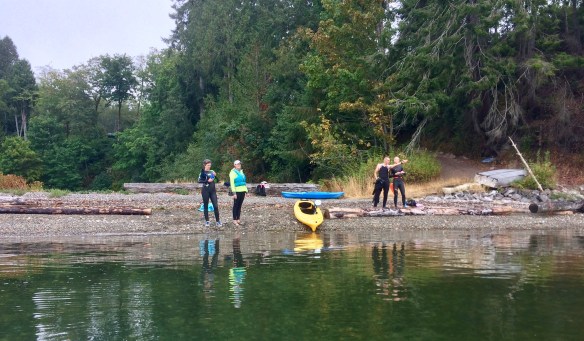 Pre-swim navigating.
Miss me much? I spent four days at Holden Village last week. Near the end of our visit the Good Wife said, “That was fun!” To which I replied, “It’s always fun.”
1. I get to watch the Gal Pal try to make a reverse layup. This is always a highlight. I confess that’s my go to move when I’m down a letter or two in “HORSE”. The GP is deadly from the free throw line so sometimes I find myself needing to make a come-back. She knows it’s coming and there’s nothing she can do (except practice in private before the next visit).
2. In ping pong, I get to chip away at the Gal Pal’s backhand. It’s an unrelenting assault on her weaker stroke. 21-7 if memory serves correct.
3. It’s the perfect place for introverts like me to meet people because it feels like everyone else is extroverted. In actuality, it’s just the set-up. Communal dining, classes, outdoor furniture, close living quarters. Even the socially challenged like me can’t help but meet people. Some of my favorites this time:
4. When at Holden, I’m a serious reader. Read, hike, eat, meet someone, beat Lynn at something, read, repeat. I finished Ta-Nehisi Coates’s Between the World and Me and half of Killers of the Flower Moon. Of course, with some New Yorker thrown in for good measure.
5. There’s something about “three hots and a cot” that makes me more appreciative of my normal quality of life. It’s also very nice not to have to drive anywhere. The whole village is walkable in about two minutes.
6. Unplugging is a reminder that we should control our personal tech, not let it control us. It’s a very helpful reminder that we don’t have to succumb to anyone’s expectations that we’re always on. We are free to pick and choose when to plug in.
7. Without work and household responsibilities limiting us, it’s nice to have extended conversations with the Good Wife, about all kinds of things. It’s like a marriage retreat without the obligatory lectures and group sessions. Most people in modern societies fill their lives with things that confound extended conversation. Almost everything is emptied out at Holden.
8. I get to watch the Gal Pal jump into a very cold Lake Chelan from the boat ramp right before our departure. So entertaining, she drew a nice crowd. Proud to say I maintained my objectivity, awarding her an 8/10, the two point deduction was for holding her nose.
9. The scenery is decent.
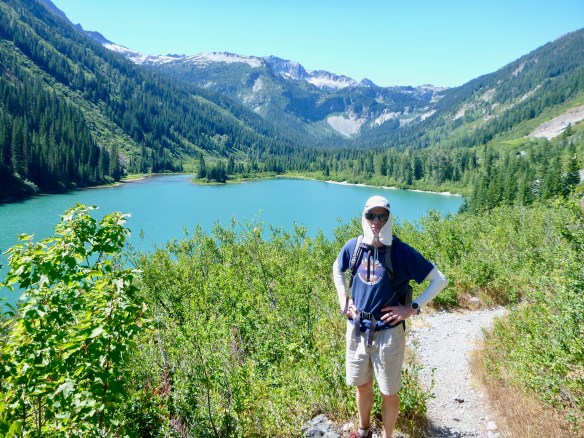
* When I told The Good Wife that I had a running date with a 14 year old girl, she said something to the effect of, “I can’t believe her grandma trusted you.” To which I said, “Thanks a lot!” There’s a lot more reverse layups in her future. Left-handed even.
The labradude’s cancer is in remission. So he decided to run a half marathon Saturday. Proud of him.

Somehow I got elected to Church Council. After agreeing to serve on the Nominating Committee, I was told people thought I’d be perfect for Council. Damn, upsold by my own church. There should be a law.
“Okay,” I said in a weak moment, “As long as everyone knows going in that I’m skeptical of a lot that people accept as the status quo.” “That’s great, that’s exactly what we’re looking for.”
Add that to the Good Shepherd Lutheran things of which I’m skeptical. In large part because at the first (monthly) meeting in early June there was no opportunity to pose questions let alone offer alternative viewpoints about anything of substance. It was, in essence, a long business meeting.
Even more concerning than that though was how the meeting began—with quick approval of the previous minutes and summary reports from some subcommittees. I only knew half the people, and even the less introverted* didn’t know everyone, still there were no introductions, not even names. In 36 meetings over the next three years** we’re going to have to work together to make some difficult decisions on behalf of the larger community. Like a farmer mindlessly heaving seeds on the ground, the working assumption seems to be that everything will be okay because everyone will get along fine. Like that’s the natural order of things.
I know the opposite to be true because I’ve worked in an intensely interpersonal field for three decades and The Good Wife served on Council during a particularly tumultuous time in the church’s recent past. When two people or organizations with two hundred plus people do not build in mechanisms for preventive problem solving and the cultivating of mutual respect, dissension will be the default. Family members won’t speak, married couples will divorce, work teams will fragment, and antipathy will rule the day.
So I wrote the Council President and tactfully suggested that if we don’t have time for any team building, we at least introduce ourselves at the start of tomorrow night’s meeting. He said it was a good idea and then asked if I’d lead a 15-20 minute team building activity, which translates into 1m per person after this planned intro:
One thing I’ve learned as an educator who emphasizes small group cooperating learning is that when it comes to effectively teaming with others in families, in schools, in the workforce, or in other contexts like church councils, many adults have more negative than positive frames of reference. Put differently, when they think about all the teams they’ve been a part of, it’s easier for them to identify what went wrong with them than it is to explain what went right. That’s because we’re not nearly intentional enough about the ultimate litmus test of a team’s effectiveness, which is whether the sum is greater than the individual parts. Meaning, at the end of the team’s time together, do the individual members have a sense that by themselves they never could’ve accomplished anything close to what the team did.
Then I’m going to ask them to think for a minute about a positive team experience, where the team they were a part of clearly accomplished more than they would have left to their own devices. And then to briefly summarize one thing that contributed to the team’s success.
How would you answer that? How easy or difficult was it to come up with a list of positive team experiences? And the single most positive team experience? And the key take-away that partially explains the team’s success?
In thinking about what I’m going to contribute I thought of a five faculty Guilford College team I worked on in the mid 1990s to help the college redesign it’s general education program. I was the junior faculty representative and was blown away by my older colleagues smarts and interpersonal savvy. I had fun riding their coattails as we lead the 100 person faculty through the difficult process of updating the college’s course requirements***.
Then I thought of the cycling team I am a part of most Tuesday and Thursday nights. Or take Saturday’s 94-miler around Capitol Forest. Left to my own devices I would’ve averaged 18mph not the 20mph that five of us managed. But aerodynamics are more physical than interpersonal, so I kept exploring the hidden recesses of my pea brain.
Eventually, my positive team experience that most clearly embodies the “sum being greater than the individual parts” bubbled up. “Team Lynn and Ron Byrnes” whose primary project the last 25 years has been to raise two children, now young adults. In all honesty, a quarter of the time I wish The Gal Pal was more like me, meaning a quarter of the time her differences drive me cray cray. Three-fourths of the time though I know for a fact that we parented much better together than I ever could’ve myself. Her different ways of thinking and being made us way more thoughtful as we did our best to find our way absent any Parenting Manual.
Sometimes we’ve been more intentional about teaming effectively than others. When we don’t schedule time to talk and purposely work through simmering resentments, both of us end up racing to have OUR feelings understood, which is another way of saying we argue. When we’re intentional, meaning we take turns listening to, and empathizing with one another, we’re a pretty darn good team as I hope our daughters would attest.
Tuesday is the second Council meeting, but also Lynn’s and my thirtieth anniversary. I’m not just a better parent, but a way better person because of her. I look forward to teaming with her for as long as possible.
* Since I’ve kept a really low profile at church, I agreed to serve in large part to get to know a few people better. The thinking being that I’ll like it more if I have more friends.
** After five of us were elected together, we learned that to create a proper balance of term lengths, only four of us would be able to serve the whole three years. In my first act of amazing selflessness, I kinda quickly volunteered to serve only two years.
*** The one exception to the fun being when one of my noon basketball acquaintances, a Religion professor in desperate need of mindfulness training, lit into me for something our group had proposed. If memory serves me correctly, I felt better after dunking over him during that day’s pickup game.
Addendum: Turns out some regular readers of the humble blog are questioning my dunking ability. Calling it fake news.

Living in the Upper Lefthand Corner of the United States requires a tradeoff that is difficult at times. You must endure dampness and darkness for eight months of the year in exchange for four months of supernatural light and unparalleled beauty. Right now we’re in the sweet spot of the four months meaning there’s no other place on the planet I’d rather be.
During this morning’s run in Priest Point Park I was intermittently blanketed by the sun’s brilliant radiance as I moved steadily through the forest. Shirtless and sweaty at 7a, I was profoundly appreciative of July. More so than I ever would be if it wasn’t for the damp and dark runs during the eight contrasting months. The contrast is key.
Mid-day, on Mount Rainier with family, the sun ricocheted off the snow surrounding Snow Lake.
Tonight, transfixed by the fading sun on the western horizon, I will sit on the deck eating popcorn and drinking a recovery beer with family. Sunset is at 9:08p.m., but it won’t get dark until 9:45-10p.m. Must store as much Vitamin D as possible.
As a visitor you probably wouldn’t get it, you’d probably say, “Yeah sure, the weather, the trees, the water, they’re all nice, but really, no need to get all worked up about it.” To which I’d say, “I’m selling it short. I can’t do justice to the blessed light that gives me an unspeakable joy and sustains me through the dark.” At which point you’d just slowly back away not knowing what to make of me. Which I would understand and not hold against you. At all.


Addendum: For those keeping score at home, the “find the spelling errors in the initial draft” scorecard currently reads, Cal Lutheran 1, St. Olaf 1, Carleton 0.
Help others.
When Mother Dear died two years ago, my brothers, sister, and I inherited what was left in her charitable foundation. Meaning every four years I get to give away some money. This year it’s my turn and I’m not sure whom I should give the money to. Leaning towards a few non-profits that work with the homeless in our fair city.
How do you decide whom to give to? My thinking is guided by two important things. First, the gifts have to be ones moms would’ve made. Second, the gifts should have a lasting impact.
The first principle is a breeze because Mother Dear was profoundly generous. Unlike me, she didn’t overthink things. Instead, she instinctively gave when made aware of obvious needs. No paralysis by analysis.
The second principle is where I need your help. Consider this philanthropic case study. Tom and Christy Lee deserve lots of credit for their selflessness and for helping me refine my philosophy of philanthropy. Consider the math, $5,495 donated to forgive the school lunch debts of 262 families. An average of $21 per family.
It’s possible that an unexpected $21, like tiny micro-loans that have received so much positive press, could make a meaningful difference in a low-income family’s struggle to turn an economic corner. But if the families who received the unexpected loan forgiveness don’t address any of the underlying causes that resulted in them falling behind on their children’s school meals, won’t they be in the exact same place in a year’s time? Does the $21 have a lasting impact? I’m skeptical.
And isn’t the same conundrum even more pronounced for the organizations I’m considering giving to? If the organizations I’m considering giving to feed, clothe, and shelter the most vulnerable members of our community, but don’t also provide substance abuse and mental health counseling or job training and low income housing, won’t the numbers of homeless continue to tick upwards?
So is the answer to give to “both/and” organizations, non-profits that both meet the immediate needs of the most vulnerable and work equally hard to remedy one or more of the underlying causes of institutional homelessness?
Also, how do I assess the relative efficiency of the local organizations I’m considering? The overhead of medium and large sized non-profits are carefully scrutinized by excellent websites, but not smaller, grass-roots ones. How can I know whether 50 or 90 cents of every dollar ends up directly benefitting those in need?
Ultimately, how might I maximize the long-term benefits of these gifts, honor my mom, and extend her legacy?
My favorite 21 year old is graduating college this May and “launching” shortly thereafter. A college friend, a 56 year old retired SoCal fire fighter, was just accepted to a Physician’s Assistant program. This is for them. And everyone in between.
Our work tends to be the result of our personal interests; compensation considerations; and though we may not want to admit it, the relative prestige or social status associated with our chosen occupations.
More specifically, we choose among possible jobs not just because they pay the bills, but also because of the particular activities associated with them-we become teachers instead of accountants because we enjoy interacting with young people in classrooms more than we like crunching numbers in cubicles. A person attends seminary rather than law school because they want to make a tangible difference in their community without any pressure to maximize their billable hours. A person becomes a landscape architect rather than a golf club professional because they like plants and the outdoors more than they do beginning golfers.
Additionally, my fire fighter friend, if he’s typical of other fire fighters, probably partly chose his first career because of the unique work-life balance it afforded with a positive mix of twenty-four hour shifts and more than normal days off each month. I’m sure the excellent salary and benefits, service-orientation, and built in station-based community probably factored in too. A pretty great job altogether, apart from the extreme occasional danger.
Here is what even my daughter’s very good, vocation-oriented career placement center probably won’t tell her when she inquires about different possible jobs. Think about more than pay and primary activities. Talk to people doing the work about the less visible and less obvious activities, and the culture of their workplace, meaning the nature of their relationships with all of the people they regularly interact with. For me, as a university professor/administrator, my relationships are with faculty colleagues in my department and across campus, students, and numerous staff and administrators. Don’t fixate on the relative appeal of any job’s primary activities, instead, carefully reflect on the personal qualities each particular work culture is likely to cultivate.
For example, people think of teaching almost exclusively as what goes on between a teacher and her students during the middle of the day within the four walls of an individual classroom. But that’s the tip of the iceberg. Ignored are the hours spent planning daily lessons; the hours spent alone reading and responding to student work; the hours spent teaming with colleagues to plan, problem solve, and respond to student work; the time spent continuing one’s teacher education; the time spent being a part of the school’s extracurricular activities. Conventional wisdom about teaching might account for about a third of a teacher’s weekly activities.
Every job comes with a distinct work culture, some work cultures cultivate more socially redeeming personal qualities than others. Working at Chicago’s Newberry Library is probably similar, but not the same as working at Northwestern University’s Main Library. So it’s a two-fold learning process, learning about library culture generally, and a particular library’s variation on “what’s typical” more specifically. How to do that? Talk to people at the library about the culture, what’s rewarding, what’s most exasperating, why. When, at the end of your interview, you’re asked if you have any questions, ask about the work culture, what do employees say when asked what’s the best part of working at x, what are some commonalities that prove most challenging.
Most people think about work in terms of how they’ll benefit/change the people they work with, giving little to no thought about how their work will change them. Every job you do for very long will change you, for better or worse, probably more than you’ll change anyone at work. Ask people doing the work you’re considering, “How has being a landscape architect, nanny, teacher, engineer, nurse, journalist, changed you as a person?” What personal qualities does the work cultivate? In what ways, if at all, are you a better human being as a result of doing this work?”
If they can’t answer that question positively, cross it off your list. Be bold. Don’t obsess about the obvious activities, the pay, the benefits, the perceived prestige; instead think about work as a context for self understanding and self improvement. Don’t think about work as an end in itself, meaning don’t fret about how your job or career compares to your peers; instead think about work as a means to becoming a better human being.
I’m fortunate that my work culture values good, open-ended questions, but my comfort with ambiguity can exasperate more concrete sequential, literal-minded people. And I’m fortunate to work with people, teachers-to-be, who are more altruistic and socially conscious than average. Their idealism and service orientation is a nice counterbalance to my cynicism and selfishness. I’m a better person because of their optimism and vitality. When it comes to the other two-thirds of my work, it’s mostly about conflict management, which provides daily opportunities to become a better human being. More specifically, I’m convinced my success resolving workplace conflicts depends almost entirely upon my ability to carefully, actively, and sensitively listen to others.
It’s cool that being a decent husband, father, friend, and citizen depends almost entirely upon the same thing. And for that reason, I’m fortunate to get to do the work I do.
How much Mario Batali, famous chef, and father of two college age sons, do you have in you? Batali in a national newspaper recently:
I still pay for my son’s phones, so they use the “Find My Friends” app, which allows me to track them no matter where they are. If they turn it off, I give them 15 minutes to turn it back on or I turn off their phones. ’Cause if you’re somewhere you don’t want me to know about, maybe you should pay for your own phone.
It’s amazing to me that Batali is not the least bit self conscious about surveilling his sons, meaning maybe you find my reaction more surprising. But before this phenomenon becomes the new normal, let’s “press pause” and think about it a bit.
Some questions for the Batali’s of the world. Why so little trust in your adult children? Was your parenting that bad? How would you have liked it if your parents had used global positioning satellites to keep track of your every move when a young adult? When a young adult, did you have ample freedom to make some important decisions by yourself, including where to go and when? And did you learn anything important from poor decisions? In the end, were you better off as a result of the pre-gps autonomy you enjoyed?
“But the world is a more dangerous place today,” the Batali’s will say, “then when we grew up.” But social science data strongly suggests otherwise. So rampant parental anxiety about their young adult children’s well-being isn’t rational, it’s emotional, which begs a few more questions for the Batali’s. What is your greatest fear? Is it, as I suspect, that your adult children are going to be physically harmed, maybe even die?
How will your technological tethers prevent random bad things from happening? My guess is, and tell me if I’m wrong, the Batali’s can’t quite accept the fragility of life, theirs, and especially their children’s. If we want to truly safeguard our young adult children, we have to ban them from getting driver’s licenses, not allow them to go away to college, and preclude them from being outdoors in public. In addition, we need to strengthen our technological tethers so that we can detect blood alcohol, THC, and nakedness from long distance.*
Last but not least, a suggestion for the Batali broheims and their watched over peers. Scrape together enough money for your own phones. Tell your parents to take their “Find My Friends” apps and shove them. Lovingly of course. Because life is fragile.
* I hope no one in Silicon Valley reads this.
 Pressing Pause