Electronic Wolves

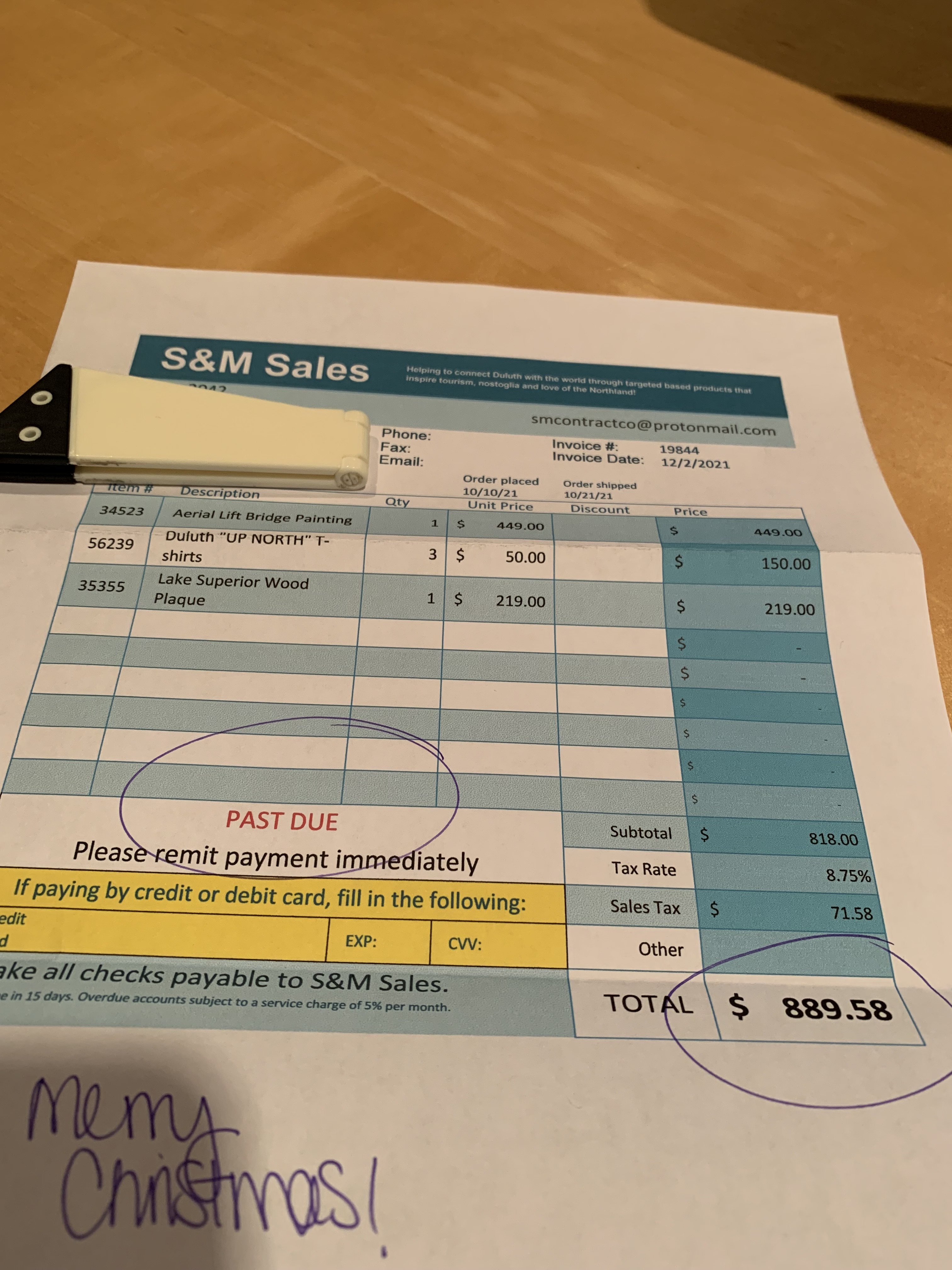
This receipt was made up by some electronic wolves that read my in-laws’ obituaries. Neither my mother or father-in-law were capable of ordering anything on-line on October 10th, the alleged date of sale. Nor would they have ever paid $50 for a t-shirt, let alone $150 for 3.

Their target is probably the recently widowed who may be just the right mix of senile and afraid. They read they were from Two Harbors near Duluth. Then they went on-line and found the most popular attractions in the area within seconds. Then they fabricated the receipt, dropped it in the mail, and waited to see if they got anyone on the line. No doubt they do sometimes.

I give them a “C” for the quality of the receipt. It’s exquisite except for the obvious pricing overreach for which I’m marking down two grades.

I don’t know how to catch these lowlifes, but assuming they are caught eventually, what’s an appropriate punishment? Life without any chance of parole?

Monday Required Reading

There is no vacation from reading. Indeed, some take the view that there’s no vocation, but reading.

The rich vs the very, very rich: the Wentworth Golf Club rebellion. The makings of a great novel.

The very, very rich vs the Mormon church. I’d read that novel too.

It’s time for car companies to shut up about electric vehicles and just ship them. Amen.

Norway’s most popular cycle route. Yes please.

Here’s what schools are doing to try to address students’ social-emotional needs. Shame on me, I shoulda lead with this.

Wednesday Required Reading

  1. Note to self. Students don’t read syllabi
  2. When your co-worker’s salary has two more digits than yours
  3. Grace is gone for school leaders. And we’re all worse for it.
  4. Kenyan students keep setting their schools on fire.
  5. The worst exceedingly expensive meal ever? 
  6. The role of bonds. Sexy, I know.

How The Center For Disease Control And Prevention Failed Us

From Alex Taborrok’s review of Scott Gottlieb’s new book, Uncontrolled Spread: Why Covid-19 Crushed Us and How We Can Defeat the Next Pandemic.

“If there’s one overarching theme of “Uncontrolled Spread,” it’s that the Centers for Disease Control and Prevention failed utterly. It’s now well known that the CDC didn’t follow standard operating procedures in its own labs, resulting in contamination and a complete botch of its original SARS-CoV-2 test. The agency’s failure put us weeks behind and took the South Korea option of suppressing the virus off the table. But the blunder was much deeper and more systematic than a botched test. The CDC never had a plan for widespread testing, which in any scenario could only be achieved by bringing in the big, private labs.

Instead of working with the commercial labs, the CDC went out of its way to impede them from developing and deploying their own tests. The CDC wouldn’t share its virus samples with commercial labs, slowing down test development. ‘The agency didn’t view it as a part of its mission to assist these labs.’ Dr. Gottlieb writes. As a result, ‘It would be weeks before commercial manufacturers could get access to the samples they needed, and they’d mostly have to go around the CDC. One large commercial lab would obtain samples from a subsidiary in South Korea.’

In the early months of the pandemic the CDC impeded private firms from developing their own tests and demanded that all testing be run through its labs even as its own test failed miserably and its own labs had no hope of scaling up to deal with the levels of testing needed. Moreover, the author notes, because its own labs couldn’t scale, the CDC played down the necessity of widespread testing and took ‘deliberate steps to enforce guidelines that would make sure it didn’t receive more samples than its single lab could handle.'”

The solution has to be a more decentralized public health apparatus, doesn’t it?

A Billionaire Here, A Billionaire There

A blogger I read is asking his readers for questions for an interview he’s going to do for his podcast with David Mark Rubenstein. Here’s the first sentence of Rubenstein’s wikipedia entry.

“David Mark Rubenstein (born August 11, 1949) is an American billionaire businessman.”

Anyone with 1,000 or more million dollars is routinely introduced as a billionaire.

Given that bizarre phenomenon, I’m going to stop increasing my wealth when I get to around $950m. I would hate to be reduced down to a “billionaire educator”.

Until then, don’t forget to upgrade your iPhones, iPads, and Apple Watches.

The ‘Can’t Miss’ Investment I Missed

Dammit. I wish someone had pulled me aside at a dinner party when I was in my early 20’s.

And told me the two words that could’ve changed my life. Self-storage. Apart from AAPL, I double dog dare you to find a better investment.

From this week’s Wall Street Journal:

“Self-storage pulled ahead of other property types in the reopening trade as the real-estate business rebounded this year during the easing of pandemic restrictions.

The storage facilities around the country have brought the biggest returns to investors in public real-estate stocks this year. Many people moved, and for those who stayed put, a desire to have more space in their homes because of remote learning and working also spurred demand for self-storage.

As of June 30, total returns from self-storage real-estate investment trusts reached 36%. . . . Over the same period, the FTSE Nareit Equity REITs Index gained 22% and the S&P 500 climbed 15%.

People generally haven’t been able to tame their consumerism, increasing the need for storage space. The self-storage industry sees demand when people’s lives are disrupted, such as relocating for a new job, marriage, divorce and education.

‘Self-storage thrives when people experience change, and Covid disrupted norms across all generations,’ said Drew Dolan, principal at DXD Capital, a self-storage developer and investor. He added that many customers who needed self-storage in 2020 were first-time customers.

Operators moved quickly during the pandemic to offer customers more choices for reservation and move-ins, including online rental agreements and kiosks that limited contact with other people.

‘What used to be a 45-minute transaction can now be a six-minute experience,’ said Natalia N. Johnson, chief administrative officer of Public Storage, in a recent presentation to investors.” 

“People haven’t been able to tame their consumerism.” My vote for understatement of the year, decade, century. I should’ve bet big on American consumers not taming their consumerism years ago. I coulda, shoulda made bank on your neighbors’ conspicuous consumption.

No it’s not too late, but the crazy recent gains have to moderate, don’t they?

Influencia

Cristiano Ronaldo’s marketing power appeared to be on full display this week when his removal of two bottles of Coca-Cola from the podium at a press conference coincided with a $4 billion drop in the company’s market value.

Before speaking to the media on Monday in Budapest a day before Portugal’s Euro 2020 opener against Hungary, the Juventus star moved the Coca-Cola bottles out of the frame and held up a bottle of water before saying, ‘Agua.’

Coca-Cola’s share price dropped from $56.10 to $55.22 soon after Ronaldo’s gesture, while the company’s market value dropped from from $242 billion to $238 billion. Coca-Cola is an official sponsor of the European Championship.”