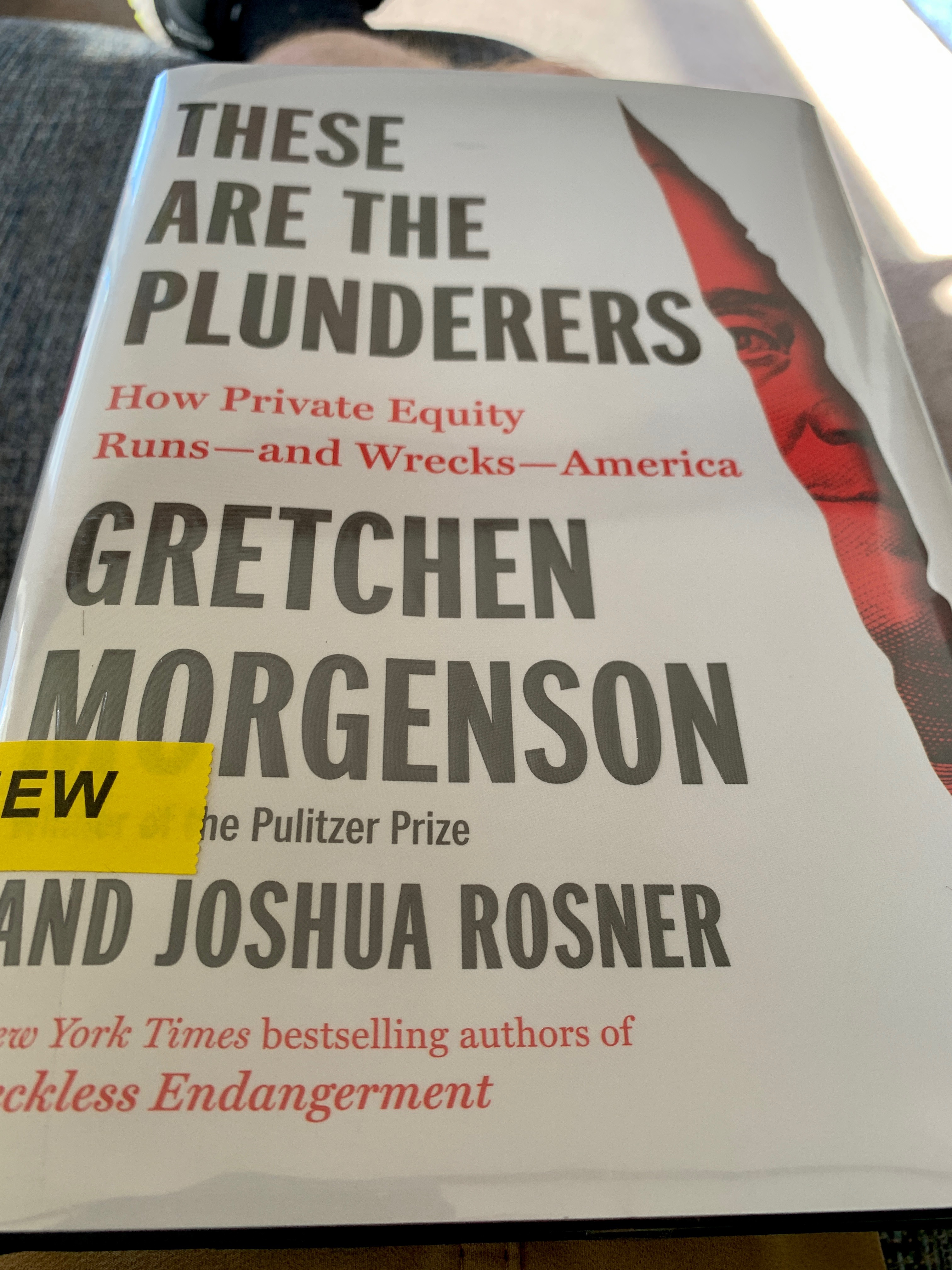
A real one-two punch.

From The New York Times.
“A large new study, released Monday, shows that it has not been because these children had more impressive grades on average or took harder classes. They tended to have higher SAT scores and finely honed résumés, and applied at a higher rate — but they were overrepresented even after accounting for those things. For applicants with the same SAT or ACT score, children from families in the top 1 percent were 34 percent more likely to be admitted than the average applicant, and those from the top 0.1 percent were more than twice as likely to get in.
And “The new data shows that among students with the same test scores, the colleges gave preference to the children of alumni and to recruited athletes, and gave children from private schools higher nonacademic ratings. The result is the clearest picture yet of how America’s elite colleges perpetuate the intergenerational transfer of wealth and opportunity.”
After reviewing more than 500,000 internal admissions assessments at three elite institutions over fifteen years, this conclusion.
“In effect, the study shows, these policies amounted to affirmative action for the children of the 1 percent, whose parents earn more than $611,000 a year.”
Can we stop the “equal opportunity meritocracy” nonsense?
In the entertainment labor battle that’s just getting going, the Screen Actor Guild members and Hollywood writers are severe underdogs. They’re up against it. “It’ being a combination of C-Suite greed; artificial intelligence-based content; too many streaming services chasing a fixed number of people with finite disposable income; a decline in digital advertising dollars; and Peter Santenello.
I didn’t know Santenello until yesterday, when a YouTube algorithm correctly guessed I’d like his stuff. Long story short, he’s a do-it-yourself filmmaker. Tonight, after my dinner date with the GalPal, I’ll watch the bulk of this film I started last night.
It’s very good in a substantive, folksy, documentary kind of way. Not slick or sensational, in this case, an up close look at some of the poorest counties in the country. Lots of other people agree apparently. The film sits at 10 million views in 7 days.
There are Santellos everywhere you look on YouTube and TikTok and other similarly ungated, entirely democratic/meritocratic outlets.
There’s a parallel development in journalism of course, where thousands of substacks are blooming. And just as with visual media, a portion are truly outstanding.
The Santellos of the new digital landscape are saying, “We don’t need television or movie studios or newspaper companies to take our content directly to people, all we need are our cameras, laptops, editing software and open access formats.”
Santello and other insightful, creative, hardworking entrepreneurs like him have breeched Hollywood’s moat. They have no intention of sharing profits or creative control with middlemen in hierarchical organizations.
This grassroots content is as predictably constant as the waves rolling in on Santa Monica beach, down Sunset Boulevard from Hollywood. It will be very difficult for SAG members and Hollywood writers to win much at negotiations from such vulnerable gatekeepers of the past.
Right now the two sides are not talking. Some expect the strike to go into 2024.
I’ll be splitting the difference, watching Santello’s stuff while rooting for the underdogs to defy the odds and somehow pull off the upset by improving their compensation.
Find your state here. Luckily, the Good Wife and I use electricity almost exclusively. Thanks to the Columbia River, only four states have less expensive electricity.
I bought a new bike. This will cause some, like DanDantheRetiredTranspoMan, to go apoplectic. Let me beat him to the punch.
“Another bike?! What was wrong with the one you just bought?! How many do you need? You’re a sad(sick) guy.”
If someone buys a new bike every 20 years, then yes, it may seem like I just bought Blanca. In actuality it was January 2020, so this is season four with her. I confess, that is a short upgrade cycle especially since nothing is wrong with Blanca. She’s still exceptional. The purchase is really some cycling friends’ fault for getting me thinking about a slightly lighter version of her. The whole idea is getting into a better rhythm on long climbs. What’s more important in life than that?
And as to number of bikes, I will be selling Blanca, keeping the quiver to a grand total of two or a fraction of the number most cycling enthusiasts have in their garages.*
You may be thinking maybe I should just train harder, lift more weights, cut back on the Costco Tuxedo cake, but all that requires more discipline and work than wiring Eric in Portland some scratch.
I met Eric at Starbucks in Woodland, WA. Recently, when he got his dream job at Specialized, as the head of their design team, he immediately put in an order for one of their nicest/lightest bikes. Shortly afterwards, he got whacked, which meant he could no longer afford the nice, light bike still in the box. Then he had to find a needle in a haystack. More specifically, someone 6’2″ with some spare change. I turned out to be his needle.
Eric revealed that a part of the problem of being laid off is they have their children in private schools. “How old are they?” I asked. “12 and 15.” When you send your kids to private schools, you’re paying twice—property taxes which fund the neighborhood schools you drive past, and of course, the private school’s tuition. That requires something Eric’s family is currently lacking, a lot of disposable income.
I thought about sending him this post,”The Private School Myth“, from way back in the day, but obviously I don’t know him well enough.
Because I didn’t need to purchase his bike, he may have taken a loss on it even factoring in his work discount. If somehow he finds that post, accepts my premise, and decides with his wife to send his kids to public schools, they’d be on their way to bouncing back. Here’s hoping.
*I really do need a hardtail mountain bike.
I’m a liberal so I can say that. Or maybe my extreme privilege disqualifies me from pontificating in that manner. Here goes anyways.
Among other recent devastating losses for liberals, the Supreme Court undid Roe, race cannot be factored into college admission decision-making anymore, Biden lost the loan forgiveness fight (for now), and businesses can discriminate against LGBTQ people.
Liberal discontent with the Supreme Court’s recent decisions and disillusionment with the conservative majority makes perfect sense especially given all their right wing nutter billionaire friends. And of course, the 2016 McConnell-Garland bullshit still lingers.
But come on. We’re still a democracy, meaning executive, legislative, and judicial power constantly shifts. The only constant is change, well as much change as two parties can muster. Sometimes majorities vote Republicans into office.* Fairly and squarely. Sometimes Republican Presidents pick conservative Supreme Court justices. Sometimes enough to create conservative majorities on the Court. Sometimes liberals lose.
What to do? Or more specifically, how to deal with it?
For example, what’s the left to do with a Court that says a web designer can refuse to make wedding websites for gay couples?** There are several problems with this decision, the most obvious being that it’s the first time the Court has made it okay to discriminate against a protected group. The primary concern is of course for LGBTQ Americans, but the less obvious concern is for the possible rollback of protections for other groups based upon race, national origin, or religion. The Court has cracked open the public discrimination door that was famously shut in 1955.
The lashing out is understandable, but what does it accomplish in the medium-long term? How do LGBTQ people and their millions of allies win the “hearts and minds” battle for equal dignity so that any business that discriminates against them has no chance to survive in our free market economy. I’m not gay, but if you won’t do business with LGBTQ people, I won’t do business with you. Times one hundred million. Or two hundred million. Or three.
It’s just like all the businesses over the last 30 years who got religion about the environment. The vast majority of corporations didn’t do it out of the goodness of the heart, they only went green because it was in their self interest. Consumers and shareholders demanded it.
Could a web design business exploit a niche as the “go to” place for soon-to-be married, anti-gay straight people looking to create gay-free wedding websites. Theoretically yes, but most people in the (dis)United States of America would join with me in not doing business with any entity that denied LGTBQ people equal dignity. How do we turn “most” into the vast majority?
By pivoting from complaining incessantly about a huge step backward in the arc of the moral universe bending towards justice and collectively acting in ways that make explicitly discriminatory businesses completely unviable. By voting, everyday, with our rainbow colored pocketbooks.
*cue the anti-Electoral College activists
**adding to the frustration, the case is based on a made-up hypothetical

Allegedly, Succession was inspired by the Murdoch family. It was the rare show that got better and better for four consecutive years and then pulled the plug at its heights.
The main characters’ greatest flaws all reached a crescendo in the final episodes. Tom admitted he loves money and thinks about it all the time. Tom and Shiv detailed what they most hated about one another. And Kendall intimated he might die if not put in charge of the family empire after the patriarch’s death.
Three of the patriarch’s children desperately tried, but failed miserably, to emulate his business success. Psychologically, the fourth, an eccentric who separated himself and dabbled in politics, fared better.
Viewers liked the depictions of extreme wealth. I found the second generation’s psychological maladies more interesting. How do you overcome largely absent, uninterested, uncaring parents? Childhood trauma. In Kendall’s, Rome’s, and Shiv’s case, you don’t.
Yesterday, I mowed the lawn with someone who is in the process of overcoming not just absent, uninterested, and uncaring parents, but abusive ones. Stephanie Foo, author of What My Bones Know.
Foo’s book in short.
“By age thirty, Stephanie Foo was successful on paper: She had her dream job as an award-winning radio producer at This American Life and a loving boyfriend. But behind her office door, she was having panic attacks and sobbing at her desk every morning. After years of questioning what was wrong with herself, she was diagnosed with complex PTSD–a condition that occurs when trauma happens continuously, over the course of years.Both of Foo’s parents abandoned her when she was a teenager, after years of physical and verbal abuse and neglect. She thought she’d moved on, but her new diagnosis illuminated the way her past continued to threaten her health, relationships, and career. She found limited resources to help her, so Foo set out to heal herself, and to map her experiences onto the scarce literature about C-PTSD.”
Foo has severed all ties with her birth family and is fashioning a new one of choice consisting of close friends who love her, her partner, and her soon to be child.
The Roy’s probably would’ve been better off following Foo’s footsteps. But they couldn’t resist the lure of their family’s wealth, status, and power. And had they gone full Foo, it wouldn’t have been nearly as good television.
Portland Oregon’s historically black Albina District would be better off with a more Scandinavian or Western European social safety net. Which would, of course, require a more progressive tax system reflecting genuine concern for the common good.
Absent Europe’s political values, and stuck with the “pull yourself up by your bootstraps” individualism so deeply engrained in the (dis)United States, Allbina’s residents are left with the generosity of Oregon’s favorite plutocrat, Phil Knight, Nike’s 85 year old founder.
After reading Shoe Dog, the story of Nike’s founding, I’m a Phil Knight fan. In fact, he would probably be my first pick in a draft of billionaires.
The Wall Street Journal reports that Señor Swoosh is investing $400m to revitalize education, housing, and the arts in Albina. That’s less than 1% of Knight’s $47.2 billion estimated net worth.
That’s not meant to be disparaging especially given this:
“The Knights’ donations to the University of Oregon have funded professorships, expanded the main library and built numerous lavish sports facilities. The Knights have given $1 billion in the past seven years alone to launch and expand the Phil and Penny Knight Campus for Accelerating Scientific Impact.
They have given $500 million to cancer research at Portland-based Oregon Health & Science University. Mr. Knight also has given hundreds of millions to Stanford University, where he earned an M.B.A. in 1962.”
It’s dumbfounding how much you and I have enriched Knight through our shoe and other sporting good purchases.
I’m glad he has a social conscience and is using some of the money we gave his company to improve the quality of life in a section of inner North and Northeast Portland.