Five Keys to Long Distance Success

In this long post I explain five keys to running, swimming, and cycling long distances successfully.

First, everything is relative. I’m an endurance athlete in the context of a relatively sedentary populace. Ultra runners, swimmers, and cyclists would laugh at my training log and chuckle at my definition of going long—a marathon, a 4k swim, 100+ miles on the bike, a half ironman.

Ultra athletes are a different breed. I don’t aspire to run 50 or 100 kilometers or miles, swim 10k, ride my mountain bike for 24 hours, or complete an ironperson. I won’t rule anything out, but at present, all my synapses are firing just fine.

Second, I’m no spring chicken, more a fall fowl, and not physically gifted, so I don’t think of success like an elite athlete who asks, “Did I win, was as I top three, did I set a personal record?” I’ve plateaued as a runner and swimmer and almost as a cyclist so I don’t expect to set many more personal records.

I define success as: 1) finishing the long distance event feeling as if my training paid off and I couldn’t have gone any faster. 2) Finishing feeling like I raced intelligently and spread my effort out evenly. 3) Finishing having left darn near everything on the course, but not being so depleted I feel weighted down with negative associations about the event. And 4) finishing with an even deeper appreciation for my health, my friends, and nature. 

For me, the keys to that type of success are five-fold: 1) train consistently, and for a length of time, and with a degree of seriousness, that parallels the length and difficulty of the event; 2) shortly before the event, assess my fitness in as objective a manner as possible; 3) based upon that self-assessment, devise a plan that will enable me to race evenly and maximize the fitness I’ve achieved through training; 4) right before the event, adjust that plan based upon atmospheric conditions; and 5) be disciplined in executing the plan.

To make this less abstract, let me illustrate each of these keys using last week’s RAMROD (Ride Around Mount Rainier in One Day, 146 miles, skipped the Crystal Mountain climb, 6,720’ of climbing, 18.1 mph) as a frame of reference.

A quick tangent first though. There’s a breed of long distance athlete that I marvel at every year during RAMROD. These are people of widely differing body types that don’t think the ride is hard enough as designed so they ride it in wools socks up to their knees, with mountain bike shorts flapping in the wind, while simultaneously loading their bikes down with every accessory known to humankind—racks, lights, bags, flowers, kitchen sinks. Most amazingly, these hardcore athletes choose to ride it alone, foregoing the considerable savings drafting provides. Wonder if they bother inflating their tires to maximum pressure? Where does this line of thinking lead, “I know, maybe this ride will be even more difficult if my break pads are rubbing.”

I appreciate different body types and personal idiosyncrasies, but my assumption is the event is damn difficult enough and even if I go in lean and mean, ride as light and aerodynamic a bike as possible, and shamelessly draft on the flats, I’m still going to be completely shelled at the end.

Back to regular programming. Key to success number one: train consistently for a length of time and with a degree of seriousness that parallels the length and degree of difficulty of the event. While this seems obvious, lots of people, maybe inspired by the 44th president of the U.S., approach long distance events with the audacity of hope. There is some truth to the notion of good and bad days, but you can’t finesse a ride around Mount Rainier. All the hope (and change) won’t help you a lick if you hit the base of Cayuse without a sufficient training base.

What’s a sufficient training base? At minimum, strive to exceed the event’s total distance in as many of the 10-12 weeks leading up to the event as possible. Also pay closer than normal attention to eating healthily, getting adequate sleep, and incorporating rest days after especially hard efforts.

Key two: pre-event objectively assess your fitness level. Granted, the term “objective self assessment” may be an oxymoron. How exactly does one objectively assess their level of fitness? By keeping a training log and studying workout data in a historical context. The keys are monthly/seasonal volume (total miles) combined with times for selected workouts whether mile repeats on the track, a standard run or bike course, a 10 mile or 40k bike time trial.

Going into RAMROD, I had to decide whether my fitness level was worse, the same as previous years, or better. Obviously, if the same, I could adopt the same type of plan, if worse, I’d have to craft a more conservative game plan, if better, I could plan to ride a tad more aggressively.

Given my off and on summer teaching schedule, I didn’t have the consistency between weeks I would have liked. I also only had one hard effort of climbing way back in late-May on Mount St. Helens and only one 100-mile effort in mid-June. On the other hand, my May/June totals were solid, I had been going very hard on race team training rides twice a week, and Monday night my Garmin confirmed that I was strong in a short, solo, very hot tune-up. In the end, I decided I was in average mid-summer RAMROD fitness, which means probably as fit as I’ll be all year. As a result, I planned on approaching the ride the same way as the last few years.

Key three: based upon the fitness self-assessment, devise a plan that will enable me to race evenly and maximize the fitness I’ve achieved through training. Related to this, knowing the course is probably deserving of “key” status itself.

For example, there are three distinct segments within RAMROD. The first is miles 0-60 from Enumclaw High School to the Nisqually Gate of Mount Rainier. The air is cool, the terrain is forgiving, and everything is right in the world. You have to get to the gate looking and feeling like you could ride a hella hilly century with absolutely no problem. The second is miles 60 and somewhere between 105 and 110. This segment mostly involves about 7,000 feet of very beautiful, unrelenting climbing. This one-third of the course requires about two-thirds of the total effort expended. The final 45 miles are all downhill, the first 10 wonderfully severe. The gently downhill final 35 are almost always into a headwind.

So my default RAMROD plan is to stay completely within myself for the first three hours to the gate. This is the non-negotiable foundation on which the rest of the day hinges. The secret to implementing this part of the plan is knowing my “all day” pace that I can maintain solo and in a group for long periods of time. My RAMROD numbers were 18 and 20-21. I spend the first three hours mostly riding past slower cyclists, but importantly, letting faster ones go. Other elements of the segment one plan include drinking early and often, skipping the 33-mile food break, and being careful to stay within my “steady” zone up the gentle climb to Ashford and the real start at the Nisqually gate.

What’s most essential in segment two is settling into a sustainable rhythm. This is where I take what my body gives me based upon my “perceived rate of exertion.” Other riders’ pacing is totally irrelevant. Related to this concept, Gordo Byrn (if a triathlete, see his co-authored book, Going Long) employs a wonderfully simple and effective four-part “easy, steady, mod-hard, hard” framework. I do long climbs in what might be referred to as upper-mod-hard zone. The toughest RAMROD climb last Thursday, Cayuse, was especially tough because of above average heat. Often I flirted with tipping into “hard” and backed off by sitting on the wheel of slower climbers for a minute or so when I’d come up on them.

The essence of RAMROD is climbing. I really enjoy the challenge of sustaining a mod-hard effort for an hour. Totally in the present, and when all is going well, slowly bridging from rider to rider, exploring what exactly is sustainable on this day on this mountain at this hour and this minute and this second.  

The litmus test of whether I’ve settled into a mod-hard, but sustainable rhythm is whether I can finish the climb without stopping (or falling over). My guess is I was one of the few people who rode from Packwood at mile 78 to the top of Cayuse at 102 (where I was shaking, nauseous, and in pretty bad shape). That was one advantage of being a bandit, I didn’t want to stop in part because I didn’t want to tap the event’s resources.

The segment three plan is to once again work together with other cyclists of similar ability to negate the headwind. Notice the symmetry. This year, Lance and I left the Crystal Mountain deli stop as the same time as a group of four. I said to Lance, “Let’s see if they’re a decent match.” Turned out, they were perfect. We were averaging 22-23 and they were taking 2-3 mile turns at the front. After my first two-mile turn at the front, I waited for Lance to pull through, waited, waited, he had fallen off the back and I hadn’t realized it.

Why did Lance fall off when he’s as strong or stronger than me? Because somewhere around mile 35, our third friend, Alberto, whose “all day” numbers are probably 20 and 22-23mph, went off the front of a solid group of about 20-25 riders that were humming along at 20-21mph. Because Lance is a young thoroughbred who can’t help himself, he decided to bridge up to him. If we were early in a race team training ride, I would have applauded the bold move, but since we were riding around Mount Rainier in above average heat, I had a sinking feeling, thinking it would make for a much more difficult afternoon. Unfortunately, I was right.

It’s understandable to think that 2mph is relatively inconsequential but it represents a world of difference when on the course all day. It’s like 30 seconds per mile in a marathon. Doesn’t seem like much, but multiplied by 26, it adds up to a sizeable difference. In a marathon, going  even 10 seconds a mile too fast over the first half or three-quarters, inevitably leads to a slower finishing time. In a day-long cycling event, going a few mph too fast over the first half inevitably leads to a slower finishing time.

Key four: right before the event, adjust that plan based upon atmospheric conditions. Enough said. I failed to do this in the Boston Massacre Marathon in 2005 and ran my slowest marathon ever. We knew Thursday afternoon was going to be hotter than normal. The adjustments I had wanted to make included starting earlier, minimize time spent off the bike, get over Cayuse in the a.m., ride even more conservatively over the first three hours. My mental cues included: Rush Limbaugh, Sarah Palin, Glenn Beck, Bill O’Reilly. Meanwhile, Lance’s mental cues appeared to be Bill Ayers, Al Franken, and Keith Olberman. The adjustments didn’t go exactly as planned and I crested the top of Cayuse at 12:11p.m. 

Key five: be disciplined in executing the plan. This takes practice. Experience is the best teacher.

My hope is something in this description of my mental approach supplements what you’re learning from experience and contributes in some small way to even more success in long distance events.
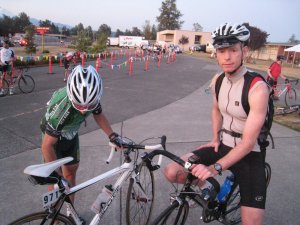
Not tan, but rested and ready

Not tan, but rested and ready

Game On

This email just in from Lance.

Okay, game on, old man.  I figure it is only fair to give you fair warning that I am coming after you at Black Hills this year.  Beginning today I am laser-focused on the next five weeks of training with the sole intent of besting you by at least one second on September 12.  Don’t let my five mile, 40+ minute run this morning fool ya’; I’m registered and all in, baby.  This is it; the Cutter battle royale that everyone has been waiting for.  My youth, good looks, and smarts vs. your old age…No Excuses!

Remember the recent RAMROD Blues post where I wrote about giving up my active life for a sedentary one. Forget it. Game on now. How many times can a guy take being called “old” in one email?

In actuality, Lance is younger, better looking, and smarter than me, and I’m spending a week in California without my bike right in the middle of the five week-build. The Vegas oddsmakers will no doubt favor Lance, but I’m wiley, and I intend on making him earn the victory.

RAMROD Blues 2

In one Northern Exposure episode, deejay Chris in the morning, said, “You have to do something bad everyday just to feel alive.” Thursday, my bad deed was riding RAMROD sans invitation. I wrestled with whether it was ethical and ultimately decided I’d be able to sleep at night if I rode it without tapping race resources. So I loaded up a hydration pack with water and food and I took $ for the Packwood convenience store, and headed towards Mount Rainer with a couple of good friends we’ll call Lance and Alberto. 

As always, it was the test of the year and fun in a sadistic kind of way, but I didn’t enjoy my outlaw status. I kept thinking true bandits probably relish their outsider, bad boy or girl status. In contrast, I regretted tagging along and will not do it again. So to the RAMROD officials who are reading this, accept my apology and please don’t ban me from future editions. I didn’t have all the facts and acted stupidly. (Can I get a beer for admitting that?)

As it turns out, it is impossible to ride 146 miles in the heat without tapping the event’s water and porta pits. I also benefitted from traffic control. Bandits are kidding themselves if they think they have zero impact on the event.

I hereby offer myself as a “recovered-bandit” and in exchange for an entry into next year’s ride, I’ll do public service announcements.

Tiger’s Tirades

Rick Reilly, widely read sportswriter who typically combines humor and emotion, has written a sober article titled “Woods Needs to Clean Up His Act.”

If someone told me a multi-ethnic golfer was going to come along from my hometown and dominant for decades, I would have assumed I would have been front and center on the bandwagon. But, for reasons I’m not entirely sure of, I haven’t become a Tiger guy.

But after reading RR’s piece, I find myself taking the contrarian view. In fact, apart from the “f’in photographer. . . and break his f’in neck” I can accept Tiger’s tirades. Maybe RR’s hackles are up because of the obvious contrast with the seemingly comatose corporate billboards that roam PGA fairways. Yeah, Tiger runs hot, but is there only one way to approach golf at its highest level? Can’t excellence take different forms?

Here’s an idea, when Tiger blows up, parents can talk about it with their kids. Maybe they can explain that just because someone excels in athletics we shouldn’t assume their private life is equally excellent. Maybe the lesson is everyone is imperfect and we’re better off emulating the family members, teachers, and neighbors we know best and who hold our families, classrooms, and communities together.

Aren’t children smart enough to understand that just because someone excels in the public square–whether in athletics, politics, or other types of work–their private lives aren’t necessarily worth emulating.

In essence, RR argues, “because Tiger’s the best golfer, and because he has the most eyes on him, he should set the best example.”

Why though?

The related social scientific discussion is because most everyone is flawed in their private lives, we need to seriously reassess our tendency toward celebrity worship and be far more pragmatic about human vices. In fact, that’s why the rule of law and institutional checks and balances are so important.

Fitness Friday—7/24

7/13 M T W R F SA SU Total


  3,000 

14:58 1k

pads/bouy

decent

  3,000 

15:08 1k

7:30/7:10

500’s

4x100Im, :35-37

      6,000 √


16i 50 2,045’ 

20.8

duress

groups 2/3

  53 1,385’ 

20.5

solid

    31+ solo 1,200 

18.3

5on/off

150 √


6  

wall@5+

  6 10+ 1:22   28 √

S. Had wanted to get three workouts in, but bagged the late week one. Not in top shape, took it relatively easy, and felt decent.

C. The “i” is for indoors. Two good, hard race team training rides. T’s was hilly and I spent the second half in small chase groups. Beautiful weather and fun. Rode so hard that I hit the wall five miles into to W’s six miler. R was hard and fun too. I hit the the top of Tenino hill hard and was in the middle of things all night. Nice to get out for a solo ride on Su before hitting the road to teach in eastern WA. I feel strong, but will lose some fitness next week no doubt.

R. If I didn’t have training partners waiting for me on W and F, I’d probably bagged one or both of those since I was still hung over from the previous night’s cycling effort.

RAMROD Blues

This just in. Michael Phelps wrote me and said he doesn’t find me that interesting either so I guess we’re even. 

For the last three years, on the last Thursday of July, I’ve ridden my bike around Mount Rainier with 799 other gluttons for punishment. 152-154 miles and 10,000 feet of climbing fun. I just learned that this year I will be on the outside looking in since I will not make it off the waitlist. I’ve spent the last couple months impressively working my way through the waitlist peloton, but I simply started too far back.

Now I don’t know what the purpose of going on with cycling and even running and swimming is. I’m not entirely sure yet, but I suppose life is still worth living. If you’re wondering why don’t I do a personal version of RAMROD, it just wouldn’t be the same without Travis and Dave, the unrivaled scenery, and the Crystal Mountain sandwich food stop. 

That giant sucking sound you hear is my motivation to go long. In fact, why ride at all, why run, why swim, why move from the couch? I think I’ll just sleep in, stay in bed, eat, and smoke cigars. I’ll sell my bike on craigslist and use the proceeds to buy new pants and belts. It’s a nice carbon frame, 60cm, with Dura-Ace 7800 components. I’m now accepting offers. I also have a few pair of size 11 Mizuno Wave Creation running shoes still in the box,  some new goggles, a pair of zoomers, paddles, jammers, a gym bag, a Masterlock, some Infinit mix, a YMCA card, and wife who probably won’t have much interest in me in a few months.

Then again, there will be more of me to love. 

Take a good look at this picture of me at the Pre-Classic in June because the next time Dano snaps my picture, he’ll need a wide-angle lens.

The "Before" Picture

"Before"

Missed Opportunity

After Beijing, some wondered whether Michael Phelps’ eight gold medal winning performance would inspire many more young people to take up competitive swimming. My guess is his dramatic success has lead to a slight increase in participation.

One problem though, I wonder if other people are like me and, outside the water, don’t find him the least bit inspiring. He doesn’t appear to have anything interesting to say and seems downright uncomfortable on the national or global stage. I can’t help but wonder what the impact would be on youth swimming if the eight gold medal winner was an articulate, engaging, and even charismatic young man or woman with a social conscience.

Think Cassius Clay in a speedo and goggles.

Fitness Friday—7/10


6/29 M T W R F SA SU Total
S       


350       

strokework

x   3,650       4,000 √-
C       


  54 900’       

20.8

[surging]

  59+ 1,606’       

20.3

Bourdeaux

strong

    37 1,578’       

18.4 solo

FishTrap

150 √+
R       


6.2   7.1       

54:42

  9 hills/trails       

Ward Lake

8.7       


  31 √


S. Chose not to swim T so came up short on yardage. My excuse? Phelps returned to competition and I didn’t want to steal any of his limelight. 

C. The best I’ve felt and the strongest I’ve ridden all year. Too bad I peaked right after the Astana Tour de France team roster was finalized. Highlight was bridging up from no man’s land to the lead group on the second climb in Capital Forest and then being in the middle of things all the way home. 

R. Fair amount of trail running. The team is in pretty solid shape. Cooled down at the end of both F’s and SA’s runs in Ward Lake. A favorite summer tradition.

Fitness Friday—7/3


6/22 M T W R F SA SU Total
S        

3,650   slow

  3,650 better       7,300 √
C        50 

2,000’  19.6

strongchase

  54 

1,180’   20.6

very solid

    100 

2k+’     18.9

faded

204 √+
R       6.6   6.6   5.8 10.5     1:20:46   29.5 √


Very light teaching week so better than average numbers. Also got more sleep. Next week should be decent, but then I’m teaching on the other side of the mountains (SU-R) and swimming and cycling will suffer big time.

S. Surprised and a bit disappointed I’m swimming slower since backing off after the build to the 2/4k races. I’m concentrating on entering wider and pulling straight back, or put differently, not crossing over, but that will remain a work in progress. I think my technique is improving, but my times aren’t reflecting that yet. Maybe I’m not rotating my hips enough? Anyways, I was disappointed I had to adjust my intervals, for example, 3:15’s/200 instead of 3:10’s. Another theory, swimming alone versus working harder to keep up with other people faster than me. Got the meters in though despite being unmotivated R morn.

C. Much improved week with near record level distance. Felt positive about both T/R race team training rides. T the group shattered into (at least) thirds at the top of Waddel and Travis and I were in no-man’s land between groups one and two. After the descent we were joined by two others and the four of us did a very admirable job chasing for a long time. R was flat and very fast and I felt good. Instead of my normal dangling on the back, I was in the mix. I’ll feel better about SU’s ride once I absorb it. Quite different than my normal long distance solo efforts. Rode 1om to the start, waited for the everyone to gather, rode hard to a food stop at 48, rode hard to another food stop at 73, rode hard to the start at 90 and then soloed home slowly. I’m more of a continuous steady effort guy than a go hard and stop and go hard again guy. But it’s fun to ride with others, so I adapt. I faded over the final 30-40 which was disappointing. The first 60-70 were probably too fast (Gordon effect). One footnote to the 100 miler you’ll no doubt enjoy. I was starting to cramp around mile 93 so I took out and opened my tic-tac salt tablet holder and two came out. Instead of putting one back in, I popped both with just enough liquid to get them down. Around mile 97, I suddenly felt dizzy and nauseous to the point of having to stop immediately. Felt better after tossing my (oatmeal and raison) cookies. Note to self, small sporadic doses of salt with lots of water. 

R. Standard week except for the bevy of selfish excuses Saturday morning. “My family and I will be on vacation in Hawaii.” “My family and I will be at Hoopfest in Spokane.” “My family and I will be at a soccer tourney in Burlington.” I’m sick and tired of team members putting their families first. I had to go to the bench and get L to cycle with Arnis and me. Let’s hope they re-examine their priorities before next Saturday.

Fitness Friday—6/26

6/15 M T W R F SA SU Total
S         


  3,800         

scm

  zzzz       3,800 √-
C         


  50   50     75 1,700’         

5on5off

17.9

175 √+
R         


    6   6.6 10  1:20         

387’

last 6:41

  22.6 √-

S. T was Evergreen masters. It’s hella early and I have to drive across town, but I like it. All I remember is one set of 10x100m on 1:40, odds free, evens w/ 50 stroke. Did the first in 1:28 and then drifted to about 1:37 which made the second half damn near continuous. Somehow, I need to get back to my old descending self. Good coach, fast team, challenging workouts. Slept through R’s workout. That happens maybe twice a year. I’m blaming Sheri because she slept through T’s workout which set a precedent. A solid workout, but only one, thus the dreaded √-. 

C. Got dropped on both race team rides. Set a negative p.r. R by getting dropped twice in the same ride. I had plenty of time on the slow slogs home to debate whether my lack of form was the result of my summer cold or from being undertrained as a result of the previous week. Weirdly, my form was better and I had more pop in April. What’s with that? Nutrition has been fine, but I haven’t been getting enough sleep. In actuality, I don’t think I’m riding worse, it’s just that the race team is riding better as a result of riding more miles than me. I’m not talented enough to hang with 50% of their mileage. At minimum, I need to ride a similar amount, but that’s not as high a priority for me. So maybe I just need to accept getting flicked off the back at some point during each training ride. But if I go in with that attitude, it’s guaranteed to happen. It’s part physical, part mental. In the spring I was riding with a little swagger, now I just don’ t have sufficient ass time to ride as confidently. One more variable is the uncertainty surrounding RAMROD. I’m 156th on the waitlist so it’s going to be close. If I knew I was in I’d be a little more motivated to go long. I did go medium-long on SU finally. 5 miles on, 5 off. Wasn’t lighting the course on fire, but also felt like there was still fuel in the tank at the end. There was wind and rollers. If T and D weren’t racing they might have pulled up to me mid-ride and asked, “Ron, on or off right now?”

R. Bagged M’s run to do final summer school prep before the first class. Rest of the week was standard, except for mile 21.6-22.6. Four of us on SA’s standard 10 miler. At one point the “youth” (late 30’s/early 40’s) dropped back about 20m. I told the Supplement (early 50’s) it was time to show the youth that we’re like fine wine, just getting better with age. “When we hit the church driveway, we begin our mile time trial.” The Supp had been waiting all morning for that invitation. 6:41 with an uphill finish. Score one for the geezers. The dreaded √- due to missing M’s run and not making up any of the miles.