Why Pedestrian Deaths Are Up In The (dis)United States

There are a multiplicity of factors, but this analysis highlights the increase in pedestrian deaths at night as a result of walkers wearing dark clothes, crosswalks being poorly lit, and a rise in homelessness.

I live 4-5 miles from a perfect storm for ped deaths. Right now in Olympia, Washington it’s dark between 15-16 hours a day. Right off a main drag, there’s a Salvation Army that is a magnet for the homeless, whom I refer to as the “walking wounded”. But they’re not always walking. I’ve seen homeless people dressed entirely in black, suddenly shoot across the street on skateboards and bikes, between crosswalks. It’s human-powered transportation Russian Roulette.

There are accidents, sometimes even deaths, but I’m surprised there aren’t more.

Maybe The Future Is Okay

Boy’s hot cocoa stand in southwest Spokane has raised $300 to help people who are homeless.

In unrelated news, except for the fact it’s another young person, I like this picture of a girl and Rafael Devers who recently signed an 11 year, $331m extension (no wonder he’s smiling) for two reasons. She has the exact right color of hair and she has mastered the selfie+, something I’m terrible at.

Why Do People Have To Live Outside?

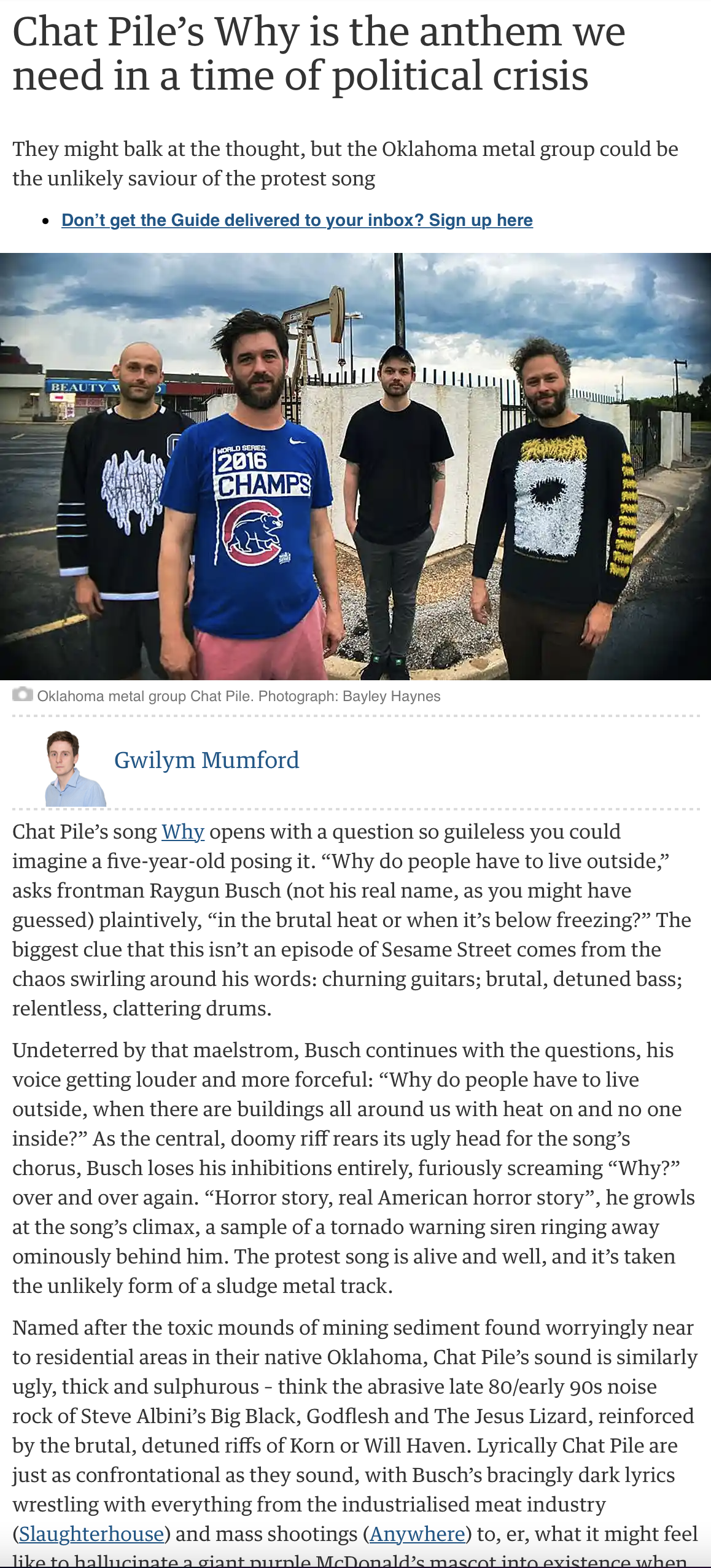
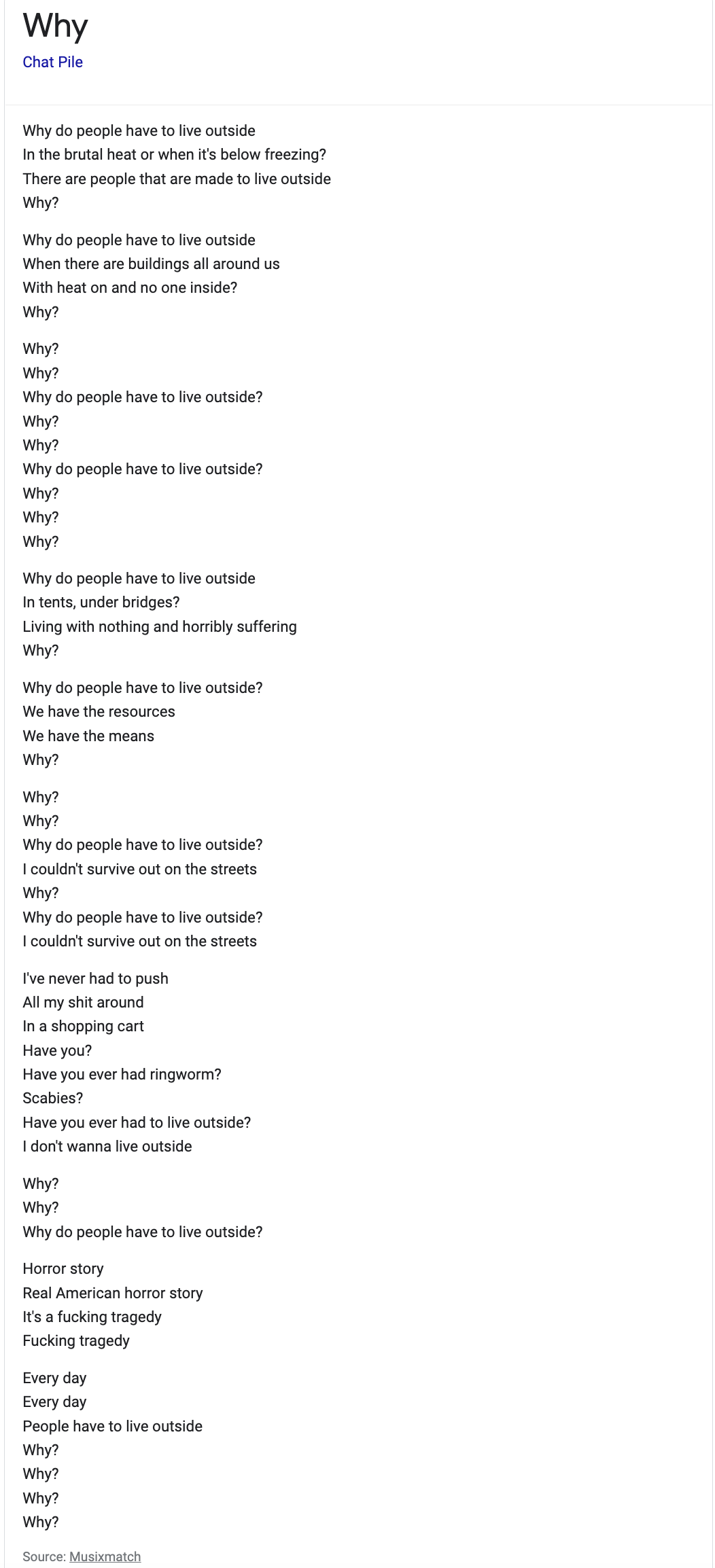
I receive a weekly culture/media newsletter from the Guardian’s Gwilym Mumford. This weeks highlighted Chat Pile’s new album. I’m not a heavy or “agit-metal” fan, but after reading Mumford’s description of their song “Why” I gave it a listen.

Damn right the protest song is alive and well. Give it a listen below.

Screen Shot 2022-08-28 at 8.01.39 PM

The Ultra Wealthy Are Winning. . . For Now

Based on yesterday’s middling statistics, including how few times the LA Times link was opened, I did a poor job framing Mckenzie’s story. I described it as a long and difficult read hoping you’d rise to the occasion. If I were to suggest all of us go run a hilly and hot marathon, I probably shouldn’t be surprised if none of you show.

I should’ve lead with the importance of regularly mixing in challenging content with all of the light, entertaining stuff that tends to dominate the interwebs.

I can’t shake Mckenzie’s story, especially after reading Evan Osnos’s mind blowing New Yorker piece, “The Haves and The Have-Yachts”. Osnos tells the story of the ultra-rich buying ever larger, more expensive yachts.

If you’re even a little bit like me, and you don’t like the ultra-rich, Osnos’s piece will turn your dislike into a much, much deeper antipathy. If you have high blood pressure, be sure to take your pills first.

I can’t help but read the stories without wondering why in hell the world isn’t overcome by poor people’s revolutions. Osnos makes a few references to the “EatTheRich” movement, but the Wikipedia entry for it describes it as a political slogan associated with class conflict and anti-capitalism.

Sometimes in my hometown of Olympia, WA I see an “Eat the Rich” bumpersticker or graffiti tag. If I was a “Have-Yachter” I’d be thrilled that the primary pushback to the growing wealth gap is some flaccid combo of political slogans and bumperstickers.

This puts me in a tough position in that I don’t condone mindless property damage or really violence of any kind, and yet, I can’t help but wonder if much more radical responses to the growing wealth gap are warranted.

Another dilemma is how do we define “ultra-wealthy”? The tipping point seems to be $30 million, but compared to Mckenzie, I definitely qualify as ultra wealthy.

The legions of ultra wealthy people reading this post are saying to themselves, “We’ll be fine, we’ll just invest even more in security.” Right now they’re right, but whether I live to see it or not, someday poor people’s rage will ignite like the fires in France, Greece, Portugal, and Spain.

Pregnant And Homeless In Los Angeles

“In 2018, three Times reporters slipped through a hole in the fence above the 101 Freeway in Hollywood and into a world of young homeless people. Their objective was to tell the story of women at the cusp of the shifting response to some of the gravest social problems: intergenerational poverty, homelessness, child neglect, mental health, foster care and addiction. A feature-length documentary will be released as a companion to this project. See all of the stories at latimes.com/hollywoodsfinest.”

Mckenzie Trahan’s story. Long and difficult to read/view, but an incredibly illuminating window into homelessness. A story of hardship upon hardship upon hardship.

How Not To Care

If you look even a little bit, the growing population of homeless men, women, and children in Olympia, Washington are easily visible; mostly you’ll find them close to the social service agencies they depend upon, like the Salvation Army and the Thurston County Food Bank. An enormous tent and tarp community stretches all along the western edge of Capital Lake on Deschutes Parkway SW. It looks like a refugee camp you might find in Northeast Africa, but worse because there’s no UNHCR to create some semblance of order. More accurately, picture Miami post Hurricane Katrina. Many more live in tents and tarps among the trees that line the Woodland Trail and the I-5 freeway.  

The classic argument between the Individual Responsibility folks, “they have to take responsibility for their bad decisions” versus the Systemic Forces folks, “the growing numbers of homeless who succumb to combinations of poverty, addiction, and poor mental health are entirely predictable given our ‘winner-takes-all’ economic system coupled with our anemic social safety net” shows no signs of abating. Nearly all of the Individual Responsibility folks respond to  homeless men, women, and children with a mix of resentment and anger. At the same time, a gradually increasing percentage of the Systemic Forces folks are exasperated as some natural areas are lost and downtown grows less clean and safe.

So why, as the population of homeless men, women, and children rises; does it seem like our collective empathy decreases? Even among a lot of decent people who have demonstrated empathy in their past for others less fortunate than them?

Mired in resentment and anger, we leapfrog caring about our fellow citizens’ pain and suffering because we don’t know any homeless person’s story. We don’t know where they’re from, what their childhood was like, what hardships they’ve had to endure. Not knowing any of those things makes it much easier to assume they’ve made a series of bad decisions. And that until they start making good ones, they get what they deserve. 

Local papers don’t have the resources to tell their stories anymore. And even if alternative papers tried, would we read them when we don’t even really look at our homeless neighbors? As if they have leprosy, the best we can do, it seems, is a quick glance.

The secret to not caring about the homeless is not knowing anything about any one homeless person. Not learning their names and not looking at them helps too, but mostly, it’s avoiding learning how and why and where things went off the rails. 

Irrespective of one’s religious views or politics, it seems increasingly common to castigate “the homeless”. Because they remain an abstraction. 

This proven strategy works equally well in other contexts too. For example, the same approach to not caring works for the growing number of Central American immigrants gathering at our southern border. Many Fox News hosts are absolutely giddy over what the gathering numbers of desperate immigrants mean for Biden’s approval ratings and the midterm elections because they don’t know any of their stories. There are laws to be enforced and political gain to be made, nevermind their pain and suffering, their humanity.

Yesterday, I screwed up. And mistakenly read this story in the New York Times.

A Violent End to a Desperate Dream Leaves a Guatemalan Town Grieving

In doing so, I was introduced to Santa Cristina García Pérez, a 20 year old, one of twelve Comitecos who were massacred by Mexican police near the U.S. border. I learned Christina was one of 11 siblings who hoped to make enough money in the U.S. to. . . 

“. . . cover the cost of an operation for her one-year-old sister, Angela Idalia, who was born with a cleft lip. . . . 

She wanted to save Ángela Idalia from what she thought would be a life of ridicule, relatives said.”

I doubled down on my mistake by taking my time to truly see all of the Comitecos mourning their friends and family. Powerful images of profound loss, one after another. Including one of Ricardo García Pérez, Cristina’s dad, placing a bottle of water next to her casket. . .

“. . . so that Ms. García’s spirit did not suffer from thirst on its journey to the next life.”

I wasn’t the only one learning about the Comitecos. The Times explains:

“The killings have stunned the community, spurred a wave of international media attention on Comitancillo and an outpouring of financial support for the victim’s families. Among other acts of largess, donations from nearby communities in the region and from the Guatemalan diaspora have paid for Ángela Idalia’s first surgery to repair her cleft lip and have enabled the García family to build a new house.”

That’s one more vivid example that when most people see someone suffering, look into their eyes, learn their name, and something about their life journey; they can’t help but care. And help.

In contrast, the homeless in my community remain an abstraction. An abstraction most of us are determined to keep at a comfortable distance. Given our mounting resentment and anger at this abstraction, we keep asking, “When is someone going to do something?” 


Hating The Homeless

Monday morning post swim workout. YMCA locker room. The showers specifically, but you didn’t do anything to deserve that unsettling imagery. I’d say I was eavesdropping on the two men across from me, but the one man hating on the homeless was so worked up, so loud, I don’t think it really counted as eavesdropping.

LIVID at how many people were living under the 4th Street Bridge downtown.

ENRAGED at how many resources the state was dedicating to helping them.

FURIOUS at them for not having the decency to live indoors.

So indignant, I couldn’t organize my thoughts until immediately afterwards. Isn’t that how it always is? As soon as I escaped his orbit, I knew what I should’ve said to him.

“It’s so amazing how you’ve never lacked for anything, how you’ve never even needed any compassion from anyone. You are so perfectly together, your life is such a model of success, you owe it to everyone of those homeless men, women, and children to share your life lessons. You should go down to the 4th Street Bridge right now and start your “Live Life Just Like Me!” lecture series. I’m sure they will be appreciative and immediately start applying all of your amazing insights on how to live. And as a result of that wisdom, and your incredible personal example, they will no longer be homeless. And just like you, they will have disposable income, some of which they will use to also join the YMCA. Then they will join us in these exact same showers, and following your amazing lead, express their outrage at some other offending subset of people.”

Tucker Carlson Thinks You’re Stupid

The New York Times* reports on how. . .

“. . . a right-wing media world that typically moves in lock step with the president has struggled to reconcile Mr. Trump’s surprise escalation with his prior denunciations of open-ended conflict in Iraq and Afghanistan.”

Adding:

“Stephen K. Bannon, Mr. Trump’s former chief strategist, said that he and other supporters of the president were still hunting for an effective defense. ‘This is a very complicated issue, and the people who support President Trump, from Tucker Carlson all the way to Marco Rubio and Lindsey Graham, are really trying to work through this,’ Mr. Bannon said on Monday. ‘What you’re seeing now — live on television, live on radio — is people working through what this means.”

Carlson broke ranks with his fellow Fox News nutters this way:

‘It’s hard to remember now, but as recently as last week, most people didn’t consider Iran an imminent threat,’ Mr. Carlson said at the start of his Monday show, going on to mock Mr. Trump’s secretary of state, Mike Pompeo, for saying intelligence agencies had identified an undefined Iranian threat. ‘Seems like about 20 minutes ago, we were denouncing these people as the ‘deep state’ and pledging never to trust them again without verification,’ Mr. Carlson told viewers, eyebrow arched. ‘Now, for some reason, we do trust them — implicitly and completely.'”

The Times summarizes:

“Just as the political world was caught off guard by the killing of General Suleimani, so was the conservative media complex. As reports of the missile strike in Baghdad that killed the general emerged on Thursday, Mr. Hannity phoned into his Fox News show from vacation to offer vociferous praise. That same night, Mr. Carlson warned his viewers that ‘America appears to be lumbering toward a new Middle East war.'”

Credit where credit is due, it’s nice that Carlson occasionally demonstrates independent thought.

But all is not well with him. The Times again:

“After his Monday segment on General Suleimani, he introduced a five-part series, ‘American Dystopia,’ chronicling urban decay in San Francisco.”

Because I find it weirdly entertaining, I watch an occasional Fox News segment. Lo and behold, Monday night I caught the first part of “American Dystopia”. Granted there is a lot of competition for this, and I am only a sporadic viewer, but the segment may very well have been the low point in Fox News television history. At least I nominate it for that.

It was only about 7-10 minutes long. It consisted of an interview with a policewoman who was repeatedly asked what would happen if particular crimes were committed in San Fransisco. Her default answer “you’d be issued a citation” was supposed to highlight the utter failure of progressive social policies. Other viewers and I were supposed to be disgusted by the lax enforcement of criminal laws, but anyone who has paid any attention to what the most informed people working with addicts have to say knows that criminalizing drug use has proven totally ineffective.

Carlson intimated that if we just incarcerated every heroin user the problem would be solved.

The video footage was something you’d expect from a crew of middle school students reporting on urban decay. . . repeated close ups of syringes and repeated close ups of human feces. Over and over to give the impression the entire city was overrun by needles and human waste.

No context was provided for where the footage was shot, how big of an area it was, and whether it was even close to representative of the entire city. Viewers were supposed to conclude that every block in San Fransisco has an assortment of troubled drug addicts on its sidewalks, who, along with other people, randomly shit on the same sidewalks.

It’s weird how San Fransisco’s real estate is among the most expensive in the country when all of its streets are lined with syringes and shit.

Of course, in this case, Carlson is carrying the President’s water, using absolute bullshit reporting in an attempt to tarnish the Speaker of the House, who continually gets the better of the President.

I’m sure Pelosi would be the first to admit that San Fransisco isn’t perfect and that homelessness is a tough, tough challenge. That’s just demonstrating a firm grasp of reality, something Fox News, Carlson more often than not, and the President find difficult.

*sorry Domingo
Two Very Good ‘Los Angeles’ Sentences

From Margaret Talbot’s “Dancing with HAIM” in The New Yorker.

Talbot doesn’t drive. Sentence one.

“In high school and afterward, I was often a passenger, and, though I’ve always enjoyed riding in cars as much as any golden retriever with its head hung out the window, I also walked and took buses a lot.”

Slowing down has it’s advantages, in particular, noticing the details of one’s surroundings. Sentence two.

“I got to know the particular topography of pedestrian L.A.: muffler shops and taquerias and strip-mall doughnut shops run by Cambodian immigrants; bougainvillea and birds-of-paradise that grow opportunistically in cracked sidewalks; abandoned shopping carts and outdoor newsstands and faded courtyard apartment buildings with grand names; the scintillation of sunshine on passing rivers of traffic, telephone-pole flyers advertising suspicious-sounding opportunities in the entertainment business, and freeway underpasses and their homeless encampments.”


The Best and Worst of Times

Excellent jobs report. Stock market records. Homelessness seemingly on the rise. When it comes to the (dis)United States economy, there are distinct winners and losers.

Eleven months ago, I bought a couple shares of AAPL for $142. Today, they are worth $270.

A few days ago I went to our downtown depository of knowledge to pick up a book I had requested. A man, middle class looking, was doing the same. Looks can be deceptive.

He informed the librarian that he “had some money” and wanted to pay some of what he owed. “Oh,” the librarian said somewhat surprised, “you have some money.” He fiddled around in his velcro wallet and pulled out a small tangled wad of $1’s. “What’s my debt?” he asked. “$5.35,” the librarian said. “Okay, I’ll pay $2 of that.”