
Privacy Is So Yesterday

This is how the story starts:

“NEW YORK (AP) — Columbia University said Monday that it has removed three administrators from their positions and will keep them on leave indefinitely after finding that text messages they exchanged during a campus discussion about Jewish life ‘disturbingly touched on ancient antisemitic tropes.'”

Do not mistake what I’m about to write as exonerating the admins. I am not shedding any tears over their dismissals. Be prejudiced and stupid at your own risk.

That said, there’s a troubling story within the larger troubling story. I’ll leave it to you to decide which is more troubling.

The story is that none of the reporting I’ve seen raises a single question about the method used to bust the admins. Someone sitting behind them used their phone to take pics of one of the dismissed admins’ phone on which a group text was running amok.

You may have seen the recent story of some guy on an airplane wearing a wedding ring who allegedly hit on and hooked up with a fellow passenger. A nearby busy body passenger filmed the whole shady thing and then uploaded it to her socials. It went viral, people found his wife, and I don’t know how it turned out. I don’t even know if the vid was edited with the hope of going viral.

Way more interesting than the actual case study was the difference in how the story was told. Specifically, there was lots of conversation about what might be referred to as “electronic etiquette”. More to the point, whose actions were more egregious, the alleged philander or the budding movie maker? That’s an issue upon which reasonable people can disagree, but the point is her total ignoring of his privacy was a part of how the story was written up.

But not in the case of the Columbia grouptexters.

The larger question is whether we want to live in a world where everything we think and write—whether in public, semi-private, or private even—is subject to public approval or disapproval or not?

I can’t help but conclude, based on the complete non-questioning of the surreptitious phone texting photographer’s methods, that few people are sweating the end of privacy.

Maybe all that’s left of the privacy crowd is a sad sack Boomer with a humble blog.
Talking About Sexual Stuff On The Phone

We routinely get loose with language. Take “phone sex” for example*. I write a family friendly blog, so it’s not like I have any experience with it, but isn’t it a bit presumptuous to label talking about sexual stuff with another person as “sex”? Granted, “talking about sexual stuff on the phone” is uber-wordy, but far more accurate.

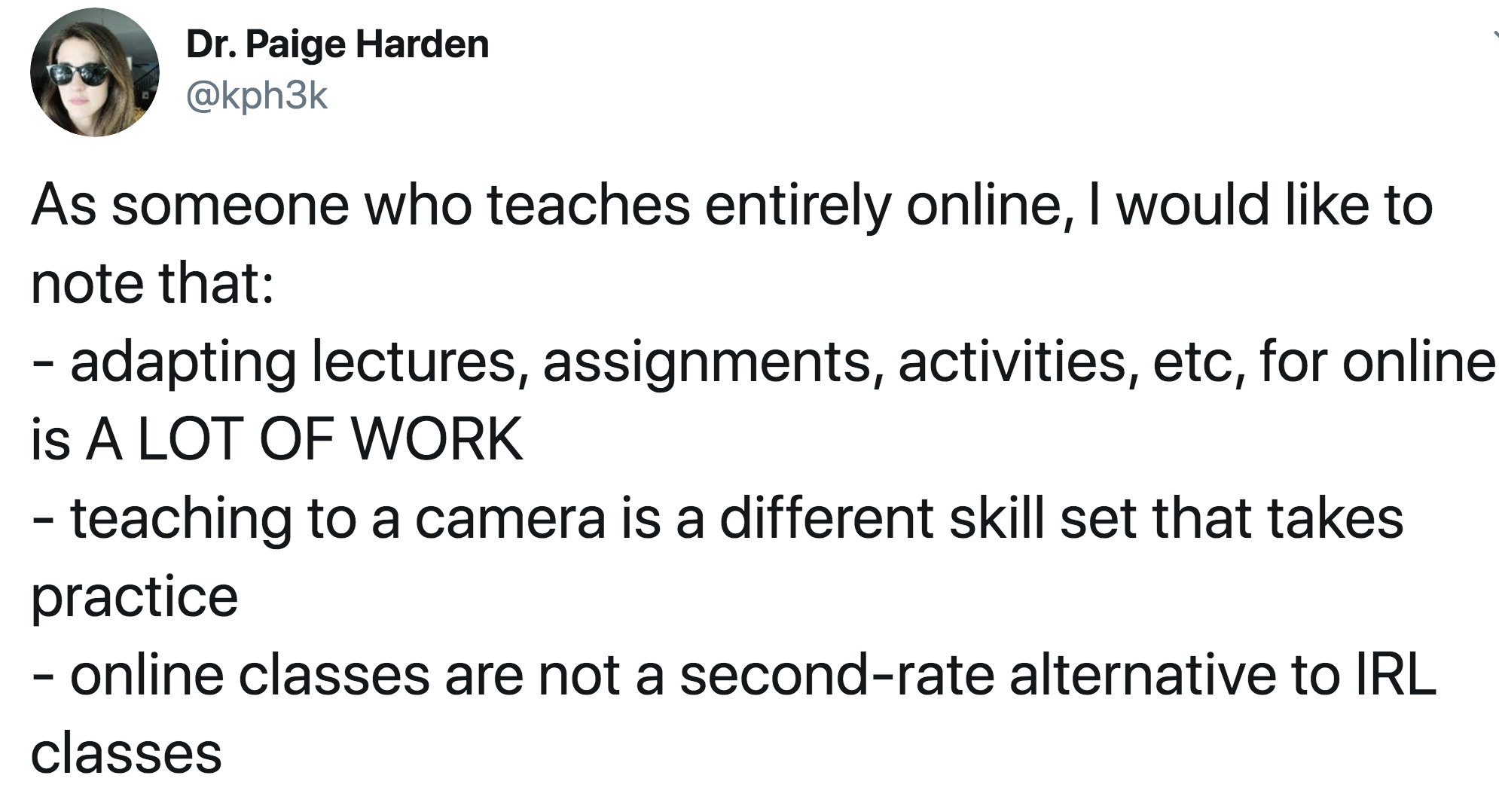
Similarly, as everyone does these days, it’s presumptuous to label “on-line teaching” as teaching. Take Dr. Paige Harden for example:

Screen Shot 2020-03-11 at 9.59.06 AM.pngHarden has an informative twitter thread on how to “teach on-line” and you can see her and a colleague in action here:**

Everyone refers to “teaching on-line”, but Harden’s specific phrase “teaching to a camera” highlights the fallacy of the phrase.

You can present to a camera, but you cannot teach to one. “Okay Boomer” alert. . . the word “teaching” should be preserved for IRL settings. The “on-liners” can go as crazy as they want with “presenting”.

Teaching encompasses more layered relationships with students than presenting. Teaching interactions involve direct eye contact, silences, nonverbal communication, occasional emotion, and one-on-one conversations outside of class where each of those are even more integral. Teaching, at least in the humanities and social sciences, entails learning your students’ stories, tweaking your plans according to those stories, and being spontaneous and authentic in ways that are difficult in a separate studio. Teaching is messy for the same reasons all interpersonal relationships are—because everyone enters into the conversation with different worldviews shaped by contrasting gender identities, class backgrounds, ethnic backgrounds, and political beliefs. And then, for good measure, add in status and power imbalances.

Teachers have a more immediate sense of how a course is going than presenters because technology-mediated feedback is harder to interpret. When I lecture in an auditorium, I can assess audience engagement based upon several subtleties including eye contact, head nods, facial expressions, and the number (and quality) of questions asked afterwards. The technologist will argue they can do the same sort of thing on-line, but I’m skeptical because teaching entails a dynamism that I don’t believe exists in on-line presenting. My “in real life” students routinely alter my lectures, discussions, and activities with unpredictable questions, or comments directed to me or their classmates, whose responses cannot be anticipated either. Again, technologist will say their presenting is similarly organic, but again, everything is relative.

So let me correct the record. As the nation’s professors and students turn to cameras, microphones, screens, and keyboards, some truth-in-advertising is in order. The country’s colleges are not moving to on-line teaching, they’re moving to on-line presenting.

*since no one talks on phones anymore, “sexting” is probably a more relevant frame of reference, another modern phenom I know nothing about

**Apple thanks you for the commercial