
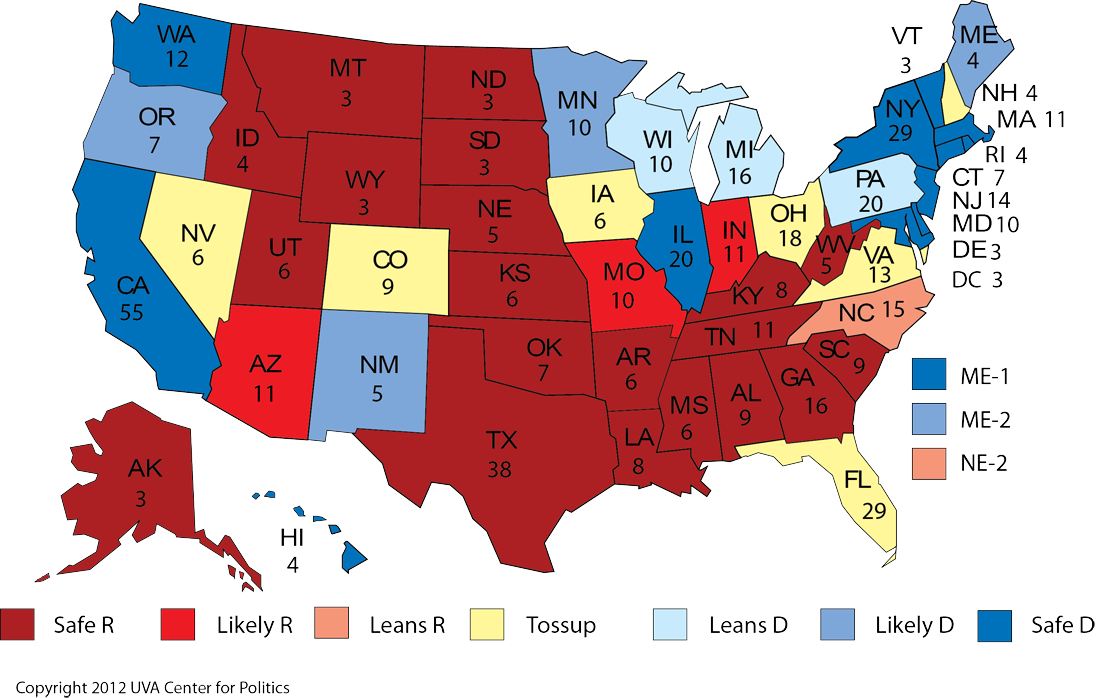
The U.S. Electoral College Map Explained

Take a gander.

Since you always aced your social studies courses you already know the President needs 270 electoral votes out of the 538 up for grabs. The winner can lose darn near forty small states, win the most heavily populated ten plus, and be the first to tag the bible on January 20, 2013.

Show the above map to grade schoolers and ask who is likely to win. They’ll say the Red Team.

Even though you understand how the Electoral College works, you probably don’t know why some states tip blue and others red. That’s what I’m here for.

It all starts with cool ocean breezes in the Pacific, upper Atlantic, and Great Lakes region. Those cool breezes translate into more moderate temperatures especially on the West Coast and in the upper Northeast. In contrast, the great, red, middle swath of the country is mired in hot and humid summers and killer cold winters almost all the time. Ocean and Great Lake breezes and cool temps contribute to blood flow, heightened brain activity, and altogether clearer thinking. Sadly, over time, people living in the great, red, middle swath of the country develop cognitive deficits as a result of oppressive heat and humidity and dramatic temperature swings. The technical term for this is Climatic Induced Cognitive Deficit Disorder or CICDD.

Also, until the last presidential election, very few people knew that on clear days you can actually see Russia from the West Coast of the U.S. That proximity to Russia—coupled with shared suffering during earthquakes, mud slides, and forest fires—explains the more collectivist mindset of Left Coasters.

Then there’s dietary considerations. Reds don’t just like their heat, humidity, and bugs, they like breaded and fried meat casserole-based potlucks more specifically. All washed down with whole milk. Blues prefer roasted vegetables, fresh fruit, and wine. That explains the dramatic physical health divide, which like the climatological differences, translates into a mental health chasm. Eat well, be well, think well.

Then there’s preferred outdoor activities. This time of year Blues hike among trees and meditate silently upon their changing colors all while looking forward to snow shoeing and cross country skiing. Reds hike among trees too, in search of large defenseless animals to shoot and kill. Then they drag them home, bread them, and fry them. All while looking forward to firing up their snowmobiles and making lots of noise and pollution. Blue outdoor activities lead to enlightenment. Red to blight and lunacy.

Then there’s different artistic sensibilities. Blues prefer classical music, independent and foreign films, modern dance, national public radio, and The New Yorker. Reds, country and heavy metal, Arnold Schwarzenegger films, reality television, Fox News, and The Washington Times. Heightened enlightenment and even greater lunacy.

Class dismissed.

How About a Vehicle Mileage Tax?

To deal with population growth, traffic density, and global warming.

From Slate Magazine.

Looking for a way to raise money for roads and public transit, San Francisco Bay Area transportation officials have decided to look into a novel idea: Taxing drivers for every mile they drive. The hypothetical tax—which at this point is only being studied as part of a long-range plan—could run from as little as a penny to as much as a dime per mile, perhaps depending on the time of day, according to the Associated Press.

The VMT (vehicle miles traveled) tax, the thinking goes, would not only bring in new revenue but encourage people to drive less. The San Jose Mercury News reports that small pilot tests of a VMT tax in cities in Oregon and Washington have shown “encouraging” results, with drivers reducing their total mileage to save money.

Sure, but how does the government propose to keep track of the number of miles that every driver drives? Under the idea being studied by the San Francisco-area Metropolitan Transportation Commission, the Mercury News’ Mike Rosenberg explains, “Drivers would likely have to install GPS-like trackers on their cars to tally travel in the nine-county Bay Area, from freeways to neighborhood streets, with only low-income people exempted.”

Oh but don’t worry, the government would never dream of using these tracking devices for anything except tallying the total number of miles you drive. “The last thing we’re interested in is where you go and what you do,” a commission spokesman told the AP.

Here’s how a free-market, true believer, business friend of mine responded to the idea in an email:

Now there is a great plan – lets get people to drive less so more businesses can fail.  Oh, if more businesses fail that mean less tax collections, and therefore leads to higher unemployment.  But wait, we can raise taxes on the successful companies and the people who buy from them can be taxed higher also….I am sure the idiot who proposed this plan, failed Econ 101.  Government can not collect more from a soft economy without slowing it down further.

That same friend often tells me I don’t know shit about business, but even as clueless as I am, I can’t help but wonder why the correlation between miles driven and economic growth is so obvious in his thinking. The pilot studies show people actually save money as a result of driving less. And can’t we presume they spend most of their savings? Albeit at places like Amazon.com. And would the miles driven/economic growth correlation, whatever it might be right now, weaken if urban planners designed more walkable and bicycling friendly neighborhoods, if people began carpooling, or taking public transportation, and/or cycling, and if people purchased even more of what the need and want on-line?


How to Tap People’s Generosity

Through detailed, well told personal stories of individuals dealing with identifiable difficulties.

Exhibit A—The grandmama bus monitor who endured bullying at the hands of marauding middle schoolers. The national media shined their light on her plight and a few days later people, moved by her predicament, had sent her $650,000+.

Exhibit B—The young East L.A. boy who built an arcade at his dad’s auto supply storefront. No one knew or cared until one person told his story on-line. Next thing you know his college education was paid for by an army of people moved by his creativity and lack of business success.

Exhibit C—A Mexican-American Seattle resident whose story was told—as part of a series on the recession—on Seattle’s National Public Radio station. Raised in a poor Mexican family. Emigrated to the U.S. Got an engineering degree and a good job with a Seattle firm. He helped his firm determine how much buildings would cost to build. When the recession hit and building ceased, he lost his job. So he opened a taco truck with his brother, but it was a struggle. Until his story was told on the radio. The next day a long line of customers weaved around the block. By mid-afternoon, they had run out of food. While the taco truck took off, other listeners offered him good jobs. In the end, building picked back up and his original employer offered him his job back. He took it.

Forget generic pleas to fight ageism, or the cost of higher education, or economic dislocation. People want to feel like their donation is helping a specific person.

The problem with this of course is that the most vulnerable people, who are the most in need, rarely have their stories told by the media.

A related question is how can governments, whether local, state, or the federal government, leverage this element of human nature to get people to see the potential benefits of selective tax increases? Governments would be well served by telling compelling stories of how individual people, families, or communities benefit from public spending.

Jacking Around

From the Associated Press:

Jack Nicklaus is trying something new to get more people to play golf. He is holding events at his Muirfield Village Golf Club in which the cup will be twice as large and the tournaments only will be 12 holes.

Nicklaus is concerned that fewer people are playing golf. He says it’s important to think beyond the traditional rules and try something different to make the game more appealing.

That would be THE Jack Nicklaus I idolized growing up, making his “make it two-thirds as long and far easier” logic all the more painful to process.

When marathon participation someday drops off, race officials will no doubt make marathon running more appealing by Jacking it, making it a gradual downhill 17.5 mile “fun run”.

We should probably Jack the 500 free in high school swimming too. The new more appealing “335 yard free” will be even more popular now that participants can wear fins.

And paying taxes shouldn’t be such an onerous task. Let’s Jack them. Just do your best to pay two-thirds of what you would normally owe and try to do it by June 15th if at all possible.

Time we Jack the fence at Safeco and move it in a third of the way. At least when the M’s are at bat. Offense is appealing. Similarly, let’s increase the size of soccer goals by a third. On fire now. I’m going to Jack the house-cleaning, the yard work, and my exposure to Tea-Partiers.

Obviously we have a lot of work to do making things more appealing, but at least now, thanks to the Golden Bear, we have a model. What do you say, let’s start Jacking around.

Why the Rich Don’t Feel Rich

The title of a great article by Laura Rowley on Yahoo’s Personal Finance page last week.

In short, Todd Henderson, a U of Chicago lawyer who makes $300k/year with his doctor wife, got hammered by his blog readers for arguing that he wasn’t rich and couldn’t afford a tax increase.

The blowback took two forms. First, people understandably took him to task for his questionable logic. After reading his post, I was stunned by his lack of perspective. I guess he doesn’t know many regular folk. And I guess he didn’t read the recent WSJ article that detailed how many poor people go shopping at Wal-mart at 11:50p.m. the last day of every month so that by the time they hit the check-out registers with their baby formula, diapers, and food, their new food stamps have kicked in. Or I guess he hasn’t traveled in a developing country.

Second, people questioned his sanity for daring to write the post, intimating that he would have been better off not writing it at all. This is where I disagree. While I have no sympathy for his argument, I admire his courage for honestly stating his views. As a blogger, and person I suppose, I probably self-censor myself way too much. Henderson didn’t get hung up on “what might other people think”, instead he chose authenticity. Questionable arguments honestly communicated deepen our civil discourse and strengthen our democracy.

Empathy Impaired

The New York Times’ commentators have been writing a fair amount about how to revive our moribund economy and related issues like consumer and government spending, taxes, and unemployment. Sometimes I find the readers’ “recommended comments” more interesting than the essays themselves. They’re liberal and decidely cynical about life in the U.S. today. Their most common rallying cries are corporate greed, class warfare, out-of-touch politicians, and right-wing media.

Recently, they’ve been most fired up about members of Congress being out-of-touch with ordinary citizens, many who have been laid off, and too many that appear to be entering into permanent unemployment.

The question I haven’t seen asked is how does one, whether a member of Congress, or a college professor, develop empathy for the under-employed or short, medium, or long-term unemployed? The best answer of course is direct personal experience, but giving up one’s job in the interest of greater empathy doesn’t make much sense.

There have to be better ways, whether documentaries, essays, novels, photographs, music, and plays, that can help humanize the out-of-touch among us. The arts seem especially well suited to this task. I wish The Times’ irate, cynical commentators would each choose an art form and begin telling their stories with the out-of-touch Congress as their primary audience.

Winning Personal Finance 2

I’ve been successful for several reasons: 1) most importantly, my parents’ work ethic, saving habits, and frugality have been deeply imprinted in me; 2) second most important, I chose to marry someone who wants to live a similar lifestyle as me; 3) I’ve educated myself reading and studying lots of material; 4) I found Vanguard early on which has saved me a lot in investing costs; 5) I’ve come to enjoy managing money so I set aside a few hours every week to continue learning and make decisions; and 6) I almost always avoid impulse purchases.

What might one and two mean for you? When it comes to family history and partner, I’m a personal finance +/+. The gal pal and I have probably had as many financial arguments as the next couple, but they’ve ebbed in number and intensity over time, and ultimately, our personal financial values are very similar. What if you’re a personal finance -/+ or the dreaded -/-? While it’s impossible to completely undo a “losing personal finance” family history, financial counselors can help minimize the damage and your time and resources are probably best spent working with them on minimizing the effects of negative role modeling before turning to asset allocation, minimizing taxes, and the like. Similarly, if your partner and you aren’t in sync, financial/couples counseling is probably more important than technical financial advising. Proactively, the more premarital counseling focused on each person’s financial history, values, and goals, the better.

What about reasons three, four, and five? How much time do you set aside each week to educate yourself about saving, investing, minimizing taxes, and related personal finance topics, not counting paying bills and balancing your check book? Put differently, how much time do you spend thinking about the forest that is you or your family’s financial well-being? My guess is, on a weekly basis, the average person spends very little time thinking about where they’ve been, where they are, and how to reduce expenses. Quiz. What was your net worth, assets minus debits, on 12/31/09? Will you recalculate it at the end of this month and then every quarter? If my assumption is right, is it any surprise that so many people are unsatisfied with their personal financial situation?

Reason six leads to tip five or experiment one, don’t buy anything that hasn’t been on your “To Buy” list for at least a week. Personal example. Three plus years ago I bought eight pairs of $120 running shoes for $60 a piece. Running shoe companies “update” their shoes regularly, every year or so. As far as I can tell, “updating” shoes means “we changed the colors”. If you’re savvy, you can pick up the “old” model at half price. When the big box of eight shoes arrived, it blew the daughters away. “Dad, you saved $480!” “Tru dat.” Fast forward, I’m halfway (250 miles) through pair eight so I’ve started to shop for a similar deal. No luck until last week. I found my Mizuno Wave Creations, model 10, for $65. Model 11, $135. Only two sizes were available, one was mine. Darn if the website would only let me buy two pairs, so I called them. They said they’d investigate and get back to me. Long story short, they found a third pair and all three are in transit. Normal cost for three pairs at $135 and 8.5% taxes, $439.42. After thanking the salesperson I said, “I saw something on-line about a Costco or Triple A discount.” “Yes, what’s your Triple A number?” Cost went from $201.50 ($6.00 shipping) to $181.50. Let’s see you do that on your fancy pants iPhone with the barcode application.

Now my $9,000 loss is a mere $8,742.08.

Winning Personal Finance 1

Everyone is hocking financial advice so how does one decide whose to follow? For example, why on earth should anyone pay any attention to the personal financial advice I offer below? What makes one advisor more credible than another, credentials, their popularity, their marketing savvy, something else? Credentials are nice in that they create a floor with respect to technical knowledge, but they don’t tell you much about the person’s ethics, integrity, or track record. Ultimately all credentials tell you is they succeeded in passing exams.

If I was looking for a financial advisor I’d look for someone that managed their own money well and emphasized saving, investing simply, and had other values that jived with my own. But how do you know if someone manages their own money well when we’re loathe to talk about our personal finances?

Tip one. Ask anyone wanting to manage your money to prove that they’ve managed theirs well. That will probably reduce the pool from which to choose in at least half. Take me for example, I have managed my family’s money well, but for privacy reasons, I won’t provide details except to say that for every ten financial decisions I make, I tend to make seven or eight good ones. Were I in the biz, I would completely understand if that lack of specificity caused potential clients to walk away.

Tip two. Ask any potential financial advisor about some of the mistakes he or she has made and what they learned from them. Last year I made a $9,000 mistake. I repeat, last year I made a $9,000 mistake. It was a brutal, self-inflicted wound that took time to shake. My goal is not to be perfect, but to consistently make more good decisions than bad. Look for a humble advisor who acknowledges complexity and doesn’t over promise. That will probably reduce the pool of potential advisors by at least another half.

Tip three. Even if you find a financial advisor that meets all of those criteria, don’t decide to work with him/her without first looking at yourself in a mirror and repeating several times, “No one will ever care about my financial well-being as much as me.”

Tip four. Never accept any financial advice passively. Instead educate yourself and recognize that no one will ever care about your personal financial well-being as much as you. More specifically, become your own financial advisor. That’s the best financial advice I’ll ever offer. Become your own financial advisor.

Well, the best advice until Part Two.