Saturday Assorted Links

1. Alison Byrnes’s dream vacation. Maybe yours too?

2. Kate Wynja, high school golfer of the year.

“. . . it broke my heart for the team.”

3. Restaurants of the future. Count me as pro simplification.

4A. Female members of congress by party affiliation.

4B. The future of the Democratic Party. Maybe.

5. Republicans’ latest tax con.

6. The future of cycling.

Twice The Fun, Half the Money

Two words. University housing. Few travelers know that most universities have housing options for any visitors looking to save serious money on nearby hotels. Many times the options range from inexpensive minimalist dorm rooms with shared bathrooms to modestly priced hotel-like rooms with private bathrooms.

The Good Wife and I just spent three days living in a small, but very clean and comfortable hotel-like room on the campus of The University of British Columbia in Vancouver. The centrally located hotel is normally filled with conference participants, job candidates, and visiting faculty. The first night we watched our President pal around with the world’s worst dictator on a 42″ plasma t.v. and throughout our stay we luxuriated in the large commercial kitchen that came complete with a giant fridge/freezer; precise tubs and instructions for labeling our food; free fruit, tea, and coffee; newspapers; and an expresso maker complete with two types of beans waiting to be grinded.

And don’t forget U.S. readers, everything north of the border is currently 24% off, so our three nights cost $302. See how far that will get you in downtown Vancouver.

It gets better. Large university campuses like UBC, go Thunderbirds, have tons to recommend them, especially in the summer, when there’s a tiny fraction of the normal number of people. On our first campus walk, we met a man who befriended us and told us we had to visit the Rose Garden because “the roses knew you were coming, so they’re blooming” and also the Museum of Anthropology which has the world’s largest collection of Pacific Northwest indigenous art.

We dug the roses and the MOA, but the cheap vegetarian restaurants on campus rocked too. And the running was great, the trail that looped the campus, the tartan track, the coastline trail. Next time we’ll take our bicycles because West Vancouver’s ubiquitous bike lanes we’re calling us.

Best of all though was the swimming. After arriving, we learned a new state of the art aquatic center had recently opened in the middle of campus. BEST pool ever. Tons of natural light, beautiful materials, white, clean, spacious—the hot tub is designed for 34. I thought I had died and gone to heaven. Entrance to heaven, $5. Bring a quarter or a loonie for a small or large locker and your own towel, shampoo, and soap.

The pool was set up for long course. I could’ve swam, hot tubbed, and steam roomed all day. The only mistake I made was diving off the 3 meter board. Trying to impress the Gal Pal was not worth tweaking my shoulder.

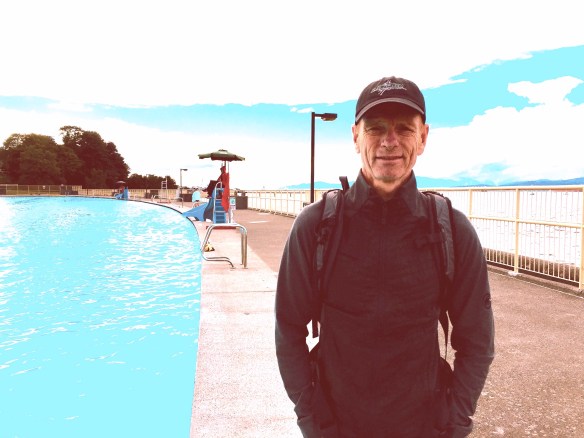
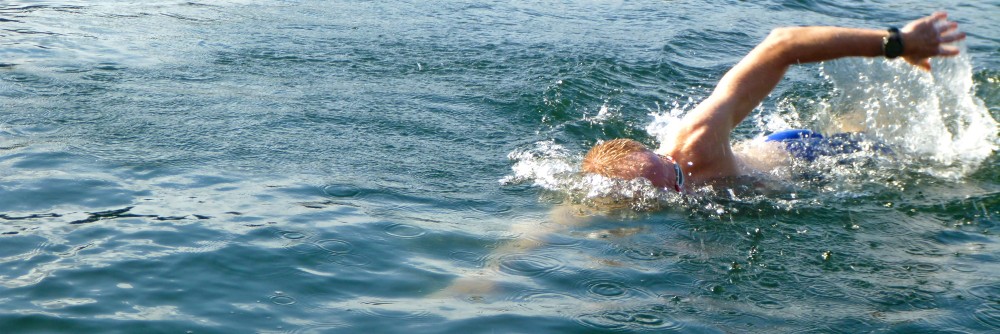
Speaking of swimming, the nearby 137 meter long Kitsilano pool, or Kits pool if you’re cool, was what inspired our trip to West Vancouver. We were mesmerized by the pictures. Not sure it was real, we knew we had to experience it ourselves. It’s described as the third sexiest pool in the world, but that was before The Good Wife graced it with her presence. It was hard to get her out of the water. We had perfect timing too, decent weather, a week after $3.3m in improvements, but a week or two before the summer surge.

And if you’re fortunate enough to visit Vancouver, don’t miss the Granville Island Public Market for some nice art and excellent food. Speaking of food, the first night we ate at Lido, one of the Richmond restaurants featured in the previously highlighted NYT article. We we’re the only non-Asians for as far as the eye could see, super cool. The bok choy, green beans, chicken, and white super sticky rice were off the charts. Heads up—they only take cash and get Canadian money in advance because they don’t want to be bothered with silly currency adjustments.

The best part of this trip, besides reconnecting with my best friend, was mixing with locals the whole time. Downtown we would’ve been two of thousands of tourists. On campus, in coffee houses, at Kits Beach, everywhere we went, we were surrounded by ordinary Canadians, largely Chinese-Canadians, living their daily lives. As travelers, that’s how we’ve always rolled.

IMG_0932_4Popt.jpg

UBC’s New Aquatic Center

kitspool-980x580.jpg

Kits Pool


IMG_1199

Now The Sexiest Pool En Todo El Mundo
IMG_1198.jpg

Post coastline to downtown run and leisurely swim with far fewer flip turns than normal.
Really Bad Writing

Or more accurately, thinking.

I do not know Shivani Vora, but I seriously question her sanity. In “How to Have a Luxury Vacation in Norway for Less”, she writes perhaps the most outlandish phrase I’ve ever read in the Paper of Record.

“Norway is a great choice for travelers on a limited budget. . . “

Trust me on this, there are about 194 better choices if you’re trying to stretch your travel dollar.

[Postscript: I’m receiving unrelenting pressure from one of the caption contest contestants. She really wants to know whether she won; however, upon meeting with my attorneys, I’ve been advised to limit the competition to non-family members. Consequently, congratulations to Lance for the victory.]

Only One Border

Imagine everyone in the world agreeing to limit their long-distance travel to mitigate the problems associated with climate change. Specifically, imagine everyone agreeing to only cross one border whether state, provincial, or national, in their remaining days on earth.

For example, living in Western Washington State, I could choose to travel only to one of the following places for the rest of my life: Oregon; Idaho; or British Columbia, Canada.

Even though I was born in Idaho, I’m more familiar with and fond of Oregon and British Columbia. Which brings me to a very difficult decision. Oregon has an abundance of beautiful terrain to recommend it. And I still haven’t played Bandon Dunes or any of the adjacent courses. And of course there’s Shakespeare outdoors under the stars in Ashland, cycling in the high desert, running the Deschutes River trail, Batchelor, Hood, the Three Sisters, Crater Lake. Don’t just take my word for it, give this guy’s work a look-see.

Despite the difficulty knowing I will never cross the Columbia River again, I’m going north to British Columbia. For the rest of my life. As much as I like Oregon, I love British Columbia. Victoria, Vancouver, Whistler, the Okanogan Valley, Penticton. Barely scraping the surface of the southernmost part of the province has been enough to tip the balance.

The GalPal and I will stay here a few nights. Here too. And we’ll make regular visits to our private suite at the Hotel Grand Pacific in Victoria.

Part of it is a feeling I get in B.C. I’m sure I idealize it, but I like knowing there’s less gun violence, a progressive head of state, a single payer health care system, and often a self-deprecating sense of humor. I hope some of my Washington State friends are down with my decision. It would be a lot more fun to have some company along for the many, many ferry and border crossings in my future.


On Travel 2

Today, the Good Wife and I have been married for 29 years, 11 months, and 18 days. Fairly confident we’ll make it to three zero, we’re planning a celebration of marital endurance bliss for a week and a half from now. Given assorted responsibilities we can’t shake, we’re temporarily tabling a trip to a Spanish speaking country in favor of a nearby quick hit.

Meaning Portland, Oregon.

Read and/or watch the New York Times depiction of the Rose City and then dig this person’s comment which I’m assigning an “A+”:

“It’s a very pretty video. Please forgive my peeve. Some of us aren’t cheering.

It’s the weirdest feeling to have lived somewhere your whole life and suddenly feel like a stranger. The aggressively smug city in the video is not Portland as many of us know it (or knew–past tense–and loved it). Portland is unrecognizable to me, anymore. Portland was a decided introvert until fairly recently; a dark, foggy haven for privacy-loving people, many of them genuine eccentrics–not the braying and proud ‘Portland Weird’ of now.

The self-satisfied extrovert it has become is due mainly to hype and an internet-fed culture of rootlessness and restlessness (“I can do better!”), spawning quality-o’-life-seeking newcomers looking to reinvent themselves and put their stamp on what too many have regarded as a tabula rasa, ignoring what existed before they arrived to ‘improve’ it.

The noisy eagerness with which new lookalike (mostly white, mostly moneyed) arrivals and discoverers advertise and idealize the city feels like an extension of FB-fed narcissism and now-epidemic attention seeking. “I found it! I discovered it! Look what I did!” Portland makes a great FB post, a great tweet, a great NY Times feature. It reflects well on mememe. Aren’t we all clever for discovering this place? We are curators!

“Authentic” is not a word I’d use to describe Portland now. And I always thought relentless self congratulation was the antithesis of ‘cool.'”

How does one add to that? It’s not just a very thoughtful take-down of the NYT, it’s a trenchant critique of our penchant for superficial travel.

On Traveling

A nice insight:

“If you travel a lot, you should not restrict yourself to “nice” places, which are more likely to disappoint.”

Instead, make your way to places like Shenyang, China. What are some other “off the path” not so nice places one should go?

Addendum: How much of travel decision making is inspired, at least in part, by status anxiety? For the self actualized among us, with no status anxiety, sources tell me Picqua, OH is on the upswing. Fort Picqua Plaza, the Midwest’s Taj Mahal.

Update: Sources tell me I can’t spell. It’s Piqua, OH. Apologies to the Heartland.

Life After Work

As is often the case, I’m confused. One day last week Ron Lieber, a Times blogger, summarized research from The Journal of Consumer Research that finds older people often draw as much happiness from ordinary experiences—like a library visit or an afternoon spent gardening—as they do from extraordinary ones. Then, on the same day, with stories of extended trips to exotic locations, the Times David Wallis’s published a contradictory article titled, “Increasingly, Retirees Dump Their Possessions and Hit the Road”.

Wallis writes that between 1993 and 2012, the percentage of retirees traveling abroad rose to 13 percent from 9.7 percent and about 360,000 Americans received Social Security benefits at foreign addresses in 2013, about 48 percent more than 10 years earlier. Wallis illustrates this trend through examples of people like Lynne Martin, 73, a retired publicist and the author of “Home Sweet Anywhere: How We Sold Our House, Created a New Life, and Saw the World”:

Three years ago, Martin and her husband sold their three-bedroom house in Paso Robles, Calif., gave away most of their possessions, found a home for their Jack Russell terrier, Sparky, and now live in short-term vacation rentals they usually find through HomeAway.com. The Martins have not tapped their savings during their travels, alternating visits to expensive cities like London with more reasonable destinations like Lisbon. “We simply traded the money we were spending for overhead on a house and garden in California for a life in much smaller but comfortable HomeAway rentals in more interesting places,” Ms. Martin said by email from Paris.

Another couple in the late 60s sold their house, bought a Recreational Vehicle, and started volunteering full time for two nonprofits. So far, they’ve repaired damaged homes in 28 different states.

One of the older vagabonds, or Wallis’s term is better, itinerant baby boomers (IBB), said, “I used to dream about all the places I would go as soon as I was old enough to get away. But then. . . life happened.” That’s probably the key variable, whether older people have pent-up wanderlust.

Wallis explains that many IBB’s are traveling on the cheap, volunteering for nonprofits and organic farms in exchange for room and board or finding free places to stay through Couchsurfing.org which puts its membership of people 50 and older at about 250,000. Given the manner in which most retirees are traveling, maybe the two pieces aren’t completely antithetical after all.

The common thread is that retirees are choosing experiences over material possessions. Listen carefully everyone under 50 and you’ll hear the collective, “Ah shit, why did we accumulate all this crap?!” Personal finance researchers tell us one-third of seniors have nothing saved for retirement. It’s a good thing ordinary experiences prove so fulfilling in later life.

Both pieces were short so an important subtopic was left out, just how similarly retired partners think about how to spend the last chapters of their shared lives. I know many couples think differently about their idealized post-work lives. What to do when one person wants to see the world, and the other, the backyard?

I’m the opposite of the IBB who dreamed about all the places to go. I’ve been very, very fortunate to travel and live all over the U.S. and on three different continents. Don’t tell the Good Wife, but I’m content to walk, swim, run, cycle, and drive throughout our hood, our state, and the Western United States and Canada. She wants to travel to Spanish speaking countries so I should probably renew my passport. I will take one or two or three long distance trips for the team. But I’d be just as content taking the labradude for a walk in the woods.


Good and Bad News—Your Life Experience is Unique

No one has followed your exact path. No one has grown up in the same family, attended the same schools at the same time, read the same books, worked the same jobs, traveled to the same destinations, settled in the same place. Ever. Your unique life path is a wonderful strength. As a result of it, you “get” the specific people you grew up with and you’re an insider at the places you’re most familiar.

But your unique life path is a serious limiter too. One that inevitably handicaps you at times. It’s the reason you struggle to understand people and places with which you’re unfamiliar. Clearly, seeing the world from other people’s points of view does not come naturally. More specifically, we routinely fail to adjust for other people’s different life paths. Which is why there’s so much interpersonal and intergroup conflict.

A close friend attended a mostly white, mostly upper middle class liberal arts college. By most conventional measures, she received an excellent education. But in some ways she was ill-prepared for an increasingly diverse world. At one of her first teaching jobs she had a militant African-American colleague who routinely ruffled her feathers. Deeply frustrated, she complained to me, “He’s racist!”

In college she had few opportunities to interact with African-Americans and never with militant ones. If she took the time to learn more about his life path she would have been much more sympathetic to his radical critique of the dominant culture of which she was a part. And consequently, she wouldn’t have taken his anti-white diatribes quite so personally.

Can you supersede your life path? Can I? Partially.

How? By purposefully seeking out unfamiliar people and places through literature, the arts, and travel whether near or far. And when interacting with unfamiliar people, substituting curiosity for negative preconceived notions. Asking, for example, why do you believe what you do? And then listening patiently.

The Tourism Trap

Talked to an elderly couple at church about their recent adventure in China—Beijing, Tiananmen Square, The Great Wall, Xi’an and the Terra Cotta Warriors. I checked off the same spots during my first trip to China in 1997. And today I looked at a friend’s Facebook pics about a recent trip to China—Beijing, Tiananmen Square, The Great Wall, Xi’an and the Terra Cotta Warriors.

Anyone that stays on the well worn, urban, tourist pathway of Beijing, Tiananmen Square, The Great Wall, Xi’an and the Terra Cotta Warriors, really can’t say they know much about China which is still largely rural and poor. As tourists, we lack creativity, independence, and a sense of adventure. Our collective lack of creativity, independence, and sense of adventure creates tourist traps—must see locations that make people feel like they understand a people and place far more than they really do.

Of course, in the U.S., foreign visitors have their checklists too. Here’s the Top Ten according to Forbes Traveler—1) Times Square; 2) The Las Vegas Strip; 3) D.C. and the National Mall and Monuments; 4) Faneuil Hall Marketplace; 5) Disney World; 6) Disney Land; 7) Fisherman’s Wharf/Golden Gate Bridge; 8) Niagara Falls; 9) Great Smoky Mountains; and 10) my birthplace NavyPier Chicago. If you’re an American citizen, what kind of feel would a foreign visitor get for your community if they went from one “Top Ten” site to another?

How does a sense of obligation to see standard tourist sites form, that if I’m traveling to Country A, B, or C, I have to see X, Y, and Z? Is it a fear that someone might ask upon returning, “Did you see the Great Wall? Did you see Times Square?” Are we defenseless in the midst of the iconic sites incessant, sophisticated, billion dollar marketing campaigns?

My most memorable travel experiences have been off the beaten trail. In China, a bicycle was indispensable to experiencing more of daily life. When abroad, I’ve learned the more still I sit, the more I listen and observe, the more I learn about different forms of daily life.  Lo and behold, many people live markedly differently than me and their unique ways of life work well for them. Once I learned what’s “normal” is culturally defined, I not only learned to appreciate foreign cultures, but cultural diversity in the U.S. as well.

International school visits have always been enlightening. The different architecture, curricula, teaching methods, teacher-student interactions, extracurricular activities, and feel in foreign schools always provides wonderful insights into the larger culture.

Think about a foreign tourist to the U.S. that spends a few days at the Grand Canyon and a week on the Vegas Strip. And another that spends ten days visiting private and public elementary and secondary schools in urban, suburban, and rural communities. Which would learn more about life in the United States?

What other, “off the radar” experiences—besides school visits, a farmers’ market visit, riding city busses, a homestay or two, attending religious services, a hospital visit, watching a youth sports tournament, visiting a courthouse and sitting in on a trial, attending a summer concert in a park—would you recommend to a foreign visitor who wanted to not just recreate, but learn as much as possible about life in the U.S.?

Here’s a travel challenge from Roman Krznaric, the author of the book I’m currently reading, The Wonderbox. This from a chapter titled “Empathy”:

The idea of empathy has distinct moral overtones and is often associated with ‘being good’. But experiential empathy should be really regarded as an unusual and stimulating form of travel. George Orwell would tell us to forget spending our next holiday at an exotic resort or visiting museums. It is far more interesting to expand our minds by taking journeys into other people’s lives—and allowing them to see ours. Rather than asking ourselves, ‘Where can I go next?’, the question on our lips should be, ‘Whose shoes can I stand in next?’ 

Brief Insanity, Compliments of Alaska Airlines

Previously I’ve written about one of my favorite reads of 2011—William B. Irvine’s A Guide to the Good Life: The Ancient Art of Stoic Joy. Irvine has a sub-section titled, “Anger—on overcoming anti-joy”. Here are my notes from that sub-section, mostly excerpts I wanted to remember:

Anger is another negative emotion that can destroy our tranquility. Seneca referred to it as “brief insanity” and said, “No plague has cost the human race more. A waste of precious time.” Punishment should be “an expression not of anger but of caution.” Calm correction; not retribution, but instruction (160). Need to fight our tendency to believe the worst about others and to overreact to little things. The more we eschew comfort and harden ourselves, the more likely we are to not get angry (161-2). Best counter is humor, choosing to think of the bad things that happen to us as being funny rather than outrageous (162).

We should contemplate the impermanence of the world around us.  When angered by something we should pause to consider its cosmic (in)significance. Also, remember our behavior also angers others. Seneca, “We must agree to go easy on one another. We should force ourselves to relax our face, soften our voice, and slow our pace of walking, then our anger will have dissipated.” (163). When unsuccessful at controlling our anger we should apologize, which has a calming effect on us and lessens the chance we’ll make the same mistake in the future (164). Seneca, “make yourself a person to be loved by all while you live and missed when you have made your departure.” (165).

This is the story of my recent epic failure at applying these insights. We were flying from Seattle to Santa Barbara to visit the in-laws for five days. My father-in-law was nice enough to drive an hour and a half to pick us up. Right before our Alaska Airlines plane was supposed to board we learned the gate had been changed. By the time we got to the new gate, discussed whether we needed to check in, and learned the “plane had been downsized,” we were what the airlines refer to as “shit-out-of-luck”. Our seats no longer existed and the flight was way overbooked. In years past airlines would offer more and more coin until enough people agreed to give up their seats. In the new economy, Alaska stops at 3 bills, and then says to their shit-out-of-luck flyers, “Sorry.”

Doesn’t matter that your father-in-law has already left to pick you up or that you paid Pujols-type money for the tickets. Agent, “We’ll fly you to L.A. and bus you to Santa Barbara.” To which Seneca would have said, “Wonderful, I love Los Angeles and the bus ride promises to be scenic.” But in a major setback to my pratice of Stoicism, I succumbed to “brief insanity” and said, “You’re kidding right?!!! You have to get more people off the plane!” “Sir, I can’t physically remove people.” “I’m not asking you to physically remove anyone, you have to offer them more incentives.” “We don’t do that.”

That initial exchange was first base in what turned into an inside-the-park anti-joy homerun. I didn’t swear, but got progressively more heated as I rounded second and was waved into third by the agent’s total lack of empathy. I told her I knew she wasn’t to blame for the last minute plane change, but her employer was and it was their policies that were so aggravating. Agent, “Sir, you’re not the only one ‘shit-out-of-luck’ (paraphrasing).” Turning to the twenty somethings behind me who were probably texting friends, “At Alaska gate. Out of a seat. Old dude has totally snapped, quite entertaining. LOL,” I said, “I can’t help it if I’m not as passive as everyone else.”

Finally, completely fed up with me, she said I should go to the Alaska customer service desk. Three hours later, four travel vouchers safely tucked away in the iPad case, we were on our way to Burbank. A high-speed “life flashing before your eyes” Supper Shuttle trip later, we were in Santa Barbara a mere five hours behind schedule.

In hindsight, given Alaska Airline’s short-sighted, bottom-line, customer-be-damned business practices, I don’t regret acting a fool. I do though regret two things. I regret my fellow customers rolled over probably assuring that Alaska will disrupt more travelers plans, and I regret I didn’t seek out the agent after returning from the customer service center. I would have apologized for taking my anger out on her instead of the spreadsheet reading Alaska Airlines execs who probably make ten to a hundred times more than her.