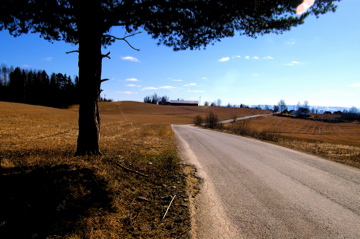
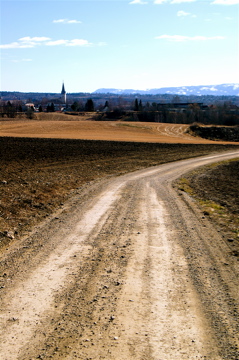
Heritage Run

The last time I was privileged to live abroad, I enjoyed writing an essay about my regular run in Chengdu, China that appeared in PLU’s magazine. Maybe I’ll share it sometime this year.  

As you can probably imagine, China and Norway are extremely different places.  For instance, it’s nearly impossible to compare population density in a Chinese city and a Norwegian burb. Even though running in Norway isn’t nearly as chaotic and eventful as running in China, I thought you still might enjoy learning about it.

In China, I did about five pancake flat miles five days a week, four outside the Sichuan University campus and one inside it on a black cinder 400m track. I ran in and out of a stream of cyclists and I could easily see a thousand people during the 38-40 minutes it took to complete my run.

During my hilly 8 mile Norway run I might see a few dozen people if I count those speeding by in BMW and Audi station wagons with rooftop boxes.  It’s not anywhere near as sensory an experience, but I’ve come to enjoy the quiet, the rolling farmland, the beauty, the peacefulness and naturalness of it all.


My hometown running crew—PC, Dano, and Double S—will be surprised to learn I have “a route” since I typically make them run a different 10-miler every Saturday.  As my mom says, “Variety is the spice of life.”  I occasionally improvise here, but usually tough out what I’ve labeled the Heritage run. It has a lot to recommend it: no stop lights, not even any stop signs (at my age it’s hard to get started again after stopping); hardly any traffic; as the pics hopefully attest, it’s scenic (even more so when snow covered); and the hills and 650 feet of elevation require an honest effort.

If I led my crew on this run, one of my aforementioned, hill-adverse training partners, would flip me the bird well before the midway point.  I’m only running three times a week because the day after a Heritage run, I like to swim or take the day off.  I’m taking more days off here since no one is waiting outside for me in the morning.  My favorite segment, which I’ve labelled “Grandma’s Stretch,” is about five miles in. I like it because most of the elevation is in the bank and I get to begin cashing it in. Also, it dissects exquisite family farmland.

Through this segment I sometimes picture Grandma Byrnes as a young girl running around the beautiful farms that dot the hills on each side of the road. She emigrated from Norway at age 13. It’s not a stretch to think that Grandma’s Stretch probably looked fairly similar 100 years ago.  

Our Northern Retreat has gone extremely well.  In addition to our new Nordic friends, I’ll miss pounding the bike paths, neighborhood streets, and farm roads that make up the Heritage run.

[Note to runners: between 1:00 and 1:04 depending on the footing, wind, and just how honest an effort.]


Pedaling Downhill with the Wind II

Reasonable people can and do disagree about class privilege and the degree to which we are an equal opportunity-based meritocracy.  I clearly stated my opinion in the previous post, but I want to remain open to differing perspectives that might deepen my thinking. 

The following examples of how the wealthy enjoy relative advantage range from lower-level subtle privileges to more dramatic obvious ones.  In and of themselves, the first handful of lower-level examples don’t provide much of an advantage, but they probably do in combination.

• Wealthy people can buy consumer goods in the “off season” on sale.

• Wealthy people can pay more to purchase higher quality goods that last longer even when adjusting for the higher original price.

• Wealthy people can buy consumer goods in bulk when they are on sale.

• Wealthy people can select higher health and auto insurance deductibles and thereby pay lower insurance premiums.

• Wealthy people can pay more in the short-term for “star-related” energy efficient appliances in order to save money in the long-run.

• Similarly, wealthy people can pay more in the short-term for a hybrid vehicle to save money in the long-run.

• Convenience credit card users, often receive money back on their purchases, thereby reducing their expenses (As a convenience credit card user, I receive 1.4% back on every purchase and therefore pay 98.6% of what most people do).

• Convenience credit card users avoid paying exorbitant interest fees.

• When purchasing a home, wealthy people can pay at least 20% of the total cost, and thereby avoid mortgage loan insurance.

• Wealthy people can afford the best accountants and thereby pay less in taxes.

• As noted in a previous comment by CK, wealthy parents can enroll their children in college admission test preparation courses.  Also, they can hire academic tutors, athletic coaches, and music instructors to help their children excel and get into the most selective colleges.

• Wealthy people sometimes receive annual financial gifts from other wealthy family or friends.

• People with wealthy parents don’t need to help out their elderly parents financially in their final years. 

• Wealthy people tend to benefit more from networks of other wealthy people.  Put differently, they have greater social capital.

• People with wealthy parents often receive large inheritances upon the death of their parents.

• The wealthy sometimes pay for their homes entirely and avoid mortgage interest altogether.

• The superwealthy, with substantial assets, earn considerable investment income, which they refer to as “multiple revenue streams”.

What’s my point of detailing these advantages all my multimillionaire readers want to know.  Am I simply fueling the flames of class envy?  Not at all.  Maybe ignorance is bliss, but I don’t think so.  I also don’t think guilt is particularly productive.  As someone who enjoys considerable class privilege, I think about it because it reminds me that “to whom much is given, much is required.”

Others, more radical than me, would call on privileged people like me to work towards greater equality in society by consciously giving up my privilege. 

They’d see my position—that’s it’s sufficient to be socially aware of the added responsibilities that come with privilege—as woefully inadequate.  I’m cool with that.

Another idea, and maybe the most important, is that privilege tends to reproduce itself from generation to generation.  Put differently, every family has momentum, either positive or negative.  There’s no standing still. 

Some people live alone, but no one is a complete island unto himself or herself. Most of us are part of family networks.  Individual members of family networks make daily decisions—whether or not to learn, work, save, invest, take care of themselves—that when taken together, lead overtime to relative advantage or disadvantage.

I’ve benefited from positive family momentum throughout my life.  And to extend the cycling metaphor, my daughters are beginning the bike rides of their young adult lives in the considerable draft created by the positive momentum of their grandparents, their mother, and possibly even their father.

The question is, how conscious of that are they?  Will each avoid the pitfall of privilege—a sense of entitlement—and instead develop a social conscience?  And as adults, will they act on their added responsibilities by contributing to a better world by doing socially redeeming work in some small corner of it?  

Pedaling Downhill with the Wind

US citizens like to think of the US as a meritocracy meaning people’s success is a result of their initiative, ability, and work ethic as opposed to their family background, gender, or ethnicity. According to psychologists, people that think they control their own destiny have an internal locus of control. In contrast, skeptics who believe that institutional racism, sexism, and classism make it more difficult for people of color, women, and the poor to succeed have more of an external locus of control.

The meritocracy/internal locus of control crowd believes strongly that there is equal opportunity in the US. In their thinking, all the children born today in the US start “the race of life” with similar prospects.

The external locus of control crowd is skeptical that there is equal opportunity. They argue that all the children born in the US today begin the “race of life” with a staggered start. Those children whose mothers received excellent prenatal care, those that lucked into stable, well-educated, financially secure families begin life with a clear head start. Those children whose mothers didn’t receive quality prenatal care, those born into undereducated, poor, dysfunctional situations begin life several yards behind the starting line.

These contrasting orientations are ends on a continuum and most everyone’s locus of control falls somewhere in between completely internal or external.

Twenty years ago, Peggy Mcintosh, published a widely read and discussed essay titled “White Privilege: Unpacking the Invisible Knapsack.” A feminist Woman’s Studies professor, McIntosh wrote the essay after reflecting on how different her day-to-day experiences were compared to her African-American female colleagues. The bulk of her essay is a list of the specific ways she experiences privilege in her day-to-day life as a result of being white.

I can’t speak for Mcintosh, but I’m guessing she’d acknowledge we’ve made progress in race relations in the last twenty years, but at the same time, she’d argue many of her examples, are unfortunately, still relevant.

After using Mcintosh’s essay to prompt discussion in a class lately, I began thinking about the ways wealth contributes to privilege in American society. I believe the affluent enjoy several advantages over the less well-to-do, advantages that make it relatively easier for the wealthy to increase their wealth.

I do not believe life in the US is the level playing field my Republican conservative friends would have me believe it is. Rather, to use springtime metaphors, I believe the wealthy are pedaling downhill with the wind.

Does that mean self-discipline and initiative are irrelevant? Of course not. Also, there are always examples of extraordinarily resilient people who accomplish far more than one would expect given the circumstances of their childhood. We should reflect on and learn from these anomalies, but they don’t disprove my thesis. It’s important to distinguish between patterns and themes, and occasional, individual exceptions to those aggregate totals. Put differently, it’s important to think sociologically.

In the spirit of Mcintosh’s essay, I’ve started a list of specific ways the affluent are pedaling downhill with the wind. I’ll share those sometime soon.

For now, I have to highlight one glaring example from the Wall Street Journal website from a few weeks ago. And I quote:

“It is no longer enough to be a millionaire to enjoy the best perks on Wall Street. These days, one has to have at least $10 million to afford the best that retail brokerage firms can offer to clients.

Take the case of Smith Barney, which will cut bank deposit rates to some of its wealthy customers in June when the Citigroup Inc. unit rolls out a “tiering” rate system on bank deposits. After the change, mere millionaires won’t earn as high an interest rate on their deposits as investors with accounts of $10 million and up.

Clients with $1 million or more in assets at Smith Barney currently earn the highest interest rate on deposits in the program. In the new program, the interest rate they receive will be reduced; clients will need $10 million and up in their accounts to receive the premium rate.
The move is part of most Wall Street firms’ strategy to distinguish among different client segments and focus more on the richest of the rich.

Under the program, besides tiers at $10 million in assets and $1 million, other tiers are $500,000 to less than $1 million; $250,000 to under $500,000; $50,000 to less than $250,000; and those with less than $50,000 in assets.

An illustration based on Feb. 20 interest rates circulated to Smith Barney financial advisors indicates that those with $1 million to $10 million in assets will be most adversely hit. From previously receiving yields of 3.81% on their deposits (as of Feb. 20), their annual percentage yield would drop to 2.76, a fall of 27.5%.”

There you have it, relative advantage. Smith Barney definitely has the right to run it’s business any way it likes, but stories like this one, that I doubt many equal opportunity believing, internally-oriented readers take much time to deconstruct, make the notion of meritocracy a joke.

To assist readers in reading between the lines, I’d like to see the WSJ include a truth in advertising-type disclosure at the beginning of articles like the Smith Barney one. Here’s a possibility, “The following story makes any argument that the US is a meritocracy laughable.”

Smith Barney has me fired up enough to take it a step further. I hereby enlist any of you also moved by this example to help me identify potential recipients of the inaugural 2008 MBA—Meritocracy Bullshit Award, that I will hand out once there are enough nominations to choose from. And to any graphic artists out there that want to design the award, may I suggest a person riding their bike down hill with the wind at their back.

Until you light up the comment section with your recommendations, Smith Barney will remain the 2008 MBA leader in the clubhouse.

 

Passion

I’m looking at the 4th tallest structure in Europe, the Berlin TV tower, which is 364m high.  The fam and I are at a Fulbright seminar and I spent our first morning trying to get online.  Of course I could have paid the exorbitant fee our hotel wanted, but that would run counter to stipend stretching.  I could post entirely about the last hour, but I think I’ll just hit yesterday’s highlights before retyping the planned post from laptop to internet cafe computer.  And as a sidenote, who gave the German’s permission to move the z and y on the keyboard?

Great Third Reich tour yesterday lead by two youngish American Fulbrighters based in Berlin.  We probably walked five miles in part because a huge half marathon had shut down the bus system.  Damn runners.  The tour was informative and memorable.  The 15 year old was particularly tuned in.  The 12 year old drifted in and out.  The 12 year was enthralled with a sidenote, the hotel where Michael Jackson dangled his baby from a window.  Several pictures were snapped.  Our room is on the 34th floor of a nice hotel with an amazing view in what used to be East Berlin.  Loved the bus rides in from the airport, very gritty sections of former East Berlin.

On to the planned post.  47 minutes of time left, so forgive the rough trans.

Isn’t passion in some form, or to some degree, integral to wellness?

At Lexington Junior High in Cypress, CA, I dreaded my 7th grade Spanish class.  I struggle with languages and the teacher was going through the motions.  The class started at something like 10:20 and ended at 11:10.  I explained to my hombres who were equally bored that our problem was the minute hand (pre digital) had to fight gravity to make its way from the bottom of the hour to the top.  Knowing that didn’t prevent us from endlessly staring at the classroom clock in the hope that someday it might miraculously skip forward.

One of the best barometers of passion is the opposite of my Spanish experience.  When passionately engaged with something, time loses relevance and seemingly stands still.  A few springs ago, A, J, and I stood standing in our family room watching in complete disbelief as L gardened right through dusk and into complete darkness.  Eventually, we gave up on her cooking dinner and turned on the outdoor lights for her.  When she came in dirty, exhausted, and completely contented, she said she hadn’t noticed the sun had set.

What activities give you the most joy?  When does time at least slow, if not stop?  How can we develop passions or maintain existing ones in our work-a-day world?  Do you enjoy camarderie with others who share your passions or are they solitary pursuits?  Are we doing everything we can to help young people develop socially redeeming passions?

These questions bubbled up a couple mornings ago after listening to the head coach of England’s national football team on BBC Radio.

In a tone so serious it’s impossible to exaggerate, he intoned: “Where have our great goal scorers gone?!!!  What are we doing to develop the next generation of great goal scorers?!!!  I had just come to and was semi-conscience so I searched for the transcript online to see if I was imagining things.  While looking for the transcript, I stumbled upon Nick Webster’s blog, which convinced me I had heard correctly.  Here’s an excerpt from one of his recent posts:

“So where are the English strikers and will they ever come back?

With a sick feeling in my stomach, I’m afraid to say that until a major shift in attitudes and social conditions occurs, we’ll not see an Englishman top the scoring charts for at least another decade.  I have three reasons for my pessimism.  Firstly, a lack of street football.  Secondly, a lack of poverty.  Lastly, too much time in front of the TV and video games.  All three reasons are related.

When, I was a kid, we’d play in the streets for hours on end.  In fact, in summer it wasn’t uncommon to have matches that lasted eight hours or more as children came and went.

The score wasn’t that important but scoring always was.  I can still recall great goals from my childhood-from swerving thirty-yarders that Petr Cech would’ve struggled to stop to mazy dribbles that would have Diego Maradona (circa 1986) drooling.

It was in the street that you would try the outrageous finish because it didn’t matter if you missed-you had another seven hours to make amends.

Although I wasn’t from a poor family, there still wasn’t a great deal of money for extra stuff.  The movies were a luxury, malls were non-existent and ice/roller skating was for rich kids.  Football was all I had-and rest assured I’ve played my fair share of games with balls that wouldn’t must FIFA inspection.  The hunger of poverty has often been cited as a major factor in producing the two greatest players in the world, Pele & Maradona-scorers of ridiculous goals.”

Even though I didn’t grow up playing the “beautiful game” and haven’t fully embraced it despite being a soccer dad for the last decade, I want to meet the Nickster because I love his passion.  Forget economic malaise, global warming, the threat of terrorism, poverty, education reform; dammit we need some goal scorers.

Given the Nickster’s logic, maybe Gordon Brown should do everything in his powers to accelerate England’s economic downturn in the hope that a world-class English striker or two might rise from the ashes.  Were that to happen, I’m guessing the Nickster and his football-mad friends might just accept the trade-offs and re-elect Brown. 

L’s life is enriched by gardening, the Nickster’s by football, and yours?

(apologies for the typos, it’s the Germans fault)

First Quarter/Right to Access

A double-entry.  Part one, the blog at the one-quarter mark.  Part two, Norway’s “right to access” law and swimming.

Fifty two weeks, divided by two, equals twenty six, the same number as miles in a marathon.  In that case, we’re just past the 10k mark, a good place to reflect on things.

I’m enjoying blogging and have a fairly lengthy list of topics I look forward to writing about over the next 10k.  And thanks to referrals from regulars I suspect, the number of readers continues to tick upwards.  Life is simpler in Norway, so I’ve had more time than normal to commit to the weekly post; as a result, as you may have noticed, they’ve increased in length.  They’ll probably shrink later in the year when I’m more pressed for time.

A lot of widely read bloggers suggest churning out lots of relatively short, imperfectly edited entries.  In contrast, I typically complete a post 4-6 days ahead of time and then spend 5-15 minutes a day editing it before posting it Sunday night or Monday morning.  Also, as you’ll notice, I don’t list the blogs I most enjoy, some of them written by friends who have recommended my blog to their readers.  I could add them, but I don’t know, it’s an eclectic list and I guess I wonder if just because I like a particular blog, you would too. 

A small proportion of readers choose to post comments, which I understand.  Unsurprisingly I suppose, younger readers account for a disproportionate share of the comments.  Apart from the occasional comments, I have no way of knowing what’s most important to me, the degree to which posts stimulate individual reader’s thinking and spark conversations.

Seems to me there are two distinct ways musicians, actors, writers, or other types of artists—build an audience.  The first is to ignore conventional wisdom, pursue your muse wherever it takes you, develop a truly distinctive sound, voice, perspective, or look, and hope people respond.  A second approach is to continually tweak one’s sound, voice, perspective, or look based upon whatever the artist perceives the majority of people want to hear, read, and see.  In the most extreme form, market analysis or focus group-based art.

In our consumerist society, the first approach is the path less taken.  (Imagine Frost market testing different stanzas within his classic poem!)  The first approach brings Dylan to mind.  When he picked up an electric guitar for the first time, and many of his most faithful followers were livid, he ignored them.  Granted, he already had some commercial success, but ironically, his decision to experiment and pursue his music wherever it took him moved more and more people and his audience continued to grow as he evolved. 

My preference is to split the difference.  I’d like to improve the blog, so I’d appreciate it if you’d shoot me an email or post a comment about which subcategories you are most enjoying reading/thinking about?  Also, what do you think about post length, too short, just right, too long?  Dig the new font?  Thanks in advance for any other feedback you might provide as well.  If you don’t have my email, consider posting a comment at the end of this entry. Also, I could definitely use some business/technical assistance if anyone wants to volunteer their expertise.  For all intents and purposes, I’m clueless on both accounts.  I could use guidance on a host of things including: the best way to copyright my work, website-design improvements or enhancements, and suggestions for building the readership.

Part two.  A few weeks ago I realized one of my deepest held dreams, but before I reveal it, I have to get something of my chest.

Norway has a unique “right of access” law that is explained on the State of Environment Norway website as follows:

[Everyone in Norway has a right of access to and passage through uncultivated land in the countryside, regardless of who owns it. This is of course of fundamental importance for traditional types of outdoor activities. It gives everyone the right to walk in the mountains and forests, go skiing in winter, and cycle, toboggan and ride on paths and tracks.

The right of access to uncultivated land is set out in the Outdoor Recreation Act, and is based on respect for the environment, landowners and other users. The right of free access and passage applies to uncultivated land, but also to cultivated land when it is frozen and snow-covered. It also includes farmyards, plots around houses and cabins, and industrial areas. The right of access does not apply if you are using a motor vehicle.

On uncultivated land, you may go anywhere you like on foot or on skis and picnic wherever you want. You may also put up a tent for the night – or sleep under the stars – but you must keep at least 150 m away from the nearest house or cabin. If you want to stay for more than two nights in the same place, you must ask the landowner’s permission, except in the mountains or very remote areas.

The right of access also involves responsibilities. You must show consideration and care, so that you do not cause any damage or inconvenience to the landowner or other users. You must also respect the countryside: make sure you take everything with you, including your rubbish, and never leave an unsightly campsite behind you.]

How progressive and enlightened right?  Well not if people exercise their “right to access” while you’re TRYING to get in a good swim workout like I just was at the Ankerskogen 50 meter pool.  The fish among my readers know well what it’s like to begin entering into a nice lap-swimming grove only to find Clueless Swimmer heading straight at them.  Why?  Because CS is the only person who starts in the deep end without bothering to ask if they can “split the lane.”  Instead, they’re intent on splitting your head.  Meanwhile, who knows what Clueless Lifeguard is thinking.  This might happen a couple of times a year.  In Norway, multiple those odds by say, 100%, and you begin to approach the likelihood of swimmers exercising their right of access in your lane.  A few weeks ago when I swam at Ankerskogen, it was nearly empty, but that didn’t stop a mom and child from choosing my lane to play in.  You have to be kidding me, there’s an entire OLYMPIC-SIZED pool for you two to practice your somersaults.  I wrote it off as an anomaly, but that was naïve. 

Today was classic.  Norway is the land of the slow breaststroker (insert joke), which I can deal with.  Slow Breaststroker got in MY lane, but I was able to swim around her fairly easily.  That is until SB’s Man Friend joined her and they proceeded to do slow-mo breaststroke side-by-side 5-10 meters in front of me as I was about to begin an interval!  Did they expect me to swim under them?  What did I ever do to them?  I switched lanes and shortly afterwards noticed that the Tandom Breastrokers tired about two-thirds of the way into the lap and decided to recover on the lane lines with their legs straight out in effect shutting down the entire lane.

Just appreciate the cross-cultural differences my arse, that is just wrong.  The only good news in the TB’s universal breach of lap swimming etiquette is that they did the same thing to another lap swimmer a little later.  Until then, I thought they somehow intuited that I was a US citizen, and were taking out their anger over the Iraq War and American imperialism and hegemony more generally on me.

A little later, poof out of nowhere, a few kids appeared right in front of me in MY lane.  I pulled up as if swimming into something in open water only to see the proud parents beaming from the deck.  “Way to exercise your ‘right to access’ kids!” 

Let’s revisit the wording of the law shall we: On uncultivated land, you may go anywhere you like on foot or on skis and picnic wherever you want.  Nowhere does it say, in a public pool, you may do slo-mo tandom breaststroke whenever and wherever you feel like it.  Nor does it say you may play in the one damn lap lane that someone’s working out in.

Okay, I feel better.  Can you tell I’ve entered a new phase of cultural adaptation, one where I’m less likely to romanticize cultural differences and I’m more cognizant of contradictions, imperfections, and complexities?

But fortunately, the news is not entirely downbeat on the swimming front.  As mentioned, one of my long held dreams was surprisingly fulfilled recently . . . if only temporarily.  I’ve always thought it would be way cool to have access to a lap pool that I could swim in whenever I’d like.  No time restrictions, no Biannual Pool Guy swimming next to me every third fifty, no Clueless Swimmer heading straight for me, no Tandem Breaststrokers blocking my path, no lifeguards to tell me I can’t run on the deck or see how far I can spit water in the shower.  Turns out, Hedmark College University, my current base, has a pool that’s occasionally used by students.  Recently, I received an invite to swim with a couple of faculty on Tuesday at 7:45a.m.  They were great, both about 60 years old.  One said, “We are two boys, and we swim, oh about 500-600 meters and then sit in the sauna.”  I was invited to join the boys in the sauna, but opted to swim a bit more than 500-600 meters.  We three boys had the pool and fitness center to ourselves.  And I’m happy to report neither of them breaststroked into my lane.  It’s a decent, five-lane wide pool, but quite short at 16.67 meters.  Lord knows I need work on my flip turns, plus, the price is right.

As I dressed after that first swim, I started to connect the dots.  I have a key card to the building and locker room.  So don’t tell anyone, but I’ve started going solo.  Not as good a workout as normal since everything is broken up with all the pushing off.  I can tell I “recover” a bit with every one to two second push off.  But beggars can’t be choosers, and in my opinion, solitude and swimming are the perfect way to start the day.  When do I want to swim next?  The mind whirls. 

Solitude

The quality or state of being alone or remote from society. 

The fam is on vacation visiting friends in Sweden.  I opted for solitude.  I’m somewhat enigmatic in that I enjoy interacting with my students, my family, and my friends, but simultaneously have a deep-seated, profound need to spend time alone.

My need for solitude has been tough at times for L to accept.  I appreciate that twenty years in, she’s getting it.  “Do you want to go to Sweden with us?  It would be more fun with you.”  “I don’t think so.”  “Okay.”  

So I alternate between being social and a loner, which may not be as paradoxical as it first appears.  I think of those tendencies as competing drives like the ebb and flow of the tides.  Without ebbing, or withdrawing from social environments, I wouldn’t have any sense of self or any insights into much of anything, and without any sense of self or insight, I don’t think I’d have much to contribute to social settings once re-engaged.  Being alone enables me to recharge my “human-interaction” battery.  Social interaction takes energy that can be invigorating, but sometimes for me, there’s a net loss of energy.

I opted for solitude because the last seven weeks have been intensely social.  The fam and I have gone from living four semi-disparate lives in a large home to living closely overlapping lives in an apartment.  And the next two months promise even more intense family time.  So this is a five day-long intermission from which all of us will benefit.

I know what I’m about to admit will cost me, but c’est la vie.  I like watching Booknotes on CSPAN.  In particular, I like listening to authors talk about their writing process.  A few years ago I was watching a Booknote interview with a writer who also taught writing at some university.  The interviewer asked the author, “What’s the single most important lesson you try to convey to your students?”  His answer was unexpected, but brilliant.  “Writing and solitude are inseparable.  Being a writer is a solitary existence.”  He went on to share his opinion that most of his students weren’t nearly comfortable enough with solitude to excel as writers.

Most writing instructors focus on the technical aspects of the process.  Solid fundamentals are important, but this author conceived of writing as a craft that is impossible to hone independent of self-understanding and insight.  Once again, this makes me think about personal technology.  I suspect people are growing less and less comfortable with solitude.  This may be particularly true of the youngest and most wired among us.  For example, like all 12 year olds probably, my youngest daughter bounces from friend to activity to friend to activity and back again.  Often, when no friends are available and there’s no activity to participate in, she goes into “What now?” mode.  

If my hunch is accurate that many young people are relatively uncomfortable with solitude, I wonder if it’s a result of adult-initiated over-scheduling.  If young people go from school, to sport1, to music, to sport2, to youth group or community service, and back again, when do they get comfortable spending quiet time by themselves?  And if they’re uncomfortable spending quiet time by themselves, how do they become introspective?  And if they don’t become introspective, how do they develop a distinct sense of self?  And without developing a distinct sense of self, how do they avoid mindlessly following the lead of their peers and the popular culture?

And guarding against over-scheduling is only part of the challenge.   Remember how idealistically I described my vision for our “Northern Retreat” in an earlier entry, in essence, the four of us spending inordinate amounts of time connecting on a deeper level.  In part, that’s been true, but note to self: wireless internet has radically changed things in the last five years.  Picture this.  On one laptop, one half of the family is in one room watching “America’s Next Top Model” on-line.  On another laptop, another member is watching an NCAA college basketball tournament game.  The third laptop doesn’t have a wireless card so the fourth family member is, gasp, reading a book. 

Simply put, there are differing degrees of solitude, some forms more enriching than others.  Meaningful solitude involves more than being alone.  Are you as alone if you’re by yourself listening to your iPod, watching “America’s Next Top Model” on-line, instant messaging, or all three at the same time?  Sometimes, when the stars align and I get an hour or two at home by myself, I don’t take full advantage because I watch a sports event for awhile and squander the remaining time on-line. 

However, a break of this length means I can take advantage of dinner and cross-country skiing invitations, watch some bball on-line, trim my email inbox, and still have plenty of time left over for being quiet, reflecting on things, writing, resting, and recharging.

And with each passing day, I’m looking more forward to my family’s return.

Creating an Active Lifestyle

After reading my fitness story, a sedentary friend wrote (well not really, but it’s a nice literary device), “Okay Ron, I liked your story, but what should I take from it?  I’ve failed at repeated attempts to create an active lifestyle.  For a change, don’t be an egghead academic, just spell out the implications of your story as simply and specifically as possible.”

Here’s my best shot. 

1.  Stop using time constraints as a rationale for a sedentary lifestyle.  Until you start creating positive momentum through a modest routine, be honest with yourself and say, “Being fit isn’t important enough to me yet.”  My sedentary friend might say, “You were a grad student without children.  I work longer hours and have more family responsibilities.  Don’t have the time.”  This line of reasoning perplexes me.  Has everyone else except me completely mastered time management?  Below I suggest exercising one to four hours a week for the first several months.  Are people really so time-efficient that they can’t squeeze out one to four hours a week? 

2.  Focus on improving the quality of your life more generally and let weight loss be a natural by product of developing an active lifestyle.  My initial goal wasn’t to lose weight, get ripped (obviously), or win races, it was to become more disciplined in the hope that it would carry over into my life as a doctoral student researching and writing a lengthy dissertation.  So instead of starting with the normal question, “How much weight should I lose?” forget the scale and think about the other areas of your life (diet, personal finance, family commitment, spiritual devotion, etc.) that might improve if you develop greater self-discipline through a consistent fitness routine.  Positive spill over.

3. Set manageable goals and be patient.  Don’t expect to get fit in a few weeks or months.  When I was sedentary and soft, I wasn’t as overweight as most Resolutions and I was young, so you may want to adjust downwards from my modest starting point, 20 minutes, 4-5 days a week.  First month, one to one and a half hours a week of walking, swimming, rowing, cycling, or light jogging.  Month two, two hours a week.  Month three, three hours a week.  Month four, four hours a week.  Sometimes when I travel and find myself in a hotel fitness center, I marvel at Treadmill Guy doing his annual workout.  He’s recognizable by his spare tire, ALL OUT pace, streams of sweat, and precarious position near the back edge of the treadmill.  I resist telling TG what I’m thinking, “The Olympic Team has already been selected.  Slow down for pete’s sake, so that when you’re done there are positive associations with the activity and you don’t dread your next workout.  It took years of sitting still and eating poorly to get that out of shape, so it’s going to take just as long to become fit.”

4.  For the first year, do all activities at low intensity.  Many triathletes use a training pace frame of reference based upon “perceived rate of exertion”: easy, steady, mod-hard, and hard.  Do all activities during the first few months at an easy pace meaning it’s easy to maintain a conversation.  Feeling frisky after a few months, accelerate a bit to “steady,” which means you can still maintain a conversation or sing “Serpentine Fire” outloud with Earth, Wind, and Fire on your iPod (actually, stay away from “The Elements” because they’ll transport you to mod-hardville faster than you can sing “When I see you’re face like the mornin’ sun you spark me to shine.”).  Save the mod-hard and hard stuff for years two and beyond.  More Norah Jones and less Nelly. 

5.  Avoid comparing yourself to more experienced walkers, runners, swimmers, or cyclists.  I’m competitive, but as I was getting going, I channeled my competitive energy into a training log where I recorded distances and times.  Instead of asking myself, can I keep up with that stud down the street, I wondered whether I could go a bit further than last month, or whether I could run a regular route 15 seconds faster than normal.  When I competed, it was against myself, and truth be told, I continue to do that.  This is where Treadmill Guy’s friend, Biannual Pool Guy, get’s tripped up.  Sometimes when I’m in the middle of a 500 or 1,000 free in the pool, BPG will wait for me and time his push off as I’m completing my flip turn.  He does his best to hang for two laps, rests for a few minutes, then repeats.  I get a kick out of this, but BPG would be much better off working up to a continuous 500 free at his own “just getting into swimming” pace.  One’s ego can conspire against slow, steady, and evolutionary progress.  Also related to pacing, conventional wisdom is to find training partners, preferably people a bit stronger and faster.  That’s definitely helpful for competitive athletes, but I don’t think it applies to someone starting to piece together an active lifestyle.  My advice, start out alone or find someone whose fitness is just as much a work in progress.

6.  Pay attention to and celebrate subtle signs of progress (I didn’t breathe quite as hard on that hill, I wasn’t quite as tired at the end, I had a bit more energy at work today, etc.) in order to create positive momentum.  Once a weekly rhythm is established, positive momentum will kick in.  For example, once I got into a weekly exercise groove, I gradually started to eat more healthily.  My thought process was, “Tomorrow’s run will be less difficult and more enjoyable if I eat x instead of y or 1/2x instead of x.”  Gradually I began to develop a base level of fitness to where I could run 3-4 miles without becoming winded or do a 1,500-1,800 meter swim workout with ease.  As I burned more calories and switched to a lower-fat diet, I lost weight; as a result, my shortish workouts at an easy/steady pace became even easier.  Positive momentum.

7.  Keep your “I should probably be working out right now” wasted time to a bare minimum by exercising first thing in the morning and/or commit to meeting a workout partner at an appointed time.  Also helpful, organize your workout clothes/equipment and the next day’s breakfast/work clothes/lunch the evening before to expedite getting to work and gradually move up your bedtime about the same number of minutes as your intended workout.  Other excellent solutions to the time dilemma, if at all feasible, do some of your commuting or errands on foot or bicycle.  Related suggestion, if you hook up with a training partner, be the type of training partner you want to have.  His conservative politics and predictable routes aside, my ace running partner, MC, also known as PC, is the gold standard of training partners because he’s as consistent and prompt as a German train.  We run three or four days a week at 6:15a.m. in all conditions and if either person is 90 seconds late, we know it’s due to a rare communication breakdown.

8.  Use exercise to develop a deeper, more intimate feel and appreciation for the natural world.  A couple of women who live on our street are committed walkers.  I bet they walk an hour a day every day, but I don’t understand why they loop our neighborhood over and over and over.  They don’t have small children at home so my guess is it’s just a habit.  There is a park with nice wooded trails easily within reach, but to each is own.  I guess it’s better than exercising mostly indoors.  My suggestion is to break out and find a wooded trail to walk or run on, pedal into nature, or find open water to swim or row on when the mercury rises.  As a result of doing those things, I feel a deeper connection to my corner of the world.   

9.  After a few months of consistent exercise, consider signing up for an event, such as a 5k walk or run, or 30 mile bicycle ride, as an added incentive to train.  If you do sign up for an event, reread number five first.  Some people get caught up in comparisons and commit to especially difficult events like a marathon or Ironman distance triathlon that are way beyond their level of fitness.  Sometimes the event is so difficult it’s mostly a negative experience and has a detrimental effect on their medium to long-term effort to build a consistent fitness routine.  One and done-ers.  Do some 5ks before your first 10k, some 10ks before your first half marathon, a 100 kilometer or metric bicycle century before your first 100 miler, some sprint triathlons before your first Olympic, and several Olympics before your first half Ironman.   

10.  After you develop a lifetime commitment to fitness, remember the sedentary chapters in your life and encourage others who are striving to get fit regardless of their starting point.  A few years ago, after returning from a dinner-hour swim workout at the Y, I said to L, “Water aerobics is a joke.”  “What are you talking about?” she asked.  “Every person in the water aerobics class tonight was seriously overweight.”  In hindsight, that was one of the more ignorant and arrogant things I could have said.  I didn’t know what any of the participants weighed a few months or a year earlier.  Maybe they were just starting to make the lifestyle changes that would lead to improved health.  They weren’t sitting at home on the couch eating and watching television; they were working out in sync with what I’ve written here.  They deserved respect and encouragement not disdain.   I forgot that I had been sedentary once.  Besides, as my running, cycling, and swimming training partners like to remind me, there’s always someone more fit.  A great Swahili phrase comes to mind, harambee, which translates, “Let’s all get together and push.”

School Ski Day/Stipend Stretching

The plan this week was to dig into my fitness story a bit, but the word of the week is “spontaneity” so I’ve decided to Brett Favre (improvise) and reflect on a few recent events in Norway.  I just lost my Norwegian readers. 

I’m not as spontaneous as I could be, and probably should be, but within the first ten minutes of waking up Wednesday, I completely switched gears.  I lectured in Lillehammer on Monday and in Rena on Tuesday so I had planned on working at home on a high school curriculum unit I’m writing about Venezuela.  Seconds after waking, L asked if I wanted to go skiing with J, her, and J’s school.  School ski day, cool.  Much to my surprise, and hers, I said yes. 

I’m glad I Brett Favred because it was one of my favorite days so far.  Some kids went downhill skiing, but we went cross-country skiing with about a third of the students.  What I’ll remember from the day for a long time is not just the natural beauty, but also the cultural differences.  We skied 4.7 kilometers up to a cabin where we snacked and warmed up before reversing course.  And it was COLD, -5C, but even colder with the wind-chill.  It was so cold I had to ski away from L to get some feeling back in my fingers.  Wife. . . fingers. . .  wife. . . fingers. . . fingers!  J is a natural though and she covered nearly all of my moves. 

Compared to the type of physical activity elementary teachers might organize in the US, this was way more challenging.  In the US, some standardized test obsessed districts are shortening or eliminating recess and some “avoid all potential lawsuit” districts are even banning life-threatening activities like tag or flag-football. 

I was also struck by the trust that undergirded the whole thing.  We were the only parents that accompanied the students and the teachers pretty much left the students to their own devices.  Sometimes J and I caught up to a seven or eight year-old pipsqueak kicking and gliding for all he or she was worth with no one else within 200 meters of him or her.  All alone on a trail that wasn’t marked that well in the elements getting it done.  Most likely, elementary school teachers in the States would scale down this type of physical activity out of concern that some parents might flip if their child got too cold, too isolated, or too physically drained.

Some of the children were relatively new arrivals from Somali and other warm environs.  A couple of them struggled to keep pace so a teacher directed them to a warming hut where they hunkered down until we returned.  No big deal.

Rough transition.  I just watched a humorous BBC news segment about a text messaging crisis in London.  Recently, apparently, thousands of Britons have injured themselves by walking into street poles and other immovable objects while texting.  As a result, I kid you not, in parts of London, city officials are wrapping streetlights and related poles in what looks like white wrestling mats.  Alright, you’re wondering what kind of leap was that, from cross-country skiing in Norway to text messaging on London streets?  They let this guy teach writing?  In light of the pipsqueak skiers’ resilience, I wonder whether Americans (and Britons maybe) have become too preoccupied with eliminating every potential risk.  By attempting to eliminate every possible risk are we shortchanging our children’s development?  Discuss.

Another rough transition.  Topic two, stipend stretching.  Usually, professional travel is straightforward.  Travel within the university’s guidelines, save and submit receipts, get reimbursed.  A Fulbright grant is different in that they estimate what it should cost you to travel to your site and live there.  They don’t pay for dependents’ travel, but do kick in a bit more in living expenses for a spouse and children.  When you arrive they wire the lump sum to your US account and say “Good luck.”  No receipts, no reimbursement.  This arrangement plays to my strengths because I can reign in spending with the best of them.

We’ve explained to A and J that our plan is the same as L’s 25 years ago when she received a lump sum scholarship to spend a semester studying in Sweden.  She decided to live as simply as possible in order to travel elsewhere afterwards.  We’re traveling to Germany, Italy, and Switzerland in May, and I don’t know if you’ve noticed, but the Euro is laying in wait for us.  We figure if we’re frugal now, we’ll begin our European travels with a bit of a cushion, which should help with more high prices.

We went out for pizza last weekend, a rare, and therefore exciting event.  As we debated whether to order a 30cm or 40cm pizza, I couldn’t help but notice the couple next to us had piled their trash onto their pizza pan alongside three exquisite, untouched pieces of pizza.  With increasing conviction, I repeatedly warned the fam that I was about to rescue those pieces from their tragic fate.  In the end, I resisted which inspired A to resist my repeated dares when the same couple only ate half of their cheesecake. 

Apparently wiseacre dumpster diving sketches make an impact because a few nights later J suddenly informed us, “In school, they handout a piece of fruit every day, I could bring an extra one home.”  Stunned, L, A, and I simultaneously grimaced and wondered what had we done?  I drew on fifteen years of parenting experience to think of the perfect response.  “I don’t think one fruit a day is going to put much of a dent in our European expenses, but if you beat up a few kids each day and take their fruit, then it definitely might.”

We have two major expenses: rent and food.  Rent is a fixed expense.  Our food strategy is to buy what we need not necessarily what we want and minimize waste.  Those are not onerous tasks.  We’re probably eating even more healthily than normal, tons of fresh fruit and veggies, little meat, and very little alcohol.  Truth be told, the “we” and “we’re” in the last few sentences mostly refer to L and me.  A and J spend the bulk of their allowance on chocolate. 

Most nights are low-key.  We read, watch television, and hang out together more than at home.  We venture out a couple of nights a week.  The double x chromosomes went to a great violin concert this week and we are working our way through two “12 clip” swimming pool passes.

The tough thing about stipend stretching is acknowledging that I might want to cut back more than the other members of the team.  Leftover pizza joking aside, I’m being careful not to impose my level of asceticism on others.  I just hope by the time A and J have to see a therapist to work through this experience, they’re old enough to pay for it themselves.

I’m enjoying focusing exclusively on needs.  I don’t plan on buying a single non-food, non-essential item while I’m here.  That’s liberating.  There are a few cool outdoor stores in town, but I haven’t even been inside any of them yet.  Not only do I want to stretch the stipend, I don’t want to transport one more ounce of stuff home. 

Stepping off the consumerist treadmill has helped me better understand how time consuming “pre-consuming” activities are, desiring something, researching it, comparison shopping, ruminating over it, finding the best price, rethinking the purchase, and on and on.  Then add into that mix the time spent traveling to and from stores and the energy needed to store and maintain everything purchased.  Amazing how much time I’ve saved by opting out of shopping. 

The most positive consequence of cutting back to the bare minimum is being reminded that the most meaningful experiences—getting to know Norwegians, leisurely meals and quite evenings with the fam, writing, cross country skiing, are mostly nonmaterial.

Finally, a pearl from one of J’s classmates who I got to know while waiting for the ski busses.  As she got on the bus after downhill skiing all day, I asked, “How was your day?”  “Good,” she said, “but I broke my leg, just a little.”

Fitness Story

Two months into the blog, time for a pop quiz to see if you’ve been paying attention.  What’s an important area of wellness I haven’t touched upon yet?  I’m sure there are several good answers, but the one I’m looking for is personal fitness.  I’ll trust you to grade your own quiz after answering a second question still to come. 

Kind of ironic I haven’t touched on fitness yet because it has become foundational for me, not simply in turns of physical well being, or as a narcissistic end in itself, but as a means to being a better person.

Where to begin?  I guess by reiterating the last, all-important point, fitness has become foundational as a means to being a better person.

I’m a regular at a YMCA (fitness center) in Olympia, WA.  Every January, “Y” friends and I brace ourselves for the sudden uptick in traffic.  The “Resolutions” are fairly easy to pick out.  They’re hammering on the cardio machines, in the pool, and on the spin bikes for all of five to ten minutes.  Once again, by mid-February at the latest, it’s easy to find a primo parking spot and have a swim lane and locker room bench all to yourself.

Instead of poking fun at the Resolutions for the predictability of their routine, I feel for them and the majority of North Americans who are out-of-shape and not as healthy as they might be. I know they aren’t enjoying the quality of life they might.

Why is an active lifestyle so elusive? 

Instead of sharing a “Men’s Health” or “Shape” magazine-style “Eight Steps to Improved Fitness in the New Year” I want to share my fitness story, not because I’m so together (I’ve been putting off today’s run for hours), but because it might inspire alternative ways of thinking about fitness and might help a few people adopt more active lifestyles. 

My story might make more sense if I first describe two ways I think about change and growth more generally.  “Critical incident” inspired change and growth is where someone experiences something specific and dramatic and is suddenly changed from that point forward.  For example, a National Public Radio story I heard a few years ago summarized the life story of music mastermind Quincy Jones, who grew up in Seattle.  Late one night, when he was 11, he broke into a YMCA with a couple of his friends.  Once inside, his friends ran around looking for trouble.  Meanwhile, he peeled off and stumbled into a half-dark music room and sat down at a piano for the first time in his life.  In the quiet, he began to play, and was so mesmerized his entire life course was altered. 

A lot of older triathletes attribute their start in the sport to a particularly compelling Hawaii Triathlon television broadcast where a female leader self destructed in the last 100 meters of the race.  She fell, got up, fell, got up, and eventually crawled to the finish.  A fair number of viewers were so transfixed by her example they simultaneously committed to training for the race at that exact moment (Hey, I want to self destruct too!). 

Sometimes the death of a significant other is a critical incident that induces fundamental change and growth; sometimes a travel experience in another part of the world; sometimes a religious text; sometimes a particularly moving film, or concert; or the inspiring example of another person transforming their life. 

I like the unpredictable and emotional aspects of critical incidents, but I find even more value in “slow, steady, and evolutionary” change and growth.  Of course the two types can be complimentary.  The sedentary television viewer fired up by the infamous Hawaii Triathlon finish has to swim, cycle, and run on a weekly, monthly, and yearly basis through tough conditions, injury, and flagging motivation. 

People who try to induce critical incidents (January 1st is more of an arbitrary line in the sand than a critical incident) for continuing inspiration are recognizable by their starts and stops and repeated change in activities (and overflowing garages) that characterize their lives.  In contrast, people who commit to slow, steady, and evolutionary change and growth tend to think in the medium and long-term, are able to delay gratification, and are relatively self-disciplined.

My “physical activity” story in about 600 words.  I grew up playing sports nearly every day after school and spent summers playing outside.  In high school I played two sports, golf and water polo.  Quiz question two: Which was better exercise?  I also cycled in Southern California for four or five years in my mid-20s; however, by age 28-29, I was pretty sedentary.  If five friends wanted to play 3-on-3 basketball I was game, but I never worked out with any regularity and I was 20 pounds heavier than today.

The second chapter of my “physical life” began in mid-1990.  I can’t really point to a sudden or dramatic catalyst, instead it was a subtle, gradual six to nine month process that began while I was teaching at an international school in Addis Ababa, Ethiopia.  Addis has idyllic weather and my wife and some teaching friends and I played tennis a few days a week after school on way cool clay courts (hit and slide, slide and volley).  Also, two nights a week I played intense pick-up basketball games with a few colleagues, a few US marines stationed at the embassy, and a few Baptist missionaries holed up in Addis due to civil war.  After those games I’d lay comatose in a hot bathtub until I was a complete prune.  As a result of those weekly activities, I was in semi-decent shape, but still wasn’t nearly motivated enough to workout alone. 

Up to that point I despised running, but for some inexplicable reason I followed the lead of some of my Ethiopian colleagues and began jogging around the soccer pitch a few days a week near the end of the school year.  I continued to dabble with running upon returning to the States.  I might have totaled 10 miles a week.

In the fall of 1990, I enrolled in a PhD program in Curriculum Leadership at the University of Denver.  Again, I made a decision that doesn’t seem dramatic enough to be “critical incident” worthy, but in hindsight, may have been.  I knew that less than one half of doctoral students finish their degree, about 80% finish the coursework without trouble, but only about half of those ever finish their dissertation.  [Extra credit: Which percent then, do successfully finish?]  Intuition told me doggedness and self-discipline would be more important than natural brilliance, good thing too. 

I wondered would I be able to make slow, steady, evolutionary progress on my dissertation when no one cared whether I worked on it, let alone completed it?  I wasn’t sure, but decided that if I couldn’t muster the self-discipline to workout at least 20 minutes a day, 4-5 days a week, I didn’t stand a chance of completing my dissertation and defying the grad school odds.

Then a funny thing happened.  As one day turned to one week and one week to one month, the 20 minutes got a little easier.  I altered running and swimming and didn’t count pick-up basketball as a part of the 20 minutes.  As running 2-2.5 miles or swimming 1,000 meters got easier, I started to almost enjoy the activities.  That fall, as I headed out for modest run after modest run in the leaf-filled streets of our Denver neighborhood or biked to the university’s pool, little did I know I wasn’t just passing my self-discipline litmus test, I was laying the foundation for a lifetime of fitness.

Overtime, I extended the runs and swims and sent a shiver through the pro peloton by returning to cycling.  Over the last five years, I’ve averaged about 1,500 miles of running, 130 miles of swimming, and 3,500 miles of cycling per year.  I spend about 7 hours a week running and swimming in the winter and about 10 hours a week running, swimming, and cycling in the spring, summer, and fall.

There are as many ways to develop an active lifestyle as there are people, but as I reflect on my experience, a couple of things stand out.  I’ll share those observations next week since this has already become fairly lengthy.  Also, one epic cross-country skiing day aside, February was a lousy month workout wise, and I need to start March out right with a run.  It’s a cloudy, cool (3C) Saturday afternoon in Hamar, Norway and 90% of the ice has melted.  As soon as I let my guard down that 10% will probably bite me.

Before heading out (procrastination idea #147, writing), one last physical activity-related note from Norway.  Recently I laid temporary claim to a mountain bike from PLU’s study abroad stable (the students are only here in the fall) and have been commuting daily, in the cold, and over the ice.  It’s not much of a workout because the distance is so short, but it’s great not having to time the busses.  Despite my best efforts, I don’t know if I’ll ever pass for a Norwegian bike commuter.  I refer to their riding style as “ballsy.”  “Ballsy” riding consists of three parts, only two of which I’ve got down: 1) no helmet; 2) in the street as much as possible, switching to the parallel bike trail only as a last resort; and 3) no wussy, cold weather, ear protection.  I’ve nailed one and two, but I keep my sensitive Pacific Northwest ears covered at all times.  And don’t tell my two wheeled homies that I have long underwear on under my pants and liners under my gloves or I won’t have any street cred.

And what value is a visiting lecturer without street cred?

The Future of Friendship

Pretty dramatic spike in readership this week.  Thanks to those that are forwarding the link and welcome new readers.

To what degree, if at all, are your friendships enriched by your use of internet-based personal technologies?

At the University of Olso, a US Fulbright student is studying how mobile phones are impacting interpersonal relations in Norway.  She reports there are more mobile phones in Norway than citizens because a lot of people have both work and personal phones. 

Recently, I asked a 16-year old Norwegian how many text messages she sends a day.  “Since purchasing this phone three months ago,” she said while digging into her phone’s archive, “I’ve sent 10,600.”  You do the math.  In the meantime, while trying to write the last paragraph, I sent my first three text messages (the third message was simply “leave me alone”) to my daughters who find my incompetence amusing.

In late August a few years ago, I played 9 holes of golf with five entering PLU students as a part of orientation.  I played with two of the students and an orientation counselor played with three.  When my group finished, the other group was still on the 9th tee, a par 5.  I suggested to my playing partners that we wait to see how their round went so that we could connect one more time since the whole purpose of the activity was to help the students get to know one another.  Fifteen minutes later, as we walked off the green together, five of the six students instantaneously flipped open their phones and started talking to who, friends participating in other orientation activities somewhere else in Tacoma?  What did we wait for I wondered. 

I acknowledge that cell phones, text messaging, instant messaging, blogging, social network sites, iPods, blackberries, and gps devices are changing how we interact with one another, but are those technologies contributing to closer, more meaningful friendships?  As you’ve embraced these technologies, have there been trade-offs?

I feel out-of-step with most people who are enthusiastically embracing the whole gamut of internet-based devices.  I find email imminently helpful, and I’m enjoying blogging, but I’m skeptical of whether cell phones, texting, and social network sites are contributing much to people’s interpersonal relationships.

When it comes to these technologies, I’m not totally clueless, just partially.  My friends tell me they value their cell phones because they like keeping tabs on their children’s whereabouts, they like knowing they can reach someone quickly in case of an emergency, and they like the convenience of adjusting schedules on the fly. 

I turned 46 last week and maybe the mantra of the 60’s, never trust anyone over 40, applies here.  Given my recent rant about privacy and my techno-skepticism, I wonder, am I even older and moldier than my biological age suggests?  And if I’m a curmudgeon already, what does the future hold?

Add into the mix this excerpt from a recent Wall Street Journal article about the future of friendship:

“Technologies like text messaging and social networking have made it possible to keep track of a much larger group of people than ever before.  With built-in alerts, you can get a constant stream of information about your friends and what they’re doing.  In the future, more information will end up in your social network—and you’ll be able to send that information automatically to your friends, wherever they are.  ‘The opportunities to keep in touch with people are going to abound,’ says Fred Stutzman, a researcher at the University of North Carolina.  And as GPS hardware becomes more widespread, that information will follow wherever you go—literally.  You’ll be able to keep track of the physical whereabouts of your friends.  It will also get simpler to use all these services.  Today, you have to sign up for MySpace to reach MySpace users, sign up for Facebook to reach Facebook users, and so on.  Futurists predict that in 10 years, you’ll be able to reach anyone using any service on your computer or cell phone.”

As an undergrad I did poorly on my first economics exam and promptly changed the course to “pass/no pass.”  Somehow I passed, but it must have been a close call.  Ironically, despite doing poorly, I took several key concepts from that course—among them, scarcity, elasticity, opportunity cost, and the law of diminishing returns—that I continually return to both in my professional life as an educator and in my personal life.

The WSJ excerpt brings the law of diminishing returns to mind.  At what point does a person have so many friends that they can’t see them regularly, can’t keep up on their daily lives, and inevitably sacrifice intimacy? 

Despite all the technological advances, time isn’t expanding so our potential for close friendship is still limited. 

Since everyone is awake about the same amount of time, imagine everyone has approximately 50 “friendship credits” and friendships range from “1” acquaintance to “10” the most intimate friend.  One person might have 5 “level 10” friends, another might have 10 “level 5” friends, another, 25 “level 2” friends, and yet another 50 “level 1” friends.  Maybe a more likely friendship profile would consist of something like 3 level 10’s, 2 level 5’s, and 5 level 2’s.

Seems to me that in their seeming excitement about technological advances, the Wall Street Journal’s futurists slight basic sociological insights.  Technological advances will undoubtedly make staying in touch with more people even easier, but the trade-off will be intimacy because meaningful friendships will continue to require consistent face-to-face contact.

Check back with me in 2018, but over the next decade, I don’t foresee a single technological innovation contributing significantly to deeper, more meaningful friendships.

If I have to choose, and that’s my precise point, we all have to choose, I’d prefer a relatively small, low-tech circle of close friends to a much larger tech-based circle of acquaintances.  How about you?