Where Your Federal Tax Dollars Go

This table shows where US citizens federal tax dollars go. The largest single expense? Entitlements. Social Security, Medicare, and Medicaid make up 38.5% of the first sample family’s federal taxes. The second largest? Nine military subcategories that total 22.5% of the sample family’s federal taxes.

Over one half of the sample family’s federal taxes fund entitlements and military expenses. That can’t be sustainable.

It’s only a matter of time until both the social security retirement age and means testing increases. As a result, well-to-do people will receive reduced benefits later in life. And we’ll be forced to reduce the size of our military and our commitments abroad. We can’t afford the status quo any more.

Teaching and Texting

Starting five or so years ago, the student teachers I work with really started wrestling in earnest with what to do about their students’ cell phones that started bubbling up in secondary school classrooms everywhere.

Despite a range of school-wide “no cell phones in class” policies, the typical secondary student continues to send over 3,000 texts a month from behind textbooks and under desks.

Now, some of my twenty-something student teachers, who’ve come of age during this era of inveterate texting, are doing it in my classes. As a result, we’re at the point where many texting school administrators are asking texting teachers to enforce no cell phone policies. And they wonder why they aren’t making any headway.

A first year writing student of mine told me that he and his football teammates recently volunteered in an elementary classroom near campus. He was amazed at the way the teacher capitalized on their help—by texting away on her cell phone throughout their entire time with her students.

Consider two contrasting texting schools of thought. One is the “embrace change, why fret about new forms of communication” school. These people point out that you can’t put the toothpaste back in the tube and that interpersonal communication has been forever changed. Within schools the onus is on educators to adapt to this new, permanent reality. Work with not against incessantly wired young people. In fact, figure out how to use texting, cell phones, Facebook, and social networking for academic purposes within the classroom. To do otherwise is to risk becoming even more irrelevant.

While I’m sympathetic to that argument, I embrace a “model for and teach young people how to use cell phones and related personal technologies so that face-to-face interactions aren’t indelibly compromised” school of thought that’s really more about electronic etiquette writ large than just texting in schools. I’m not willing to take a laissez-faire, “texting in classrooms is way too pervasive to do anything about” approach.

When it comes to assessing my graduate student teachers’ class participation and professionalism, I ask them to help me assess themselves on these eight points:

1) I was prompt and attended each session.

2) I communicated as far in advance as possible about any class time missed.

3) My cell-phone never distracted anyone.  It never rang and I never text messaged during class.  I didn’t surf the net or catch up on email on my laptop.

4) I was careful not to dominate discussions.  I listened carefully to others and was attentive during my peers’ presentations and class discussions more generally.

5) My questions and comments often deepened class discussions.

6) I was conscious of others’ learning and purposely contributed to positive group dynamics.

7) [If applicable] I directly and constructively communicated any concerns I had during the course.

8) The course was better than it otherwise would have been as a result of my participation.

The most recent student I asked to stop texting could have argued that despite her texting, she’s excelling at 7.5 of the 8 points, so what’s the big deal. The big deal is this half point, “I listened carefully to others and was attentive during my peers’ presentations and class discussions more generally.”

She did argue that she’s a skilled multitasker and that she has no problem keeping up with everything. She’s unaware of recent neurological research that shows there is a clear multitasking cost in terms of divided attention.

For me there’s two issues, divided attention, and most importantly, eye contact is integral to a successful seminar. I design and teach the seminar to help students realize, for some of them for the first time ever, that they can in fact learn from one another. For that to happen though, they have to continuously and conscientiously track whomever is speaking. No matter how skilled the texter, texting inevitably compromises that.

It’s fascinating to me that each of this semester’s texters had no clue I was aware of their texting. One seminar has ten students, the other sixteen, and we sit around an oval table. As a result, it’s extremely easy to detect because heads dip and eyes go straight down.

I wonder what percentage of my students would say I should just chillax about in-class texting. I’m hopeful it would be a minority and that the majority appreciate my efforts to preserve the classroom as one of the last bastions of direct, eye-to-eye, interpersonal communication.

Websters—2011

As these new entries in the 2011 Webster’s dictionary illustrate, the English language continues to evolve. Remember, to truly learn new words it’s important to integrate them into your speech as much as possible.

• dinorossi—to repeatedly come up just short of one’s objective. Also rossied or d-rossied. I hit the jump hard and caught major air but rossied the landing.

• notredame—of or pertaining to a once great individual or group that is loathe to accept its obvious decline. Also notredamed; notredamenation. Like Ancient Romans, 21st century citizens of the United States were caught off guard by their collective notredamenation.

• christopherhitchens—the incessant turning of events and topics into unmitigated negatives. Also c-hitched. I enjoyed Lester Brown’s newest book until he returned to form and c-hitched half way through.

• obamathon—something doomed, over time, by unrealistic expectations. Also female-obamamama; conservative-obamanation. It became clear early in the season that Jake Locker’s Heisman Trophy campaign was an obamathon to the voters.

• tigerwoods—to forego one’s family and reputation for extramarital sex. Also tdub; tdubbed; tdubbing. The South Carolina Governor said, “The hell with it, where’s my hiking boots and map of the Appalachian Trail? I’m tdubbing it.”

• claybennett—1) to say one thing and do another; 2) to steal. Also cbennett; cbenn; cbenned; claybennetted. 1) Whenever I call her, it’s someone else, think she cbenned me? 2) I didn’t have my wallet and was really hungry, so I claybennetted some powder donuts.

• nancypelosi—to fake smile even when deeply angered. Also nancypelosied. Despite the auditor’s obnoxiousness, I nancypelosied my way through the IRS interview.

• hailegebreselassie—to dominate opponents at different times and in different contexts, also gebb; gebbed; hgebb; hgebbed. Again, Ron gebbed Dave and Lance throughout the 2010 cycling season.


Anywhere Anytime

Visited the derm recently. My fair skin is giving out. Way too much sun early on. Living in Washington State means I won’t get that much more exposure, but I’m afraid the damage is already done. I’m supposed to go in for an annual check up, but didn’t seem to get around to it last year.

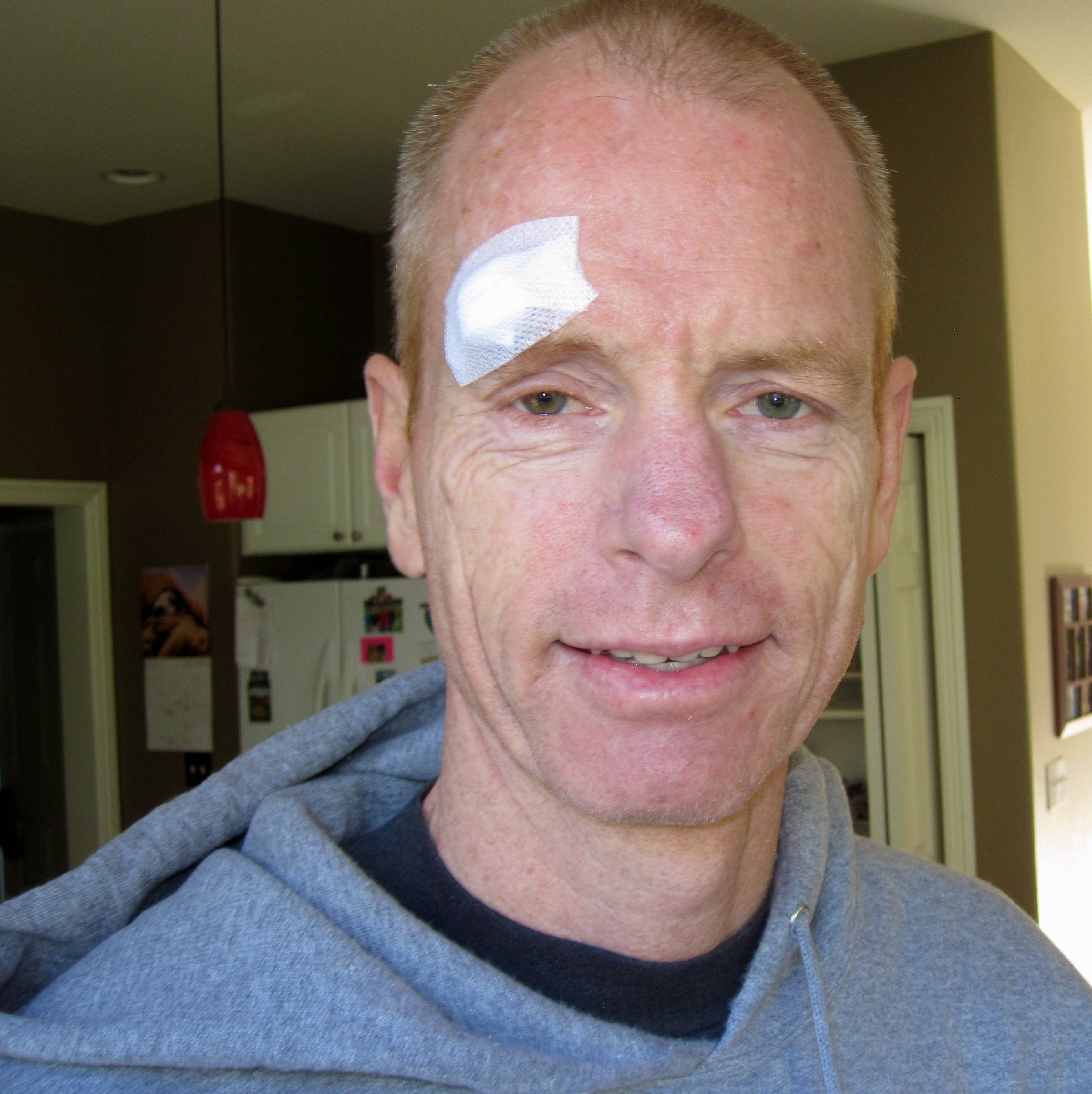
Dr. Derm was like a kid in a candy shop with the liquid nitrogen. Arm, forehead, back, leg. “Mind if I just. . . ” “No, go for it.” I could have timed it better since I’m in full blister mode days after Halloween. She added two biopsies for good measure. Have to go back next week to have a couple above the eye stitches removed.

She said it might leave a scar. Cool.

When I was twenty, I did a summer-long internship in inner-city Boston. Day two I was voted MLM, “Most Likely to get Mugged,” by my fellow interns. Was it my fault I had a safe, suburban, youthful mug?

Now though thanks to Father Time and Dr. Derm’s knife maybe I’m finally going to start looking like a bad ass.

In the middle of my internship, near the end of a hot and humid summer day in the Jamaica Plains section of Boston, I walked from a food bank where I volunteered two days a week to the nearest subway station for the trip back to Dorchester. Walking alongside a large housing project, I thought to myself, man, that’s a large water fight up ahead. Wonder how they get the hydrants open? Look at all the girlfriends on the porch.

Suddenly, the water fighters turned their attention to me as if I had a sign on that said “Help Ron Win the MLM”. And by “turning their attention,” I mean they started running after me with buckets in hand.

I’ve run fast maybe four times in my life. Three times in Louisville, Kentucky before age eight when I was deathly afraid of dogs and tried to outrun a few and that day in Jamaica Plains. Long story short, barely made it to the “T” unscathed. Those scoring at home recorded it as a near mugging.

Now, there will be no more running. I’ll be able to walk anywhere, anytime, Clint Eastwood Gran Torino style. I’m trading in my MLM for a BBA, “Biggest Bad Ass”. It’s about time.

Don't Mess With Me

How Autobiographical?

Awhile back, I started out a fitness update with a passing reference to an encouraging sibling of mine who once told me “no one cares” about my swimming, cycling, and running.

That begs a larger question. What type of writing do readers, blog readers more specifically, find most interesting?

I’m not entirely sure, but I have some hypotheses. Think of the blogosphere in terms of a continuum with writers either off the stage altogether, on the stage’s edge, or center stage. Put differently, there are blogs focused almost exclusively on impersonal specialized content of some sort; other blogs that focus on the sometimes personal application of relatively impersonal specialized content, and blogs whose content is in essence the personal details of the author’s life.

I don’t read a lot of blogs, but here are a few that I do that represent fairly well the different points on the continuum. Each is wildly successfully at least measured by readership. Also interesting, Cowen and Trunk self identify as having Aspergers.

Example one, Marginal Revolution by Tyler Cowen, an economist. Written primarily for other economists, the content is sometimes a reach for me, which is nice. Cowen is scarily prolific posting several times a day. The main thing to note about his blog is he’s mostly off-stage. Sure he’ll ask for restaurant suggestions for where ever he’s traveling next, and he’ll summarize what he’s reading every few weeks (also scary, seemingly a book a day), but don’t look for him to write about whether he’s getting along with his wife or daughter or his non-academic interests.

Example two, DC Rainmaker by Ray Maker, a triathlete. I highlighted Ray’s blog recently. Written primarily for other triathletes, the content tends towards the science of triathlon training. His reviews of triathlon related electronics are the clearest, most detailed, and intelligently written up on the internet. He’s also an outstanding photog who sprinkles twenty or so pics in his three or four posts a week. Ray is my “stage’s edge” example. Two-thirds of the time he focuses in on all things triathlon. The other third, you learn about his worldwide travels (I’m guessing he does IT for the State Department), his fascination with sharks, his love of cooking and food, and “The Girl” who he was recently engaged to.

Example three, Penelope Trunk’s Brazen Careerist. Penelope is the undisputed “center stage” champion. She’s successful I suspect for the same reasons the authors my writing students and I are reading—Esme Cadell, Sherman Alexie, and Frank McCourt—are: 1) She understands that not every moment in every day and not every day in every week is equally interesting. She’s skilled at teasing out from the details of her life “critical incidents” that encapsulate the most interesting elements of her life that also resonate with other people. 2) When describing and exploring the meaning of the critical incidents of her life she grabs readers by the collar by providing intimate details even when they are not flattering. Scratch that, especially when they’re not flattering. And there-in lies the third reason. 3) She doesn’t self-censure herself, instead she opts for authenticity, transparency, the unvarnished truth, pick your phrase(s). In the same literary vein, Tina Fey’s or Liz Lemon’s self-deprecation on “30 Rock” is pure genius.

So in essence, my sib didn’t go far enough. If I self-censure myself and churn out safe, vague, self-conscious descriptions of the personal aspects of my life no one will care for any parts of my personal life story let alone the swimming, cycling, and running chapters of it.

And in all honesty, three years in and I still haven’t figured out yet how to follow Trunk’s, Cadell’s, Alexie’s, and McCourt’s examples in this format. For example, I’ve consciously chosen not to write about the most personally significant thing that has happened to me this year. I’m not quitting though and I suppose this post is another step in the process of figuring where I want to sit on the continuum and exactly what type of blogger I want to be.