
A Cry for Help

If you’ve been paying attention, you’ll recall a confession I made a month or two ago—I’m more handsome than handy. As a result, once a year, the GalPal hires a handyman or should I say “person” to caulk, replace the carpet on the garage steps, fix faucets, and other things that I should probably know how to do.

But I’ve always been mechanically challenged and no one ever taught me how to replace or fix carpet or faucets. My “tool chest” is unbelievably bad. So once a year I suck it up and make out a $300 check to some manly man who spends five hours doing what would take me five weeks. Good for the economy right?

The GalPal upped the ante recently when she came home from church with the “great” news that she met a handywoman who was just starting up her business. “I want to give her a try.” Damn, what if her van is parked in the driveway when the boys drive by? Screw the Neanderthrals, good for gender relations right?

If only I was that evolved. Truth be told, one of two things has to happen. She has to switch to a nondescript van or my hyper handy brother-in-law has to move from Indiana to Washington so he can chip away at my “Honey do” list throughout the year, thus sparing me more Handywoman humiliation. My b-i-l, let’s just call him Bil, is known among his four adult children as “The Smartest Man in the World.” Not just the smartest, also the handiest and funniest. I’m beggin’ ya Bil.

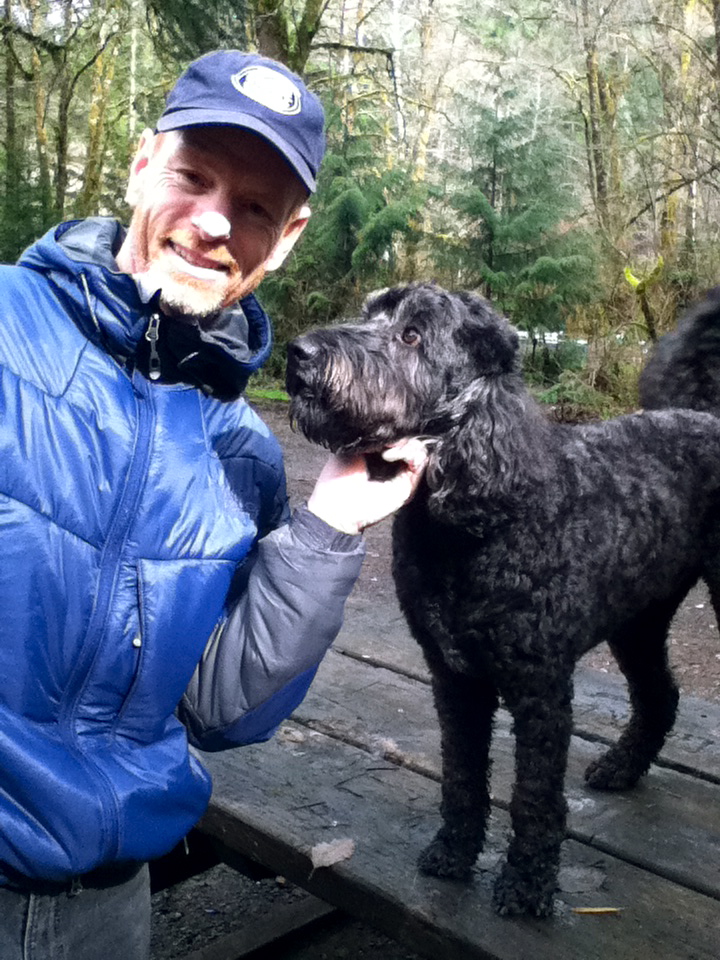
Like all of us, Bil is fallible. His one flaw is a doozy too. He lives several states and thousands of miles from his only grandchild, see below in full dog regalia, my godchild. The inhumanity! It’s high time he pack up his fishing poles, rifles, Pittsburgh Stealer jerseys, wife, and head due west. If Olympia is too dark, gray, and wet for six months of the year, what about Wenatchee, which is convienently half way between here and Missoula, MT, home of flappy eared grandchild.

The outcome? He sees his grandson every few months, he sees us a few times a year, he makes the Handywoman redundant. A distinct win-win for family and my ego.

Postscript. I recently installed a new toilet. Well, truth be told, I watched my friend next door instal our new toilet. To his astonishment I had removed the original before he arrived. Him, where is it? Me, recycled downtown at Habit for Humanity. Him, didn’t know you had it in you. Wish you had saved the hardware. Me, breaking down things and demolition have never been the problem, it’s the putting back together where I suck.

This slideshow requires JavaScript.

It Gets Better Project

Timely, important, moving, potentially life saving website, book, videos and more based on a pledge—Everyone deserves to be respected for who they are. I pledge to spread this message to my friends, family and neighbors. I’ll speak up against hate and intolerance whenever I see it, at school and at work. I’ll provide hope for lesbian, gay, bi, trans and other bullied teens by letting them know that “It Gets Better.”

And although the week is only half-over, I’m going out on the limb and anointing this semi-related (connect the dots yourself) post by Alex Tabarrok, Do Cellphones Cause Brain Damage? POW-status (Post of the Week).

And this Jerry Seinfeld Royal Wedding gem the QOW (Quote of the Week).

“You know, it’s dress-up. It’s a classic English thing of let’s play dress-up. Let’s pretend that these are special people. OK, we’ll all pretend that—that’s what theater is. That’s why the British have the greatest theater in the world. They love to dress upand they love to play pretend. And that’s what the royal family is—it’s a huge game of pretend. These aren’t special people—it’s fake outfits, fake phony hats and gowns.”

And this Sudhir Venkatesh’s Slate magazine semi-related piece (again, connect the dots yourself), “What Is the Matter with Sociology?” the BESS award—Best Essay on the State of Sociology of the week.

And at the risk of starting a ROW, I anoint you Reader of the Week.

Is Online Learning A Good or Bad Thing?

I know you can’t put the toothpaste back in the tube, but is the steadily increasing popularity of on-line learning a good or bad thing?

Depends. If all one wants students to do is recall mostly factual information on mostly objective exams, online learning makes a lot more sense than everyone meeting at brick and mortar locations at the same time.

But if it’s important that students learn to think critically, analyze content, and show empathy for others or develop greater self-understanding, a social conscience and interpersonal skills, it’s problematic because those skills tend to require “thinking out loud” side-by-side, asking questions, debating case studies, listening, problem-solving, and in the end, constructing knowledge together.

Then again, it’s probably just a matter of time until on-line instructional software incorporates group video conferencing and other related features that will make all of those more interpersonal aims equally achievable on-line.

Until then I confess to getting more than a little queazy when applicants to the Masters teaching certificate program I coordinate inform me they attended on-line universities. “Is that going to be a problem?” Inner voice, “Hell yeah!” Apart from counseling and diplomacy, I can’t think of any more intensely interpersonal profession than teaching.

I want prospective teachers to be subject-matter experts—which means knowing the elementary curriculum AND eight year olds inside and out or 9th grade physical science AND adolescents. I also know that their success as teachers will hinge as much or more on their ability to get along with students’ families and their fellow teachers and administrators more than their undergraduate grades or teaching licensure test scores. When it comes to adults getting along with one another, every school is dysfunctional, just in different ways and in different degrees.

Isn’t most contemporary work similarly interpersonal? And shouldn’t education be about citizenship as much as it is employment? And doesn’t effective citizenship require well developed interpersonal skills?

Maybe the better, more specific question is what distinguishes good online programs from bad ones? My guess is the best online programs are hybrids that require students to combine their online learning with weekly or monthly face-to-face teaching and learning experiences on brick and mortar campuses.

Palm Springs Retrospective

Managed to earn points while sharing a one bedroom, one bath timeshare with the in-laws for four days in Palm Springs last week. Something about my “unusual patience” and “good humor”.

In-law humor can be kinda delicate, but I have to admit, I was pretty funny. My sense of humor is a barometer of my level of stress and my connection to the peeps I’m with. The greater the inner calm, the deeper the connection, the funnier.

Sunshine and warm temps were a highlight. It was bizzare walking off the plane after 41 straight days of rain into the sun-drenched semi-opened airport. Thought the GalPal was going to pull a Pope, get on all fours, and kiss the ground.

In four days, I worked out for 45 minutes. Went for a run one morning. Ran through the development, down to Dinah Shore, into Patriots Park, around the high school, to Mission Hills, and back. Ran and ran and ran some more. Thought to myself, that had to be a solid 7.5-8 miles. Pulled the GPS out of my shorts pocket, 5.75 miles. Chalk it up to warmer temps and no teammates.

Playing golf with my father-in-law was a highlight. I negative split both rounds, 46-40-86 and 50-38-88. Easy, shortish, 6,100 yard courses rated 69.5. As expected I have no touch, but I somehow finished round one off with two birds for the first time ever. Round two was a par 35-37, so I had a 12 footer to play the back nine in level par as the Brit’s say. Channeled my inner-Schwartzel and hit the hole, but it lipped out. Renting clubs was an interesting experience because they were nicer than my sticks. It has been twenty years or so, so maybe I should upgrade before Senior Tour qualifying school next year.

The California strawberries and Salmon Farfalle at a restaurant whose name I can’t remember were off the hook.

Enjoyed a grande green tea latte non-fat extra hot (that was for my sissy who probably quit reading a few pgraphs ago because of the self indulgent nature of this post) at a swanky hotel with a lake in it. While there, we saw a bikini clad women walk smack dap into the middle of a business attire happy hour.  The GalPal declared, “Sex worker.” Who knew she possessed that type of radar? So of course the rest of the afternoon, whenever I spotted a scantily clad woman, I had to ask, “Sex worker?”

Taking the tram up to the top of Mt. San Jacinto was a highlight. The GalPal is injured so instead of hiking we found a big rock in the sun, grooved on the cool temp, meditated on our surroundings, and had a nice talk. We didn’t plan well, only having two apples in one backpack. Make that one after the GalPal watched hers bounce down the side of the mountain. I had to make a tough call, could I rescue the runaway apple without expending more calories than contained within the apple. I rolled the dice, hunted all over the hillside, and finally tracked it down. Bruised, but still edible.

The one lowlight was the 40+mph winds on our final day. Let’s just say our take-off was NOT fun. All I could think was “I’ve probably flown more miles than 90% of the people on this plane, but I’m still more scared than 90% of them.” One would think the more you fly, the more you get used to turbulence. Not me. I sacrificed all of the points I had earned over the four days in about four minutes. Certain my life was about to end, instead of thinking about my lovely wife and wonderful daughters, I thought I may never get a chance to hone my short game and turn my 86 and 88 into 76’s and 78’s. How tragic that would be.

This slideshow requires JavaScript.

Teach Friendship

Most friendships just evolve. Our closest friends typically end up being people with whom we share a common activity or interest. In terms of living emotionally healthy, constructive, fulfilling lives, nothing matters much more than who we become friends with and whether they inspire us to be better or worse people than we would be without them.

Because we aren’t as intentional as we might be about our friendships, we assume the young people we have responsibility for will just “find their way”. Experience is a great teacher, but parents, teachers, coaches, youth pastors, and other adults that regularly work with young people should explicitly teach friendship. Choosing friends that inspire is a learned skill. Just hope that those types of friendships naturally evolve at your children’s and your own risk.

Those were my thoughts while reading a nice one-pager by KJ Fields titled “How to spot an unhealthy relationship” in Group Health’s Spring 2011 NWHealth magazine. Thanks to Fields for providing a tool for teaching friendship. These are signs that a relationship may be bad for you:

  • You don’t feel respected or listened to.
  • The other person’s opinion is always the one that matters most.
  • Your feelings are belittled.
  • You act differently around this person, fearing disapproval or anger.
  • You feel worried and tense about the relationship, rather than enjoying it.
  • You’re always the one to make the effort or compromise.
  • Your values and beliefs are far apart.
  • The other person is overly critical of you, and frequently insults you.
  • You find yourself lying to hide information from the other person.

That’s a nice conceptual framework for dinner table, school, or youth group conversations with adolescents especially about peer relations in general and dating relationships more specifically.

In Praise of Anonymous Giving

We’re living in the Age of Self Promotion. That’s why this recent headline, “Secret Admirers Give University $100m,” is so refreshing. Thank you to the anonymous “Kalamazoo Promise” donors.

The magnitude and non-Ivy League nature of their generosity are both inspiring, but their counter-cultural selflessness even more so. Appears as if the donors were honest about a few strings or conditions that accompanied their gift. “If you accept this gift, you can’t name the medical school after us, you can’t allow us to influence your construction and operation of the medical school, and you can never reveal our identities to anyone.”

Save or Spend?

There are three types of people in the material world: savers; spenders; and somewhere, someone, who perfectly balances the two. Too bad young lovers rarely get around to asking, “Saver or spender?” because mismatched partners no doubt deal with more than normal stress and conflict.

A consummate saver, I’m a distinct minority. News outlets have been churning out report after report about Baby Boomers not having saved nearly enough for their impending retirements. Look for older and older employees in the workforce.

Recently, a Wall Street Journal writer (article link—Want to Retire Wealthier?) asked, “Why is it so difficult for people to set aside money for the long-term future?”

Then answered, “Low earnings and high temptations are obvious reasons. But perhaps the most basic cause is a fundamental human frailty: We view our future selves as strangers.”

The intriguing article continued:

Estimating with any precision what you will want 30 or 40 years from now is almost impossible. You don’t know your future desires, because you don’t know your future self. What will you want or need when you are 65 or 70 or 80 or older? Who knows?

Viewed this way, it isn’t surprising that the young typically don’t want to save for their retirement, since that stage of life feels as if it will be lived by someone else. And when you save money today on behalf of your remote future self, you deprive your immediate present self of cash you could use right now.

Of course, if you spend tomorrow’s savings today, you won’t have cash when you need it in the future—but that day of reckoning is decades off. That is true for those of all ages, but the lost opportunity is greatest for young people, because money set aside at an early age has more years to grow.

Yet it is highly unusual for people to think more vividly about their future selves than about their present selves, say psychologists.

The project underway at Stanford seeks to close this gap between the present self and the future self, without turning young people into misers. By enabling the young to see themselves as they will be when they are old, virtual-reality technology can transform their urge to spend for today into a willingness to save for tomorrow.

Interesting finding. Pictures of people’s future elder selves inspire them to save more.

Reminds me of the “marshmellow study” described here.

In that study, researchers learned that young children who couldn’t wait to eat one marshmellow (“low delayers”) and thereby sacrificed receiving a second one, seemed more likely to have behavioral problems, both in school and at home. They got lower S.A.T. scores. They struggled in stressful situations, often had trouble paying attention, and found it difficult to maintain friendships. The child who could wait fifteen minutes for a second marshmellow had an S.A.T. score that was, on average, two hundred and ten points higher than that of the kid who could wait only thirty seconds.

You and I know S.A.T scores are inconsequential in the bigger picture, but it’s hard to underestimate the importance of delaying gratification.

I wonder, what’s the secret to striking the best possible saving-spending balance? Put differently, how should one balance living in the present on one hand and in the probable future on the other? And if virtual-reality technology holds promise for helping spenders save more, what might help hyper-savers strike a better balance?

Ethiopia’s Epic Underachievement

I was cycling indoors at home recently while watching a tape of the just completed LA Marathon. Like the movie Groundhog Day, Ethiopians moved to the front of the both the men’s and women’s races. Ethiopia’s Bizunesh Deba, looking freakishly fresh, sat on American rookie Amy Hastings for the first 18+ miles at which point she slowly put 150-200 meters into her for victory in 2:26:34. Deba, 23, has won seven of the nine marathons she’s entered. Someone is mismanaging her, but I digress.

In the men’s race 26 year-old Ethiopian marathon rookie Markos Geneti ran a 1:02+ half and blew away the field coasting home in a course record 2:06:35. He’s a preeminent short and middle distance runner, but the marathon is where the money is in track and field these days. From now on, he’ll get six figures to show up at races.

The LA Times reported that Geneti plans to invest his $125,000 in earnings in a school in Addis Adaba (correct spelling, “Ababa”).

I was intrigued by Amy Hastings grittiness and guts. When she fell off Deba she crawled back into touch, fell off again, and got back in touch, before fading right before the finish. It was an incredible debut. Afterwards, I read an interview with her from before the race that included this question: One of the appeals of elite-level running is that the people, by and large, are smart, nice, insightful, introspective, all those good things. In addition to the fact that you obviously love the sensation of running, I would think that the kind of people that you meet in running, the kind of people you’ve been teammates with, the kind of people you’re rivals with, have been a big part of the appeal, isn’t it?

This got me thinking about what else we may be able to generalize about elite marathoners. To the interviewers list I’ll add: self confidence, intense competitiveness, extraordinary self-discipline, resilience, optimism, and off the charts toughness.

If I were to write about every elite Ethiopian runner, you’d have to set aside the next hour. It’s Kenya, Ethiopia, then all the other countries of the world combined. I like Geneti and Deba in London (assuming Deba starts spreading out her races better).

And when I taught at a private international school in Addis Ababa, my best students were Ethiopian public school students who won scholarships to our school and went to Harvard and other elite universities after graduating. These athletes and these students accomplishments beg the question, how does a country with Geneti and Deba and Nebiyeleul Tilahoun type of human resources continue to struggle to meet people’s basic needs?

The short answer is poor governance. No doubt Meles Zenawi celebrates “his” runners accomplishments and uses them to bolster his own image among his people. Here’s his story.

I hope Ethiopia’s runners, young students, and other citizens find inspiration from the Middle Eastern protestors to help close the Great Rift Valley that exists between their impressive human potential and bitter day-to-day realities. And I hope upon hope that Meles Zenawi is living in exile when Geneti and Deba walk into the opening ceremonies in London in the summer of 2012. Assuming, that is, they make the team.

The Public School Budget Crisis and the Dilemma of Professional Development

From the Tacoma News TribuneDuring the course of a school year, the cost to offer professional development adds up to a tidy sum, which is getting harder for school officials to ignore as they comb their budgets for savings.

Fork in the public school budget road. Given budget shortfalls in the tens of millions, the question for the Tacoma School District, and nearly every other one, is how to prioritize among competing trade-offs including: 1) continuing professional development including the mentoring of beginning teachers; 2) retaining more teachers and thereby maintaining smaller class sizes; 3) consolidating (meaning closing some) schools; or 4) reducing pay. Put differently, the District can’t afford to maintain the same professional development program for the same number of teachers in the same number of schools at the same level of pay.

I’m here to help.

Dear Superintendent Jarvis,

While it’s not obvious, as the coordinator of my university’s Masters Teaching Certification program, I’m on the front lines of this dilemma. Currently I’m reading applications, interviewing prospective candidates, and deciding (with the help of some colleagues) who gets the chance to earn a teaching license and who doesn’t. Ours is an above average program, but we need more applicants with even stronger academic backgrounds to choose from. As you’re well aware, legions of fifty and sixty-something boomer teachers are nearing retirement.

In short order, the profession is going to need an infusion of smart, dedicated, caring teachers. The medium and long-term health of your schools depends upon my university attracting deeper and stronger pools of applicants.

While admittedly difficult, I implore you to take the medium to long view by continually asking what priorities are most likely to attract more highly capable college graduates into the profession. The “least worst” outcome is to reduce professional development and consolidate some schools. On average, K-12 teachers make 40% less than their college graduate peers.

I suspect that for every percentage of teachers’ pay you cut and for every student you add to their average classrooms, we lose strong prospective candidates to the business world and other graduate programs. Chip away at compensation and increase teachers’ work loads through larger classes and our pool of applicants will shrink and weaken. The future quality of teaching in your schools hinges on preserving pay and favorable work conditions.

Professional development excellence does not requiring flying in a math expert for two days for $5k. Doing so suggests there isn’t a single teacher within the district who has specialized math expertise that will benefit others. Paying a charismatic professional speaker for a few inspiring talks is easier than changing the work culture, but it creates cynicism because of the utter lack of follow through. If we’re honest with ourselves, we know the medium and long-term benefits of distant experts will always be negligible.

Instead, think bottom-up and assign more responsibility to your teacher-leaders for professional development. Ask them to survey their colleagues and then plan more meaningful discussion-rich sessions around the issues they’ve identified as most important.

If you carefully explain how consolidating schools is the “least worst” outcome most people will eventually come around. People are understandably upset that their property values have plummeted while their property taxes have stayed the same or increased. No one ever likes to see their neighborhood school close, but they’ll be more understanding if you help them connect the dots between school closings, greater economic efficiency, and more manageable property taxes down the road.

Yours Truly,

Ron

I Predict

One year ago, I predicted the Seattle Mariners were going to win the World Series. Finishing the regular season at 61-101, they just missed the playoffs. Their anemic offense set records for futility. I am the original April Fool.

A few weeks ago I predicted the Belmont Bruins were going to win a few NCAA tournament games and go farther than Arizona. Wrong and wrong.

I will not be swayed. I predict I’m going to see the sun next week when I’m living large in . . . wait for it. . . Palm Springs, California. Look for me. I’ll be the dude by the pool with a hoodie over my headphones. This is what I’ll be rocking.

I also predict Butler over KY which means you should bet on UConn or VCU (where I interviewed for a job back in the day). Shaka did too much press this week. Wasn’t smart. Beware the bright lights.

In other news, we learned this week that the President has been lurking on Pressing Pause. Wednesday’s headline read, “Obama calls for U.S. to cut oil imports by a third by 2025“. Of course any goal that exceeds a politicians term by a year, let alone nine or thirteen, is disingenuous. In 2025, Obama will be playing golf on a daily basis. I call bullshit on any politician whose promises exceed his or her term.

Every once in a while you write a post that starts out nice and focused, say on failed predictions, and then goes off the rails, and we all know what happens when a train jumps the rails.

Fitness update. See, total nonsequitur. Jumping the rails never ends well. March was very solid. In terms of Tour de France prep, I’m slightly ahead of schedule. Lighter than normal teaching schedule, injury free, no excuses. Swam 2x/week, 29,400m; cycled about 4 hours a week, 349 miles, all but 76 indoors on the M3; and ran 4x/week, 148 miles. And I’m turning into a pushup planking machine. Highlight of the month (or year, or decade, or my athletic life), when Marley spotted me too big of a lead up our hill and I held him off for the driveway victory. Lowlight, doing backstroke right on the lane line during a busy day at the pool and first brushing an unknown woman’s breast, then her hip, and then her thigh in the lane next to me. I was not arrested and I have not seen my picture in the lobby. Wonder what the statue of limitations is on something like that?

What races or events are on the schedule? Apart from waiting on the RAMROD lottery, strangely, none at present.

As soon at Butler cuts down the nets, the obvious question isn’t what to do in Libya, but who is going to win the first major golf tournament of the year at Augusta National? Tiger, Phil, Watney, Kuchar, Westwood, Double E, Kaymer, Couples, Matteo Manasserro? I’m going to go with Watney, which means he’ll be lucky to make the cut.

For tolerating this stream of consciousness, I give you Cori Schumacher, who because she’s not for sale, is the Pressing Pause Person of the Week. Link here.

As always, thanks for reading. Have a great weekend and “see” you next week.

Left to right, The Winner and the LOSER