
Z

First in a series. Possibly. Depending. Upon your response. A series where I introduce you to the most loyal PressingPausers. The peeps who read regularly and respond sporadically, in Z’s case almost always behind the scenes using something known as electronic mail. Or actually, snail mail half the time.

Z was a mentor, friend, lunch bball brother back in the day when I taught at Guilford College in Greensboro, NC. Is still a dear friend, despite living on the wrong side of the country. A now retired psychology professor whose wheelhouse was really social psychology, and even more specifically, the power elite. He was the rare small liberal arts college professor who managed to maintain a large university-like research agenda, pumping out articles and books on men and women he followed over decades from their admission to the “A Better Chance” program into the uppermost levels of business, government, law, and other professions. Lucid, imminently interesting, substantive stuff.

And he’s also The Commissioner. The guy who holds the M-W-F noon basketball game together, now I think half a century old, through court closures, pandemics, and Father Time. He published a great book on that part of his life too. When angry and much larger Joe Groves didn’t like my defense and/or my committee’s general education curriculum revision proposal, Z would reign Joe in with a look or quick comment in the locker room. Everyone always respected The Commissioner. Even angry Joe Groves.

Today, by chance, this was on the doorstep. Sent by Z.
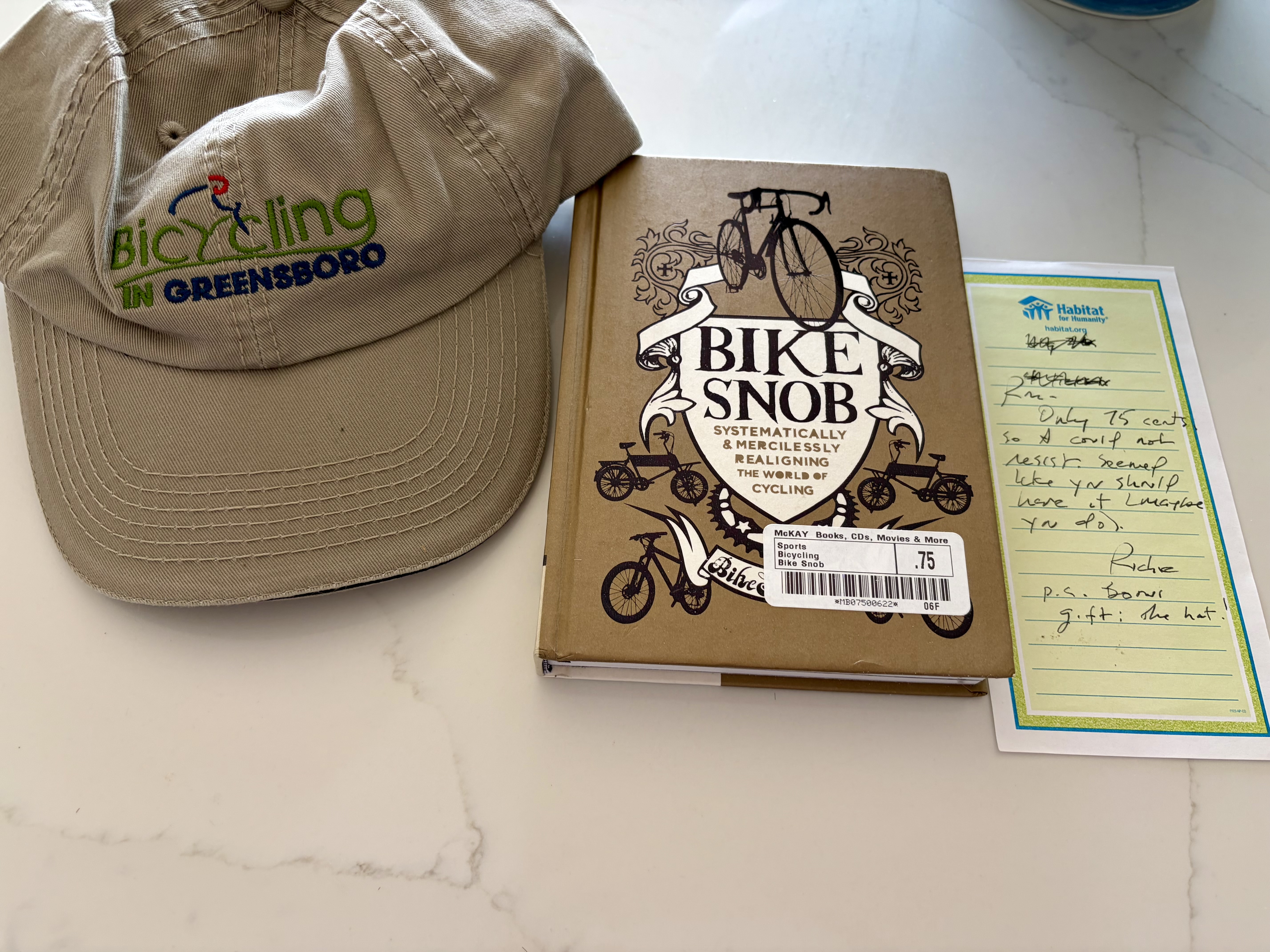
I can’t believe how lucky I am to have a friend who still thinks about me almost twenty five years since I padded his assist totals with my silky J.

Z or I sent the other a winning t-shirt every April depending on how the NCAA tournament played out, I took a handful of west coast teams, he took an equivalent number of east coast ones, but conference craziness fecked all of that up, so now it’s the occasional book. Like with too many of my friends, I need to pick up the slack. Note to self. Find a book, send it.

Z, like me, really dug his students. He also loves his border collies and L, a wonderful pottery artist.

Ironically, I just bought something in his parts, Wilmington, NC more specifically, that I can’t tell Z anything about. Interesting things about Wilmington, NC, it’s where Michael Jordan grew up and where I competed in my first triathlon. Threw my back out the day before, didn’t know if I could go, but got through the intracoastal waterway swim feeling okayish. Then the out-n-back 40k flat/windy bike. I could swear it was a side wind! At the turn around I learned it had been a full-on tail wind, so that last 20k into the wind was when I realized I’d seriously overcooked myself. Let’s just celebrate that there’s no internet archive where you can find my 10k split and leave it at that. But I digress.

Why can’t I tell Z about my Wilmington, NC purchase? Because it was everything he’s not. It was spendy, frivolous, flat out silly. Z likes to remind me that the mountain bike that he rides all the time he picked up at a garage sale, back in the day, for $50. When we were hangin’ he drove a worn in Toyota Corolla wagon with more miles than he had lunch ball points. His computer was ancient. I remember a landline in the crib. Prob still there. Because why not, it works, he’d correctly say. Z is a reminder that you never have to recycle, reuse, or reduce if you don’t ever replace.

So, no, he’ll never know what is on a 3,042 mile journey from his NC to my WA. Like my 10k run split, a national secret of the highest order. Better that way. He’d be disappointed. And Z, the best guy in the world, is that last person I’d want to disappoint.

The Ultimate Litmus Test

At the end of life, how does one know whether they’ve lived a good life or not? More personally, how will you know if you have? How will I?

Many of us live as if professional reputation, material wealth, and social status are the key ingredients, but watching The Good Wife get closer to the end provides an altogether different litmus test.

Which is this. Have you been a good enough friend, to enough people, long enough, that they’re there for you at the end? Or has a certain self-centeredness and peripatetic life left you mostly alone?

You’ll only know which of these is the case if you die slowly. Some of us will go quickly like a friend of mine who fell over dead on his bike in Italy last summer. Although he didn’t have time for the “close friend” litmus test, his memorial service provided positive clues to a life well lived.

Based on the “close friend” test, Lynn has lived an exceptional life. Unfortunately though, she’s unable to take solace in that knowledge. Because like many of us, she’s incredibly hard on herself.  My unprovable hypothesis is that the built-in feeling of inadequacy began at birth with Lynn wondering, “Why didn’t my mom want me?” Almost certainly, it didn’t help when 45 years later she contacted her birth mom only to learn she still didn’t want any kind of relationship.

Consider the last 48 hours. Yesterday, Lynn participated in a zoom call with her four dear college roommates. “Participated” meaning listened intently and smiled throughout. Today, an hour before Pastor Carol was coming by with communion, Susan texted to see if she could pop in. I said she could join Lynn and Carol, Carol happens to be Susan’s pastor, and the three of them visited for over an hour. I could go on and on. Lynn’s support network has blown my mind. She is being loved and supported by so many people none of whom are the least bit phased by her worsening symptoms like her loss of voice.

Some bring art, some bring pictures, a lot bring food. In the end, they just want to be next to her. And to see her smile. When we’re without her smile there is going to be a painful void in a lot of people’s lives, not just A’s, J’s, and mine.

I intend on honoring Lynn’s eventual legacy by prioritizing friendships even more.

Two Worlds

Public and private. All of us behave a little or a lot differently whether we’re in public or not. In extreme cases, people live “double lives”.

The dichotomy between Lynn’s public life, by which I mean when friends and family visit, and private one, where I’m the only person around, is so glaring that it got me thinking.

Specifically, I’ve been pondering why she’s not just okay when friends and family are around, but especially smiley (and today, extremely giggly) and physically better than normal. There’s a wonderful lightness. I guess it makes sense learning what we’re learning about the importance of close interpersonal relationships to our overall health and well-being.

But man, the whiplash that comes when friends and family leave is intense. And disorienting.

When home alone she pops boosters between timed meds and her body is off and on, and when on, she’s bored, and she struggles with any sense of purpose. There’s a heaviness.

Why am I telling you this? Not sure. Maybe to help you mentally prep for this phenomenon if you’re ever a primary care giver. Or maybe I’m letting you in hoping for some sort of connection.

Last night, I had an epiphany. A tough one that I was hesitant to share with Lynn because I expected a negative/defensive reaction.

I told her I had an observation I wanted to share with her. “You have a restless spirit.” There, I said it. Fortunately, I was wrong, because she didn’t argue the point. She listened carefully as I told her I missed her, that it felt like all of her time and attention was taken fighting her Multiple Systems Atrophy. That there was no time or attention left for me.

That I felt more like an employee than best friend.

Most people confined to a wheelchair and unable to do hardly anything independently watch a lot of tv and read. Since Schitt’s Creek ended, Lynn doesn’t watch tv and her reading glasses, despite repeated trips to the optometrist, aren’t working well enough for her to read much.

Thus, when alone, if she’s feeling okay, she’s in constant motion searching for something to do. Anything to do. Or she’s laid out on the couch waiting for her meds to kick in. The only time she’s not on the move is when her body completely quits or she’s asleep.

Our convo, mostly about how dying is scary and spiritual malaise, deepened. She cried and said she didn’t know “I loved her that much”. I took in what I think was her deeper message, “I didn’t know I’m that lovable.” I told her lots and lots of people love her.

I told her I was having a hard time dealing with her restlessness and with her constant MSA fight. That caring for her took all my energy, that there was no leftover energy to just hang. And that it would be really sad to spend our final months or years together not really together.

Case in point. Saturday and Sunday nights I throw dinner together for the fam and then sit at the kitchen island with my own dinner while one or both daughters join their mom at the dining room table. Hell, during the week I do it too, leaving Lynn to eat by herself. Yeah, you’re right, I am a lowlife.

While I am a lowlife, I probably deserve a few points for being vulnerable and risking the convo. Sadly, in part, I risked it because soon we won’t be able to have back-and-forth conversations of that sort.

But not being especially centered myself these days, it’s really tough to take on her anxiety about dying, her exasperation at MSA’s relentless progression, and her general unease and utter restlessness. Especially given the cost that restlessness is taking on our friendship. For now.

Postscript: We ate dinner together. Afterwards, there was more slow dancing in the kitchen. The roller coaster keeps rolling.

Pro Proximity

I’m sorry, but as a professor I have to sporadically use unnecessarily complex words. Like “sporadically” in place of “once in awhile”.

More illustrative of this professional obligation is the term “dialectical dilemma” which is when two seemingly conflicting things are true at the same time. Por exemplar, I annoy people*, you annoy people, people inevitably annoy one another, a little or a lot, some of the time, or nearly all of the time. It’s just baked into our daily lives. We give and we get.

Social scientists keep learning about all the ways close interpersonal relationships, or more plainly friendships, are essential to our well-being. Especially as we get closer to senior discounts.

So what are we to do? We annoy each other, but need each other.

Some people choose to live in remote settings where they’re way less likely to interact with others. Thus, they’re way less likely to be annoyed, while simultaneously giving up the substantial benefits of social interaction.

To each is own of course, but I’m convinced we should embrace the risks of being annoyed by living in closer proximity to others. Put differently, we should design our lives so we have to interact with others on a regular basis. Knowing our feathers are going to get ruffled.

Zillow has a cool feature called the “Walk Score” for residences. Our old home had a Walk Score of 0. Our new one has a Walk Score of 65. From the country to the city we go.

One day last week, the Good Wife tricked me bigly. “Do you want to weed the front together?” she asked. I knew I was looking especially fetching, but that was a shameless come-on if I ever heard one. I pictured us rolling around in the dirt. Maybe? Instead, once I got into full tree trimming and power weeding mode, she announced she was going inside.

Then. It. Happened. It turns out we live on a major bike route. Someday, if you bike from downtown Olympia to the Westside, you will go right by our house. In an hour, 15-20 cyclists went by. Of all sizes and shapes. After a kitted-out BTorian passed on his mountain bike, he turned back and said, “Is that Ron Byrnes?!”

A little later Suzie, the owner of a downtown art gallery stopped on her ginormous Specialized e-bike. And we talked and talked and talked. She asked me when I’m getting an e-bike, which in hindsight, prob shoulda prepared me for the Burgerville bullshit.

And then Burke, from two houses down came over, and we talked. About how middle schoolers care about one thing, peer relations, and therefore will say ANYTHING to preserve them.

Long story short, in one hour I spontaneously interacted with more people than I did in eight years at our Nature Park residence. Which is good for me, because I’m an introvert.

So six miles and 65 points later, I’m damn near a social butterfly. A slight exaggeration, but don’t hate me because you ain’t me.

*Last week, when I was in too big of a hurry, I may have left my Costco cart against a curb in the parking lot instead of returning it to the cart stand. A women in a minivan slow rolled right by me, GLARED at me and then WAGGED her finger at me as if I had just run over a kitten and a puppy. It was so over the top, it didn’t have the intended effect. Instead of feeling shamed, I felt amused and amazed that I could annoy her that easily.

It’s My Parents’ Fault

Suffice to say, my personal life has gotten significantly more difficult of late. Obviously, this isn’t the time or place for any details. Just know, as your humble blogger, I am “compartmentalizing” these days.

The GalPal wants me to find a therapist to help make things less difficult. I know lots of people who are benefitting from therapy, and intellectually I am definitely pro-therapy, but when push comes to shove, I am Resistant to seek the help of a mental health counselor myself.

Not only am I pro-therapy, I believe our well-being depends largely on the quality of our closest interpersonal relationships, and those relationships depend largely on our willingness to be vulnerable about our inner lives.

The gender stereotype that males think and talk almost exclusively about tangible objects—whether news, weather, or sports, okay maybe cars too—doesn’t apply to me. I’m always thinking about deeper things than just how bad UCLA men’s basketball is this year.* What to do with the nearly constant deeper inner dialogue, that is the question.

Two imperfect answers spring to mind. The first was modeled by a friend a week ago when he asked if we could talk. He suggested a bike ride, and despite the frigid temps, of course I was in. Looping FishTrap Loop shoulder to shoulder, I initiated, “So, what’s up?” “It’s a long story,” he started, but really it wasn’t. It was a very good talk/ride and I’d like to think he felt better afterwards.

What’s imperfect about that? With occasional exceptions like the one just described, my closest friends, being of the male persuasion, aren’t as adept as women at talking about their feelings. As a result, it’s rare for a male friend to genuinely ask, “So, what’s up?” Could I take more initiative with my friends in digging deeper into “real” life? Fo sho.

In theory, writing could be a helpful outlet too. That is, if I could figure out the endlessly convoluted privacy concerns of those nearest and dearest to me. Which I can’t. And before you suggest it, journaling ain’t the answer, because that’s just a more visible form of the inner dialogue.

So, given those limitations, why not just “do” therapy? Asked differently, what the hell is wrong with me, that I’m so resistant to “professional” help?

I’ve been mulling that around and around.

What I’ve concluded is that the Good Wife doesn’t fully appreciate just how much I am a product of my parents’ “too extreme for their own good” intense independence. Both my mom and my dad grew up without much, during the Depression, in eastern Montana. When my dad died, his obituary was in the New York Times. Individually and together, they developed resilient, “grin and bare it” approaches to life that worked for them.

Mostly. Better for my dad than my mom who would have benefitted greatly from therapy after my dad’s death, from which she never really recovered.

Again though, that knowledge of how helpful therapy can be is overridden by my parents’ modeling which was rooted in the brutal conditions of eastern Montana in the 1930’s. Suffering was synonymous with living. You just endure it, in whatever form it takes.

Asking me to just dial up a therapist feels like asking me to break from my past and my people, to defy my DNA. Despite all the decades, I am still of eastern Montana, still of Don Byrnes, still of Carol Byrnes, still of believing that I must grin and bare it mostly alone.

For better, or more likely, for worse.

*thank goodness for the women

Monday Required Reading

School starts tomorrow, so time to buckle down. Plus, Scottie loves assigned reading.

  1. I want one.
  2. Turns out, it’s really hard to scare a seal. Bonus trivia, the Byrnes clan is celebrating the fact that eldest daught lives 5 miles from the Ballard Locks as of today.
  3. Effective altruism has gone mainstream.
  4. The six forces that fuel friendship.
  5. How does it feel to be a teacher right now?
  6. Guilty as charged.

‘You’re Dead To Me’

Kaitlyn Tiffany’s thoughtful reflection on the increasing tendency of people to cut one another out of their lives.

“The internet is wallpapered with advice, much of it delivered in a cut-and-dried, cut-’em-loose tone. Frankly worded listicles abound. For instance: ‘7 Tips for Eliminating Toxic People From Your Life,’ or ‘7 Ways to Cut a Toxic Friend Out of Your Life.’ On Instagram and Pinterest, the mantras are ruthless: ‘There is no better self-care than cutting off people who are toxic for you’; ‘If I cut you off, chances are, you handed me the scissors.’ The signature smugness and sass of Twitter are particularly well suited to dispensing these tidbits of advice. I don’t know who needs to hear this, a tweet will begin, suggesting that almost anyone might need to hear it, but if someone hurts your feelings, you are allowed to get rid of them. There is even a WebMD page about how to identify a ‘toxic person,’ defined aggressively unhelpfully as ‘anyone whose behavior adds negativity and upset to your life.’ Well, by that measure … !”

How Well-Intentioned People Slowly Fall Apart

A clear, thought provoking excerpt from  Matthew Fray’s book, This Is How Your Marriage Ends: A Hopeful Approach to Saving Relationships.

Dig the last two paragraphs:

“If I had known that this drinking-glass situation and similar arguments would actually end my marriage—that the existence of love, trust, respect, and safety in our marriage was dependent on these moments I was writing off as petty disagreements—I would have made different choices.

I could have communicated my love and respect for her by not leaving tiny reminders for her each day that she wasn’t considered. That she wasn’t remembered. That she wasn’t respected. I could have carefully avoided leaving evidence that I would always choose my feelings and my preferences over hers.”

In one portion of my first year writing seminar, my students and I explore the concept of romantic love and the notion of “soulmates” more specifically. Next fall, in that context, we will read this essay. Eighteen and nineteen year olds don’t even remotely think about romantic relationships in Fray’s suggested terms because no one ever asks them to. In my teaching experience, when they are challenged to, they routinely rise to the occasion and reveal genuine maturity and depth.

More broadly, if you want to invite me to a dinner party, I would enjoy using this excerpt as a case study of sorts to engage other couples about the relative health of their relationships. It would be thrilling because it could go spectacularly wrong, but even then it would be revealing to hear people’s different perspectives on Fray’s telling of his divorce story.

Or I suppose, we can just keep talking about Elon Musk, the price of gas, and the weather.