Christine O’Donnell

This is funny. From wikipedia:

She attended her university’s commencement ceremony in 1993 but did not receive a degree, due to outstanding unpaid tuition.

Her apparent familiarity with debt means she might do well in Congress. One wonders though, what are the odds if she loses (the special Senate election in Delaware) on November 2nd that she attends the swearing in of newly elected Senators anyways?

Positive School Culture

The “secret” of creating a positive school culture is to attend to the details. The larger feel of a school, its overarching ethos, often hinges on subtleties like student friendly signs like this one. A single sign is relatively inconsequential, but a constructive tipping point can be reached when positive signage is combined with other student friendly practices.

Beautifully Sad

College drop off one is in the books. How was it? Beautifully sad. After the final hugs, we finally boarded the airport shuttle bus. Eighteen made it especially tough because she wouldn’t walk away. She just waited and watched, never budging. I guess I should have known that was coming, but Fifteen had to inform me that Eighteen’s always stood frozen in time watching whatever conveyances take her loved ones away. Points off for not knowing that.

I was surprised by the GalPal’s relative calmness. Later she informed me she’d been crying quite a bit in private over the last few weeks. Her spirituality made all the difference. Her epiphany? Ultimately, Eighteen belongs to God. We’ve just been taking care of her the last eighteen years. She’s also convinced the distance will prove instrumental in Eighteen assuming adult responsibilities.

Lots of thoughts were swirling around in my head on the shuttle bus ride to the airport. The overarching one was how beautifully sad the separation was. I suppose some parents are glad when their young adult children finally leave the nest. That, in my mind, would be sad sad.

It was a reminder that in life whenever we choose intimacy (by partnering with someone for long stretches of life or by choosing to reproduce), we inevitably increase the risk of painful separation brought about by human fallibility and/or the natural passage of time.

Another thought was how nice it was that I didn’t have to give the final pep talk I had tentatively planned titled, “Work Even Harder, Honor your Grandparents, Don’t Eat Too Many Chocolate Cocoa Puffs, and Be Sure to Get Enough Sleep” because we spent four days together, days marked by dinners out where I told a few college and life parables that communicated everything I had wanted to. I know her well, she listened carefully, I felt no need to elaborate.

The weirdest thing about the four days was how comfortable Eighteen was in her own skin, even when surrounded by her sometimes annoying sister, mother, (and always) annoying father. Day four, after moving in to her dorm room, I suggested she go to the dorm’s dining hall for lunch and “meet us back here” by the student store cafe. “No, I’d rather eat with you guys.” It wasn’t the decision of a shy, anxious, introverted first year, but that of a young woman who appreciates her family and wanted to enjoy our visit to the very end. Despite the antics of her perpetually silly family, there was never a hint of embarrassment, just a mix of fondness and gratitude.

A silver lining of the trip was the thoughtful way Fifteen seemed to process a visit to a neighboring college, her dad’s dinnertime parables, and her sister’s first day of college orientation. She’s always done well in school, but now I think she’s even more motivated to do her best.

The first five-six days at home have been different, but nice. Last week I bought a smaller piece of halibut, only half a gallon of chocolate milk, and the GalPal and I have had enjoyed more time alone.

And the inevitable, natural passing of time marches on.

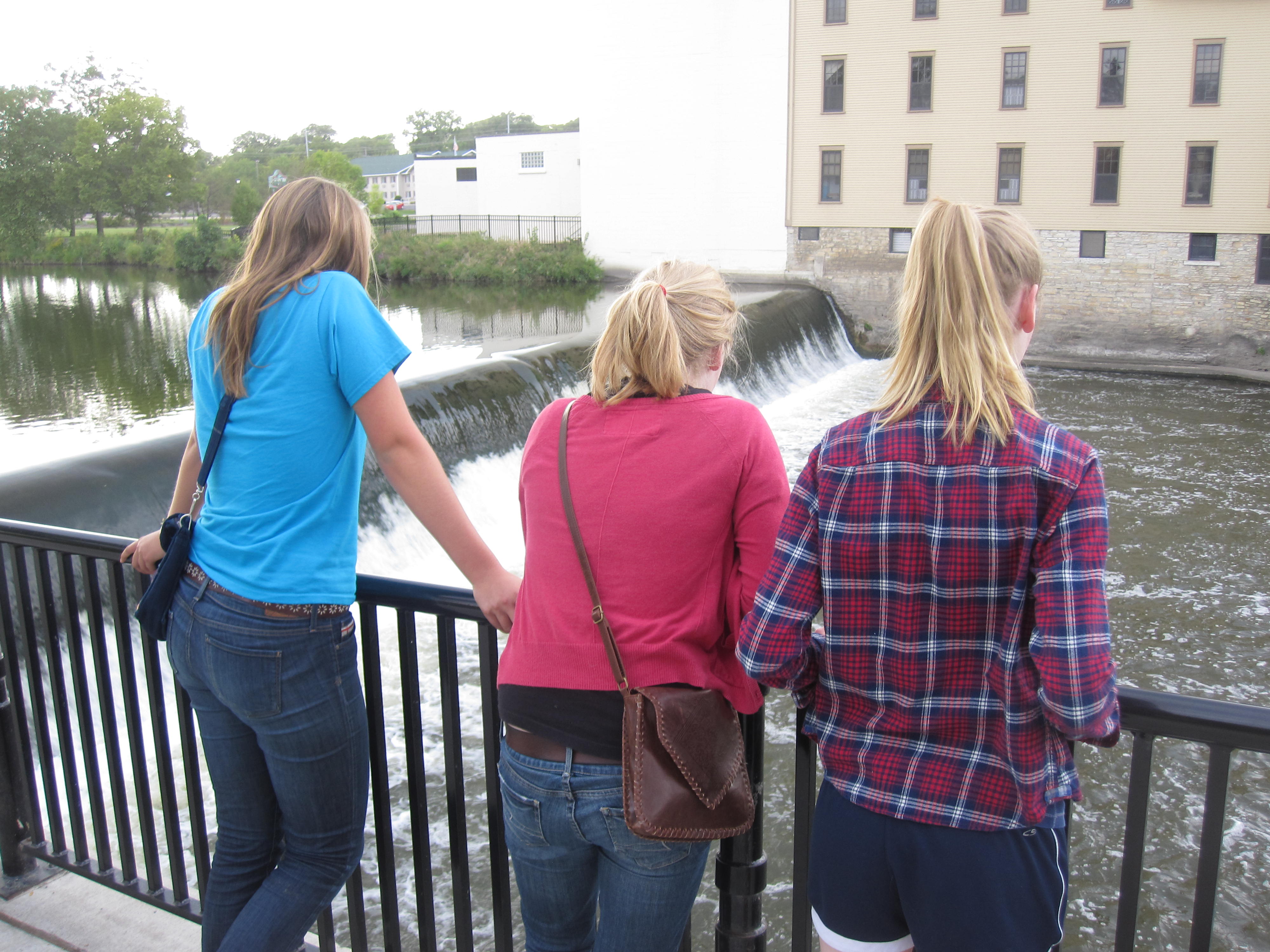
Left to Right. . . Two College Women and a High Schooler Ponder Their Future

Resilience

I’ve been thinking about how different my daughters’ lives are and the seventeen year old central character’s in Winter’s Bone.

Winter’s Bone has the feel of a documentary/commercial hybrid. It’s the story of a seventeen year old woman taking complete care of her mentally out of it mother, 12 year old brother, and six year old sister in a desperately poor, rural, Appalachia-like environ.

Her dad is elsewhere cooking meth and he’s put the house up as collateral on a bond and then missed his court date. As a result, the house will be repossessed if he’s not located within a week. The bulk of the film is the daughter trying to locate the father. In the hands of these particular filmmakers, it’s a brutal, powerful, mesmerizing story.

Despite the increasing prominence of national chain stores in this country, this film was a reminder that substantive regional and subcultural differences still exist.

My daughters have a legion of educated, financially secure parents, grandparents, aunts, uncles, and older cousins. They’re entering adulthood with a nine-person offensive line to run behind. The central character in Winter’s Bone had an extended family wracked by poverty, substance abuse, and violence. When the ball was hiked to her, she had no one to block for her.

Despite all the countervailing evidence, many Americans believe every young adult has an equal opportunity to flourish. Did the drug users in Winter’s Bone choose separately to take drugs or did they succumb to pervasive environmental influences? Were they immoral, undisciplined psychological weaklings or rather was their demise practically inevitable and entirely predictable from a socio-psychological point of view?

Even though the central character turns out okay because of her uncommon resilience, we need social, economic, political, and education reforms to expand the life opportunities of poor young people. The challenge is implementing those reforms without forcefully capping other young people’s life opportunities. Exceedingly difficult to pull off, especially in a recessionary era.

Sometimes I wonder if my daughters might be too privileged to develop the type of resilience they’ll have to draw upon to be successful adults. They don’t project a sense of entitlement, and they are socially aware, but they could be even more so.

Eighteen’s fancy pants college should show the class of 2014 Winter’s Bone so that they more fully appreciate the amazing opportunities their college experience will provide them.

[first Pad post, harder to edit sans mouse, so DKB cut me some slack]

Gerotranscendence

Word of the week. Before you start using it in conversations, read about it here.

In other aging-related news, thanks to Ronni Bennett for recommending Positive Momemtum to her readers earlier this week. I “met” Ronni through a Wall Street Journal essay she wrote. I wrote and asked her for some blogging suggestions and she was very generous with her time and insights. Her outstanding blog is titled “Time Goes By” and I highly recommend it to anyone that is getting older. Note that her header is one of the best in the blogosphere.

Please don’t tell Ronni I’m only 48.5 years old because all the bloggers she’s recommended are supposed to be 50+. However, maybe I only think I’m 48.5. Maybe I lost count somewhere like one sometimes does in “99 Bottles of Beer on the Wall”.

Like a Cuban pitcher, maybe I’m older than I’ve been thinking these last several years. I mean how else to explain this piece of recent mail?

I can’t share with you, my loyal blog readers the first thought that came to mind when I read this piece of mail, without losing the respect of my mother, one of the people whose respect means the most to me, because she finds swearing offensive and objectionable.

Maybe there’s a way around this conundrum. Here’s a hint. My knee-jerk reaction was to say the same thing I said to a running friend recently when he wondered aloud whether my friends and I may have deserved to have a can of beer thrown at us while cycling single file on the edge of the road.

Loss of ability to smell? Hearing loss? Loss of mobility? That’s how you warm me up for your “free” products?! For your information, I just did a little 119 mile bike ride around the Puget Sound. Put that in your pipe and smoke it.

Send another mailing like that and you’ll be the one’s needing additional security.

Rethinking Report Cards-Conclusion

What forms will the pushback against alternative report cards likely take? Several. First, many middle aged and older people will argue “Traditional report cards worked just fine for us back in the day. My friends and I turned out okay.” Change is threatening. “Was my education incomplete/imperfect?”

Schools should be continually reinventing themselves to better meet the needs of students who must adapt to a rapidly changing world. Reformers should be mindful that propositions like mine will make many older people defensive, but they should not let that dynamic thwart them from making the necessary changes.

Second, the families of students who have been most successful within the traditional reporting system will protest. Good grades are way of maintaining one’s privilege in an intensely stratified society. Alternative report cards should be designed so that they can’t be easily co-opted by the academically privileged. Probably easier said than done.

Third, teachers will most likely protest the additional time that will be required to write individual report cards. Calculating grades take secondary teachers a long time, but these narrative report cards, if done thoroughly and thoughtfully, will take even longer. We need to attract teachers who embrace the additional time as a worthwhile trade-off for providing substantive information that makes teaching and learning much more meaningful. How to do that probably requires another series at another time.

Thoughts?

Rethinking Report Cards 3

How might this type of alternative report card revitalize teaching and learning? For starters, it would require teachers to clearly distinguish in writing between undeveloped and highly developed skills, sensibilities, and personal attributes and also to thoroughly and thoughtfully place students on related continua.

The skills I’ve highlighted would also promote interdisciplinary teaching and learning.

It would benefit traditional “A” students by clearly communicating that everyone has room for improvement, that in fact, we never arrive at total mastery of any content, set of skills, or sensibilities.

It would also benefit students whose natural strengths don’t align well with schools’ traditional emphasis on math and English/Language Arts. The report cards would better communicate that academic excellence is a life-long endeavor that takes many forms.

What form will the pushback against report cards like this likely take? Tomorrow’s conclusion.

Rethinking Report Cards 2

Why have grade-based report cards stood the test of time with hardly any variation despite radical changes in the world more generally? What purposes do grade-based report cards serve?

Grade-based reports cards have proven so resilient because they are a sorting mechanism. They enable teachers, counselors, and coaches to quickly and simply categorize very large numbers of students and slice and dice in terms of extracurricular and graduation eligibility. Similarly, they enable college admission officials to quickly and simply categorize large numbers of students and slice and dice in terms of their relative value especially when compared to something like narrative summaries of each individual’s strengths and next steps.

But as a result of endemic cheating that takes place in secondary schools grades are not nearly as indicative of meaningful academic achievement as nearly everyone thinks.

Listen to secondary students who have been labelled successful as a result of receiving good grades. If honest, many of them will tell you that they didn’t earn them. Instead, they learned to “do school” by cutting corners whether copying one another’s homework, manipulating teachers to lower their expectations and/or routinely extend deadlines, and cheating on exams. In hindsight they often express regret and confess to remembering little from their coursework. They regret that their writing, thinking, and oral communication skills aren’t more fully developed.

If grade-based report cards were to be radically redesigned, how might teaching and learning be revitalized? Answering this question actually first requires asking what might an updated, new and improved report card look like?

It would prioritize skill development, it might incorporate on and off-campus extracurricular activities, it would rest on narrative statements of each student’s distinctive strengths and most important next steps, and it would incorporate some degree of self-assessment. What skills? Here’s five: 1) the ability to process large amounts of information and distinguish between what’s most important and what’s least important; 2) the ability to synthesize seemingly disparate information; 3) the ability to evaluate the relative accuracy and objectivity of television programming, internet websites, digital images, and other multimedia content; 4) the ability to write and speak clearly, insightfully, and persuasively; and 5) the ability to understand a topic or issue from another person or group’s point of view. It would also incorporate important sensibilities and personal attributes including small group smarts, cross-cultural understanding, resilience, and personal integrity.

Tomorrow’s starting point. How might this change revitalize teaching and learning?


Rethinking Report Cards 1

Grade-based report cards are a “regularity of schooling”. Regularities of schooling are those features of school life whose utility we rarely question, such as age-based grade levels, starting school in September and ending in June, and assigning students grades based upon the quality of their work (Sarason). Regularities of schooling result from teachers being far too busy to stop and reflect on the advantages and disadvantages of the daily practices they inherit from the veteran teachers they replace and way too busy to envision promising alternatives.

The question, “Why are we doing this, this way?” is rarely asked, nor the natural follow up, “Is there a better way?” The unspoken answer, “Because it’s always been done this way.”

Similar limits of time result in parallel regularities of consumerism, church life, health care, marriage, and, I suspect, every sector of life and the economy. On those rare occasions when we have spare time to thoughtfully evaluate the usefulness of our personal and work life activities, we tend to fill the quiet empty spaces with television, internet surfing, and related noise/activity.

We aren’t disciplined enough to stop, reflect, envision, and thoughtfully implement promising alternatives to the regularities of our personal and work lives.

Why have grade-based report cards stood the test of time with hardly any variation despite radical changes in the world in which we live? What purposes do grade-based report cards serve? If they were to be radically redesigned, how might teaching and learning be revitalized? What form will the pushback against updated alternative report cards likely take? I begin answering these questions tomorrow.