Why American Teens Are So Sad

Derek Thompson in The Atlantic.

Somber opening that won’t surprise anyone working closely with adolescents.

“The United States is experiencing an extreme teenage mental-health crisis. From 2009 to 2021, the share of American high-school students who say they feel “persistent feelings of sadness or hopelessness” rose from 26 percent to 44 percent, according to a new CDC study. This is the highest level of teenage sadness ever recorded.”

The rest is required reading for anyone seeking to understand teen mental health.

Symbolism Over Substance?

I am fortunate to live in Olympia, Washington in the upper lefthand corner of the (dis)United States. This morning I did one of my fave runs. To Priest Point Park, a loop of the heavily wooded east-side trail, and back, 7.5 miles for those keeping score at home. Now I’m sitting at my desk looking alternatively at my computer monitor and Budd Inlet, the southernmost part of the Puget Sound, a series of saltwater inlets that are, in essence, a bucolic part of the Pacific Ocean.

But did I really run to Priest Point Park and am I really sitting above Budd Inlet? Indigenous groups are succeeding in renaming places based upon their history. Now, Budd Inlet is more appropriately called the Salish Sea and the Olympia City Council is in the process of renaming Priest Point Park, Squaxin Park, after the Squaxin island tribe, who lived here first.

I am down with the updating, but I wonder about a potentially subtle, unconscious even, unintended consequence. What if we think land acknowledgement in the form of updated place names is sufficient and stop short of more substantive changes that would both honor Indigenous people’s history and improve their life prospects?

Of course it doesn’t have to be either/or, it can and should be both/and, but we seem prone to superficial, fleeting acts that are often “virtue signaling“. We change our blog header to Ukraine’s flag, we put “Black Lives Matter” stickers on our cars, and otherwise advertise our politics in myriad ways, but we don’t always persevere. With others. Over time. To create meaningful change.

What is the state of the Black Lives Matter movement? How much attention will the media and public be paying to authoritarianism in Eastern Europe a year or five from now?

Admittedly, that’s a cynical perspective, but I prefer skeptical. I’m skeptical that substituting the Salish Sea for Budd Inlet and Squaxin Park for Priest Point Park will do anything to protect salmon, extend educational opportunities for Indigenous young people, educate people about our Indigenous roots, or improve Indigenous people’s lives in the Pacific Northwest more generally.

In fact, I wonder if it may, in an unfortunate paradoxical way confound those things. I hope not.

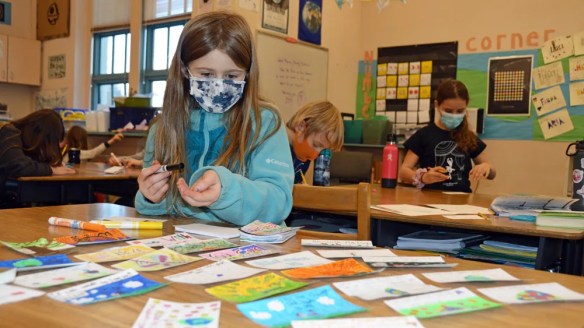
Spreading Kindness

Inspired by Ann Braden’s “Flight of the Puffin” fourth and fifth graders are making and sharing kindness cards with people in their school community. 

Fifth grader Hazel Uvenes reflects:

“The person who gets the card knows that they are kind and different and amazing in their own way. I think it’s really great because sometimes the littlest things can bring somebody out of a bad day.”

She added:

“I think maybe it could uplift their spirit a lot, and they feel like they can have fun, they believe in themselves, they can be kind to others. . . “

Soon the students will share their kindness cards with local organizations in order to brighten even more people’s days.

Lincoln-Kindness

Schools Remain Sites Of Joy

Hey school principals, pay even closer attention to positive emotions and experiences.

Applies to leaders of all sorts. Scratch that, people of all sorts.

From Education Week, “Rx for Principals: Take in the Joy”.

“. . . almost 45 percent of principals said they had considered leaving their jobs or sped up their plans to exit the principalship because of COVID-related working conditions.

Yes, working conditions for principals have been tough. But that’s only part of the story. Even in the current circumstances, schools remain sites of joy. Principals regularly experience this joy, and it could make a big difference in how they perceive their working conditions.”

Let’s start asking principals. . . and others. . . about their most positive experiences.

“If you ask principals about their positive experiences, you will hear a steady stream of stories and see their faces light up with smiles. For example, an elementary school principal in an urban district described being moved to tears seeing an English-learner student, after a difficult year of transition, reading in two languages. Another principal talked about how meaningful she found coaching a novice teacher who was struggling but also improving by the day. Such experiences too often go unnoticed and unshared.”

What have been your most positive recent experiences?

The United States Free Fall Starts Here

With a decline in public support for public education and a concomitant decline in quality.

George Packer in The Atlantic argues that we’ve turned schools into battlefields, and our kids are the casualties.

“It isn’t clear how the American public-school system will survive the COVID years. Teachers, whose relative pay and status have been in decline for decades, are fleeing the field. In 2021, buckling under the stresses of the pandemic, nearly 1 million people quit jobs in public education, a 40 percent increase over the previous year. The shortage is so dire that New Mexico has resorted to encouraging members of the National Guard to volunteer as substitute teachers.

Students are leaving as well. Since 2020, nearly 1.5 million children have been removed from public schools to attend private or charter schools or be homeschooled. Families are deserting the public system out of frustration with unending closures and quarantines, stubborn teachers’ unions, inadequate resources, and the low standards exposed by remote learning. It’s not just rich families, either, David Steiner, the executive director of the Johns Hopkins Institute for Education Policy, told me. ‘COVID has encouraged poor parents to question the quality of public education. We are seeing diminished numbers of children in our public schools, particularly our urban public schools.'”

Packer states what’s increasingly obvious:

“The high-profile failings of public schools during the pandemic have become a political problem for Democrats, because of their association with unions, prolonged closures, and the pedagogy of social justice, which can become a form of indoctrination. The party that stands for strong government services in the name of egalitarian principles supported the closing of schools far longer than either the science or the welfare of children justified, and it has been woefully slow to acknowledge how much this damaged the life chances of some of America’s most disadvantaged students. The San Francisco school board became the caricature of this folly last year when it spent months debating name changes to Roosevelt Middle School, Abraham Lincoln High School, and other schools with supposedly offensive names, while their classrooms remained closed to the city’s children. Republicans have only just begun to exploit the fallout.”

And then concedes he’s “not interested in joining or refereeing this partisan scrum.” Poignantly adding:

“Public education is too important to be left to politicians and ideologues. Public schools still serve about 90 percent of children across red and blue America. Since the common-school movement in the early 19th century, the public school has had an exalted purpose in this country. It’s our core civic institution—not just because, ideally, it brings children of all backgrounds together in a classroom, but because it prepares them for the demands and privileges of democratic citizenship. Or at least, it needs to.

What is school for? This is the kind of foundational question that arises when a crisis shakes the public’s faith in an essential institution. “The original thinkers about public education were concerned almost to a point of paranoia about creating self-governing citizens,” Robert Pondiscio, a former fifth-grade teacher in the South Bronx and a fellow at the American Enterprise Institute, told me. ‘Horace Mann went to his grave having never once uttered the phrase college- and career-ready. We’ve become more accustomed to thinking about the private ends of education. We’ve completely lost the habit of thinking about education as citizen-making.'”

Packer and Pondiscio nail it.

Ca$hing In On The Political Divide

Imagine if there was some perfectly legal way to make money based upon people’s mutual antipathy for one another.

Introducing Conservative Move whose message is simple:

WE’RE MOVING YOU

TO VALUES, PROSPERITY, & SAFETY

When your community no longer reflects morals and values, it might be time to move. We’re an organization of real estate agents here to help you sell your homeorganize the move, and buy a home in a community where you feel safe, valued, and at home.

They emphasize three things that liberals make damn near impossible . . . great schools, safe streets, and lower taxes. Because any rational person knows liberals stand for crap schools, dangerous streets, and high taxes.

They could’ve gone with “no longer reflects YOUR morals and values,” but chose instead to tap deeper into their potential customers inner hate.

Then a kicker:

TIRED OF YOUR WOKE WORKPLACE? WE CAN HELP! 

I prob deserve some blame for this entrepreneurial effort for writing about gun control back in the day on this way too liberal blog.

Right to Bear Arms

“Maybe we should just divide the country into 25 “hawk” and 25 “dove” states. Pick one representative of each view and have them take turns picking states for everyone else. Since I disagree with almost everything in paragraph one, I nominate myself for the doves, and my first pick is Washington State. Clint Eastwood, representing the Hawks, will no doubt take California which I’m not happy about at all. My second pick, Oregon.

For practical reasons, residents of hawk and dove states will be allowed to travel freely into ideological enemy territory; however, they will have to agree to adapt to life in ideological enemy territory. For example, Clint will have to leave his gun at home when he flies to Seattle and I will have to avoid committing a violent crime when visiting California lest I be fired upon by private citizens and/or executed by Ahrnold. Social scientists can do longitudinal studies on the quality of life in each set of states.”

So I guess you have me to blame or thank for Conservative Move, depending upon your perspective. Now certainly, it’s only a matter of time before every conservative finds every other conservative and they fix their children’s schools, eliminate the crime in their community, and lower their taxes.

Monday Required Reading

You Can Learn to Love Being Alone.

“People who pursue solitude of their own volition ‘tend to report that it feels full — like they’re full of ideas or thoughts or things to do. . . . In this way, it’s distinct from loneliness, a negative state in which you’re disconnected from other people and it feels empty.”

Putin’s Bloody Folly in Ukraine.

“As Putin spills blood across Ukraine and threatens to destabilize Europe, Russians themselves stand to lose immeasurably. The ruble and the Russian stock market have cratered. But Putin does not care. His eyes are fixed on matters far grander than the well-being of his people. He is in full command of the largest army in Europe, and, as he has reminded the world, of an immense arsenal of nuclear weapons. In his mind, this is his moment, his triumphal historical drama, and damn the cost.”

The style and substance of South Carolina basketball’s Dawn Staley.

“‘She loves on them hard,’ associate head coach and longtime confidante Lisa Boyer says. ‘She’s playful with them, she’s hugging them, she’s there for them. I think they sense the fairness. I think they sense the genuineness of her. She speaks to them — it’s not some fairy tale. She’s telling them the deal.'”

“‘I owe basketball,’ Staley says. ‘I’m forever indebted to it. It engulfed my life for the positive. The game has gotten more of my time than my friends and my family. I feel like on a smaller or larger scale, it can impact my players’ lives in some kind of way.'”

A Renowned Community of Quilters is Taking on Copycats—and Winning.

“’We put a lot of work into it, and it’s about our life,’ Charley says of quilting. . . . We used these quilts for warmth. It was about our struggle, and our survival.'”

“Charley might feel differently, she offers, if these makers — who may have, say, studied textiles at art school — sent some of their profits back to the community that inspired them. But that doesn’t happen. “This work is ‘inspired’ in your mind, because you see the quilt pattern,” Charley says. “But you don’t know my story. And you’re going to try and duplicate it — and go to Joann Fabrics to do it?’”

Stat Of The Day

Professional basketball division. Luke Kennard of the Los Angeles Clippers is making 44.6% of all his shots this year, but 44.8% from three. The further away he is from the basket, the (slightly) better he gets. Last night he was 8-9 from 3 in a 142-111 victory over the Houston Rockets.

My “j” is similarly filthy, but I plan on continuing to dunk when the opportunity presents itself.