It’s My Parents’ Fault

Suffice to say, my personal life has gotten significantly more difficult of late. Obviously, this isn’t the time or place for any details. Just know, as your humble blogger, I am “compartmentalizing” these days.

The GalPal wants me to find a therapist to help make things less difficult. I know lots of people who are benefitting from therapy, and intellectually I am definitely pro-therapy, but when push comes to shove, I am Resistant to seek the help of a mental health counselor myself.

Not only am I pro-therapy, I believe our well-being depends largely on the quality of our closest interpersonal relationships, and those relationships depend largely on our willingness to be vulnerable about our inner lives.

The gender stereotype that males think and talk almost exclusively about tangible objects—whether news, weather, or sports, okay maybe cars too—doesn’t apply to me. I’m always thinking about deeper things than just how bad UCLA men’s basketball is this year.* What to do with the nearly constant deeper inner dialogue, that is the question.

Two imperfect answers spring to mind. The first was modeled by a friend a week ago when he asked if we could talk. He suggested a bike ride, and despite the frigid temps, of course I was in. Looping FishTrap Loop shoulder to shoulder, I initiated, “So, what’s up?” “It’s a long story,” he started, but really it wasn’t. It was a very good talk/ride and I’d like to think he felt better afterwards.

What’s imperfect about that? With occasional exceptions like the one just described, my closest friends, being of the male persuasion, aren’t as adept as women at talking about their feelings. As a result, it’s rare for a male friend to genuinely ask, “So, what’s up?” Could I take more initiative with my friends in digging deeper into “real” life? Fo sho.

In theory, writing could be a helpful outlet too. That is, if I could figure out the endlessly convoluted privacy concerns of those nearest and dearest to me. Which I can’t. And before you suggest it, journaling ain’t the answer, because that’s just a more visible form of the inner dialogue.

So, given those limitations, why not just “do” therapy? Asked differently, what the hell is wrong with me, that I’m so resistant to “professional” help?

I’ve been mulling that around and around.

What I’ve concluded is that the Good Wife doesn’t fully appreciate just how much I am a product of my parents’ “too extreme for their own good” intense independence. Both my mom and my dad grew up without much, during the Depression, in eastern Montana. When my dad died, his obituary was in the New York Times. Individually and together, they developed resilient, “grin and bare it” approaches to life that worked for them.

Mostly. Better for my dad than my mom who would have benefitted greatly from therapy after my dad’s death, from which she never really recovered.

Again though, that knowledge of how helpful therapy can be is overridden by my parents’ modeling which was rooted in the brutal conditions of eastern Montana in the 1930’s. Suffering was synonymous with living. You just endure it, in whatever form it takes.

Asking me to just dial up a therapist feels like asking me to break from my past and my people, to defy my DNA. Despite all the decades, I am still of eastern Montana, still of Don Byrnes, still of Carol Byrnes, still of believing that I must grin and bare it mostly alone.

For better, or more likely, for worse.

*thank goodness for the women

Dear Taylor

Dammit, I can’t take it any more. A few months ago the word on the street was Austin Reaves. Now it’s Travis Kelce.

Gerl, if you’re really interested in a long-term stable relationship, you gotta quit with the professional athletes, actors, and musicians.

Repeat after me, no public figures.

You need to find yourself a librarian who makes time for his grandmother on Sunday afternoons.

Granted, settling down with a normie may not be great for your art, but there are always trade-offs in life. If you want a family, find yourself a nice librarian and do your best to keep it on the down-low.

You’re welcome.

Ron

Awestruck

I’m officially in the ‘squeezing out’ part of summer.

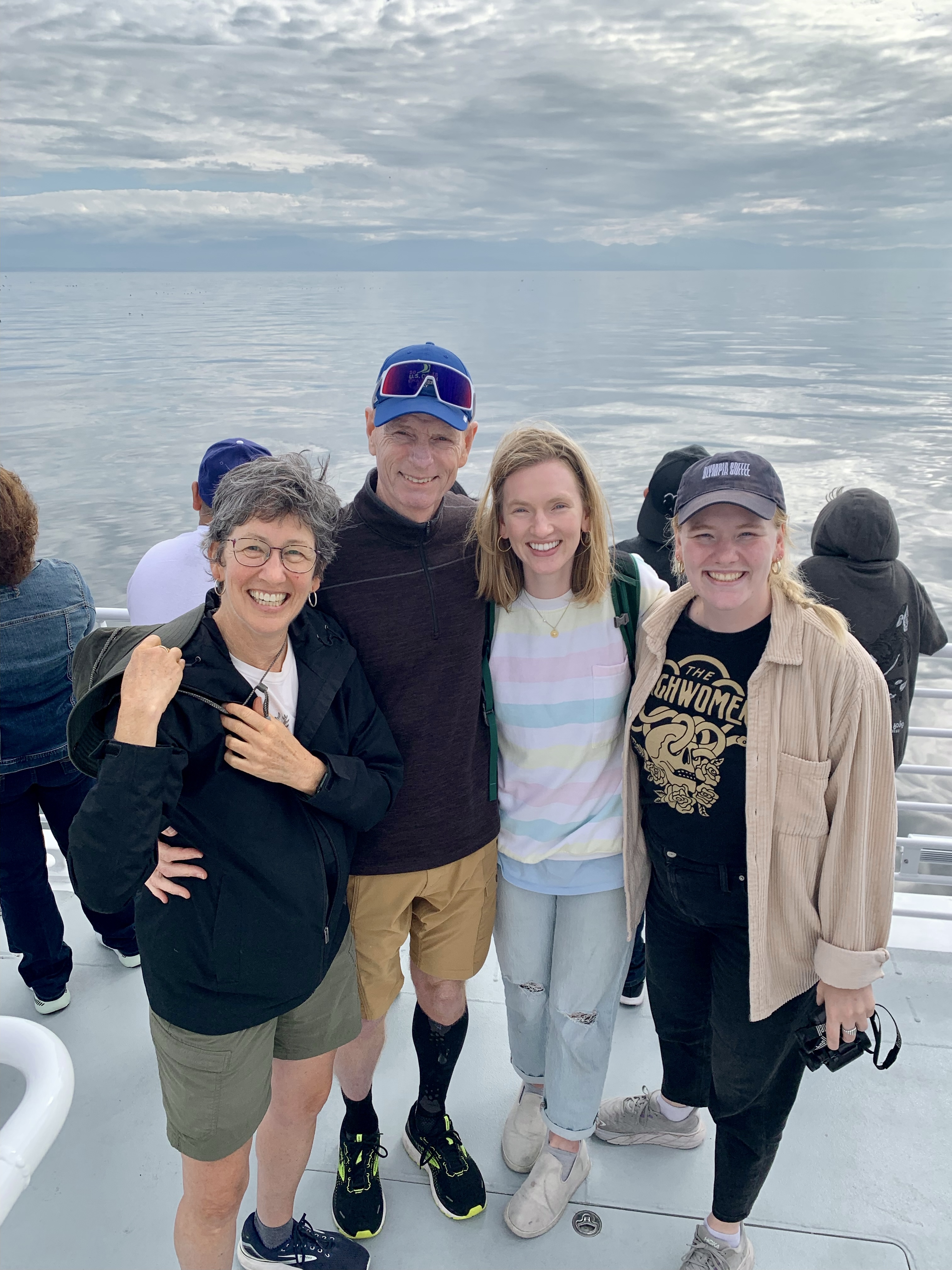
Yesterday, to see whales, the fam traveled from the Southernmost part of Puget Sound to the Northernmost. Off the coast of San Juan Island, our tour operator found two young adult humpbacks. The sight and sound of their exhalations every few minutes were mesmerizing. Off and on we were party to a smallish portion of their backs and small dorsal fins with an occasional flashing of their giant, gray and white splotted flukes.

Then, out of nowhere, one breached, getting about 90% out of the water. Immediately afterwards, their partner did their best to match them. Even having seen whales breach in photographs and video, it was among the most unique/surreal experiences of my life. The boat’s naturalist said they see whales breach about six times a year.

There’s nothing like winning nature’s lottery.

My Students Evaluate Their Parent(s’) Parenting

In response to a chapter on the downsides of “hyper-intensive parenting” in Ruth Whippman’s America the Anxious.

I’ve just started chipping away at the behemoth pile of essays, so this may be coincidental, but a theme of tough-minded, strict disciplinarian parents is emerging. The 18 and 19 year old students are mostly appreciative of their hard ass parent(s).

Except for one little thing, as a student who moved to the Pacific Northwest from Mexico at age 8 explained. She wrote eloquently about being afraid of her mom and emotionally stunted because she never had anyone to discuss her feelings with. A lot of the time she’s not sure what she feels, and when she has some modicum sense of them, she doesn’t know what to do with them. And she concedes, she’s wholly incapable of asking for help.

I used “little” above facetiously because emotional intelligence is THE BIG THING. They think their future success hinges on picking the exact right academic major or getting good grades. But their relationship success, professionally, but especially personally, will hinge in large part on their ability to calmly and constructively discuss their’s and other people’s feelings.

What say you, should I tell them or just let them discover that on their own through inevitable trials and tribulations?

Washington State Students Can Now Take Excused Mental Health Days

Washington joins 11 other states that specifically allow students to take excused mental health days off. From Crosscut:

“Schools can now accept mental health symptoms in the definition of an excused absence, just as they do physical health symptoms. It formalizes allowing students to take days off to care for their mental health, including for counseling and behavioral health appointments.

The law does not allow students to excuse themselves, and each district will come up with its own requirements — for example, if a parent or doctor note will be needed to determine whether an absence is excused.”

One principal acknowledged,

“. . . it’s a change that’s been needed. ‘If a kid breaks their leg, we wouldn’t expect them to take part in PE. But I don’t think there’s an equivalent for a student with debilitating depression.'”

The new rule also enables schools to collect information on its overall mental health, which can inform how they might respond in other ways.

I’m not sure much more information is needed to conclude families, teachers, and administrators are woefully unprepared to adequately help students’ with their mental health challenges.

Week One’s Highlight

Fall semester is off to an excellent, largely mask-free start. Of course it takes more than one or two class sessions to get a true feel for your students’ personalities, but all signs point towards a great semester. The most notable demographic shift of the last few years seems to be accelerating—a significant increase in Latina students. I have half of the football team in one writing seminar (slight exaggeration) and half of my students in my other one want to become writers which is exciting.

Some context. For those newish around here, earning a chili pepper, signifying hotness, on the website “Rate My Professor” is my primary career objective at this point. The one unchecked box. And with each passing year, the Las Vegas oddsmakers say my receiving one is less and less likely.

The highlight of the week happened Tuesday morning when I descended the stairs of our house. Since I’ve been slumming it for months unshaved in t-shirts that could double as bike rags, the Good Wife was impressed with how much I had cleaned up. As she moved in for a steamy back-to-school smooch, she said the nicest thing ever. “I would give you ten chili peppers.”

download

Coming To A Theater Near You

Sometimes A lot of the time I amaze myself.

A movie idea just came to me and no doubt it’s gonna be warmly embraced by Hollywood’s top studios. Let the negotiations begin! Since I’m the ultimate triple threat, they will probably want me to write, produce, and star in it.

The idea came to me Saturday, shortly after Al’s memorial service at The United Churches in our fair city. The service was another amazing remembrance of a remarkable person. Similar to the one for my in-laws last year. At that one, my wife and daughters did a beautiful job capturing what made them so special. If watching a slide show of a person’s life and listening as family and friends reflect on how they left the world better than they found it doesn’t inspire you to consider how to best spend your ever shrinking time, then something’s wrong.

Forget psychedelics, forget chasing fame and money, forget vanity in all its forms, nothing is as inspiring as positive people’s life stories. Just ask anyone involved with hospice care. Al’s three sixty-something daughters told unique, funny, and moving stories about their father. And another friend talked about how Al lit up the retirement community he was a part of and had to be held back when hiking in the mountains even into his 90’s. The quintessential extrovert, Al embraced life to the fullest. He said he would sleep when he was dead. Long live the memory of Al Walter.

Back to my homerun of an idea. Remember Wedding Crashers? Well, how about Memorial Crasher?! Part Ted Lasso, part Ricky Gervais’s After Life, Memorial Crasher is the story of a dude who has lost his zeal for life, meaning it’s the story of most of us. Just can’t find the loving feeling he enjoyed in his youth. He’s surviving sure, but not thriving. He breaks out of his malaise after attending a memorial service for a close friend. As per usual, his resolve to be a better person and live life more fully only lasts a few weeks, then he slowly reverts to his formerly alienated, disconnected, somewhat negative self.

So he concocts an antidote to his default condition. He scours obituaries in local papers and church bulletins, and when he finds particularly inspiring ones, which happens about once a month, he crashes the memorials. No one ever knows he has no connection to the deceased. That way he receives a steady stream of reminders of what’s most important and is continually inspired to be more selfless and daring.

Consequently, his life is transformed. His focus shifts from himself to others. He cultivates gratitude for how little time he may have left. He becomes a much better neighbor, friend, and person.

And picks up several Academy Awards along the way.