Good For You!

Last Saturday I’m  hangin’ at Bill’s memorial service groovin’ on the water view. J keeps telling me seals are popping up when I’m not looking and I’m teasing her about being delusional. It’s noon and the morning’s 10 miler is taking full effect. I say to my gal pal, “I wish someone would hurry up and start in on the buffet.” To which she replies, “Why?” “Because I’m going to be the second in line.” With the utmost earnestness she replies, “Good for you! Good for you!” What the “h” “e” double hockey stick? “You’ve been the first on more than one occasion.” So who knew the GP had been keeping score all these years.

In other family news, someone is spreading a vicious rumor that A. lowered my 500 free time of 6:17. Something about a 6:16.8 at last Thursday’s meet. Okay, I was the timer in the next lane over and this is all I remember. I remember my gal pal timing partner chatting up the timer next to us, the same one who “timed” A’s race. I recall the GP slipping next door neighbor timer a 5-spot right before the 500 free. Me thinketh he started the clock a tad bit late and stopped it a tad bit early. I’d like to review the film if there was some. A’s reaction was hilarious (new Mastercard commercial, shutting Dad up, priceless). She didn’t know or care what place she finished (2nd). She just looked at the electronic timing board like an Olympic athlete and then erupted with joy. Ever the gentleman, I was the first to give her a congratulatory hug even though I got soaked in the process. A great moment, partially because I know I could still kick her ass in open water.

J’s in that stage where in private dad is okay half the time, and in public, not so much. Driving to church Sunday with J and G who slept over. Much to J’s dismay probably, I’m drilling G about last weekend’s regatta in Seattle. “Well you didn’t drown, that’s good. What place did you get?” “About third, but there were tons of other teams.” “Tons, that’s two thousand, 3rd out of 2,000 awesome. J’s trying to conceal it, but she’s smiling so I press metal to pedal. “Wait a minute, tons is plural, so 3rd out of at least 4,000! Wowza!” Full-on smile. Of course is she discovers this story made it into the blog, I’m big in trouble.

Ambition Reconsidered

Unfortunately, I seem to need a steady stream of reminders that life is fragile. I want to live fully conscious of my mortality to avoid taking my health, my wife, my daughters, my extended family, my friends, my work, and nature for granted. It’s a work in progress.

This week I received a postcard with information about my 30 year high school reunion (insert joke here). A few minutes later I had created a minimalist profile and was catching up with classmates via their profiles. Eight classmates have died, two that I knew. Had I been thinking like a mathematician, that wouldn’t have been too surprising, but I wasn’t, so it was.

Equally poignant, an older neighbor-friend died suddenly in his sleep a few weeks ago. Bill was a hardcore cyclist who rode year round no matter how shitty the Pacific Northwest weather. Tough as nails, he conquered RAMROD twice by himself. He wasn’t fast, but everything is relative. His memorial was Saturday at Olympia Country Club. I was the second or third person to sign a poster his widower had laid out on a table surrounded by touching family pictures. Not sure what to write, I peeked at what the elderly gentleman that went right before me wrote. “Bill, you don’t have to go at my pace anymore. You were a good friend that always understood me.”

I think that was and is moving.

In Sunday’s sermon, Pastor John touched upon what he referred to as our society’s three “A’s”, affluence, appearance, and ambition. Maybe ambition gets a bad rap. At the memorial I joked to L and J that when I go they’ll have the same RAMROD t-shirts hanging from my memorial table. My ambition is for some friends to be there and for them to say I was a good friend.

Simplicity

IMG_0103

Behold a favorite possession. Design genius. Simple, unbreakable, maintenance free. Reminds me of a genius move mi esposa made several years ago when she landscaped with large bolders. Beautiful, simple, unbreakable, maintenance free. So far, I haven’t had to fertilize or mow them.

I know some people enjoy spending their time fixing things. I’m more handsome than handy, so I usually don’t enjoy fixing things. I’d like to spend less time maintaining and fixing things—cars, bikes, the lawn, the house, although truth in advertising, mi esposa takes the lead in maintaining the house. Given my orientation, a condo would make more sense than a house, but the abrakadabradoodle probably wouldn’t like that so it’s a non-starter.

If you’re like me and you’d like to spend less time maintaining and fixing things, there’s two obvious courses of action.

First, declutter. Sell or give things away that aren’t used regularly and then have the discipline not to repurchase substitutes. Own less and buy less.

Second, seek out products that require less maintenance and fewer repairs even if they cost more and you have to delay purchases.

Other ideas or product recommendations?

Damn, I kid you not, my wireless mouse just broke.

Deep-seated Fear

We’re reading Unequal Childhoods by Annette Lareau in my Soc of Ed class. In the book, her grad students and her report on their findings from having carefully studied several middle, working class, and poor families. The vignettes are centered upon each family’s nine or ten year old child.

She contends that middle class parents practice “concerted cultivation” by which she means they consciously supplement their children’s schooling through numerous extracurricular activities. In contrast, working class and poor families aren’t nearly as “child-centered”. Instead, they let their kids informally play with peers and rely upon, what she terms, the “accomplishment of natural growth”.

Lareau argues there are advantages and disadvantages to both approaches. I agree with a few of my students who have suggested the best approach is probably something in between.

When reading Lareau I can’t help thinking about the parenting approach L and I have taken over the past 17 years. I think we’ve made a good team which is another way of saying I’m proud of the young women our daughters have become.

But Lareau’s analysis has also got me thinking about my childhood. My parents were middle class when I was 9 or 10, but they took more of an “accomplishment of natural growth” approach than a “concerted cultivation” one. Maybe in part because I was the fourth of four, but I don’t think birth order was as significant a variable as the larger ethos of the time.

Even though the Vietnam War was raging (I iced-skated at Kent State once a week and was surprised to see the downtown burned down on one trip to the rink) and the counter-cultural revolution was in full bloom, parents didn’t feel they had to keep an eye on their children all the time.

I spent my summers biking a mile and a half (clubs on handlebars) on fairly busy roads to the nearby nine hole par-3 golf course and Olympic-sized outdoor pool. One summer my friends and I set up a schedule where I taught golf on M-W-F and they taught swimming and tennis Tu-Th.

I played organized baseball, but everything else was “pick up” in the hood.

Flash forward to a swim-meet conversation I had with a friend last week. The more she talked the more obvious it was that she’s afraid for her daughter. Among other revealing statements, she confessed, “I’m just so glad it’s a closed campus.”

Contrast her with my sissy who let her then 17 year old drive across several states with friends one summer. Throw in a ski boat, cabin, and I think boys for good measure. I remember asking her, “Are you crazy?” To which she replied, “She’s never given me a reason not to trust her.” Trip went off without a hitch.

My guess is my friend is far more typical than my sis.

The question is, why? How much of it has to do with nonstop national media coverage of horrific abductions and/or murders? Unlike my sister, maybe my friend spends her evenings watching those handful of cable television channels that cover (and sensationalize) crime nonstop. Is Nancy Grace to blame?

Negligent parents deserve criticism, but why don’t we challenge the increasing number of overprotective , fearful parents, to consider the costs of their sometimes obvious overcompensating?

Ted Kennedy-Don Byrnes

The media spotlight has shifted, but fortunately, I’m not beholden to it. Here’s one perceptive paragraph in a post on Ted Kennedy’s death that’s thoughtful throughout.

“There are of course those on the far right who are so used to hating Kennedy that they’ll not recognize how he was motivated by the best of intentions, how he struggled to overcome personal tragedies and flaws, and how widely respected he was by colleagues on both sides of the aisle.   They’ll demonize him in death, just as many on the left were unable to let Strom Thurmond live down his early segregationist days.  Those people don’t know what being human means, they are too wrapped up in politics and their own biases.”

Watching the aftermath of Kennedy’s death made me think of my dad who was born just five or so years earlier and died as a result of a heart attack fourteen years ago. At first I suppose Kennedy’s death made me think of my dad because of a physical resemblance, but ultimately, because they shared similar personal attributes.

Like Kennedy, my dad excelled at his life’s work, in his case business, rising to be the chief executive officer of two large companies at the time of his death.

Like Kennedy, he was well respected by everyone he worked with. Like Kennedy, that was because he asked genuine questions of everyone irrespective of their status and then listened as if they mattered.

Most impressively of all, like Kennedy, my dad was humble, not needing or wanting public praise for work well done.

Like Kennedy, my dad’s work ethic was off-the-charts.

Unlike Kennedy, my dad grew up in an Eastern Montana family of very modest means. And unlike Kennedy, my dad was not religious or liberal.

But the more I’ve learned about Kennedy over the last few weeks the more convinced I am that those differences wouldn’t have mattered. Had they met, they would have liked and respected one another a great deal.

The world is a better place as a result of the lives they lived.

Long live their memories.

In Defense of Eavesdropping

I can’t help myself.

If I’m waiting for an airplane, eating at a restaurant, walking out of a movie, setting up at a triathlon, I tend to listen in to other people’s conversations going on around me. Awhile ago, when eating out, my better half “caught me” smiling at someone else’s conversation and shot me her elementary teacher “disappointed in you” look. I suspect she would prefer it if I focused lovingly on her eyes all the time, waiting patiently for whenever whatever is communicated. 

But her disapproval is misguided because eavesdropping is a form of curiosity, a positive attribute. 

Admittedly, one’s curiosity in the form of eavesdropping can take publicly acceptable and unacceptable forms. I don’t sneak onto the phone as family members are taking calls, I don’t sneak into their email accounts, and I don’t move closer to you at the airport or in the restaurant so that I can hear your conversation. 

One reason I don’t do those things is I don’t have to. To generalize, relative to many other people around the world, Americans are loud, so a lot of times people consciously make their conversations public. I trust you’ve met Loud Cellphone Person once or twice. “I’M DOWN AT THE GATE! Pause. WHEAT! ONION! GREEN PEPPER! BUT NOT TOASTED!” I’m not as fond of eavesdropping on LCP because 1) the content is usually inane and 2) I don’t like having to imagine what LCP’s friend is contributing to the conversation. It’s like watching Serena hit the ball without Venus on the other side.

Listening to talk radio is a form of eavesdropping. Reading is a form of eavesdropping on other people in other places and other times. When we go to a theater, pay $10 to see a film, we sit down with a hundred other people and in essence say, “Let’s all eavesdrop together, shall we?” Why is listening to the radio, reading and watching film, all windows of sorts into other people’s lives, perfectly okay, but listening into a conversation in the chairs, booth, lobby, or bike rack next to me is not? I don’t think all the people on the radio, in print, and on film have given their implied consent.

When I listen in to what other people are saying, and by extension thinking, I’m expanding my perspective on the different ways people interpret their surrounding and make sense of the world. It’s a natural activity of a social being. 

All of us do it, in different forms and to different degrees.

I’m okay, you’re okay.

CA Vacation by the Numbers

Pac Northwesterners Loading Up on Vitamin D

Pac Northwesterners Loading Up on Vitamin D

9:  Chickens in Dave’s and Joy’s Santa Barbara backyard.

500: Days of Summer from the film we saw.

50: Meters of the San Luis Obispo (or SLO if you’re cool) outdoor pool we swam in.

25: Yards across said Olympic pool since it was set up for short course.

35: Times I used my new tiny neoprene camera case with a velcro belt loop as a pretend cell phone.

35: Times I embarrassed my daughters talking really loudly into new “cell phone”.

125: Times I said “tru dat” to emphasize the absolute veracity of something.

9: Hours slept per day.

-1: My score relative to par for six holes on Wednesday (a bird and five pars).

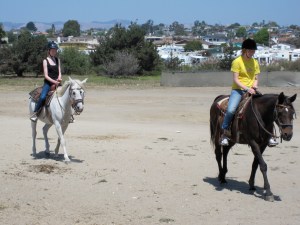
Horsing Around the Pismo Beach Dunes

Horsing Around the Pismo Beach Dunes

1: Time 17 showed me around Facebook.

4: Extra miles run (and walked) in the hills after missing a turn.

5: Pieces of fruit eaten per day.

1: Time I stole a Harry Potter novel from 17 while staging a Pothead intervention.

164: Feet of elevation in about .25 miles on Equestrian Drive.

0: Times sleeping daughters requested a follow up guitar-based wake up song.

Lance's Worst Dream—Swimming on Vacation. . . Tru Dat!

Lance's Worst Dream—Swimming on Vacation. . . Tru Dat!

What, if anything, will we learn from the recession?

I’m not a regular viewer (a necessary qualifier to retain some semblance of masculinity), but I caught an episode of Oprah one night last week. The theme, the recession’s negative impact on people.

I’ll introduce you to a few of the guests, describe what I think the producers wanted me to conclude from the segment, and explain my actual reaction.

Guest one, a 24 year-old woman, had lost her job with an interior decorating company. Not only had she done three internships in college, she had “done everything right” and still ended up standing in an unemployment line. I was supposed to conclude that’s wrong and sad. Sure it’s sad whenever anyone who really wants to work can’t find a job, but even sadder was the subtext: college graduates are entitled to good jobs.

Robert Reich, whose contributions were underwhelming, was the talking head putting the individual stories into the broader context of a changing economy. With respect to guest one, even I might have done a better job framing her experience.

Here’s the takeaway for her, the other student in the news lately who has sued her college because she can’t find a job, and anyone who thinks a college degree entitles them to a good job. A new day has dawned. Sizeable student loans and a college diploma guarantee little. Increasingly, businesses are more productive with fewer people. Profit margins are shrinking; consequently, the race to eliminate jobs is accelerating. You’re competing with more people for fewer jobs, not just your college classmates, but elderly people who are finding they have to continue working, and highly motivated, ambitious peers from across the globe.  Good grades and the perceived prestige of your institution mean little absent the following: a genuine curiosity; a strong work ethic; well developed communication, critical thinking, team, and problem solving skills; cross cultural knowledge and skills; integrity, and resilience.

Guest two was a couple that had been living large. The X had a successful hair salon and the Y was a successful realtor before both lost their jobs. As their financial situation worsened, their well-to-do friends quit associating with them. It was clear by Oprah’s sadness, that I was supposed to feel similarly, but I didn’t. Oprah kept asking superficial questions like, “So they don’t invite you to their dinner parties anymore?” To which unemployed couple sadly replied, “No they don’t.” Audience members shook their heads in dismay.

I did my best to set aside the obvious irony of one of the wealthier people in the world exploring the sadness of downward mobility, and wondered why and the hell didn’t she ask them why they pursued friendships based upon superficial signs of material wealth in the first place. This was a sad segment, but not at all in the way the producers intended. What was most sad was the couple’s utter lack of self-awareness. They never said what might have made it a socially redeeming case study. “The recession has been an important wake up call. It opened our eyes to the limits of consumerism and materialism, neither of which form a meaningful foundation for friendship.”

In fairness, one of the other segments did convey a “silver lining, now we know what’s most important” moral, but I couldn’t help but wonder how long the guest’s commitment to frugality and meaningful relationships will continue once the recession ends.

Guest three was a former Denver newscaster who was making 250k at the time of his dismissal. He had taken a 30k/year job working as a vet’s assistance because he had always had a genuine love of animals so his resilience was noteworthy. But again, I couldn’t give the producers the “my how sad” reaction they seemingly wanted because he acknowledged making a whole lot of money for the last 10 years of his 30 year career. Oprah and RR seemingly had it on cruise control and couldn’t bring themselves to ask him and his wife the obvious question, “Why didn’t you live more simply and save more of it?”

Have I lost my mind, criticizing Harpo Productions? I will now be entering the witness protection program.

Tiger’s Tirades

Rick Reilly, widely read sportswriter who typically combines humor and emotion, has written a sober article titled “Woods Needs to Clean Up His Act.”

If someone told me a multi-ethnic golfer was going to come along from my hometown and dominant for decades, I would have assumed I would have been front and center on the bandwagon. But, for reasons I’m not entirely sure of, I haven’t become a Tiger guy.

But after reading RR’s piece, I find myself taking the contrarian view. In fact, apart from the “f’in photographer. . . and break his f’in neck” I can accept Tiger’s tirades. Maybe RR’s hackles are up because of the obvious contrast with the seemingly comatose corporate billboards that roam PGA fairways. Yeah, Tiger runs hot, but is there only one way to approach golf at its highest level? Can’t excellence take different forms?

Here’s an idea, when Tiger blows up, parents can talk about it with their kids. Maybe they can explain that just because someone excels in athletics we shouldn’t assume their private life is equally excellent. Maybe the lesson is everyone is imperfect and we’re better off emulating the family members, teachers, and neighbors we know best and who hold our families, classrooms, and communities together.

Aren’t children smart enough to understand that just because someone excels in the public square–whether in athletics, politics, or other types of work–their private lives aren’t necessarily worth emulating.

In essence, RR argues, “because Tiger’s the best golfer, and because he has the most eyes on him, he should set the best example.”

Why though?

The related social scientific discussion is because most everyone is flawed in their private lives, we need to seriously reassess our tendency toward celebrity worship and be far more pragmatic about human vices. In fact, that’s why the rule of law and institutional checks and balances are so important.

Swimming Against the Stream

The scene. R and J on a Saturday afternoon in the Byrnes kitchen a few weeks ago.

Me: Where’s M been the last few weekends?

J: She got grounded.

Me: What?! You’re kidding me!

J: No, fell behind in school.

Me: That’s amazing.

The mind whirls. I didn’t know any of my upper middle class liberal acquaintances had it in them. I keep repeating it to myself, “She got grounded, she got grounded, she got grounded,” to assure myself I heard correctly.

Old-school-discipline. Wonder if they consulted with any lawyers or therapists first? They don’t know it, but M’s mother and father are my new heroes. They’ve restored my faith that at least in some homes there’s still a meaningful demarcation between adult and child. 

I believe most of my liberal acquaintances coddle their kids way too much, but as per American tradition, I can’t say that. And since I can’t say it, I shouldn’t write it. Too late I guess. 

Interestingly though, they seem to be getting away with what in my view is far too little discipline. Why? Because they’ve invested the time and have decent enough relationships that their kids have steered clear of the most serious pitfalls. If asked about their parents’ parenting, the kids would probably say, “Yeah, they are invertebrates, but I know they care about me and because of that I’m not going to do drugs, give up in school, or drink myself silly.” 

My dad’s parenting and management philosophies began with instilling fear in children and employees. Fear would evolve into respect, and fortunately for him, it worked. I’ve taken a different approach with my own kids, but I think there’s a huge middle ground. If California is coddling and Vermont is fear, I’m Kansas. 

Fast forward to last week when L told me she was beyond frustrated with one of our daughters who was blowing off her daily chores.

Me: Ground her posterior (I used a shorter term, but don’t want to offend).

L: What?!

Me: Ground her gludius maximus. Withholding allowance has no effect. Friends are the only thing that motivates her. Ground her.

L (through devious smile): That’s not a bad idea.

The fire spreads.