Andre Agassi

Thoroughly, thoroughly enjoyed Agassi’s autobio on a lot of different levels. Here’s my blurb Double A didn’t ask for. “As riveting and provocative a parenting/psychology/media studies/sports studies case study as you’ll read for a long, long time.”

Got into one of those grooves where it was very hard to put down. I like tennis and could have been decent if I was quicker, had a better backhand, could get my first serve in, and had a second serve.

I followed it more closely when Agassi, Courier, Chang, and Sampras were kicking ass nearly every weekend. Now I get excited about Federer and Nadal a few times a year.

It was fascinating to “relive” the era from Agassi’s perspective and reflect on how easy it is to misinterpret things through media lenses. Agassi was greatly misunderstood by everyone outside his inner circle.

That realization was a reminder that people’s questionable actions often make sense when we truly understand the context of their lives. The media loved to rip Agassi for not always playing up to his potential and symbolizing style over substance, but his erratic play and behavior made sense in the context of his two decade long identity crisis. And his identity crisis made sense in the context of his dad’s and Nick Bollettieri’s oppressive parenting and coaching.

My daughter didn’t understand how he ended up being thoughtful and intelligent when he left school in the eighth grade which led to a nice talk about the difference between schooling and education.

People who are not tennis fans will still find it a worthwhile read, but they may end up skimming the 10% or so where Agassi does color commentary on his own most consequential matches.

In the end, Agassi was imminently likable which only added to the overall enjoyment. Here’s hoping Stefanie, his children and him live happily ever after.

Eastward Ho

Conventional wisdom suggests we should be planning for the year ahead writing down specific, measurable personal finance, family, health, intellectual, work, service, spiritual goals. Fools don’t plan to fail, they fail to plan.

I’m just not feelin’ it.

Instead, I’m at a point in my life where positive processes hold more allure than specific, measurable goals. Rather than focus on tangible products, I want to tweak my already healthy daily routines that create positive momentum in my life.

If I remember to whom much is given much is required, spend an hour or two a day moving, save more than I spend, read and write regularly, pay attention to my wife and daughters, and do right by my friends, students, and co-workers, 2010 will turn out well.

Story of the Week—Close to Home

By John Brant. November’s Runner’s World. Exuberant elite runner gets hit by a car near the end of a training run. Fortunate to live, but quality of life radically altered.

An excerpt:

Jenny’s need for therapy far exceeds the funds available for it. Her recovery, moreover, has been slow and undramatic, and the family understands that the public’s interest will dwindle as time passes. “Jenny hasn’t made the big jump,” Peter acknowledges. “There is no feel-good hook to her story. Brain injuries need time. Long-term, it would be great to see her speaking for herself and telling her story in public. I think she would make an ideal spokesperson for understanding brain injuries.”

In the meantime, which might stretch indefinitely, Jenny’s family and friends make a point of living in the present. They rarely give way to exhaustion, or indulge in self-pity. “People assume that I must be angry,” Peter says. “They tell me, ‘You must be furious that one moment two years ago has led to all this misery, and messed up your sister’s life—and your life—forever.’ But I can honestly say that I don’t feel that way. I can’t afford to get angry because I’m too busy trying to figure my way through each day.”

Thanks to John Brant I regained some perspective as I read this story while cycling indoors M morning. Most writers would have tried to turn Jenny’s story into another feel-good redemption story. Brant’s approach works so well because it’s purposefully not beautifully written. He does not draw attention to himself, but keeps the focus on Jenny and her hardships, where it belongs.

Sunday/Monday I was beginning to feel sorry for myself for being behind on tasks, having too much to do, and not feeling much support. Brant, through his telling of Crain’s story, shook me out of my self-centeredness and helped me appreciate the tasks I’m behind on, the opportunities my work affords me, and the solid support I enjoy.

A month ago, a trooper friend and training partner got on some of us for running too cavalierly on the road. He was right, we have to be more careful. Any cyclist enthusiast knows someone who has been hit by a car. Some bounce back, but many are never the same, and too many die. Runners are at less risk, but as Jenny’s tragic story illustrates, no one can control for careless or reckless drivers.

As this year of cycling and running next to cars comes to end, I’m thankful to have remained upright. I appreciate my health, my family, my friends, my work, and I look forward to riding and running similar distances in 2010.

God willing that is.

The Potential Conundrum

As employees, parents, athletes, friends, artists, investors, people, how do we know if we’re performing to our potential? More specifically, how do you know what your potential is as a runner or how do I know what my potential is as a writer? How do we know if we’re seriously underachieving or maximizing our potential?

Self-understanding is obviously a big help. The introspective person who knows herself well definitely has a headstart on the non-introspective person. But we can’t objectively assess our potential without other’s thoughtful input. Given that, we should be providing more feedback to one another. Me to you, “You’re really good at ‘x’. Maybe if you did ‘y’, you could accomplish ‘z’.” You to me, “You have a talent for y, if you applied yourself even more you could probably do x.”

The problem though is no one likes to receive unsolicited advice. So where does that leave us? Waiting for one another to ask for input. To a co-worker, “What do I do particularly well? What are some specific things I could improve upon?” To a fellow athlete, “What do you perceive to be my strengths? Where could I improve the most?” To a spouse, Tiger to Elin for example, “What do I do especially well? What are some specific things I could improve upon?”

The problem with that though is we’re insecure, afraid that our weaknesses outweigh our strengths. Consequently, we don’t seek outside opinions. Our own are negative enough.

In the end, I’m too insecure to seek objective feedback from those who know me well; as a result, I’m unsure of my potential in any given context, so it’s anyone’s guess whether I’m underachieving, maximizing my potential, or something in between.

Wealth Happiness Ratio

Interesting human interest article in the Wall Street Journal earlier this week about people struggling with their return to work. Largely focused on one man who took advantage of being laid off to connect with his two youngish sons in ways he never had before. A week at a special father-son camp, informal basketball games before dinner, etc. Over the six-nine months he was unemployed, he also began exercising and lost 25 pounds. Now he’s taken a time consuming job and is ambivalent about the loss of family and personal time. He said he gets home at 6:15 and the kid’s evening routine consists of dinner, homework, and bed. And so far he’s gained back 15 of the 25 pounds.

I’m giving the author of the article a “B”  because it was incomplete. Ironic that a journalist writing for the nation’s biz paper wouldn’t explore how the family might reduce their overhead in order to enjoy better balance. My guess is that man’s family, like all families I suppose, could cut expenses in myriad ways. For example, I couldn’t help but wonder how long his commute is and whether he could reduce it by moving closer to work. If I had to cut expenses in order to strike a better work-life balance one of the first things I’d do is try to move within bicycling distance of my work. Then there’s the “new necessities”, cell phones, cable television, expensive lattes in the Pacific Northwest, that few people think about in the context of how many work hours each requires. A related example that I always find odd, the triathlete with an expensive coach who complains about too little time to train.

It’s as if all of us are on a materialistic treadmill that impairs our ability to logically think through the time/material possession trade-off. I can’t downsize my life when the people on the treadmill to the right and left of me are seemingly living larger and larger. Of course their debt, like their treadmill, isn’t visible either.

Why don’t more people question “the wealthier the happier” assumption that powers the materialistic treadmill? Few of us can practice conspicuous consumption and also carve out the necessary time to enjoy close interpersonal relations with family and friends. Not everyone chooses conspicuous consumption, but most do it seems.

Why is that?

Ideologues

I have some close friends whose politics are almost the complete opposite of mine. Our friendships endure because their personal attributes trump their whacked out politics :). Occasionally, one likes to send me ultra conservative mass emails “just to keep you up to date on what we crazy right-wingers are passing around these days to keep our morale up.”

Sunday’s was a video mocking how successful Barack Obama has been considering he graduated from a “community organizer community college”. Occasionally, I’ll crack a smile. They’re rarely good, but this one was particularly bad.

For satire or comedy to work, there has to be an element of truth in it. President Obama has an impressive education history that I suspect some of my friends on the right would wrongly attribute to affirmative action.

Much of the credit probably goes to his no-nonsense mother who demanded excellence. The apple doesn’t fall far from the tree, and the President and his wife, whose parents were equally demanding apparently, are holding their daughters to the same high standards. The right won’t acknowledge this, but the President hasn’t used race as an excuse for not achieving. What’s more traditional and conservative than two married parents holding their daughters to very high educational expectations? The power of their personal and parenting examples seem lost on the right.

I don’t know, but my guess is my conservative friends can’t bring themselves to acknowledge that Obama’s well-educated and a committed and caring parent because it doesn’t fit into their intensely negative narrative they’ve crafted. Acknowledging these points might lead to a slippery slope of having to concede other things that might compromise their conservative street cred. Short of eliminating taxes, privatizing everything, and doubling the size of the military, there’s nothing Obama can say or do over the next 2.5 or 6.5 years to change their negative opinions.

For someone who sees subtleties, nuance, and ambiguity around every corner, this is exasperating, but I have to concede that for every right-wing ideologue, there’s a left-wing one somewhere that, because of their passionate dislike of his policies, never could bring themself to acknowledge George Bush the man had redeemable qualities.

Somewhat related to this, can’t help but notice an increasing percentage of lefties are becoming disillusioned with the President. He’s brought some of it upon himself by raising expectations so fast on so many fronts. Take all the references to a “post-partisan era” as just one example. And there’s some truth in the overarching criticism that too often he acts as if he’s still in campaign-mode, trying hard not to offend instead of leading boldly. And I still wish he’d narrow his focus.

Our collective expectations for our presidents are probably too high. Maybe our problems have become too complex and our politics too corrupted by special interest money for any president to achieve Lincoln or FDR-like greatness anymore. Maybe we’d be better off pursing personal excellence closer to home, in the ways we listen, parent, educate, care for other others, work, and conduct our lives more generally.

Ambition Reconsidered

Unfortunately, I seem to need a steady stream of reminders that life is fragile. I want to live fully conscious of my mortality to avoid taking my health, my wife, my daughters, my extended family, my friends, my work, and nature for granted. It’s a work in progress.

This week I received a postcard with information about my 30 year high school reunion (insert joke here). A few minutes later I had created a minimalist profile and was catching up with classmates via their profiles. Eight classmates have died, two that I knew. Had I been thinking like a mathematician, that wouldn’t have been too surprising, but I wasn’t, so it was.

Equally poignant, an older neighbor-friend died suddenly in his sleep a few weeks ago. Bill was a hardcore cyclist who rode year round no matter how shitty the Pacific Northwest weather. Tough as nails, he conquered RAMROD twice by himself. He wasn’t fast, but everything is relative. His memorial was Saturday at Olympia Country Club. I was the second or third person to sign a poster his widower had laid out on a table surrounded by touching family pictures. Not sure what to write, I peeked at what the elderly gentleman that went right before me wrote. “Bill, you don’t have to go at my pace anymore. You were a good friend that always understood me.”

I think that was and is moving.

In Sunday’s sermon, Pastor John touched upon what he referred to as our society’s three “A’s”, affluence, appearance, and ambition. Maybe ambition gets a bad rap. At the memorial I joked to L and J that when I go they’ll have the same RAMROD t-shirts hanging from my memorial table. My ambition is for some friends to be there and for them to say I was a good friend.

In Defense of Eavesdropping

I can’t help myself.

If I’m waiting for an airplane, eating at a restaurant, walking out of a movie, setting up at a triathlon, I tend to listen in to other people’s conversations going on around me. Awhile ago, when eating out, my better half “caught me” smiling at someone else’s conversation and shot me her elementary teacher “disappointed in you” look. I suspect she would prefer it if I focused lovingly on her eyes all the time, waiting patiently for whenever whatever is communicated. 

But her disapproval is misguided because eavesdropping is a form of curiosity, a positive attribute. 

Admittedly, one’s curiosity in the form of eavesdropping can take publicly acceptable and unacceptable forms. I don’t sneak onto the phone as family members are taking calls, I don’t sneak into their email accounts, and I don’t move closer to you at the airport or in the restaurant so that I can hear your conversation. 

One reason I don’t do those things is I don’t have to. To generalize, relative to many other people around the world, Americans are loud, so a lot of times people consciously make their conversations public. I trust you’ve met Loud Cellphone Person once or twice. “I’M DOWN AT THE GATE! Pause. WHEAT! ONION! GREEN PEPPER! BUT NOT TOASTED!” I’m not as fond of eavesdropping on LCP because 1) the content is usually inane and 2) I don’t like having to imagine what LCP’s friend is contributing to the conversation. It’s like watching Serena hit the ball without Venus on the other side.

Listening to talk radio is a form of eavesdropping. Reading is a form of eavesdropping on other people in other places and other times. When we go to a theater, pay $10 to see a film, we sit down with a hundred other people and in essence say, “Let’s all eavesdrop together, shall we?” Why is listening to the radio, reading and watching film, all windows of sorts into other people’s lives, perfectly okay, but listening into a conversation in the chairs, booth, lobby, or bike rack next to me is not? I don’t think all the people on the radio, in print, and on film have given their implied consent.

When I listen in to what other people are saying, and by extension thinking, I’m expanding my perspective on the different ways people interpret their surrounding and make sense of the world. It’s a natural activity of a social being. 

All of us do it, in different forms and to different degrees.

I’m okay, you’re okay.

Whither Fitness Friday?

Here’s the “Fitness Friday” dilemma. Of course I love the alliteration, but dislike the five day delay it requires. And yes, I HAVE to start the week with Monday. So I’m planning on posting updates of the previous week on Mondays thus necessitating a name change. If I call it “The Week that Was” can I get half alliteration credit? Twelve day update on Monday. 


In the meantime, let me provide a more qualitative update on the September 12th Cutter Battle Royale. Most people mistakenly think the sport of triathlon involves three race segments, but in actually there are six: 1) the swim leg; 2) the swim to bike transition; 3) the bike leg; 4) the bike to run transition; 5) the run leg; and 6) the trash talking. 

I’ve been neglecting the sixth segment.

Here’s Lance’s view of me at the finish line.


I've fallen and I can't get up

"Ron, I'm sorry I called you old. Please take your foot off my chest. You da' man."


I’m rounding in to good swimming, cycling, and running shape, but I’m worried about one substantive psychological hurdle. Lance has three of the cutest, nicest kids in todo del mundo and I know he’s going to position them along the last miles of the 35 mile course. It’s one thing to ignore that wimp ass voice that says, “You can’t keep running this fast. Your heart rate is too high. Slow down.” But it’s another thing altogether to ignore this one, “How can you break these kids hearts? How can you knock Lance off the pedestal his kids have him on. You’re the lowest form of life.” 

So my mental imaging recently has focused on his son and daughters in tears as I do my Usain Bolt-imitation over the last mile. As a result, I’m slowly getting comfortable with the reality that they will never look at their daddy with the same innocent awe.

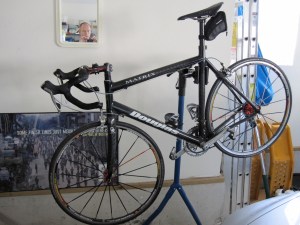
Also, since Lance is a trooper, I feel I should make it known that I will be packing heat as well. Here’s my weapon of choice.

When I pass you the picture will be much more blurry

When I pass you the picture will be much more blurry


I know what you’re thinking. That bike isn’t set up for triathlon. Where are the aero-bars, the disk wheel, the bling? My admittedly low-tech approach is my way of leveling the field and making the race more fair.

Here are some of my tools of the trade.

Tools of the trade

Tools of the trade


If I didn’t have a few syllabi to finish, I’d continue going Gary Payton on Lance, but I don’t want to run the risk of Lance deciding not to show up at the show down.

CA Vacation by the Numbers

Pac Northwesterners Loading Up on Vitamin D

Pac Northwesterners Loading Up on Vitamin D

9:  Chickens in Dave’s and Joy’s Santa Barbara backyard.

500: Days of Summer from the film we saw.

50: Meters of the San Luis Obispo (or SLO if you’re cool) outdoor pool we swam in.

25: Yards across said Olympic pool since it was set up for short course.

35: Times I used my new tiny neoprene camera case with a velcro belt loop as a pretend cell phone.

35: Times I embarrassed my daughters talking really loudly into new “cell phone”.

125: Times I said “tru dat” to emphasize the absolute veracity of something.

9: Hours slept per day.

-1: My score relative to par for six holes on Wednesday (a bird and five pars).

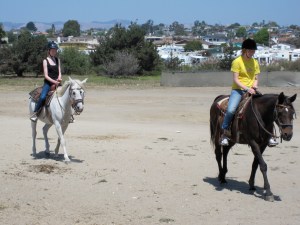
Horsing Around the Pismo Beach Dunes

Horsing Around the Pismo Beach Dunes

1: Time 17 showed me around Facebook.

4: Extra miles run (and walked) in the hills after missing a turn.

5: Pieces of fruit eaten per day.

1: Time I stole a Harry Potter novel from 17 while staging a Pothead intervention.

164: Feet of elevation in about .25 miles on Equestrian Drive.

0: Times sleeping daughters requested a follow up guitar-based wake up song.

Lance's Worst Dream—Swimming on Vacation. . . Tru Dat!

Lance's Worst Dream—Swimming on Vacation. . . Tru Dat!