What a beautiful, hopeful essay.
Category Archives: Modernization
“Gossip Girl” Mom
From an Orlando Sentinel Journal article.
“In 2008, Harden checked out four books — one in the Gossip Girlseries and three in the spinoff It Girl series — after her daughter picked them out at a Seminole library. But when she flipped through them and saw foul language and references to sex and drugs, she asked the library to keep the books out of the hands of minors. Harden would like to see warnings about certain content as well as age restrictions on borrowing. When the library said it would reshelve the books in the adult-reading section but wouldn’t restrict them further, Harden decided to keep the books, with the idea that she would be preventing other young girls from reading the material. Harden does not fault people who have offered to replace the books. ‘They’re taking some action in response to something that I’m doing, and that’s what makes our country so great, that we have that freedom,’ she said. ‘I feel like I’m a pretty middle-of-the-road kind of person. I just want children to be safe and not come across material that’s really inappropriate for their age level.'” Read a lengthier explanation here.
What’s worse, Harden’s arrogant parenting of children that are not her own or people’s apathy about children’s books and their healthy development more generally?
I’d be more inclined to credit Harden for her awkward activism if she took responsibility for the $85 in late fees she owes the library.
Stop the Germaphobes Before It’s Too Late
A sign in the lockerroom at my Y. The grammar police, headed up by my oldest brother, sister, and mother (thank you D for resisting that tendency), will no doubt seethe at the capitalizing of “Health Concerns” and the missing period, but the problem with the sign is the thought process that produced it.
When I first saw it about six months ago I wasn’t sure if it was a joke. I realized it wasn’t one day when my ass cheeks were firmly planted on a towelless bench. All of a sudden out of nowhere, three male Y workers descended on me and threw me up against the lockers. They cuffed me, wrapped a towel around me, and took me into an empty room where they interrogated me for hours. Obviously McCainiacs, they didn’t even read me my Miranda rights. They were going to let me make a phone call until I rubbed the receiver all over my ass.
“Who the f$%^ do you think you are sitting naked on the bench?” Must fight the power I decided. “I also shower barefoot, spit in my goggles, and whizz while showering.” Chaos ensued. The three of them angrily debated whether to waterboard me until one finally said, “You probably ride your bike without a helmet around children and don’t use seatbelts out of fear you might wrinkle your dress?” Who knew the Young Men’s Christian Association now specializes in questioning male members’ masculinity?
Things went downhill from there. When I refused to comply, they started to smack me around which only deepened my resolve. I wasn’t about to be bullied so I fought back in the only way I could–with words. “I intend on not just sitting naked on the bench, but rubbing my ass cheeks all over your precious benches and I hope all your members catch the serious illnesses that are no doubt incubating on said ass cheeks.”
I could tell there was a two-way mirror and the Y director was signaling to his henchmen to increase the pressure. It wasn’t until I pointed out that 100% compliance wasn’t necessary that they stopped hitting me. I explained that as long as the germaphobes put down a towel, they’re protected from naked sociopaths like me. “Never thought of that,” one conceded.
Finally, the beatings stopped. After being forced to sign a confidentiality statement, I was uncuffed and escorted back to the lockerroom. Exhausted but unrepentant, I waited for the germ fighters to disappear. Then I tossed the towel on the floor and plopped down naked on the bench feeling equal part social activist and renegade.
Globalization’s Trade-Offs
As a result of economic globalization, goods and services—whether tax returns, x-rays, math tutorials, or credit card or airline reservation-related phone calls—are being digitized and then sent via coaxial cables under the oceans back and forth to India, China, and other developing countries where people are willing to work for far less than Amerians because the cost of living in their countries is considerably less.
Additionally, just like in major league baseball and the NBA, labor pools are much more international. Recently in the U.S., we’ve hired lots of nurses from South Africa and the Philippines, computer scientists from India and Pakistan, and according to Bureau of Labor statistics, in 2009 there were 185,234 foreign born doctors working in the United States representing 127 countries. Twenty-four percent of all medical school classes include foreign-born students.
If national borders are fences of sort, the fences are coming down.
At the same time, U.S. citizens are increasingly angry and outspoken about outsourcing and the exporting of American jobs, a sentiment exacerbated by politicians, including the president, playing to cameras. All you have to do to understand how wildly inconsistent most people are on this topic is visit the closest Wal-Mart. Few U.S. citizens have connected the outsourcing, global economic dots.
They want their jobs protected from foreign competition, but at the same time want continued access to inexpensive toys, clothes, and toothbrushes from China and other developing countries. One study asked U.S. homeowners applying for home equity loans if they would like their loans processed by a U.S. firm in twelve days or a foreign firm in ten and the vast majority opted for the foreign firm.
Arizona’s anti-immigrant law is another case in point. Many undocumented workers are willing to work difficult, minimum wage jobs that few U.S. citizens are, thereby lowering the cost of living for everyone.
Advocate for protectionist economic and more strict immigration policies if you must, but be honest about the economic costs and also insist that legislators pass a 15%-20% insourcing VAT.
Human First
I disagree with most conventional wisdom about gender. Odds are I think about it differently than you. I acknowledge men and women are different, but I feel standard gender stereotypes about men are extremely limiting. More generally, I believe standard gender stereotypes about both men and women are unhelpful exaggerations. I question the usefulness of the classic masculine/feminine continuum. I’m human first, male second. I want to be a more caring, sensitive, selfless person, attributes typically associated with women. Instead of accepting exaggerated gender differences as the natural order of things, educators, parents, anyone involved with young people and I would be better off identifying attributes we want to help both young men and women develop.
Religion and Politics
History suggests you can’t get elected to high office in the U.S. without at least marketing yourself as a practicing Christian. Yet, once elected, Christian principles often take a backseat to Realpolitik. Why do Christian constituents seemingly give a pass to faux politicians like Sarah Palin for subverting the “turn the other cheek” challenge of the gospel by advocating for “a punch for a punch” on children’s playgrounds? Much more importantly, why do Christian constituents give a pass to real live politicians like Barack Obama for greatly increasing the use of drones to kill people in Afghanistan?
We Don’t Know Phil Mickelson Either
Masterful Masters. Listening to Bones and Mickelson talk it through and then witnessing Mickelson’s shot on 13 from the pinestraw and trees just may have been worth wasting a beautiful afternoon indoors. Unbelievable. Has there ever been a better player-caddy relationship?
Sometimes an announcer make no sense like when Jim Nantz said Tiger’s play on Thursday was so warmly welcomed by the Masters patrons (don’t call them fans) because Americans love the redemptive arc or something nonsensical like that. What the heck does Tiger’s making a few birdies and getting his life together have to do with one another?
Here’s how the press will want you to remember the 2010 Masters. Phil was inspired to win it for Amy, his wife who is battling breast cancer. Watch SportsCenter for the continuous replaying of Phil’s and Amy’s post championship embrace or the Golf Channel or see pictures of it in Sports Illustrated on Thursday. Analysts will laud Phil as the anti-Tiger for days to come. Faithful family man versus filandering “family” man. The joke will be, “Wonder which blonde Tiger would have embraced had he won?!”
The truth of the matter is, we don’t know Phil just like we didn’t, don’t, and won’t ever know Tiger or Kobe or Sandra or name the public figure. Hell, do we truly know half of our friends and acquaintances? Maybe Phil hasn’t always been faithful. With no way to know, why put him on a pedestal for anything other than that filthy shot on 13. That’s not cynicism, it’s healthy skepticism. Cynics assume the worst, skeptics know things aren’t always as they appear, and therefore, question conventional wisdom.
Now Lee Westwood, he seems like an all around great bloke. :) Here’s hoping he breaks through later in the year.
No Guarantee
The start of a lecture I’m giving to faculty and students at Buena Vista University in Storm Lake, Iowa in a few weeks. Get your tickets before it sells out.
The Makings of a 21st Century Education
Consider the first and last sentences from a January Wall Street Journal article titled “Even-In-A-Recovery-Some-Jobs-Won’t-Return”. “Even when the U.S. labor market finally starts adding more workers than it loses, many of the unemployed will find that the types of jobs they once had simply don’t exist anymore. Harvard’s Mr. Katz warns that past experience suggests. . . conjecture is likely fruitless. ‘One thing we’ve learned is that when we attempt to forecast jobs 10 or 15 years out, we don’t even get the categories right,’ he says.”
Let that sink in. The Harvard expert admits, “we don’t even get the categories right”. So what are college students to do? And what are faculty to do? How should faculty design curriculum, teach courses, and advise students in a “we don’t even get the future job categories right” world?
April Miscellania
• The wife got me with a pretty good April Fools, said the new car “wasn’t starting in the morning” and “we should have someone look at it.” I had to return serve. So a few hours later I told her “Good news, the NYT is reporting that young trendsetters are dying their hair gray.” She laughed heartily until I said “April Fools!” That fact that it wasn’t a joke, is now the joke. That’s just the multi-layered way I roll.
• Got some rare direct blog feedback at dinner last week. One of my sibs said indignantly, “Why should anyone care about the details of your fitness routine?!” I explained those posts are primarily for Lance. Consider them optional, not required reading. Lance NEEDS to know how hard to work to maintain his running and cycling superiority.
• So here’s my indignant sib-adjusted fitness report for March. Battled a micro-tear in one calf and then threw my back out lifting/twisting dumbbells to and from the rack without my legs. Lost about a week. Swam 23,900m; cycled, 340; ran 97. WOM (workout of the month) was a 33 mile ride and 2.25 mile run with my 22 year old uber-niece who is about to kick some serious butt at the College Nationals Triathlon in Texas.
• March Madness update. The WSJ computer and I are currently in sixth or seventh place out of eleven in the office pool. If Duke wins, I will probably end up on the podium, but no one remembers who came in second. The first five participants don’t even follow college bball. I’m actually glad computers apparently can’t quantify something as complex as a 64 team tournament. It won’t be the same when it goes to 96 teams. Classic case of less being more. Of course this year I wish it had been 196 because then UCLA might have qualified.
• This recent David Brooks essay is one of my favorites of his of all time. Brooks got killed by the most recommended commenters. I found some of their comments perceptive, but most of those were of the “Look at me, I caught you being inconsistent” variety. No one is always perfectly consistent. Many of the most recommended comments struck me as weakly argued, mean-spirited, knee-jerk liberalism. I’m a liberal, but not a fan of knee-jerkism of any variety. Very easy to criticize especially so indirectly. I give Brooks credit for courage. He knows he can’t win when it comes to most NYT readers.
• Personal record for blog readership in March 2010; however, no reason to get carried away, you’re still a member of a select group. For reasons I’m not entirely sure of, people never comment on my personal finance posts, so I think I’ll retire that thread. Even though readership is up, commenting is not. Maybe I’m not angry enough? Maybe I need to tap my inner-Glenn Beck. Also, for reasons I’m not entirely sure of, I can’t get many readers to follow the small number of links I sometimes include. Case in point, you didn’t even open the previous Brooks’ link did you? I know everyone is pressed for time and I appreciate the fact that more people are at least logging on and skimming posts.
• Turns out I was exaggerating when I wrote that I’d pay anything for an iPad. I have not ordered one yet not because I wanted to read the reviews that were just published and let the application/software dust settle a bit. I anticipate buying one sometime before the summer equinox, but as a card carrying late adaptor, if so moved, I reserve the right to postpone the purchase indefinitely. Not owning one won’t stop me from adding “Sent from my iPad” on the bottom of my emails. Faux tech cache. Sometimes I amaze myself.
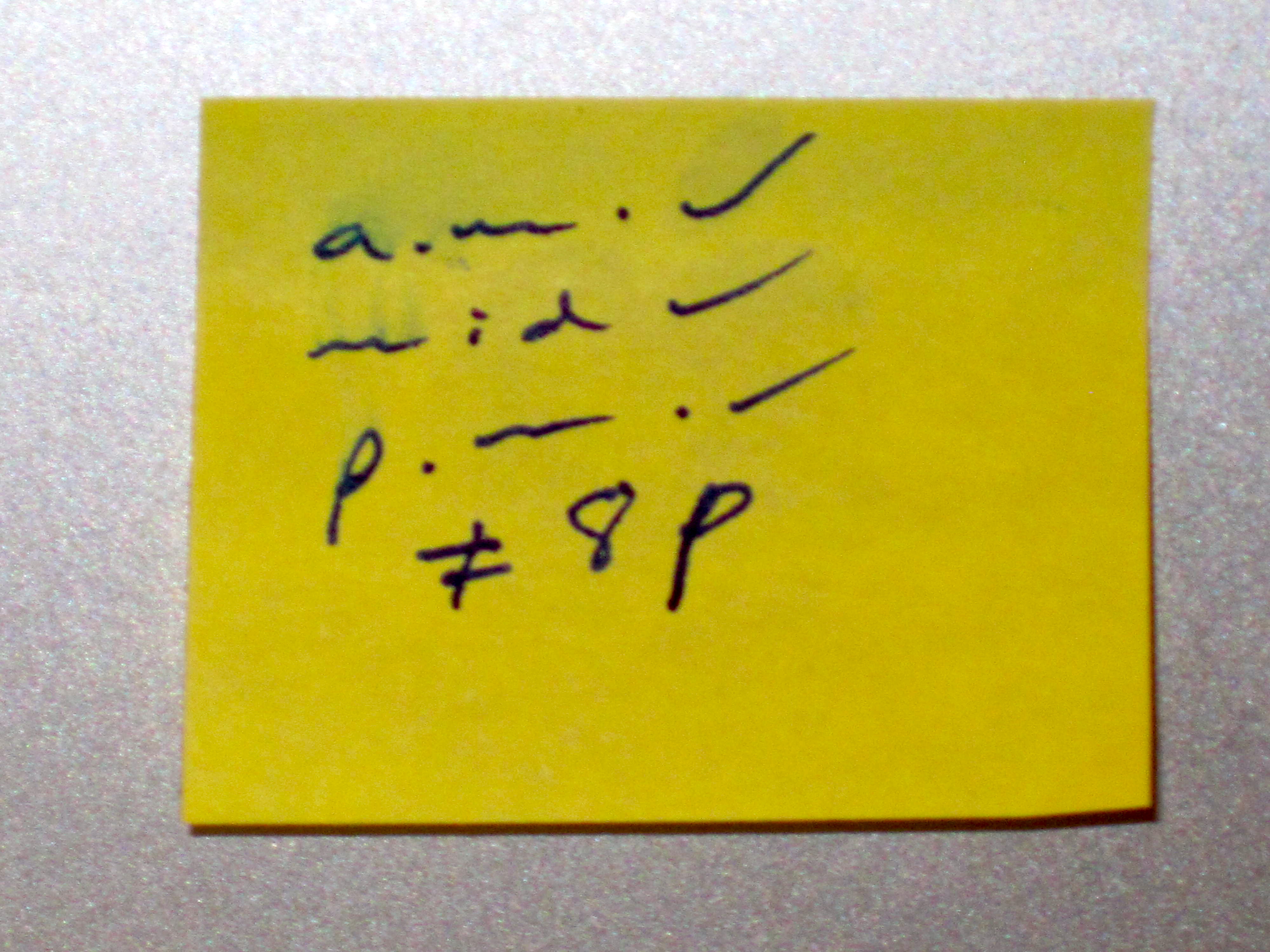
• Speaking of email, publicly admitting that I suck at it in my last post proved cathartic. Oddly, it inspired me to turn over a new email/internet leaf captured in this sticky note. Three days later, I’m stickying to it. Now email is not the boss of me, I’m the boss of email!
Not Sure
What’s the optimal timeframe for “To Do” lists, a day, a week, a month, a year, a lifetime? I’m not sure. A day seems far too short, a year and lifetime unhelpfully long, unless the list is filled with BHAGs. For some people it’s all about the week ahead and the Sunday p.m. planning is key.
Maybe the optimal timeframe boils down to the nature of the “to dos” on the list. The vast majority of mine are of the daily/weekly variety and that’s probably why I get stuck in “tyranny of the urgent” mode. Of course it feels good to check off “clear my inbox,” “read papers 2.1-2.4,” and “call X back,” but only on the surface because it’s frustrating not to make progress on weightier, more meaningful medium and/or long-term projects.
If I subdivide my “To Do” list into daily, weekly, and monthly subsections, I predict I’ll still get stuck in the daily thicket. I’ve read some productivity lit and I think I need to breakdown my medium and or long-term project-related “to dos” into numerous small, specific “to dos”. I should also take more time to “plan backwards” by figuring out when I want to complete the medium and long-termers and then determine what intermediary steps and related deadlines make the most sense.
Truth be told, determining the perfect timeframe and wording my “to dos” with greater specificity probably won’t result in a radical increase in productivity. For that I think I need to combine improved “to doing” with greater self discipline to read and immediately act on email once in the a.m. and once in the p.m. Right now, there’s too much email water torture going on.