Great Forest Fires

I’ve always dug the New Testament epistle of James. Maybe it’s his straightforward writing style that even I can understand. Two recent stories made me think of Chapter 3 verses 3-5:

When we put bits into the mouths of horses to make them obey us, we can turn the whole animal. Or take ships as an example. Although they are so large and are driven by strong winds, they are steered by a very small rudder wherever the pilot wants to go. Likewise, the tongue is a small part of the body, but it makes great boasts. Consider what a great forest is set on fire by a small spark.

Story one involves Peter Alliss’s induction speech at the Golf Hall of Fame ceremony a few weeks ago in Flo Rida. Mrs. Weymouth, Alliss’s U.K. grade school teacher wrote on his final report card, “Peter has a brain, he’s just loathe to use it. . . . I fear for his future.” Alliss brought the house down by ending his speech by flipping Mrs. Weymouth the bird.

Story two is from the Johnny Carson documentary that aired a few weeks ago on PBS. Early in Carson’s career his mom took in a show. Notoriously mean, he asked what she thought afterwards. She replied something like, “That wasn’t funny. Jack Paar was way more funny.” Carson was crushed.

Has anyone ever captured the potential for harm that results from impulsive, hurtful comments as beautifully as James? All of us say things we regret. Slowing down, regularly centering oneself, praying or meditating, are probably the best ways to avoid saying mean-spirited, hurtful things that may very well spark great fires within the social networks of our lives.

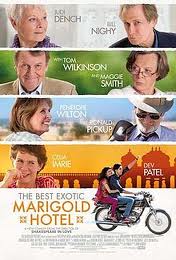
The Best Exotic Marigold Hotel Movie Review

I like the Christian Science Monitor’s movie reviews. Here’s a link to their review of The Best Exotic Marigold Hotel (TBEMH) so you can compare and contrast theirs and mine. I won’t read theirs until completing mine.

This is going to be short because I don’t want to reveal too much about the plot and therefore ruin it for you.

Rare is the movie made for the 40+ crowd probably because seasoned citizens don’t go to as many movies as younger peeps so they’re riskier financial endeavors. For the sake of more diverse choices at the local cineplex, I hope TBEMH makes a lot of money.

I liked it, Betrothed liked it “a lot”. India is a country I’d like to visit and I’m a sucker for any film where I feel like I can even partly “experience” the subcontinent. The street scenes and soundtrack were good, but not on the level of Slumdog Millionaire or Monsoon Wedding, one of my favorite films.

All-star cast. Mostly believable story lines. It’s a film that mostly respects your intelligence. It’s not predictable, but a few Hollywood coincidences (e.g., running into one another in the chaotic city) detract a bit.

And if you’re like me, it will inspire you to think about the purposes of life and how you’d like to spend the last few chapters of it. How many films can you say that about? I’m just not sure it left that indelible a mark. While I recommend it, it’s not a film I’ll tell anyone in a few months that they “absolutely have to see.” That’s why I’m giving it a B+. Read the Monitor review, go see it yourself, and let me know what you think.

[Okay, I just skimmed the Monitor review. Two “B+’s” meaning they and I have what’s know in assessment circles as “inter-rater reliability”.]

Driving Hate Underground and the Illusion of Progress

I need help in the form of divine intervention, a Pentecostal moving of the Holy Spirit, to feel any kind of Christian brotherhood with Sean Harris, senior pastor of Berean Baptist Church in Fayetteville, North Carolina. Here’s an excerpt from one of Harris’s recent sermons:

So your little son starts to act a little girlish when he is four years old and instead of squashing that like a cockroach and saying, ‘Man up, son, get that dress off you and get outside and dig a ditch, because that is what boys do,’ you get out the camera and you start taking pictures of Johnny acting like a female and then you upload it to YouTube and everybody laughs about it and the next thing you know, this dude, this kid is acting out childhood fantasies that should have been squashed.

Dads, the second you see your son dropping the limp wrist, you walk over there and crack that wrist. Man up. Give him a good punch. Ok? You are not going to act like that. You were made by God to be a male and you are going to be a male. And when your daughter starts acting too butch, you reign [sic] her in. And you say, ‘Oh, no, sweetheart. You can play sports. Play them to the glory of God. But sometimes you are going to act like a girl and walk like a girl and talk like a girl and smell like a girl and that means you are going to be beautiful. You are going to be attractive. You are going to dress yourself up.'”

Hearing the hate in his voice makes it twice as troubling. Take two minutes to listen to it here.

I saw Harris interviewed about his sermon on CNN. He didn’t apologize. Instead he backpedaled on some of the words he used, like “punch” by which he meant “shove”. Oh, okay Harris, all is well as long as parents are just shoving their young children for not conforming to your homophobic conception of traditional gender roles.

Harris’s “sermon” has gone viral and he says he’s received tons of negative press including death threats. Responding violently to Harris’s violence makes no sense from either a Christian, Constitutional, or common sense perspective. The best response would be for everyone to stop attending his church, but the most troubling aspect of this saga may be the congregation’s seemingly unconditional support for Harris. They laugh and cheer throughout the sermon and have come to his defense following the media backlash. Are these the only couple hundred of people in the country without a gay or lesbian family member or friend?

Harris presents an interesting case study of hate. Hate crimes obviously have to prosecuted to the fullest extent of the law, but what about hateful thinking and speech? Once Harris’s semi-private thoughts and words were made public, he felt a need to temper his hate by offering up a series of synonyms in the hope that some combination of them would appease the media and public so that they’d move on to the next story and leave him alone to pastor his church.

The key question is how do we create public spaces—whether school or church classrooms, community centers, work conference rooms, or public media—where the Harris’s of the world can articulate their fear, anger, and even unadulterated hate without the fear of being tarred and feathered? Because until we shine the light of civic discourse on hateful thinking and hate speech, it will fester, increase, and intensify.

The current way of dealing with hateful thinking and speech is to silence the perpetrators through what often takes the form of “counter hateful thinking and speech”. Instead of leaning more heavily on the First Amendment, we opt for public shaming. Expose them on YouTube and compete to see who can damn them to hell most quickly, creatively, and persuasively. As a result, no one ever learns anything about the underlying causes of the perps’ fear, anger, and hate. And we delude ourselves to think we’re making progress. All we’re doing is driving hate farther underground where it festers, increases, and intensifies.

The CNN interviewer who interviewed Harris looked like he was quite proud of himself. Post interview he was probably thinking, “Boy, I really held his feet to the fire, taught him what is and isn’t acceptable, and caused him to feel at least a little remorse.”

Wrong. I suspect Harris’s only take-away was “I have to be more mindful of the media’s reach.” Worse than not feeling remorseful, I suspect Harris’s fear, anger, and hate towards homosexuals is now coupled with amped up anger and hate towards the mainstream media. Whether Harris likes the media is less important than whether we create public spaces where a wide range of challenging, even hateful ideas can be discussed openly and honestly in the hope that the pockets of hate that prevent the church from fulfilling it’s mission and limit the potential of our democracy can be chipped away at.

We have a very long way to go.

I Recommend

• My new personal favorite money blog—Mr. Money Mustache. MMM started in April 2011 and he’s killing it. The DIY (Do It Yourself) Colorado bicycle riding blogger writes well and employs a nice mix of confidence, humor, disgust at the status quo, and personal finance insight. His alternative approach to life is resonating with lots of readers. Recently he’s added case studies based upon readers’ lives. Check this recent one out. Favorite excerpt, “Every young adult should be able to comfortably sleep on somebody’s floor, drive an old manual-transmission car with rust holes to a concert, and eat leftover pizza for breakfast. Without complaining.”

• Groovy post by The Minimalist Mom.

• Provocative and timely essay on Chronic Traumatic Encephalopathy (CTE) and what the end of football might look like.

• “Glee is an Immoral Television Show and It’s Time to Stop Watching It.” Trenchant critique by a young, smart, prolific blogger.

• Errol Morris documentary film, Tabloid, about Joyce McKinney, an unstable woman with a criminal disposition. Sex, religion, crime, all mixed together. The one Netflix viewer who wrote, ” She does not need a movie made about her. She needs some real help” is correct. On the other hand, deviance is often interesting because it provides contrast. See Grizzly Man and Take Shelter. I found the most fascinating character to be a minor one, a British tabloid journalist whose total lack of conscience was harrowing.

• Badass video—6 minutes.

Iron-Distance Triathlon Training Update

Is it possible to write about triathlon training in ways that aren’t painfully narcissistic? To write about it as a means to more meaningful ends like greater self understanding, greater appreciation for health and nature, for self improvement more generally?

I’m a triathlete and I find most triathlon writing uninteresting. Too many triathlon writers assume others are as interested as them in the details of their training sessions, their equipment choices, what they had for breakfast at 4:30a.m. pre-race, who they happened to run into right before the swim, their frustration that everyone drafted on the bike, and “their amazing support crew.”

Maybe triathlon writing will never be of interest to people who would never think to string a swim, a bike ride, and a run together. I’m diving in based on the theoretical possibility that one can engage the non-triathlete world if the niche sport is a springboard for thinking more deeply about struggle, life purposes, and things social scientific. If this post gets more than average page views I’ll weave in occasional swimming, cycling, and running posts. If not, I won’t.

I’m four weeks into training for Ironperson Canada on August 26th, an athletic event consisting of a 2.4 mile swim, a 112 mile bike ride, and a marathon (26.2 miles, but you knew that already). The four weeks in March called for increasing volume beginning with 51% of max, then 58%, 65%, and 72%. This week, hallelujah, I’m dropping back to 58%. In March I swam 29.6 kilometers; rode 392 miles inside, 150 outside; and ran 167 miles. I’m giving myself an “A-” for the month. I hit the swimming and running targets, maintained some core work, even lifted a bit, but fell a bit short of the cycling targets. I’m blaming La Niña for that. If we have many more colder and wetter than normal weeks, I may snap.

I’m not too worried about being behind on the bike. In May, I’m cycling up and down the Eastern Sierras and then I’m riding up, down, and around Southern and Central Oregon in late July. Eventually, I will return to summer 2011 form. Last weekend the weather broke for 48 hours and I got out for the first long group ride of 2012. I got dusted on the climbs by people I dusted last summer. Of course they hadn’t run 10 miles beforehand, but still, I realize I can’t replicate the intensity of group rides when I’m soft-pedaling indoors while watching Downton Abbey (that’ll intimidate my competition).

On the plus side of the ledger, I’m doing a better job of embracing a process I’ve long resisted. I’ve made peace with my decision to go long. I’ve always considered iron-distance training and racing a form of lunacy. Here’s why it’s taken me so bloody long to dip my toes in the long-distance waters:

1) Long-distance triathlon training and racing confounds one of my more important life goals—to maintain balance between sleep, work, family, friendship, citizenship.

2) Long-distance triathlon has become a big business and participating in it confounds another goal—resisting mindless consumerism. For me, the incessant in-your-face advertising that accompanies the increasing commercialization of the sport takes away from the beautiful settings and the purity of the activity. Go ahead and call me inconsistent, but I acknowledge the benefits of capitalism while simultaneously disliking the conspicuous advertising that is integral to it.

3) Long-distance triathlon is exceedingly expensive and I already play one country club sport—golf. And a person, if they’re a 99-percenter, should only be allowed one country club sport. I’ve benefitted greatly from capitalism, and I don’t begrudge any business legit profits, but I don’t like contributing to the supply that enables the World Triathlon Corporation to charge exorbitant entry prices. More triathletes need to say enough already, I’m seeking out less expensive races, or I’m sitting out the season altogether.

4) Long-distance triathlon is a poignant example of peer pressure something we should grow out of, by say, fifty years-old. I like to think of myself as individualist, but I have to admit I wouldn’t have committed to this race if it wasn’t for my brother and Lance who I will no doubt be cursing at my lowest moments on game day. I’ve never heard anyone of their own volition say, “Next weekend I think I’ll swim for an hour, then cycle for six more, and then run for four or more.” Hey, can I join you? And I have an idea, let’s wait until it’s the hottest day of the year.

5) Admittedly paradoxical, but I suspect long-distance triathlon has detrimental effects on one’ health. Especially for those who make it a lifestyle and repeatedly go long. If one trains seriously and then swims 2.4 miles, rides 112, runs a 10k, and then rests a lot, their body probably benefits. It’s the last 32k of the run where the health tipping point is most likely crossed. Apparently, studies of veteran long-distance triathletes are already showing the health costs of their mania.

Now though, I’m viewing it as a one-off project. And its part and parcel of the interest and identity tweaking I alluded to in the previous post. I told the GalPal, unless I don’t perform to 90% of my (perceived) ability, it’s one and done. If I don’t race smartly and thereby am not able to capitalize on my training, I reserve the right to a do-over in Santa Cruz in fall 2013 or 2014.

Also, in reading a bit about aging, I’m learning it’s important to mix things up on occasion, to break out of one’s normal routines. It’s easy to get in a rut—at work, while working out, in the sack, in one’s relationships. It’s important to travel to new places on occasion, meet new people, experience new things. This is about experiencing a few related things—getting in the best physical shape of my life and discovering my mental and physical limits. And I’m curious about how well I can spread my effort out throughout the day and how long I can force myself to run. Six months of lunacy to learn more about my mind and body.

Correction. Only five more months of long-distance lunacy.

Conflict is Normal

Hope I don’t jinx myself with the next sentence. I’ve just passed through a period of above average interpersonal conflict. The wife, the daughter, everyone has been conspiring against me.

A lot of our behavior is explained by insecurities rooted in our past. As a result of our insecurities, we get sideways when other people dare think and act differently than us. Our tendency is to try to change the way they think and act. They resist. We persist. The result. Interpersonal conflict.

At a recent conference I met an insightful woman who was a professional mediator. She said something in passing that I found rather profound. “If we can normalize conflict, we can respond to it instead of react to it.” If intimacy and conflict are inseparable, as I believe they are, why do we react so poorly to conflict rather than constructively respond to it?

When we think of conflict as a weakness, as a sign of failure, and as something to be avoided at all costs, we get caught off-guard by it. That makes the successful resolution of it less likely. When we assiduously avoid conflict, natural low-level resentments build and become corrosive.

When we respond to conflict we slow things down enough to think and we’re mindful of treating the other person the way we want to be treated. We may get very emotional and talk animatedly, but we do so knowing a resolution is going to require respectful give and take. Instead of just waiting for the other person to stop talking long enough to begin arguing a point, we truly listen, and are mindful of the other person’s feelings.

When we react to conflict, we lose control of our emotions, sometimes end up shouting past one another, quit caring as much about the other person’s feelings, and ultimately say hurtful things which makes resolution much more difficult. Respond—gradual progress towards resolution. React—things spiral downwards.

It would be nice if there were Harry Potter-like wands that we could use on one another to make us more accepting of ourselves and more secure. Then maybe we’d be freed from the grip of wanting to change others to think and act more like us. By truly accepting ourselves, maybe we could learn to accept others—even their different politics, values, personalities, and life goals.


Book Review—The Orphan Master’s Son: A Novel

Despite the preponderance of superficial on-line communication in these most fast paced of days, my reading over the last fourteen months convinces me that long form non-fiction and fiction writing may be as healthy as at any time in the recent past. That’s my way of saying, damn I’ve read a lot of amazing books recently.

None more so than Adam Johnson’s The Orphan Master’s Son: A Novel. I don’t write well enough to adequately credit Johnson for one of the more creative, imaginative, and haunting novels I’ve read in a long, long time. I’m sure you’ve seen a movie or two that left you completely drained as a result of the film’s suspenseful arc, quality of acting, and artistic beauty more generally. Immobilized, you just kind of stared blankly as the credits rolled. That’s how I felt upon finishing The Orphan Master’s Son. Unable to get off the bed, I wondered who is this extraordinary guy with the ordinary name, where does his imagination come from, and how and the hell did he write that? Total and complete awe.

Here are some answers from Johnson himself:

When I arrived at Pyongyang’s Sunan Airport a few years ago, my head was still spinning from a landing on a runway lined with cattle, electric fences and the fuselages of other jets whose landings hadn’t gone so well. Even though I’d spent three years writing and researching The Orphan Master’s Son, I was unprepared for what I was about to encounter in “the most glorious nation in the world.”

I’d started writing about North Korea because of a fascination with propaganda and the way it prescribes an official narrative to an entire people. In Pyongyang, that narrative begins with the founding of a glorious nation under the fatherly guidance of Kim Il Sung, is followed by years of industry and sacrifice among its citizenry, so that when Kim Jong Il comes to power, all is strength, happiness and prosperity. It didn’t matter that the story was a complete fiction–every citizen was forced to become a character whose motivations, desires and fears were dictated by this script. The labor camps were filled with those who hadn’t played their parts, who’d spoken of deprivation instead of plenitude and the purest democracy.

When I visited places like Pyongyang, Kaesong City, Panmunjom and Myohyangsan, I understood that a genuine interaction with a North Korean citizen was unlikely, since contact with foreigners was illegal. As I walked the streets, not one person would risk a glance, a smile, even a pause in their daily routine. In the Puhung Metro Station, I wondered what happened to personal desires when they came into conflict with a national story. Was it possible to retain a personal identity in such conditions, and under what circumstances would a person reveal his or her true nature? These mysteries–of subsumed selves, of hidden lives, of rewritten longings–are the fuel of novels, and I felt a powerful desire to help reveal what a dynastic dictatorship had forced these people to conceal.

Of course, I could only speculate on those lives, filling the voids with research and imagination. Back home, I continued to read books and seek out personal accounts. Testimonies of gulag survivors like Kang Chol Hwan proved invaluable. But I found that most scholarship on the DPRK was dedicated to military, political and economic theory. Fewer were the books that focused directly on the people who daily endured such circumstances. Rarer were the narratives that tallied the personal cost of hidden emotions, abandoned relationships, forgotten identities. These stories I felt a personal duty to tell. Traveling to North Korea filled me with a sense that every person there, from the lowliest laborer to military leaders, had to surrender a rich private life in order to enact one pre-written by the Party. To capture this on the page, I created characters across all levels of society, from the orphan soldier to the Party leaders. And since Kim Jong Il had written the script for all of North Korea, my novel didn’t make sense without writing his role as well.

I agree with “Maine Colonial” the author of the top-rated of Amazon’s 69 Orphan Master’s Son reviews who wrote, “The book can be confusing, as it jumps from one narrator to another, one time period to another, one style to another, with no explanation. But it’s so vividly written, I didn’t worry about the shifts and came to enjoy the crazy-quilt style.”

Maine Colonial also references an interview Johnson gave in which he said he sees his book as a “trauma narrative,” in which a survivor of traumatic experiences tells stories that are similarly disjointed and that “bend and mix genres as characters attempt to patch their stories back together using the stories they find around them.”

In the weeks and months immediately following 9/11, I remember reading and hearing lots of analysis that suggested our intelligence forces couldn’t thwart the attack in part because no one could visualize one of that nature and scope. If Johnson ever tires of teaching creative writing at Stanford, it would behoove our nation’s security agencies to tap his unparalleled imagination.

Best read after Nothing to Envy: Ordinary Lives in North Korea by Barbara Demick.

Grade—A.

Life and Death as a Minimalist

Mark Albert was one of my best friends when we taught together at the International Community School (I.C.S.) in Addis Ababa, Ethiopia twenty-two years ago. A University of Pennsylvania grad, Mark was super smart, quirky/funny, outgoing, sports crazed, and overflowing with energy for middle schoolers and math. After watching most of his classmates go to Wall Street, he decided to teach math in West Africa as a Peace Corp volunteer. After three years in Gabon, he started his international teaching career at I.C.S. He arrived with a treasure chest filled with all of his worldly possessions which consisted mostly of math textbooks, some beautiful West African shirts, and an acoustic guitar. A model of minimalism. Maybe one can’t help but be a minimalist when living on a Peace Corp stipend.

Today, like me, Mark is 50 and a part of the Sandwich Generation (SG). The SG consists of people mostly in their 40s and 50s who are “sandwiched” between aging parents who need care and their own children. According to the Pew Research Center, just over 1 of every 8 Americans aged 40 to 60 is both raising a child and caring for a parent, in addition to between 7 to 10 million adults caring for their aging parents from a long distance. US Census Bureau statistics indicate that the number of older Americans aged 65 or older will double by the year 2030, to over 70 million. SGers face many challenges including saving for their own retirement while trying to save for their children’s education.

The Wall Street Journal recently wrote about common challenges SGers face after elderly parents die:

As older parents approach death, they often leave lengthy to-do lists for their children. The tasks can be both physical and financial. Some children must deal with a tangle of arrangements—everything from heating-oil contracts to trusts—along with jumbled stock certificates, car titles or life-insurance policies for which there may be no backup copies. Others must sift through boxes or rooms full of belongings. Sometimes siblings get involved, complicating matters further. When the chores become overwhelming, it can be difficult for family members to recover sentimental treasures or tie up financial loose ends. At the extreme, the sheer volume of stuff can clutter a house and weigh down its value—a problem if the home must be sold quickly.

Often the heir(s) get so overwhelmed they procrastinate indefinitely. I didn’t realize how many estate sale and related companies exist to help heir(s) tie up every imaginable loose end. Probably a growth industry given the aging population.

While reading the article I reflected on how extremely lucky I am that my mom and in-laws have wills; have made arrangements for and already paid to be cremated; and have provided detailed, organized info on their finances. Their end-of-life planning is a natural extension of their lifelong love.

Another blessing, they’ve begun giving away things, but all that means is they have a tad bit less than a lot. Which got me thinking about my own death and how radically simplifying my life could be a powerful final act of loving kindness for my wife and/or daughters.

The mindless cliche, “He who dies with the most toys wins,” is exactly backwards because the larger your material footprint upon death, the more onerous the task for your heirs to divide up, toss, sell, and just plain deal with everything.

What if, as I age, I gradually shift from run-of-the-mill decluttering to radical minimalism. And how cool if I could time my death to give away everything except a token or two for memory sake—say my iPad 56 with pictures and video of our life together. So after the funeral, my heirs return to a near empty house, relax in a peaceful unhurried manner, open a bottle of wine, and say nice things about the guy who left so few loose ends.

One True Religion?

Indulge me while I paint with a broad brush. Most people are either religious or non-religious. Among the religious, quite a few believe their religion is the one true religion. Consequently, those outside their tradition are unsaved or infidels and doomed to eternal damnation.

This “zero-sum, sheeps and goats” line of religious thinking might make a modicum of sense if there was a genuine free-market of religious ideas from which each adult chose once they had considered a wide-ranging smorgasbord. A grand religious meritocracy if you will where the most enlightened, hopeful, helpful religions would probably hold claim to the most adherents.

But that’s not even close to how religious people “choose their religion”. People’s religious choices are mostly the result of where they’re born. And I don’t know about you, but I had no control over where I was born (shout out to my faithful following in Boise, ID). Born in Northern Nigeria, one’s almost certainly a Moslem; Southern Nigeria, a Christian; central India, a Hindu; Israel, a Jew; Alabama, a Southern Baptist: Utah, a Mormon. In fact, do people choose their religion or does their family’s religion or the predominant religion where they grow up tend to choose them?

If religious identities are rooted in geography and culture, “zero-sum, sheep and goat, mine is the one true religion” belief only makes sense if some countries and cultures are special, divinely created, better than the rest. And why trust anyone who believes they won the birthplace lottery of life about religion or anything else?

Related recommendation.

Schooling the World: The White Man’s Last Burden

Last week I presented a paper at a “Globalization, Diversity, & Education” conference near Portland. It’s a small conference attended by equal numbers of liberals and radicals. An ideological oasis for lefties. At times it felt like I was on the set of Portlandia.

People enjoy like-minded company because it’s self-affirming, but at conferences it makes for less-interesting sessions because there’s little to no tension. When everyone is of the same mind, no one is pressed to rethink or refine their ideas. Conflict is exasperating, but after awhile, blanket likemindedness can be equally vexing.

I’ve never been too fond of professional conferences mostly because networking is a weakness of mine. Also, too much of the content is theoretical and directed only at other academics resulting in an echo chamber far too removed from families’, teachers’, and students’ day-to-day lives. And too often it’s a game—participants are simply padding their vitas with an eye toward promotion. I couldn’t help but think how differently people would have to write their papers if they were forced to present them in pubs or community centers to a mix of citizens from different walks of life.

The highlight of the conference was the film “Schooling the World: The White Man’s Last Burden” by Carol Black. Black created the Emmy award winning television series The Wonder Years with her husband Neal Marlens. TWY is one of my fav series of all time. After TWY, and the birth of her children, Black withdrew from Hollywood, got involved in the alternative education movement, and researched cross-cultural perspectives on education which lead to the making of the film. Black attended my paper presentation and helped in the discussion of it. I also talked to her right before the film screened. A lot of her thinking about alternative education resonants with me. Someone I wish I could get to know better.

Here’s the film summary from the DVD cover:

Schooling the World takes a challenging, sometimes funny, ultimately deeply disturbing look at the effects of modern education on the world’s last sustainable indigenous cultures. If you wanted to change an ancient culture in a generation, how would you do it? You would change the way it educates its children. The U.S. government knew this in the 19th century when it forced Native American children into government boarding schools. Today, volunteers build schools in traditional societies around the world, convinced that school is the only way to a ‘better’ life for indigenous children. But is this true? What really happens when we replace a traditional culture’s way of learning and understanding the world with our own?

It’s as well made and provocative an educational documentary as you’re going to see. Many viewers will resist the message and leave upset. After watching the film, one person did ask Black why she drew such a sharp dichotomy between the “negatives of western education and consumer culture” and the “positives of non-western cultures and people”. Black acknowledged the dichotomy and said it was intentional because no one ever questions the premise that western education is a positive force for all of the world’s children. It was a thoughtful explanation for the film’s one-sidedness. I couldn’t help but think of how when I’m arguing with my Better Half, frustration clouds my thinking and I take more extreme stands than I normally would.

I could write a few week’s worth of posts on the film’s content. One thought. Few in the audience probably thought to use the film as a mirror for evaluating their teaching. Every educator enters the classroom with biases, privileging some cultural practices, disregarding others. Put differently, every educator sometimes slights the significance of their students’ backgrounds. While watching the film, I couldn’t help but wonder, “How do my preservice teachers and how do I impose our worldview on students?”

Another thought in the form of a premise. Even if we could close every boarding school in traditional societies around the world, indigenous cultures would still face the same challenges imposed on them by western education as a result of global media including television, music, film, and advertising. I’ve written in the past about the societal curriculum‘s effect on students. Sam Wineburg and friends have shown that modern film is the single most influential resource in shaping high schoolers historical understanding. Here’s their paper titled, “Forest Gump and the Future of Teaching the Past.

Beginning in the late 80’s and early 90’s, I was blown away by how pervasive western popular culture was in my travels through East Africa and China. In African markets, endless posters of the three Mikes—Jackson, Tyson, Jordan. Hiking up a steep trail to the Great Wall, I was subjected to Lionel Ritchie whose music was being piped in through cheap speakers tied to tree branches.  Immediately after a Chinese teacher talked teaching with some colleagues and me as required, she turned far more animated and excitedly asked if we had seen the Bridges of Madison County. My favorite Michael Jordan poster in China, like all English in China, had a wonderful typo. Under his picture it said, “Michael Jordan, MBA.” Tru dat.

So given global satellites, coaxial cables, the internet, and smart phones, the central question, “How can we avoid imposing our worldview on the world’s last sustainable indigenous cultures?” is even more challenging than the film suggests. Maybe Black’s film will inspire someone else to make a companion one on the global media. And maybe people much smarter than me will figure out how to manage globalization so that indigenous cultures aren’t completely overwhelmed to the detriment of us all.