Anywhere Anytime

Visited the derm recently. My fair skin is giving out. Way too much sun early on. Living in Washington State means I won’t get that much more exposure, but I’m afraid the damage is already done. I’m supposed to go in for an annual check up, but didn’t seem to get around to it last year.

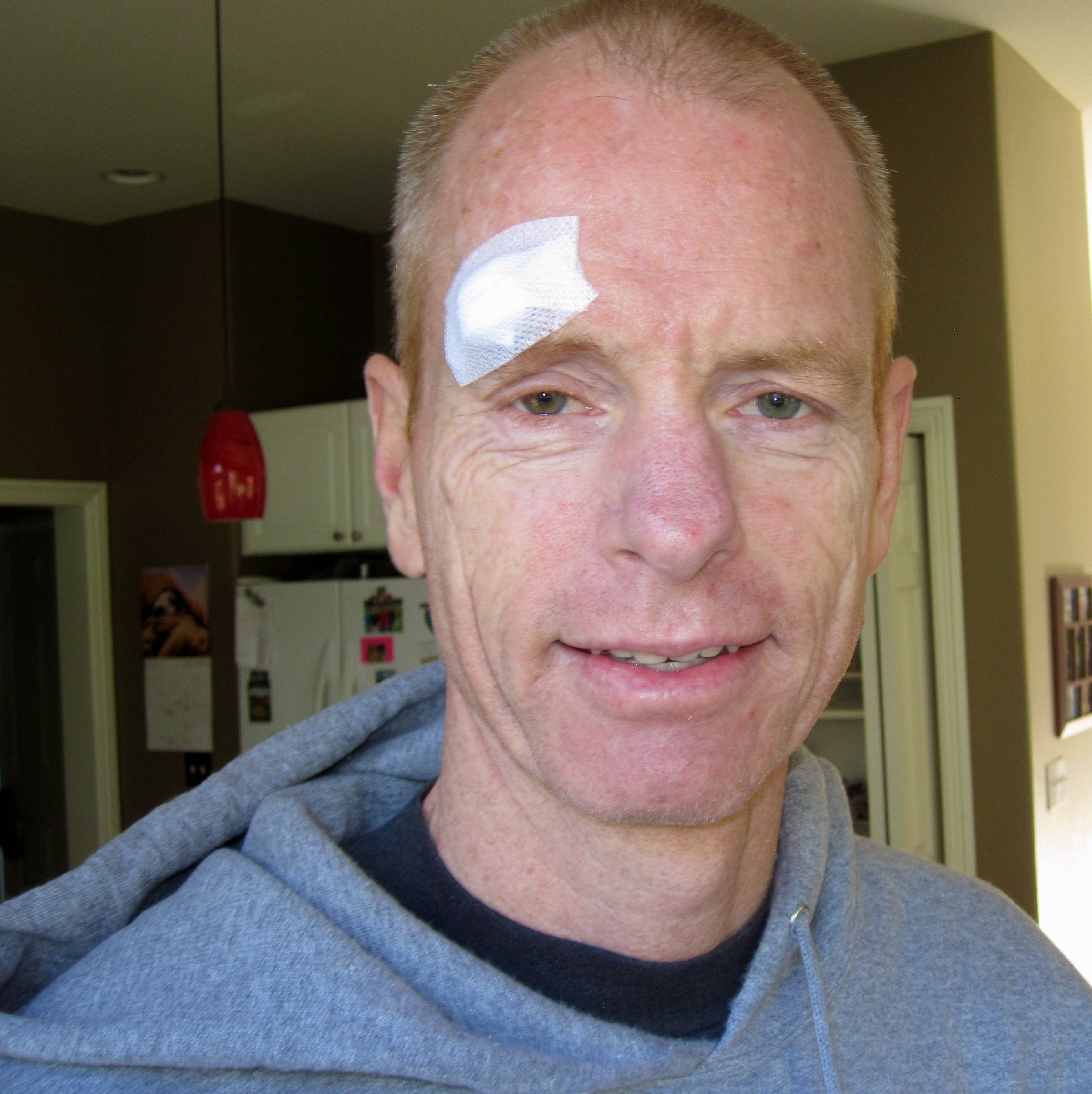
Dr. Derm was like a kid in a candy shop with the liquid nitrogen. Arm, forehead, back, leg. “Mind if I just. . . ” “No, go for it.” I could have timed it better since I’m in full blister mode days after Halloween. She added two biopsies for good measure. Have to go back next week to have a couple above the eye stitches removed.

She said it might leave a scar. Cool.

When I was twenty, I did a summer-long internship in inner-city Boston. Day two I was voted MLM, “Most Likely to get Mugged,” by my fellow interns. Was it my fault I had a safe, suburban, youthful mug?

Now though thanks to Father Time and Dr. Derm’s knife maybe I’m finally going to start looking like a bad ass.

In the middle of my internship, near the end of a hot and humid summer day in the Jamaica Plains section of Boston, I walked from a food bank where I volunteered two days a week to the nearest subway station for the trip back to Dorchester. Walking alongside a large housing project, I thought to myself, man, that’s a large water fight up ahead. Wonder how they get the hydrants open? Look at all the girlfriends on the porch.

Suddenly, the water fighters turned their attention to me as if I had a sign on that said “Help Ron Win the MLM”. And by “turning their attention,” I mean they started running after me with buckets in hand.

I’ve run fast maybe four times in my life. Three times in Louisville, Kentucky before age eight when I was deathly afraid of dogs and tried to outrun a few and that day in Jamaica Plains. Long story short, barely made it to the “T” unscathed. Those scoring at home recorded it as a near mugging.

Now, there will be no more running. I’ll be able to walk anywhere, anytime, Clint Eastwood Gran Torino style. I’m trading in my MLM for a BBA, “Biggest Bad Ass”. It’s about time.

Don't Mess With Me

Training the Mind

Regretfully, only now that I am an over the hill marathoner do I realize I have not been intentional enough about training my mind for race day. I suspect there are as many ways to train one’s mind as there are successful endurance athletes, but I’m most in tune with three strategies.

The first, and probably best known and most commonly practiced, is visualization. I dabble with this. Last Saturday, I told Dano at mile 14, “We’re exiting Seward Park (the 14 mile mark in the Seattle Marathon).”

The second entails repeating short positive phrases like “smooth and strong”, “steady strength”, or “fluid motion”. Often though, another tape bleeds into that one, one that sounds like this, “Where the hell’s the mile marker?! Who moved the mile marker?!” “Is this pace sustainable?” And “Is that the hammie about to go?”

The third involves finding inspiration from harder core athletes like Terry Fox, Lynne Cox (Swimming to Antartica), Dave Gordon (still awaiting his book), and Joanie.

If you’re Canadian you know all about Terry Fox. If you’re not, do yourself a huge favor and watch this film.

Lately, Joanie has been in the news. From a recent New York Times profile:

Perhaps running best suited her Yankee upbringing of thrift and individualism in Maine, nothing needed beyond a pair of shoes and an open road. That is how she won the Olympics, running fast and alone.

See for yourself in this four minute clip. Start about 50 seconds in. Her transcendental focus in the 1:20-1:37 segment is mesmerizing. Filing away that image for my run into Memorial Stadium.

As I was circling the Olympia High track in the pitch black one recent morn, I was thinking something similar. The beauty of running is how primitive it is. Especially when compared to cycling. The perfect sport for a minimalist.

Read about Joan’s Chicago Marathon triumph here. Excerpt. “Did I think I was going to be back here running competitively, trying to get an Olympic marathon trials qualifying time 25 years later?” Samuelson asked. “Heck no. But it’s the passion that still burns, the challenge to see how fast I can go.”

The passion still burns. . . and inspires.

Problem Solving

In response to last week’s social science/wealth inequality posts, a comment averse reader sent me the exact kind of response I had hoped to generate when I started blogging. Let’s call her Private.

Private wrote:

Duh? Were you surprised by ANY of those stats? I was not. For me, the far, far, far bigger question concerns my personal responsibility, your responsibility and our corporate responsibility to address those numbers.

She continued:

My Tuesday Lunch Club is superb at identifying social trends and issues therein. It’s solution we struggle with. My Friday dinner friends frequently discuss the week’s news. Again, no useful, doable answers. Based on your variety of sources quoted, you, too, spend a fair amount of time gleaning news stories. It’s my hope that thinking people, such as yourself, spend equal time pondering and yes, even working on and discussing with others, solutions to the problems you identify so clearly. Let’s see some posts about that!!!

Three exclamation points demand a response.

I’m an educator; consequently, I believe consciousness raising is important in and of itself. Ideas matter because they shape our behaviors. But Private would most likely reply what good is awareness of social problems absent concrete actions to solve them? Put differently, quit intellectualizing, roll up your sleeves, and do something to create more equal opportunity.

I don’t have any special insights on problem solving probably because I’m too content with the ambiguity engendered by good questions.

Nonetheless, here is an overarching belief: social problem solving takes many forms all of which should be encouraged equally. Among the forms, 1) practicing selfless, socially conscious, caring forms of parenting; 2) modeling socially redeeming principles such as humility, kindness, and empathy in one’s day-to-day interactions; 3) practicing socially redeeming principles in one’s purchases and lifestyle choices; 4) choosing work that explicitly improves others’ qualities of life; and 5) giving money and time to causes and groups that have proven track records of helping people locally, nationally, and/or internationally.

What would you add?

The GalPal is way more inspiring on this topic than I’ll ever be. While I’m reading, thinking, questioning, debating, and writing, she’s often organizing a team of friends to make dinner for a hundred homeless men and women at the Salvation Army.

Where’s the Romance?

LOVE this guy’s blog; however, I shouldn’t profess my fondness for his blog that way because “You can’t love something,” moms says, “that can’t love you back.”

But as brilliant as Ray’s blog is, there’s something lacking. The same “something” lacking from online triathlon forums like this one—romance.

Not the candlelight hot under the collar type for which the word is normally associated, but the unbridled joy that sometimes accompanies moving outdoors in nature.

Ray, sports science companies, and other triathletes are turning triathlon into a science in which every workout is endlessly sliced, diced, and analyzed.

As a middle adaptor of the personal technology the tri-scientists obsess over, I’m not immune from their privileging fitness science over the aesthetics, art, and romance of swimming, running, and cycling. Consequently, when I run there’s a gadget in my running shorts pocket that bounces signals off satellites so I know precisely how far and fast I’ve run. When I cycle, I lean on my bicycle computer to determine what kind of ride it was based upon whether I achieved a higher than normal average speed.

But there’s no computer that can capture the beauty of a late summer lake swim when the water is glassy and the perfect temperature. No reason to try to measure the rhythm of a long, smooth stroke. No counting of strokes and no measuring of heart rate required.

Nor is there any gadget on the market that can capture what it’s like to run at dawn on golden leaf carpeted Northwest trails in October in a foggy/low light mix. Why even try to quantify how alive I felt last Thursday on my pre-dawn solo eight-miler around Capital Lake. The Capital Dome was lit up and the lake surface was bespeckled with reflections of the Deschutes streetlights. Spectacular.

How do you measure what it’s like to run under the lighting of a full moon or cycle with a friend along the Sound on an unusually warm October afternoon? It’s these experiences with nature and good friends that make me feel alive, not my average watts. And it’s these experiences that clear my mind and strengthen me for day-to-day life.

I’m fortunate to have a great running posse, but lately, since I’m in marathon-mode, I’ve been getting in a few solo runs each week too which has been nice. During one last week, I spent a few of the miles replaying an argument the Galpal and I had stumbled into the previous evening. Reluctantly, I had to admit that the video replay in my head provided inconvertible evidence that I was mostly responsible for the dustup. So when I walked in the house, I apologized. The GalPal was so taken by my (rare) selfless gesture, she violated her strict “no sweaty” hug policy. All of which set me up for a candlelight hot under the collar type of evening. And that my friends is what’s known as the “running romance multiplier effect”.

Credit me when you use it.

The Intrapersonal Conundrum

Recently I advocated accepting and adapting to people’s irritating behaviors rather than trying to change them. But what about our own irritating behaviors? How do we know when to accept them versus when to commit to trying to change them?

Of course, not everyone is introspective; as a result, some people lack self understanding. Ask them which of their behaviors most irritate the people they’re in relationships with and they draw a complete blank. I’m probably too reflective for my own good, regularly engaging in self-assessment. One limitation I’m keenly aware of is an aversion to personal networking. Closely related to that, I suck at self-promotion.

Among other ripple effects, this blog has a small readership and my professional successes exist mostly within my classrooms. A colleague of mine is the opposite, a brilliant networker and self-promoter. A mediocre teacher, she’s developed a national reputation as an expert in a very specific sub-category of education. She travels all the time and speaks to large groups for lots of money.

Am I envious? Not on a personal level, but maybe professionally. I would enjoy more consulting opportunities than the one or two a year I average. But not enough to change. I understand that there’s a perfect correlation between my lack of networking initiative and the number of consulting gigs I get.

Even though social and professional networking skills are more important than ever, I’m perfectly content not being a networker or self promoter. In fact, I don’t want to get better at networking or self promotion. I’m an educator, so I’m not anti-social, I just have no patience for the phoniness on which so much of it seems to rest. “Here’s my card.” “Who cares.”

Another limitation I’m keenly aware of is a deeply rooted counter-cultural propensity for saving. My dad grew up during the Depression, and it left an indelible mark on him, and so I blame his hyper-frugal modeling. But unlike my aversion to personal networking, this is a limitation I want to change.

Here’s one of millions of examples of my often irrational economic behavior. One day in Chengdu, China I argued at length with a Carrefour manager about socks I purchased. Despite being on sale, the socks were rung up at the regular price. Our language differences, the store’s employee hierarchy, and my stubbornness made for a combustible, and in hindsight, hilarious combination.

In this area of my life, I want to act more rationally, so I’m working on loosening up.

What explains my markedly different way of thinking about these two personal limitations?

I’m not sure.

Bill Gates and the Poor Widow

Forbes is out with its “Most Wealthy” lists. Bill Gates’s wealth is estimated at $54b. He has reportedly given away $28b so far. $28b out of what would have been $82b is 34%. The $28b is an eye-popping figure, but maybe the percentage figure is even more impressive because the wealthier people become, the more focused they seem on becoming even more wealthy. A lot of credit goes to Warren Buffet and David Rockefeller for inspiring him and providing his wife and him a model for their foundation.

Often very wealthy people get lots of credit for large flashy gifts when in actuality their gifts are usually a small percentage of their net worth and they serve as needed tax deductions. [An aside. I’m looking forward to the Facebook movie coming out next week. Zuckerburg, Mr. Facebook, is reportedly furious at how he’s portrayed in the film. Yesterday he gave $100m to the Newark Public Schools. Coincidental timing?]

Then there’s Luke 21, verses 1-4. “As he looked up, Jesus saw the rich putting their gifts into the temple treasury. He also saw a poor widow put in two very small copper coins. ‘I tell you the truth,’ he said, ‘this poor widow has put in more than all the others. All these people gave their gifts out of their wealth; but she out of her poverty put in all she had to live on.'”

Gates’s example doesn’t rise to the level of the poor widow, but it’s similarly inspiring.

This BGIII mugshot (taken in 1977 following a traffic violation) is pretty funny. His smile suggests he’s confident things will turn out okay in the end even if his insurance premiums go up.

File:Bill Gates mugshot.png

Three Changes

Life in the U.S. will be considerably different in twenty years as result of three changes that few people think about much at all. While we watch “reality television,” obsess about celebrities, follow sports as if which team wins really matters in the grand scheme of things, and shop til’ we drop, these changes will remake the United States in profound, yet unknowable ways.

1) Young women are running circles around young men in secondary schools and in colleges and universities. I’ve written about the implications of this before.

2) The world’s economic power is shifting to the east.

3) The earth is warming much more rapidly than anticipated.

What specific, symbolic, yet tangible changes might wake people up to these fundamental shifts? This example is far too subtle, but still worth noting. With respect to the first change, last year, for the first time ever, women earned more Ph.Ds than men. Another more dramatic example I anticipate happening sometime in the next twenty years, the first female President of the United States.

The second change isn’t as worrisome to me as to citizens whose identities are primarily national in orientation. I reject the zero sum assumptions of the global economic race metaphor. I celebrate the fact that hundreds of million impoverished, rural Chinese and east-Indians, fellow human beings, are experiencing markedly improved qualities of life.

Number three is the most vexing because reducing C02 emissions will require international cooperation on a level never before demonstrated by the world’s governments.

Like waking from a collective slumber, twenty years from now many will wonder when and how women became so much more influential than men, when and how three billion Chinese and east-Indians became so much more influential than 400-500 million Americans, and when and how we made such a mess of the natural world.

Libertarian Cubism

Ever seen a plexiglass smoke cubicle in an international airport? Tiny with a few stools around a high table. Need a smoke? No need to leave the airport, just pop into a smoke cube and spark up. Sparking up is not really necessary though because you can easily get your nicotine fix just by breathing in the Cheech and Chong second hand cloud. Visibility is about a foot so you have to look very closely to see anyone. I can’t fathom sitting next to a smoke cuber in coach on an international flight.

Smoke cubes are an interesting libertarian solution to individual differences. In essence, airport officials are saying, “Go crazy smokers with .01% of the airport.” Apart from higher group health care costs, why should government limit people’s freedom to fill their lungs with carcinogens, suffer more health problems, and probably die prematurely?

Maybe we should embrace libertarian cubism and extend their use. For example, in the Pacific Northwest we could use some “the weather is depressing” cubes for people like Y-guy who I heard complaining vociferously this morning, the first cloudy/rainy day in recent memory. Pacific Northwest summers are idyllic, sunny and in the 70’s, but some people like Y-guy never get enough vitamin D and consequently suffer from perpetual Seasonal Affective Disorder. The chronically SAD. This morning Y-guy tried to put a damper on my life-giving swim workout by proclaiming, “Hell, it will probably rain for the next 11 months!”

Just as Y-guy should be free to smoke, he should be free to be a walking, talking, downward spiral of negativity and pessimism. I just don’t want to be subjected to his depressing monologue. What if we had a “weather is depressing” cube in the Y locker room for Y-guy and his equally depressing friends?

What other examples of libertarian cubism would you like to see introduced in your neighborhoods, workplaces, and surrounding environs?

But Will It Make You Happy?

Title of an excellent article in last Sunday’s NYT with one disruptive “how the heck are retailers going to sell to people if they become more thoughtful consumers who prioritize relationships” thread that detracted from it. That article lead to a Sunday afternoon of blog and e-book reading about minimalism, content I was mostly familiar with already. I continue to be interested in positive psychology and living more simply.

Favorite sentences from the afternoon of reading. From Leo Babauta’s e-book titled “The Simple Guide to a Minimalist Life”. Leo’s Zen Habits blog has 185,000 subscribers. “Plan your ideal day. Then strip your life of the non-essentials to make room for this ideal day, for the things and people you love.”

Okay, I’ll try.

Empathy Impaired

The New York Times’ commentators have been writing a fair amount about how to revive our moribund economy and related issues like consumer and government spending, taxes, and unemployment. Sometimes I find the readers’ “recommended comments” more interesting than the essays themselves. They’re liberal and decidely cynical about life in the U.S. today. Their most common rallying cries are corporate greed, class warfare, out-of-touch politicians, and right-wing media.

Recently, they’ve been most fired up about members of Congress being out-of-touch with ordinary citizens, many who have been laid off, and too many that appear to be entering into permanent unemployment.

The question I haven’t seen asked is how does one, whether a member of Congress, or a college professor, develop empathy for the under-employed or short, medium, or long-term unemployed? The best answer of course is direct personal experience, but giving up one’s job in the interest of greater empathy doesn’t make much sense.

There have to be better ways, whether documentaries, essays, novels, photographs, music, and plays, that can help humanize the out-of-touch among us. The arts seem especially well suited to this task. I wish The Times’ irate, cynical commentators would each choose an art form and begin telling their stories with the out-of-touch Congress as their primary audience.