Olympic Medals and International Self Esteem

Poor Canada. They bombed at the 2012 London Olympics. One gold medal and it wasn’t even in a sport. Good thing Canada has an excellent sense of humor because their gold was in a childhood backyard activity. Trampoline.

Well, normally they have a great sense of humor. Apparently not when it comes to underperforming at athletic events on the global stage. As this Toronto Star headline illustrates, “Canada Ties Uganda, Uzbekistan, and Grenada in Gold Medal Count,” they’re beating themselves up over it.

Why do nations place so much importance on the Olympic medal count? It’s as if all of the world’s countries are fourteen year-olds starting high school with shaky self esteem. What will all the others think of me? China apparently feels better about itself because they kicked ass. Did you see the women’s beach volleyball finals? Or the gold medal basketball games? Maybe the U.S. isn’t in decline after all. In contrast, Australians, also serious underachievers, are mired in a post-Olympics depression.

The irony is Canada is excelling in a much more important “competition”, the overall quality of life of its citizens. According the 2011 United Nations Human Development Index, Canada is ranked 6th in the world in “human development” which is based on several quality of life indicators including life expectancy (81.0) and per capita income ($35,166).

First through fifth? Norway (gold), Australia (silver), Netherlands (bronze), United States, and New Zealand.

In what’s turning into a global medal arms race, Canada’s and Australia’s Olympic Committees will spend way more money than normal to turn things around in Rio. Less developed countries too.

Go ahead if it makes you feel better about yourselves, but don’t let it substitute for continuous investment and improvement in the quality of life of all your citizens. Otherwise, you run the risk of winning the battle of short-term national Olympic glory at the long-term expense of improved quality of life.

Oh, and Canada, don’t despair too much. Only eighteen months until the Winter Olympics begin in Sochi, Russia.

Ironperson Canada 2012—Almost “Go Time”

As ready as I guess I’ll ever be to swim 2.4 miles, cycle 112, and run 26.2 on Sunday, August 26th in Penticton, British Columbia.

I’m assigning myself an “A-” for my prep. I’m most proud of the fact that without being accountable to a coach, or anyone, I put the work in. I’m fit. There have been times in the last five to ten years that I’ve been faster in the water, faster on my bike, and I’ve ran faster, but I’ve never been as strong in all three disciplines. I am trained for a steady and solid all day effort. I’ve gone from doubting whether it’s possible to run a marathon off a long swim and bike, to dialing in the salt supplements, and thinking I can. When I get in trouble during the day, I’m confident I can pullback, regroup, and continue on. The half grade deduction is due to the record amounts of sugar I’ve consumed over the last few months. I’ve blown through pack after pack of Costco cookies and thoroughly tested a wide range of Dreyer’s ice-cream flavors. Someone asked Charles Barkley what he thought of my nutrition and his answer is below.

The four consecutive recent Tampa, FL runs were more important than meets the eye. It took me 15 of the 30 miles to learn to slow down and sustain anything through the heat and humidity. Mid-day Friday in Olympia I ran for an hour steadily and fairly hard in a long sleeve winter shirt. I couldn’t have done that before FL. I feel fairly acclimated to heat, an achilles heel of mine. Then again, it was 94 in Penticton yesterday. If it’s that warm on race day, all bets are off.

Recently, I met two people who couldn’t understand why anyone would voluntarily subject themselves to such extreme physical activity. I’ve wondered the same thing for years, but have made peace with my motivation which I’d describe as one part peer pressure and two parts the lure of trying to pace such an event correctly.

I am an ordinary age group athlete, but I am above average at pacing events correctly. I love the challenge of spreading out my effort as evenly and efficiently as possible. That’s part of my competitive advantage. I first learned to pace a 10k well, then a half marathon, then marathons, then half irons, then rides around Mount Rainier. This event intrigues me because it will be the ultimate test of that skill. The line between my “all day” pace and “too fast” is razor thin especially on the run. Even 10-15 seconds a mile too fast in the opening miles could very well cause me to blow up in the middle or late stages of the run.

The question is do I have sufficient self-understanding and body awareness? No power meter or heart rate meter for me, just g.p.s. and intense attention to my “perceived rate of exertion”. Put differently, for eleven hours I’ll be closely assessing whether I’m breathing too hard. I have a hard time living in the present for 11 minutes, here’s hoping I can do it for 11 hours.

My physical ordinariness is evident in the fact that true fish make me look silly in the water; I can’t hang with Cat 1, 2, and 3 cyclists; and the fifty year-old down the street would have to spot me at least 30 minutes in a marathon. But 90% of triathletes have a weakness. In contrast, I’m decent across the board. That’s another advantage. Being 50.5 in the 50-54 year old division is yet another.

Given my successful training and those advantages, what are some realistic goals? I’m conflicted. Half of me feels conventional, I want to start the run right around the seven hour mark and finish 10th in my age group (last year there were 245 in my 50-54 age group). The other half wants to have a spiritual experience and learn more about myself and life independent of the race clock. That’s vague because it’s not a goal as much as a tough to articulate feeling.

Recently, a friend and fellow long distance athlete had an epiphany. He realized that racing is about learning to set goals and persevere in attaining them and then applying those skills and discipline to his non-athletic life. For me, that’s too linear, or for lack of a better term, too Western. I want to experience something of the divine. Is that asking too much?

Post race I’ll share my more specific pre-race goals and my unconventional mental prep. Ultimately, finishing 10th in my age group will come down to one thing, being able to run steadily for the whole marathon leg. In training, salt tabs have been a godsend, keeping my chronic cramps at bay. I expect them to work on race day too. So then, only two things will determine my relative success, smart pacing, and mental toughness, or guts.

Do I have sufficient guts? I think so.

p.s. Noticed the dearth of pics lately? I gave my camera to 19 for her 20th b-day. I will buy a new one soon and jazz the place up. In the meantime, I will deputize 17 and 20 as race photogs.

Sayonara Ichiro

On Monday afternoon Ichiro switched lockerrooms and traded his Mariners uni for pinstripes. Wins for losses. Unless you’re a Pacific Northwesterner or serious baseball fan, you probably don’t know that veteran Mariners don’t fade away, they just sign with the Damn Yankees.

I’ll never forget one of Ichiro’s first Mariner games when he threw a guy out at third from deep right. The “laser beam”. The best throw I’ve ever seen (at 3:52).

Despite having played 11.5 years in Seattle and being a future Hall of Famer, most Mariner fans have an “it’s about time, don’t let the door hit you on the way out” attitude towards the trade. When Griffey was traded to the Reds in 2000, M fans were crestfallen. Why the dramatic difference?

Here’s the alleged rap against Ichiro:

• he’s selfish as evidenced by his singleminded pursuit of a record number of hits at the expense of working counts, getting walked, and creating even more havoc on the bases

• he’s selfish as evidenced by his keeping to himself and providing zero clubhouse leadership despite being the team’s best player throughout most of his M career

• he was a diva—as his salary skyrocketed and his skills declined in recent years, coaches couldn’t move him in the batting order, rest him, or (until Monday) trade him because over the years, the team’s Japanese owners, his agent, and him yielded more power than the team’s shorter-tenure GM and coach

• he was duplicitous, speaking English in private while using a Japanese interpreter in public

To muddy the water even more, reporters that covered the team in the 90’s describe Griffey as difficult, surly, impersonal. Maybe the dramatic difference is the result of one, or a mix, of three possibilities.

Theory One. Griffey’s passionate style of play, his prodigious homeruns and willingness to run full speed into the centerfield wall to make a catch, more than compensated for his own interpersonal limitations. Also add into the mix the way he came up, starring immediately, with his dad in the lineup. The Kid.

Theory Two. Griffey was beloved in part because at least half the time his M’s won. The M’s lost for eleven of Ichiro’s twelve years. His popularity suffered as a result of management that wasn’t willing to spend enough to build a team that could compete. Just as Griffey benefited from positive winning vibes, Ichiro paid the price of mounting fan frustration.

Theory Three. Admittedly, far less flattering. Instead of seeing Ichiro as one, especially introverted person, many M fans didn’t understand or appreciate the cultural differences he had to deal with daily, and ultimately ended up resenting his foreignness. Given the stark contrast, I can’t help but wonder if the Grif-Ichi public sentiment chasm is at least partially explained by xenophobia.

Any of these resonate? Have another theory?

Before

After

In Praise of Meghan Vogel

All the news isn’t bad. And maybe today’s youth aren’t a lost cause after all.

Sick and tired of big time college and professional sports? Knuckleheads running afoul of the law, the commercialism, the cheating, the excesses of competition. Then take a few minutes and read about how Ohio high school trackster Meghan Vogel (on the right below) recently stopped to help a fallen competitor across the finish line near the very end of the 3,200 meter final.

Maybe it’s an especially touching story because we mistakenly think competition is an elixir for all that ails us. Vogel’s decision highlights the power of cooperation. Her compassion and humble response to her fifteen minutes of fame inspire me. And the surprising decision by the meet officials not to apply the letter of the law and disqualify the two student-athletes warrants praise.

[But of course, all the news isn’t good on the adolescent front.]

Vogel, “I just did what I knew was right.” Credit: AP Photo/The Daily Call, Mike Ullery

How Not to Ruin a Prodigy

The title of a recent article in the Wall Street Journal about Missy Franklin’s swim coach, Todd Schmitz. It could have also been titled, “How to Piece Together a Rewarding and Successful Career.”

With Schmitz’s guidance, I expect Missy Franklin, 17, from Denver, to spend her last summer of high school collecting medals in London. At least I hope so. I admire her approach to the sport and life. A large part of her success is attributable to her laidback mom and dad, and Schmitz.

The Journal story, linked to above, praises Schmitz for his deft handling of Franklin, specifically, limiting her to ten to twelve hours of training a week, about half of what most elite swimmers do. “One recent week,” Matthew Futterman writes, “Schmitz told Franklin to skip practice to get ready for her boyfriend’s prom.” Franklin says balance is as important to her success as stroke improvement. When her parents were asked why they didn’t encourage her to move to California, Texas, or Florida to swim with a much more prestigious club her father said, “Why would we? We have a kid who is happy and who keeps swimming faster.”

But there’s an at least as interesting a story within the story. And that’s the story of Schmitz’s coaching career. Within that story there are lessons for new college grads or anyone looking to jumpstart their work life.

Lesson one—Plan ahead. Futterman writes: Schmitz’s work ethic and passion for coaching were apparent when he swam at Metro State, where after practice he hung around to write down that day’s routine and ask about the philosophy behind it. “That’s rare,” said Andy Lehner, ex-coach of Metro State’s now-defunct swim team. “Most kids after practice are pretty focused on what their next meal is going to be.”

Ask high schoolers what the purpose of high school is and most will say to have fun. That mindset is evident in college to. I’m not anti-fun, but young people in high school and college need to balance having fun and strategizing about the future. Schmitz’s post practice routine nicely illustrates that.

Lesson two—Figure out what brings the most joy. Again Futterman: Before joining the Colorado Stars, Schmitz tended bar, waited tables and ran a lawn-mowing business. A business major, he became a junior executive with a national restaurant chain. But corporate success was less appealing to him than a career beside the pool, and a year after college he accepted a full-time job as the under-8 coach of the Colorado Stars, a club with about 130 young swimmers. Schmitz’s dad said he wasn’t surprised when Todd quit his corporate job to coach full-time. “It was obvious when he was dealing with kids how excited he was about it. It became real apparent that this was where he was getting his joy.”

Lesson three—Put in the time. No shortcuts. Futterman writes, “Schmitz arrives at the pool around 5 each morning and during the school year leaves most evenings at 7.”

Lesson four—Make other’s lives better. “Colleges eager to conscript Franklin,” Futterman explains, “could offer Schmitz a coaching job—a recruiting strategy that is not unprecedented in cases involving a huge star.” But Schmitz says the Stars club is big-time enough. His dream is to gain funding sufficient to build the club a pool.

I predict that Schmitz, with Franklin’s help, will get a pool built for the club. That will be a nice legacy. Schmitz’s work is worth emulating.

Missy the Missle

Killer Climbs—The Conclusion

There’s one more ride on the itinerary for tomorrow, the last day, but only one of the four of us that are remaining want to do it. I’m going for a run before we head home since I have a total of zero miles so far this week. In the sport of triathlon you “ride for show and run for dough.”

Today’s ride was from Lone Pine through the Alabama Hills and up Horseshoe Meadow Road 24 miles and 6,500′ to the end at 9,900′. There’s some YouTube vids of the road if the pics intrigue you. A large percentage of Western/Cowboy movies were filmed in the Alabama Hills. I worried all day that a massive line of Indians were about to crest the mountains above us.

We left at 6 a.m. to avoid the heat. At the top I had ridden 28.3 miles in 3:10 for a 9.0 mph average. With the return, and a shortcut back to the hotel, I rode 51.4 miles, in 4:11, with 7,008′ of elevation. The descent was not for those afraid of heights. The drops were in the thousands of feet. Truth be told, I was a bit spooked at times. All in all, a very nice exclamation point to a great week of training. My inner voices, for a change, were relatively quiet.

However, there was one inner convo that started with this question, “How can you provide your legion of readers a feel for what it’s like to climb these mothers?” Here’s what I came up with. Go to a fitness club or weight room with a leg press. Figure out your 85-90% max or what you can do about 12 times, working especially hard on the last four. For me it’s usually in the 180-200 pound vicinity. Then divide that weight in half and do slow reps for 30 minutes or divide it by two-thirds and do slow reps for an hour. Turn the heat way up, turn a fan on and don’t forget to wear a cycling helmet so you get a wee bit warmer. Now repeat six days in a row. Welcome to the team.

In related news, loosening my shoes and wrapping the damaged toe tightly with bandaids stemmed the damage I was doing to it on days one and two. Back is still fragile, but with some rest, it should be fine. After absorbing this intense segment of training, I will definitely graduate from “spring” to “summer” cycling shape. The next and final stage is “late summer” shape.

All in all, this past week of climbing was fun and a success. Thanks for coming along. We return to regular programming Monday.

This slideshow requires JavaScript.

Killer Climbs—Day 5

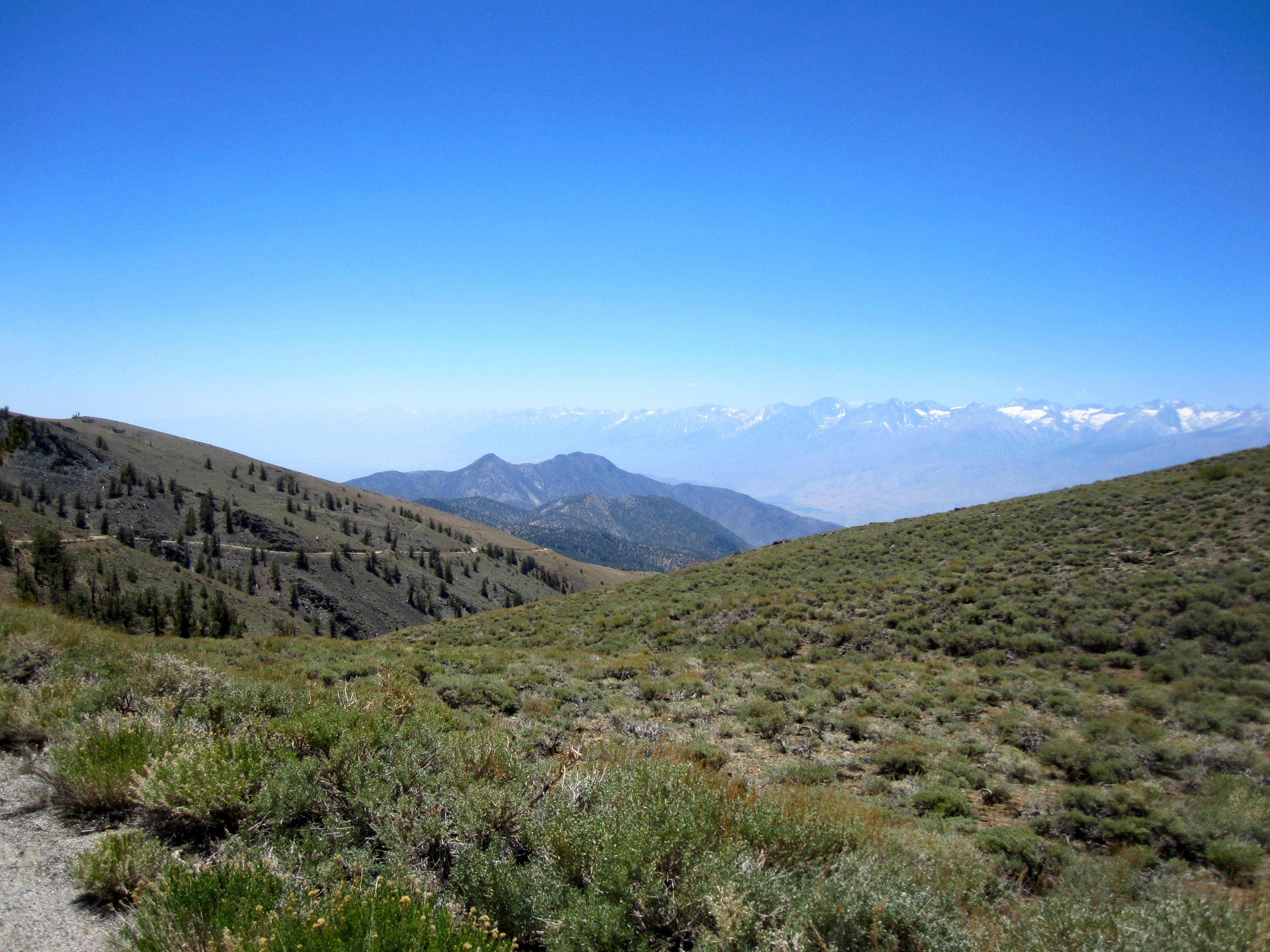
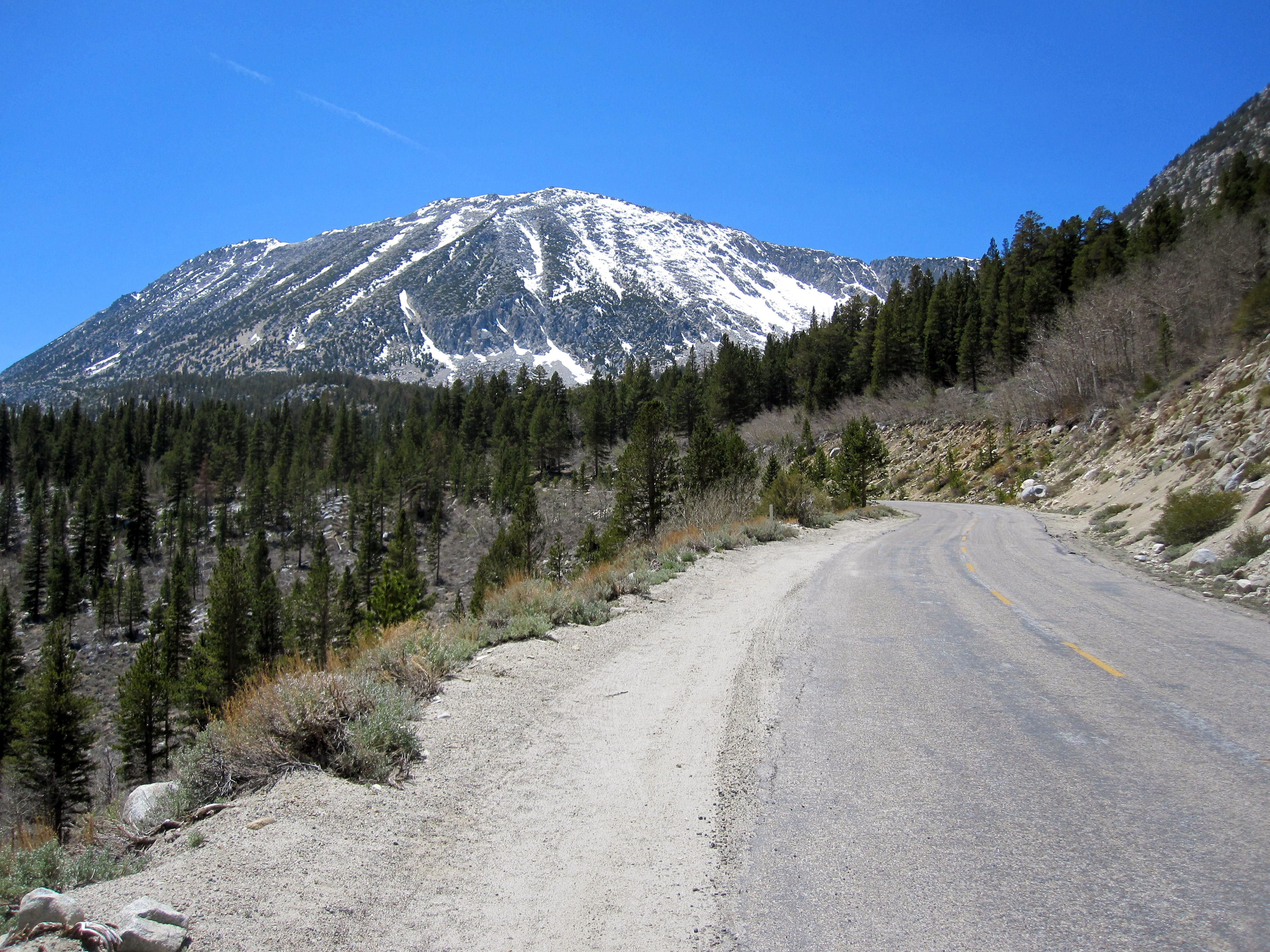
From Big Pine. Up Onion Valley. And I mean “up”. No real warm up. 5,703′ of gain in just over 13 miles. The road goes from the valley way up into the Sierras where it dead ends at a campground where there are trailheads for wonderful High Sierra backpacking. I remembered the camera and the new hotel has beefier internet so pics below.

Day’s total—44.4 miles in 3:19 for an average of 13.4 and max of 46. Beautiful ride and scenery. The first half included some gentle turns, but we were mostly moving from the Valley floor into the mountains. The second half consisted of dramatic switchbacks that made for some of the most fun riding of the trip so far. Steep, but maybe I’m getting used to it, because I got into a bit of a rhythm.

Midway, at about 6,500′, I’d look up at 12-14,000 peaks and then scan down and see shimmering metal guardrails way up high and say to myself, “Damn, steady punishment ahead.” And yet, once up on the top half, it was very cool to look down and see where you’d come from, an extremely long, brown, serpentine snake of a road. And of course I looked for the other riders to see what kind of gap I had created.

The view, coupled with my gap, meant the days of self-flagellation were over. Instead, my head swelled to historic proportions. “Contador would need roided up steak to climb this mother.” “Landis would need ‘whiskey'”. “Armstrong would need a (Dr.) Ferrari.” “Look at that road down there and look at those specks chasing me. I’m doing it on King Sized PayDays. I am among the baddest of badasses.”

After resting by a small stream at the top, the descent was fun, but you could’ve easily killed yourself since guardrails were sporadic and the drop off was many hundreds of feet. Unlike Day 3, I didn’t want to die today. Also, the freeze cracks were wicked. Still, I noticed I did one five mile downhill segment in seven and a half minutes.

Once down, four of us decided to ride to our ultimate destination—Lone Pine, 16 miles away—once again, via Hwy 395. This is where things got a little weird. It was 91 degrees and so I assumed we’d work together to make the best time possible. Wrong, Larry must of lost patience, because he took off down the road, leaving Bill, Melody, and me to chase. Or so I thought. I said to myself, “Self, the three of us will reel him in within a few miles.” So I turned around to see if Bill and Melody were ready to ride the Ron-train for awhile and they were gone. Unbeknownst to me, they crossed the street for ice at a Chevron. So I was officially in “No Man’s Land”.

I said to myself, “Self, you’ve been climbing faster than Larry, so ride like you stole it and close the damn gap.” Great, I’ve just climbed 5,300’ and now I have to time trial across the Valley floor in 91 degrees. No problem because don’t forget, I’m among the baddest of badasses. Or so I thought.

Turns out Larry is more of a badass. I should have known that when I learned he also grew up in SoCal, but unlike me, his idea of a good time was bodysurfing the Wedge in Newport. That my friends earns one a lifetime Badass Card that you can whip out whenever someone is chasing from behind. Also worth mentioning, Larry is 62 years young. Also worth mentioning, Larry has a little rearview mirror on his shades.

Damn if he didn’t throw down an epic time trial effort. I have never chased anyone so long and been so exasperated that I couldn’t close the gap. The gap began at 30 seconds. I closed it to 24 once and it grew to as much as 38. We were literally riding the exact same speed for the entire sixteen miles. Once we pulled into the Best Western in Lone Pine, I was afraid he might say, “Yeah, I was wondering where you were. I decided to take it easy given the morning’s climb and the mid-day heat.” Instead, he saw me the whole time and just resolved not to get caught. Total props! He laughed at how intense our effort was and gave me a congratulatory fist pump. Hope I’m half the badass in 12 years.

Anybody know how many times a blogger can us the term “badass” in one post? I’m sure I’m over the limit. But I doubt anyone is going to restrict me, because today at least, I’m a badass.

This slideshow requires JavaScript.
Killer Climbs—Day 3

The numbers don’t do today’s ride justice—47.4 miles in 3:54 for a 12.1mph average. 6,726′ of elevation gained.

High desert, totally exposed, steep early and brutally so late. Toughest climb of my life and I was the first one up in our little posse which makes since sense I’m the youngest and thinest. I was delivering the mail during several stretches—swerving from one shoulder to the other as if putting mail in boxes on both sides of the street. Very lightly traveled road that dead ends at 10,000′ at the Ancient Bristle Pine Cone Forest—home of 7,000 year old trees, the oldest living ones in the world. At times, despite the very light traffic, I thought a car could come around the bend and pick me off while delivering mail on their rightful side of the road. Which prompted this dialogue:

Self1: You know, a car could be coming at any second and pick you off clean and simple.

Self2: If I’d die at impact, it might not be the worse outcome because I have no effin idea how far I am from the effin top. Anyways, the will is up to date. Betrothed is still a looker. She’ll be fine. (and with that assertion, my debt for a week away is paid)

Self1: Yeah, but what if the impact doesn’t kill you and you don’t die until being dragged several hundred yards down the mountain under the car’s front bumper.

Self2: That may be slightly less fun than continuing this god forsaken climb.

Mom, I apologize for using several words you wouldn’t have been proud of today. Fortunately though, no one was around to hear them. In fact, it was so quiet, I was taking my heart rate without leaving the handlebars. I was working so hard I could feel my pulsating head, and with the bike computer clock. . . 15 in 5 seconds, meaning 30 in 10, meaning 180. That was before I lost my ability to do basic math.

I’m eating like crazy and am still probably down a few lbs.

Tomorrow is an “easy” day. A 13-14 mile climb from Big Pine up to Glacier Lodge. Rumor has it somewhere between 3-4k of elevation. It’s supposed to be 95, but we’re starting early to avoid the worst of the heat.  Stay tuned, I will let you know how it goes.


Killer Climbs—Day Two

Subtitle—Voices.

Laying in bed last night, the voice was one of my internal ones, “You really should run before riding, just like yesterday. Don’t be a loser, get up and put one foot in front of the other.” To which another of my internal ones countered, “Yeah, but what about my trip motto, ‘train, don’t strain’?”

Whenever I go to bed unsure of whether to get up and run at 5:45 a.m., I sleep a little late, lay in bed, and kick myself throughout the day for what coulda and shoulda been. Those are the days everyone is out running just to remind me that I’m a lowlife. In short, I have to totally commit and visualize it before knocking off. Go to bed all Mitt Romney flip-floppy-like and forget about it.

The ride was straightforward, climb a highway for 25 miles to South Lake. Total elevation, 5,800′. Then descend eight miles to a fork and climb for five or six more miles to Lake Sabrina. Why? Because it’s there and we drove for 20 hours to get here.

There I was 16 miles in, working my ass off, when I shifted a couple gears before standing and relieving my back. The small-ring shifter cable snapped and I was stuck in one gear. Done for the day. Since the big-ring shifter still worked fine, I had two gears, neither which I could even remotely climb in. I descended back into town and found Aerohead, an amazing hole in the wall bike shop, where Brian was waiting to repair my injured steed.

Most amazing shop experience evah. Brian had to work really hard to get the cable out and said I was almost “Completely f-ed.” Then he heard the deep squeaking noise my headset/bars have been making and said “That’s heinous.” Is that brilliant or what? Line of the day. He broke everything down, headset, fork, bars, pulled the steerer tube out and inspected it for cracks, cleaned and lubed everything and put it all back together. A craftsman. Total cost of everything, $17.69. Un-f-ing believable.

Returned to the hotel where the bed whispered, “Just lay down. Enjoy the piece and quiet of an empty room. Kick on the tube, watch some basketball, some golf, chilax.” The shower shouted, “Just hop in! Let me wash away your sunscreen, dust, dirt, salt, and fatigue. It will feel really good, promise.” I thought to myself, “Dammit, shut up! I should ride another two hours or maybe I should run.” Then the shower and bed teamed up. “Just hop in and then lay down.”

Character building run—totally exposed to the sun, warm, at elevation, partly uphill. Felt decent through 10 and like complete shit at 11. The days deets—30 mile ride in 2:04 for a 14.7mph average. 3,146′ of elevation, and a measly max of 42. 13.1 mile run in 1:47. 691′ of elevation, 8:08 pace, but don’t be fooled, I completely unraveled and entered “stick a fork in me” territory at 12. Stomach cramps prompted walking breaks.

A final voice. Again one of my own internal ones. “Who are you trying to fool? Can’t even ride for two hours and run for two, what makes you think you can ride for six and run for four? Why did you even sign up to go long? Moron. Poser. Sorry excuse of a triathlete.”

Too bad it’s not, swim, cycle, self flagellate.

Killer Climbs—Day One

Ran 7 miles before a breakfast of oatmeal, cereal, multiple English muffins with pb and honey, yogurt, juice and green tea. May have been a personal record for windiest run ever. Ran mostly into the wind for the first half which is like eating your vegetables first. My grandfather always ate his dessert first because “what if I die mid-meal”. Maybe tomorrow, in Grandpa Dana’s honor, I’ll start out with the wind.

The inaugural Killer Climb was excellent. An “A-” due to a black and blue big toe which my running posse will delight in. I don’t know why, but since suffering a previous cycling shoe injury, they think I’m a little soft. It could present troubles. Here are the day’s deets—60.3 miles in 4:10 for a 14.4 mph average. 6,195′ of climbing including riding to the end of the highest paved road in the Golden State. Maximum speed on the descent, 48.1mph, which ties my personal record. Don’t tell the Girls Club, but I will be breaking 50mph on this trip. Each year, from now on—strike that, until I die engaged in this activity in a few years—I will “descend my age”. 4,129 calories which I look forward to replacing shortly.

Rider of the day—my brother, a Southern California fixed gear cycling legend in his own mind, who was nowhere to be found. Silly me, with our physical proximity, I was sure he’d be man enough to join us.

10,300′ up in the Eastern Sierras

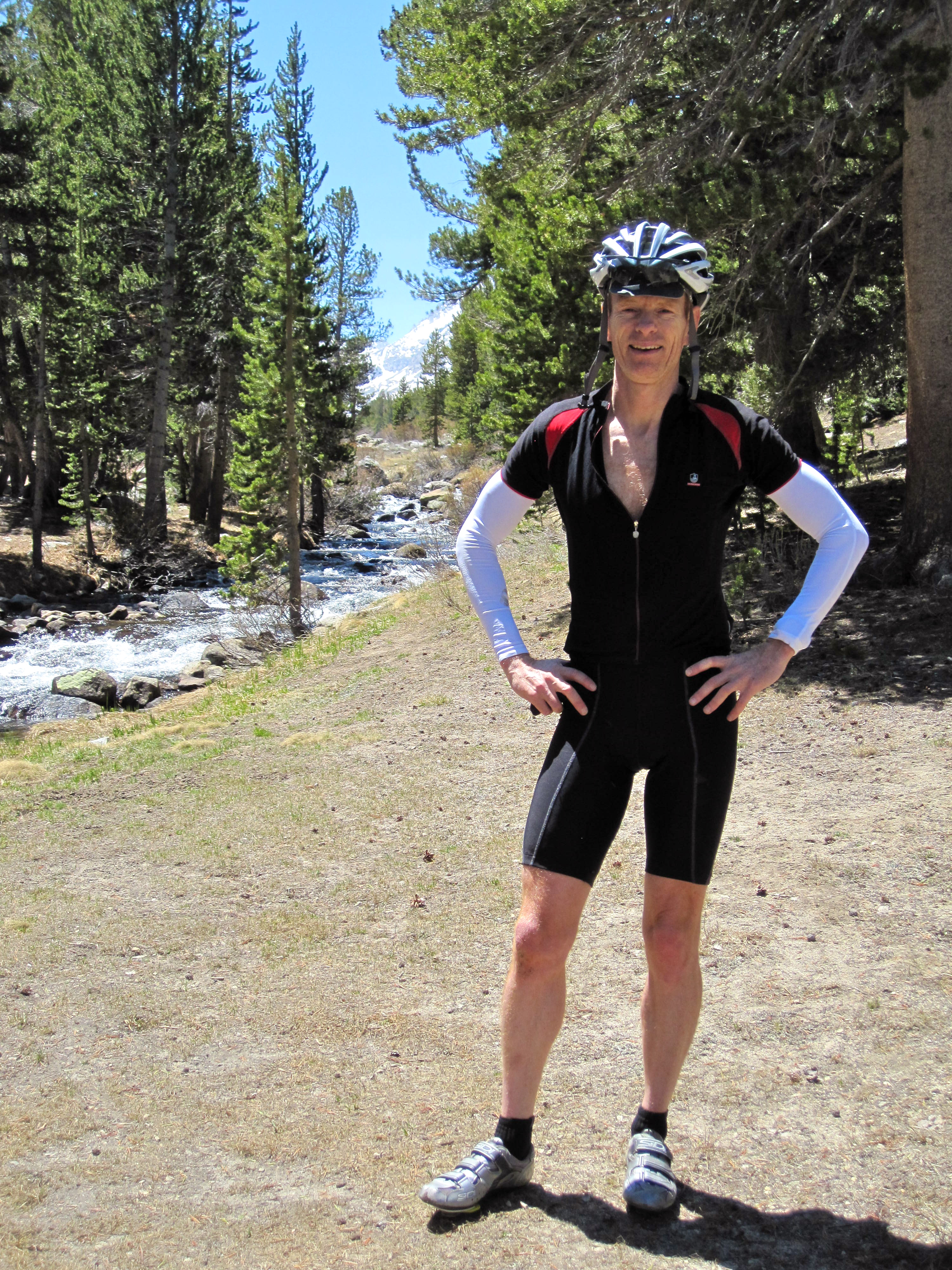
Self portrait