Weekend Notes—December 18, 2010

Miscellaneous notes unrelated to the blog’s laser focus on questioning education conventional wisdom.

• Saw a great documentary on Yao Ming five years ago. He’s very personable and likable. Since seeing that film I’ve followed him. It’s disappointing to learn he’s out for the season and that he’s probably played his last NBA game. China’s Bill Walton sans the scruffy beard, unrivaled college education, and Grateful Dead vibe.

• The GalPal turned 50 recently. Sometimes a picture is worth a 1,000 words. Fifteen’s gift tells you everything you need to know about what it’s like to live with a teenager.

• For me at least, swimming is very different from running and cycling in that I have to think about my form all the time. I get lazy and revert to muscle memory which means my elbows aren’t high enough, I cross over a bit, my stroke gets too short, and I don’t complete my stroke underwater. The challenge is trying to change these flaws simultaneously. The obvious answer is to work on one at a time, but sometimes when I try to add an additional correction in, the previous fix unravels. And the harder the set and the deeper in a workout, the worse my form. I’d probably be better off just doing slow drills for a month. Whatever I do, I swim nearly identical splits. Today’s 100’s were 1:25’s with toys (paddles/buoy).

• Just when I thought Lance was over the 2009 Black Hills Triathlon, he wants me to commit to racing the Boise Half Ironperson with him. He’s dastardly. It has a noon start. I’d begin the run around 3:3op in Boise in mid-June. I was born in Boise and I love symmetry. Maybe, like a Pacific Northwest salmon, I should return to and die in Boise? I’d rather do this race.

• The more minimalist in orientation I become, the less I like traditional Christmas gift giving. I know I should focus on the spirit of the giving and be more appreciative, it just seems most gifts don’t fill any real need and unnecessarily contribute to clutter. If you’re still wondering what to get me, massage gift certificates are $47 at the Briggs YMCA.

• It’s nice having Eighteen home from college. She had a great first trimester. Proud of her and just hoping and praying I can hang with her in the pool Monday.

• In the shocker of the week, I created a twitter account (@PressingPause) and as of today, I have one follower. Look out Linkedin and Facebook.

Thanks for reading. Have a nice weekend.

Stop Exercising

If you’re not saving for your seventies, eighties, and nineties.

Olga Kotelko is considered one of the world’s greatest athletes, holding 23 world records, 17 in her current age category, 90 to 95.

From the NYTimes Magazine:

At last fall’s Lahti championship, Kotelko threw a javelin more than 20 feet farther than her nearest age-group rival. At the World Masters Games in Sydney, Kotelko’s time in the 100 meters — 23.95 seconds — was faster than that of some finalists in the 80-to-84-year category, two brackets down. World Masters Athletics, the governing body of masters track, uses “age-graded” tables developed by statisticians to create a kind of standard score, expressed as a percentage, for any athletic feat. The world record for any given event would theoretically be assigned 100 percent. But a number of Kotelko’s marks — in shot put, high jump, 100-meter dash — top 100 percent. Because there are so few competitors over 90, age-graded scores are still guesswork.

Suspected of doping by some of her competitors, OK borrows from Lance’s playbook and repeatedly points out she’s never failed a test. Kidding of course.

Scientists researching the linkages between exercise, fitness, and longevity are busily studying OK and are finding the linkages are even stronger than suspected.

This type of fitness news is always heralded by the exercise community of which I’m a part, but is it really good news? I wonder because of another steady stream of stories about the elderly today—that they’re not saving nearly enough for their post-retirement lives. What if thirty, forty, and fifty-something spenders are also committed exercisers and then have to live through their sixties, seventies, eighties, and nineties on reduced Social Security benefits and their meager savings?

If you’re not saving for your distant future, maybe you should stop exercising.

Sometimes I wonder what a Saturday morning 10 miler with the team costs. Setting aside our time (it’s Saturday morning after all), let’s assume we’re wearing $100 shoes that last for 500 miles. That’s 2% of $100 or $2 in shoe wear and tear. Next, let’s assume we’re wearing a shirt, shorts, and socks that cost $70 new. They last at least 140 runs so another 50 cents. Then I eat and drink a lot more throughout the day than I otherwise would if I was sedentary, so approximately $2.50 for a total of $5. This is where if I had a contract with MasterCard I’d write, “And the raunchy, witty banter, priceless.”

But I’ve never factored in the hidden “Olga Kotelko” cost. Of course there are no guarantees, life is fragile, but the odds are the team and I are extending our lives each Saturday morning. I’m not sure how to quantify that.

That’s okay though because I’m choosing to think positively about my longevity and saving for the distant future. Which is why I’m going to continue training for the 2052 Senior Games.

2010 Seattle Marathon Race Report

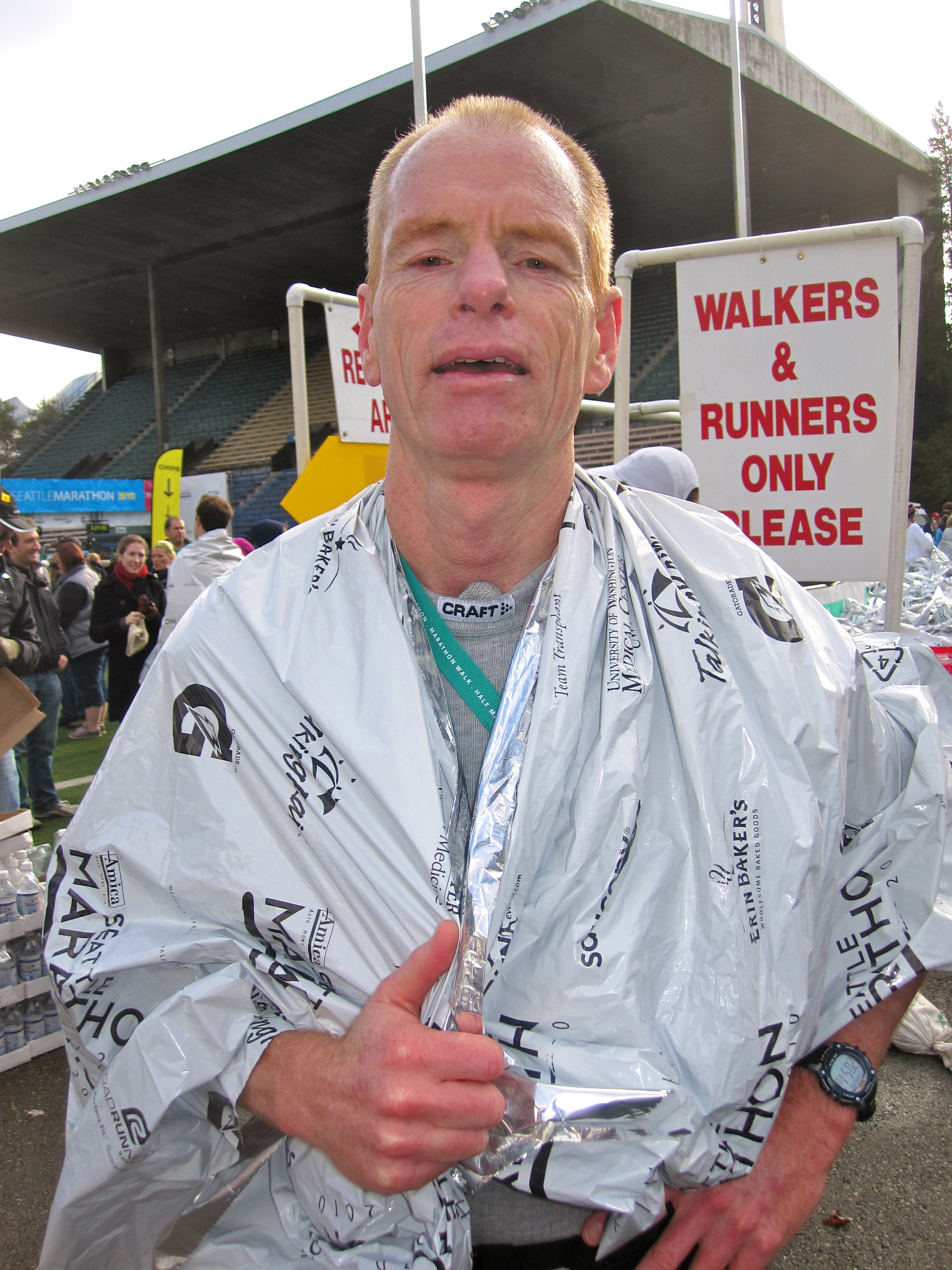
3:21:32. Overcast, wet pavement, high 30’s. Second fastest marathon. Three minutes slower than my fastest and three minutes faster than my third and fourth fastest. Not bad for an oldster.

The question I set out to answer was how many 7:30 miles can I run in a row? I had logged lots of training miles at between 7:35-7:45 and I figured with tapering, perfect weather, smart nutrition and hydration, that was a good number that would also conveniently result in a personal record.

But just before the race I had a talk with my self. “Forget the watch Self. Respect the distance, stay within yourself, and take what the running gods give you on this particular day.”

Since I had my undivided attention, I continued the self coaching. “Let’s break the race into five parts, miles 1-8, 9-16, 17-24, 25, and 26. First eight are a freakin’ warmup. If you as so much hear yourself breathing, back off. Free miles. Enjoy Lake Washington. Settle into a grove. Remember it’s a long day. Use the first hour to shorten the race with as little exertion as possible. Hit mile eight as fresh as a (just changed) baby’s behind.

Executed this to perfection. Hit mile 8 in 59:30. I was cruising comfortably, and for a bonus, I was ripping off one 7:27-7:28 after another. The out and back on the floating bridge allowed me to size up how far behind Jesse Stevick (neighbor and Oly High cross country/track coach) and Jon Riak (former lost boy from Sudan, St. Martin’s alum and apparently all around great guy) were from the leader. He had seriously gapped them. Turned out his lead at mile seven was at least as much as at the finish. The East African looking winner won it with an especially fast opening 10k. Ballsy.

I struggle with multitasking. I wanted to take my two-mile splits, but I was also drinking every two, taking gel every four, and a salt tab every eight. The running, drinking, gel taking was as much as I could handle so I just let the watch run for the first hour.

Then I cleared it and started the 18 miler. “This is such a nice grove, no reason to get excited or play the hero and push the pace, just maintain it for another hour and you’ll be in very good shape. Yeah, let’s shrink this bad boy down to a more humane distance.” This is a really nice section along Lake Wash and around Seward Park. Long story short, ran miles 8-16 in 59:45. Eight more 7:28’s, 29’s. I passed lots of people during this hour. Still felt nearly as fresh as a (just changed) baby’s behind. Great consistency, everything in control, not frantically sighting the mile posts, not even checking the watch too often, not trying to get ahead of myself. The overarching goal was to shrink it down to a 10.2 miler. A Saturday run around Capital Lake with the posse.

Mile 16. Clear the watch, restart. Self, “You know hour three is going to be considerably harder than one and two combined.” I executed part three of the plan really well too for 30-35 minutes or through mile 20.5. Then things kick up pretty seriously, including a ¾ of a mile steep segment that would prove tough on a 10k training run. By mile 21, I had a definitive answer to my question of the day. I could run 20.5 miles @ 7:30/mile pace.

Weather was perfect, didn’t overeat the evening before or morning of, salt tabs kept the cramping at bay, drank a ton of Gatorade, and ran smart, so what went wrong? Simple. I ran too few long runs (two 20 milers) and didn’t have a high enough three month mileage total to run through to the finish. Had I gotten one more massage and switched out my shoes earlier, things might have turned out differently. At mile 21 I began to fight it big time, and the quads were trashed, which made the steep downhills from 25 to 26 especially slow and painful, but it was a classic case of having to go farther than I was physically trained to go.

During the last five miles Fifteen’s question from the car trip up rang in my ears, “Hey Dad, why the marathon this year?” Over the last five miles I wasn’t fighting the “whimp ass” voice DG refers to as much as a surly contingent of whimp ass voices. It didn’t help that I was running through the half marathon walkers. “Just keep running, doesn’t matter how slowly. No walking, no way. Salvage a great day.” I was as proud of my last much slower five miles as the first 21.

Thanks Denny for the kindness and generosity. Thanks especially to the GalPal and Fifteen for great race support especially immediately afterwards. Dano for being the best training fodder a guy could ask for. Thanks DG for the foot tips and inspiration. Katie, Lance, Courter, the Principal, moms, and other family and friends for cheering me on from a distance. I felt it. And my brother for the 3:31 prediction or whatever it was.

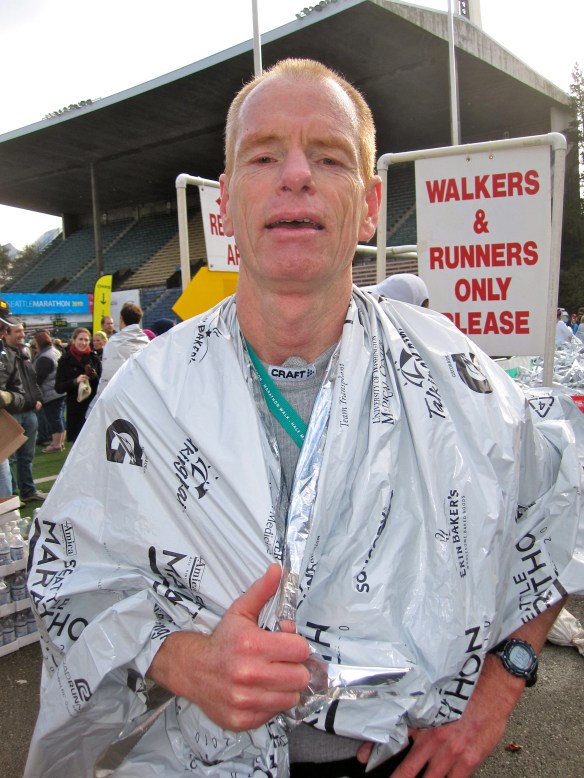
Felt even worse than I looked

Derek Jeter

From Buster Olney’s ESPN blog:

“The Yankees’ belief is that their current three-year, $45 million offer is fair, and that by offering arbitration to Jeter, they essentially would bail him out after a down year. The Yankees feel that in the past, Jeter has fairly negotiated from his standing in the marketplace — when he went to arbitration in 1999, when he negotiated a 10-year, $189 million deal in 2001. And now the Yankees feel these talks should reflect Jeter’s place in the market; they also believe that no other team would be willing to pay him what they have offered. Here’s one big factor working against Jeter in this negotiation: While the Yankees want him and are offering him above what his market value is, they operate in the knowledge that if Jeter doesn’t re-sign — if he actually walks away — then his departure would not be a mortal blow to their pennant hopes in 2011. If Jeter walked away in 2001, that would have been different; he was an exceptional player then. Now he is a good player, but far from irreplaceable.”

I’m concerned for DJ. He’s building the largest, most expensive home on the water in Tampa a few miles from my mom’s pad. How’s he supposed to finish it and furnish it with a best-case scenario pay cut of $3.9m/year ($15m versus $18.9)? Last time I cycled by his crib there was a Porsche Panamera parked out front. Next time I ride by it will probably be a Toyota Highlander.

Sports analysts refer to DJ’s value to the Yankees in terms of his personal brand and argue it contributes to the team’s brand. In essence, approximately half of the proposed contract is a bonus for distinguishing himself from the other knuckleheads in the same locker room. Don’t mistake this for Yankee bashing, it’s pro athlete bashing more generally. It’s a sign of the sorry state of pro sports that Jeter has separated himself from the vast majority of ball players by doing what should be the norm, chasing foul balls into the stands, passing on p.e.d.s, and living within the laws of the land. In short, be a good citizen and we’ll pay you extra.

What intrigues me the most about these negotiations is the relative discipline of the SOS’s, “Sons of Steinbrenner.” A lot of financial analysts that study the wealthy predict that the vast majority of young adults of extremely wealthy parents will blow through their inherited wealth given their sense of entitlement and anemic work ethic. My guess is Steinbrenner would have signed DJ by now for more than is on the table. Props to the sons for their surprising, relative fiscal discipline.

Here’s what DJ should do. Sign the contract and say, “I’m well aware that functional unemployment is 17%. That awareness makes me even more appreciative of this contract which enables me to continue making a very good living playing a child’s game for the best franchise in professional sports. This is not a ceremonial signing. I will continue to work hard day in and day out to bring Yankee fans more joy over the next three seasons.”

“I’ll figure out,” he might add once the microphones and cameras are flipped off, “how to cut some costs on the new spread.”

Yankees daring Jeter to look elsewhere?

Marathon Pacing

There are three types of endurance athletes. The first, which make up about 1-2% of the total, are the elites who race one another in an effort to win. The second and third, genetically speaking are the remaining 98-99%. The difference between type two and type three endurance athletes is that type two-ers bring a lot more discipline, consistency, and focus to their training; as a result, they finish well ahead of type three-ers.

Each group has different objectives—1’s) win; 2’s) set personal records of different sorts, qualify for the Boston Marathon, etc.; and 3’s) finish.

I assume each elite athlete enters endurance events with detailed pacing plans which they often have to chuck when the lead group goes unexpectantly slow or fast over the early and middle stages. Have a plan, but be flexible.

Type three-ers, who may also be known as “one and done-ers” or “bucket-listers” go into races seriously undertrained, inevitably go far too fast early on, aren’t quite sure what to drink and consume, and fade big time over the later stages. I don’t know how they can go into marathons with detailed pacing plans when they haven’t done enough long runs from which to extrapolate.

I’m a two. There are two types of twos, those that lean heavily on science to aid their pacing, and those, like me that base their pacing on feel, or perceived rate of exertion.

My science is checking mile splits. Overtime I’ve learned to adjust my pace based on my breathing and my mental state. More specifically, by listening to how hard I’m breathing and thinking deeply about whether I can maintain my pace for another hour or two or three. Like turning a dimmer switch ever so slightly, I’ve learned to modestly increase, hold steady, or slightly back off my level of exertion. As a result, I usually perform very close to my limited potential.

I have a few different paces in my quiver. First speed is what I label my “steady/all day” pace. When I’m in good shape, hydrating, and taking in calories, this is the pace that I feel I can maintain for hours. Third speed is “moderate-hard/on the edge/85%/half marathon” pace. My optimal marathon pace is splitting the difference between the two. Easier blogged about than done because I don’t know if I’m in optimal shape. Trying to run optimal pace on something less than optimal fitness could backfire bigtime.

To be successful, twos have to learn to let faster people go. When passed, the tendency is to to say one’s self, I’ll show him or her. When marathoning, I wear horse blinders until the last 10k when I sometimes try to settle in behind someone stronger to shake things up and expedite finishing. To refine this skill I visualize my eighty-year old mother passing me with her reconstructed knee.

The exercise scientists would have chuckled at me one morning last week when I ran down to Capital Lake, around it, and back. Eight miles. Felt really good for the first four and then glanced over at the lake and saw wave action. Oh oh. A few hundred meters later and I was heading back into the 15mph wind that had assisted me over the first half hour. My worst marathon (Boston ironically) was one where I didn’t adjust my dimmer switch fast or significantly enough in light of the warm temps and how much I was sweating (I was fooled by the breeze that was masking my sweating). Again, the scientists would say that was avoidable and they’re probably right. But I’m stubborn and I accept the unpredicatability that comes with running by feel.

Here’s a summary of Saturday’s run. Don’t tell the team we were short a tenth of a mile.

Seattle Marathon Training Update

After a few solid weeks of Seattle Marathon training I’ve hit a serious speed bump in the form of a bottom of the foot soft tissue bruise. Bad timing since last week was supposed to be my longest week. Had to pull up after a half mile one day, rested the following day, and ran 3 miles the third day. As a result, it’s unlikely I’ll be able to hang with the leaders over the final 10k.

It seems to be improving thanks to DG’s wise counsel, ice water, a tennis ball, new shoes, and flat trail running. And so I hope to put a little time into Subway Jared (New York Marathon time, 5:13) and Edison Pena, the Chilean miner/Elvis singer (5:40).

Monday’s predawn workout on the Olympia High School track was a setback of sorts too. Before hitting the track, Dano and I ran four miles with the right wing nutters. Dano only had time for 400 meters before heading home, but he can vouch for the veracity of the next paragraph.

As Dano and I rounded the first corner, one of four or five women stretching on the football field hollered, “Hey Ron!” It was dark and since I didn’t know which of my female fans it was I uttered a simple “hey” in reply.

Apparently women do love the strong silent type because once Dano peeled off the adoration, like my pace, picked up. 800 meters, “Looking good Ron.” 1200 meters, a reprieve because now they’re hopping on one leg across the width of the football field. 1600 meters, “Nice work Ron.” 2000, they’re hopping again. At 2400 meters I’m feeling part human, part gazelle. A legend in my own mind. This is how Pre must have felt.

Then it all came crashing down in one decisive ego shellacking blow. 2,800 meters, “WHEN ARE YOU GOING TO START YOUR INTERVALS?!”

“I’m nursing a soft tissue bruise.” That had to impress them don’t you think. I spent the last 400 meters thinking about how I should have replied. “I just got back from a training camp in the Rift Valley where I took it to the Kenyans. Today is a recovery run.”

Montana Grizzlies Stand Pat

The University of Montana Grizzlies will stay in the Big Sky Conference and not move up to the Football Bowl Subdivision, school president Royce Engstrom said Thursday.

“It was a complex decision with many pros and cons,” Engstrom said in a statement. “In the end, the better course is to stay with the conference we helped establish in 1963 and to continue building on its solid foundation.”

Engstrom said there were three keys to his decision — he wanted to maintain the cross-state football rivalry with Montana State; he wanted the Grizzlies to compete against institutions with similar academic missions; and he wanted to maintain the prestige and integrity the program has demonstrated.

Talk about enlightened leadership. Stories like this help me battle cynicism. In a day and age where the default is to constantly grow, continuously generate more money, and routinely increase one’s profile, the Grizz said, “We have a very good thing going and we don’t want to risk losing it.”

No doubt many Grizz alum and fans don’t see it the same way as me which makes his “no thank you” to the bright lights and big bucks of big time college football all the more remarkable.

Maybe Engstrom drew strength from this Emmylou Harris track.

I’ve felt adrift lately. Lost even. At times I wonder if some radical changes might help me feel less adrift, less lost. So far at least I’m following Engstrom’s and the Grizz’s example, looking within, finding lots to appreciate, and standing pat.

Websters—2011

As these new entries in the 2011 Webster’s dictionary illustrate, the English language continues to evolve. Remember, to truly learn new words it’s important to integrate them into your speech as much as possible.

• dinorossi—to repeatedly come up just short of one’s objective. Also rossied or d-rossied. I hit the jump hard and caught major air but rossied the landing.

• notredame—of or pertaining to a once great individual or group that is loathe to accept its obvious decline. Also notredamed; notredamenation. Like Ancient Romans, 21st century citizens of the United States were caught off guard by their collective notredamenation.

• christopherhitchens—the incessant turning of events and topics into unmitigated negatives. Also c-hitched. I enjoyed Lester Brown’s newest book until he returned to form and c-hitched half way through.

• obamathon—something doomed, over time, by unrealistic expectations. Also female-obamamama; conservative-obamanation. It became clear early in the season that Jake Locker’s Heisman Trophy campaign was an obamathon to the voters.

• tigerwoods—to forego one’s family and reputation for extramarital sex. Also tdub; tdubbed; tdubbing. The South Carolina Governor said, “The hell with it, where’s my hiking boots and map of the Appalachian Trail? I’m tdubbing it.”

• claybennett—1) to say one thing and do another; 2) to steal. Also cbennett; cbenn; cbenned; claybennetted. 1) Whenever I call her, it’s someone else, think she cbenned me? 2) I didn’t have my wallet and was really hungry, so I claybennetted some powder donuts.

• nancypelosi—to fake smile even when deeply angered. Also nancypelosied. Despite the auditor’s obnoxiousness, I nancypelosied my way through the IRS interview.

• hailegebreselassie—to dominate opponents at different times and in different contexts, also gebb; gebbed; hgebb; hgebbed. Again, Ron gebbed Dave and Lance throughout the 2010 cycling season.


Competitive Fire

You’re granted an “adolescent magic wand” with which you can provide the young adults you know an intense competitiveness or an above average ability to cooperate with others. Which do you choose?

Trick question because they’ll benefit from an intense competitiveness in the world of work and from cooperation-based experiences, knowledge, and skills in their personal lives.

An intense competitiveness will undoubtedly come in handy with the college admissions process, tightening labor markets, and the fluid, knowledge economy that an increasing number of Chinese, east-Indian, and Brazilian young adults are confidently entering.

Rewind to last week’s Narrows League Swim Meet at Foss High School in Tacoma, WA. Two hundred adolescent female swimmers exhibiting differing degrees of competitiveness. The mother and father in front of me sit passively until their daughter enters the water and then they go beserk. Their daughter, one of the top swimmers at the meet, seemingly feeds off their energy.

I’ve got the dad all figured out. Former national water polo player, then extreme fighter, and now UFC executive. He’s stolen my hair cut, but I let it go because I’m a wee bit intimidated by the tats running down his rippled triceps.

Event two for his daughter and I’m in full on eavesdropping mode. Dad is flexing for daughter and she’s eating it up from the behind the block. He air-shouts and she lip-reads, “GO HARD!” She eats it up as if there’s an electric current connecting them. Swims a 25 second 50 free and all I can think is the apple doesn’t fall far from the tree.

My approach to spectating is more cerebral. I’m in Phil Jackson-mode, sitting quietly focusing more on writing down splits than firing up my daughter. Afterwards, when I get real excited, I flash her a thumbs up sign. Forget electricity, I barely muster a spark.

It must be my fault that my daughters lack competitive fire. But just about then the competitive fire water got muddier.

I’m in the top row of bleachers, leaning against the cinder block wall next to the father of our team’s swimmer of the meet. She won the 50 free, beating rippled triceps daughter in the process, despite having only the fifth fastest qualifying time and she won the 100 breast going away (1:08). Her dad, who I know, stood passively next to me while she swam. Like me, he doesn’t have a bicep to flex. Two egghead peas in a pod, we talk philosophically. Wait a minute, where does his daughter’s intensity come from?

I ask if she’s going to swim in college. “No, we’re discouraging her from doing that it’s such a time-suck.” Mental parenting report card. Two points for separating their egos, minus one for not letting her decide herself.

Maybe competitive fire is like most things in life, part nature, part nurture. Most adolescents are wired like their parent(s) and follow their lead, but not all. What works for each family is different.

Returning to the magic wand, being comfortable with competition is important, but of course there’s a point of diminishing returns. We all know people whose competitive nature gets the best of them.

Once a young person gets into college, and once they take a job, cooperation-based experiences, knowledge, and skills are more integral to their success. Not just their workplace success, but their happiness in life more generally. Which begs the question, why aren’t we more intentional about teaching young people how to cooperate with one another?

One Size Fits None

A warm welcome to DCRainmaker readers who are pouring in as a result of Ray linking to my recent “Where’s the Romance?” post. My most read post of all time, by a considerable margin, is one titled “School Mission Statements”. Do a Google search for “school mission statements” and it’s the fourth link, but whose counting? Ray gets 6,000 hits a day, a little more than me. If yesterday’s record uptick in readership continues for very long, “Where’s the Romance?” may give “School Mission Statements” a run for its money.

Now back to regular programming.

Read an interesting swimming article recently that detailed the different mindset of sprinters. Even elite Olympic caliber sprinters don’t like training and get bored extremely quickly. (Was that the rare double adverb? Is that legal? Shouldn’t I know that?) The ability to adapt to differences and individualize one’s coaching, teaching, campaigning, and sales pitches often distinguishes swim coaches, teachers, politicians, and salespeople as particularly excellent.

In teaching it’s referred to as curriculum differentiation. Curriculum differentiation occurs when a teacher adjusts his/her lesson plan so that it meets the needs of all students.

Amazingly, nearly all of the car salespeople I’ve interacted with seem to be reading from the same script. None of them have successfully read me. If they had, they’d bypass the small talk about what I do for a living and my family which I can’t stand and focus exclusively on the car’s features (which they often are unable to do very well).

The high school coach that I help and I sometimes get frustrated with some girls that don’t practice very hard. They sleep-swim, stop to adjust caps and goggles, stretch their shoulders, go to the bathroom during main sets, and in some cases miss practice altogether. But now that I think about it, they tend to be the sprinters. Their natural tendencies and our workouts are misaligned. They’ll probably never embrace the process, or the long, sometimes monotonous and always tiring rhythms of distance training.

If I’m ever a head coach, I think I’ll design three different workouts—a sprint one, a distance one, and a distance-lite one. The sprint workout, which will emphasize intensity and variety, will last about 60% as long as the others. Instead of coasting for ninety minutes, they’ll go real hard for 50 minutes.