Shannon, Stephen A. disagree on NFL MVP this season

Never mind that the season hasn’t started.

This is a new low.

Even with the intense individualism that marks life in the (dis)United States, I will never understand the preoccupation with MVP races.

Last I checked, basketball, football, baseball are team sports. I don’t give a shit about who is the most valuable player. Now, mid-season, late season. Tell me one thing, what’s your winning percentage?

That said, it’s prob time to name the MVPP. . . Most Valuable Pressing Pauser. Are you a contender or pretender? Contender. . . someone named DanDanTheRetiredTranspo Man; Don in the premier destination for technology development; the GoodWife for her behind the scenes support, Reverend Wright, two Centrist baboons, the list goes on and on. If you’re not on the short list, I suggest you work a little harder on your brand.

Read New York Times Opinion Pieces Like You Hit A Tennis Ball

Follow through by reading the top “Top Comments”. They always expand the “discussion”.

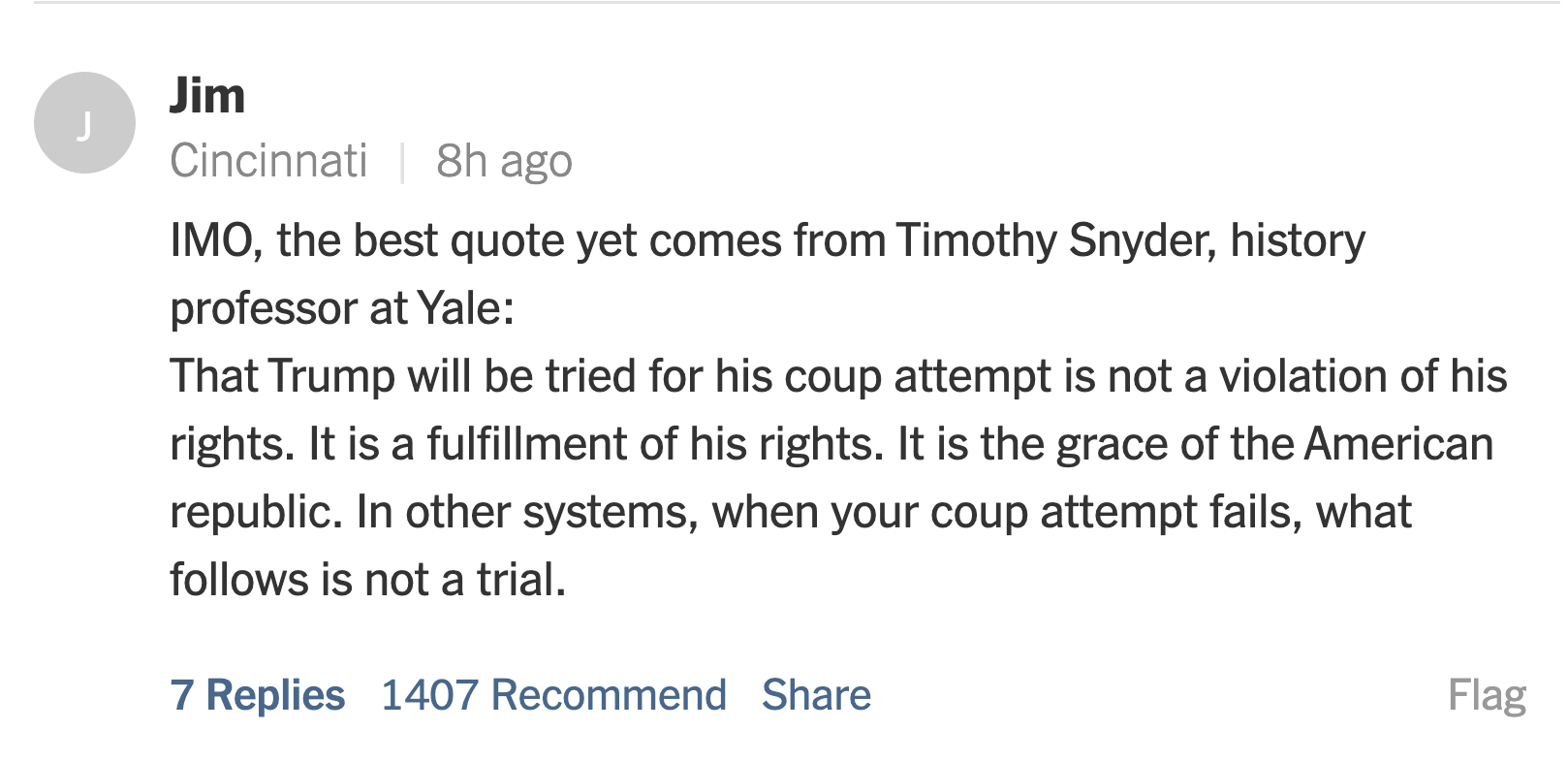
Por ejemplo, here are two of the top comments from today’s Mauren Dowd essay titled, “Coup-Coup-Ca-Choo, Trump-Style“.

Excellent point H.A. And then there’s this from Jim in Cincy.

Touché Professor Snyder.

Notes on The Gambia

When it comes to travel writing, Matt Lakeman is the man.

Among the better sentences, “Much of Jammeh’s government, reign, and conduct are pretty normal for a terrible African dictator, but at least his billowy white robe and trademark scepter is quite striking.”

And this tutorial took me back to my travels in East, West, and Southern Africa.

“As a poor country gets more tourism, the locals adapt. Many become more welcoming and friendly towards tourists since they represent an opportunity for personal and national enrichment. But other locals become more adept at exploiting tourists, whether through fraud, deception, or guilt.

One form of the latter treatment is to yell at random passerbys, usually to get attention to make some sort of sale or offer a service. This is by no means a unique element of West African travel. Any tourist who has been to Egypt, Morocco, India, Thailand, etc. knows exactly what I’m talking about.

The amateur tourist makes the mistake of defaulting to polite sensibilities and grants attention to the bystander who shouted “Hello, sir!”, “Excuse me, sir!”, “Nice to meet you, sir!” “Where are you from, sir?”, or whatever, and is soon sucked into a time-wasting and generally annoying sales pitch or preamble to a sales pitch. The experienced tourist keeps looking forward, not granting an iota of attention, in order to signal that they will not be suckered in and parted with cash.”

I also learned a new word, “sexpat”.

Siddhartha Mukherjee Writes In Bed

I sang his praises here. He won a well-deserved Pulitzer for general nonfiction for Empire of All Maladies. And he deserves a Nobel Prize for science writing for helping a knucklehead like me (mostly) understand cellular biology.

I’m just settling in with The Song of the Cell: An Exploration of Medicine and the New Human.

Here’s the backstory to the book and his writing process.

I Failed

How will large language models/artificial intelligence change K-12 education? Maybe the better question is will large language modes/artificial intelligence change K-12 education? Through teaching, research, and writing, I spent most of my academic career trying to make high schools more democratic, more international, more personal, and more relevant and purposeful.

I’m sad to report that I failed bigly. The fact of the matter is, except for all the surreptitious texting under desks, the typical high school today functions remarkably similar to the way Cypress (California) High School did when I graduated in 1980. What other institution in American life can you say that about?

Lesson learned. K-12 education is incredibly resistant to change. Like YouTube, surely ChatGPX-like devices will have some effect, but probably not enough to fundamentally alter the teacher-student relationship. One education scholar uses an ocean metaphor to explain the futility of education reform. Schedule tweaks, new curriculum initiatives, education technologies, all create changes on the surface of the ocean just as high winds do. Descend to the ocean floor however, meaning the teacher-student relationship in the classroom, and the water’s darkness, chemistry, and animal life are completely unaffected by the tumult on the surface. The teacher still mostly talks and the students listen.

Despite it being so obvious, it wasn’t easy to admit my my failure, you know, professional identity and ego and all. But the consolation is a quiet confidence that I have made a positive difference in a lot of individual teacher’s lives. Despite not having dented their work environment, I have made meaningful contributions to their professional success. I’ve failed, but I’m not a failure.

And even though I’ve admitted defeat and let go of my teacher education identity, I am still helping individual teachers on occasion, just fewer of them. Yesterday, for example, one of my first year writers from Fall 2021, a prospective teacher, wrote me seeking advice. Here’s how she started her missive:

“I hope all is well! I am reaching out to you because I need some advice. I figured you would be an excellent person to reach out to because you are part of the education faculty and have taught abroad and done things I want to do with my life. I also think you won’t sugarcoat things and you will tell me the truth.” 

I liked that she didn’t think I’d “sugarcoat things”. So, in that spirit of keeping it real, I predict high schools in 43 years, make that 2066, will still look and feel pretty damn similar. Given my protein bar consumption, it’s unlikely I’ll live long enough to see if my prediction comes true. I hope it does not.

Postscript: Not an “institution”, but same idea.

Put A Fork In It

The semester is a wrap. My parting words to my students.

“The very end of my first class as a brand new professor at Guilford College in Greensboro, NC ended in a humorous manner. I spoke for about ten minutes, doing my best to tie together all the course’s loose ends. I was pulling out my egghead professor vocab and thought everyone was listening closely. After I finished, Josh raised his hand. ‘Oh great,’ I thought, ‘Josh is going to thank me for the brilliant summary and the course more generally.’ Instead, he said, ‘Dude, you have a pierced ear!’ Then the discussion devolved into why I had never came to class with an earring. Lesson learned, keep the end-of-semester spiel very, very brief.

Price writes that ‘the more we train ourselves to notice delights—the everyday beauties and kindnesses and amusing absurdities, the things that make us laugh or that we feel grateful for—we will feel more positive.’ She goes on to suggest we say ‘delight’ out loud whenever we experience anything that sparks joy. I’m trying to adapt this practice. This morning, on my drive in through the Nisqually Delta, I saw a huge flock of birds flying in ‘V’ formation. I said ‘delight’ to myself. Then I immediately thought of this class and what I wanted to say to you now that we’re at the finishing line.

And here it is. Delight.

It’s been a complete and total delight to get to know each of you individually and collectively. I hope the rest of Year 1 goes well and that we cross paths again sometime in the future.”

Ron

The Calm Before The Storm

Wednesday, 11:30a.m., National Pearl Harbor Remembrance Day. More specifically, the week before I’m buried under final papers. Ensconced in my home office, alternating between reading, writing, and watching the Salish Sea flow northward thanks to a southern wind.

All while grooving to a folk/acoustic/electronic vibe compliments of Sylvan Esso, Becky and the Birds (Wondering), the Cowboy Junkies (Sweet Jane), and Helado Negro (Lotta Love).

On the interweb I see a Stephen Marche prediction that artificial intelligence is going to “Kill the Student Essay“. That hits close to home.

“Essay generation is neither theoretical nor futuristic at this point. In May, a student in New Zealand confessed to using AI to write their papers, justifying it as a tool like Grammarly or spell-check: ​​“I have the knowledge, I have the lived experience, I’m a good student, I go to all the tutorials and I go to all the lectures and I read everything we have to read but I kind of felt I was being penalised because I don’t write eloquently and I didn’t feel that was right,” they told a student paper in Christchurch. They don’t feel like they’re cheating, because the student guidelines at their university state only that you’re not allowed to get somebody else to do your work for you. GPT-3 isn’t “somebody else”—it’s a program.”

Marche adds, “It still takes a little initiative for a kid to find a text generator, but not for long.”

Please tell me there’s no way for ChatGPT to replicate my charming personality.

“Kevin Bryan, an associate professor at the University of Toronto, tweeted in astonishment about OpenAI’s new chatbot last week: ‘You can no longer give take-home exams/homework … Even on specific questions that involve combining knowledge across domains, the OpenAI chat is frankly better than the average MBA at this point. It is frankly amazing.’ Neither the engineers building the linguistic tech nor the educators who will encounter the resulting language are prepared for the fallout.”

I resemble that! I’ve been wrongly assuming that my Multicultural Education take-home final exam was text generator proof.

Going forward, I guess I’ll have to require students to pass through a metal detector and write it in-person.