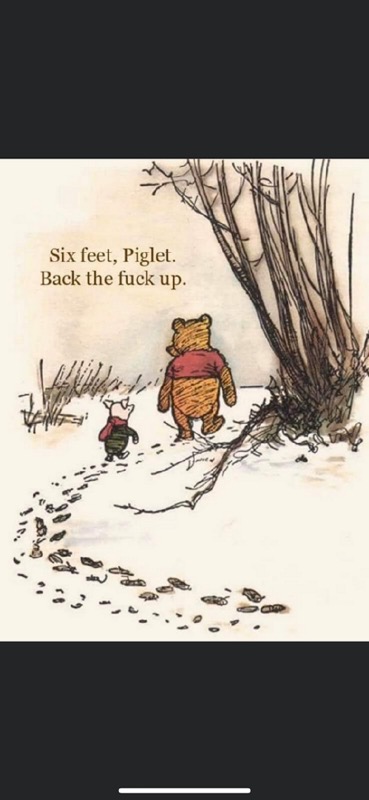
The Good Wife does not approve. “No, not OK for Pooh bear.”

The Good Wife does not approve. “No, not OK for Pooh bear.”
There’s a premium on medical advice during pandemics. Which begs a very difficult question everyone will answer differently, turn to a reality t.v. host for his specialized knowledge or medical professionals?
People in Ohio are torn. As Ohio goes, we go?
From the Columbus Dispatch, via big brother, Don Byrnes. Feds, Yost will prosecute doctors who abuse power with personal coronavirus prescriptions.
“Federal authorities and Ohio Attorney General Dave Yost said Tuesday they will prosecute any doctors who abused their power to prescribe themselves or family members experimental drugs to try to preventively treat COVID-19, the disease caused by the new coronavirus.
Ohio’s pharmacy board, in an emergency meeting Sunday, issued strict guidelines for the prescribing of hydroxychloroquine or chloroquine after pharmacists across Ohio said they were seeing hoarding by doctors of the pills for themselves or their families and friends.
The prescriptions started, pharmacists said, after President Donald Trump said during a news conference that the drugs could be effective in treating the disease. Doctors have refuted that assertion and have reiterated that there is no established cure or treatment for COVID-19 other than to support patients with breathing, pain and headache relief.”
This, it turns out, is a double negative:
“The drugs being prescribed are used to treat lupus and arthritis. Pharmacists said the rapid jump in prescriptions has created a shortage for patients who need the drugs to treat their pre-existing conditions.”
Our Pandemic Progress Report. Failing history, science, and math, and we’re utterly lacking critical thinking skills. Beyond that, our future is bright.
Nick Heath, rugby commentator, journalist and podcast producer, started commenting on everyday life as he saw it and shared the videos on Twitter.
Watch and listen here.
By the press. And so he gets away with it. Again.
1. Q&A With Avi Schiffman: the MI Teen Behind Viral COVID-19 Site. His viral website is here.
2. Japan schoolgirl uses own savings to handcraft 612 masks for people in need.
“Hime used about 80,000 yen of her own money to buy materials for the masks from around late February and spent up to five hours a day making them, using the free time she had when her school was closed due to the coronavirus.
‘I’m not that good at sewing but tried hard to make them as I want to help people,’ she said.
Will > skill.
3. Two 20-somethings extend ‘invisible hands’ in virus outbreak.
“Elkind, a junior at Yale, and a friend, Simone Policano, amassed 1,300 volunteers in 72 hours to deliver groceries and medicine to older New Yorkers and other vulnerable people. They call themselves Invisible Hands, and they do something else in the process — provide human contact and comfort, at a safe distance, of course.”
Built on “tikkun olam”, Hebrew for “world repair” a beautiful concept synonymous with the notion of social action.
4. There’s no better time for cities to take space away from cars.
5. The two Demos who should be the faces of the Democratic coronavirus response. I question the premise that we need separate, party-specific responses. The virus is non-partisan.
Boxing match. Cuomo versus Trump. Pay per view. Now.
This afternoon, the half of the country that’s sane was lamenting Dr. Tony Fauci’s absence from today’s coronavirus presser. Many took to social media asking where the heck is he?
Apparently, they’re not paying very close attention. The President, who brooks no criticism, said he’s “at a Task Force meeting”.
Sure.
Fauci on Trump Sunday, “I can’t jump in front of the microphone and push him down.”
That blasphemy coupled with the viral video clips of him squirming uncomfortably while the President bloviated sealed his fate.
Today, Fauci said, “I’m not fired yet.” Just sidelined.
I dedicate this to Travis and Mike who are convinced I’m being even less fair and balanced about the current administration than normal.
From Arnold Kling’s blog post “Calibrating anger”.
“I don’t think that anger toward President Trump is well justified. It is true that he reacted more slowly than many people who are more technically oriented and better able to read exponential processes. But almost every other leader around the world reacted just as slowly. And he was badly served by the FDA. . . Some of those FDA folks are still taking their case to the press, attacking President Trump for breaking out of their regulatory straitjacket.
No doubt that there were some officials somewhere in the bowels of the bureaucracy who saw this coming and tried to send warnings up the chain of command. Perhaps some of those warnings made it all the way to the Oval Office. But suppose that Mr. Trump had understood and been ahead of the curve. Had he told people back in February that they needed to change their behavior, I am skeptical that he could have brought the country with him. The left, rather than respecting such a judgment, would more likely have denounced early measures to stop the virus as a fascist takeover. As it is, they can call him an idiot for being too late. Fine.
I don’t recall leading Democrats putting much pressure on him to act sooner.
Where I am inclined to fault Mr. Trump is in what I see as a lack of ability to attract and retain outstanding personnel. I think that his circle of trust is too narrow. If my intuition about this is correct, then this shortcoming is quite consequential.”
I’m trying really hard to make nice so I will not say a narcissist is incapable of “hiring only the best” because their smarts and competence would accentuate his relative shortcomings.
Dammit, so close.
 Pressing Pause