Inspiration

J.D. Salinger thought he wanted literary fame, but after experiencing it, quickly changed his mind. In an era where so many people crave the media spotlight, and style trumps substance (see Palin, Sarah), I find his intentional turning from notoriety intriguing. Will a movie be made? Is there enough post Catcher in the Rye material? Will his survivors sell him out? If it is made, the best way to honor his life would probably be to not see it.

Salinger was extremely eccentric, but what strikes me as far more interesting is that even after withdrawing post-Catcher he allegedly continued to write for pleasure. There’s a purity, even beauty to that, which inspires me.

Previously, I’ve assailed our increasing loss of privacy, which is another reason I find Salinger intriguing and inspiring. He took control of his public persona instead of passively allowing others to shape it. More accurately, he escaped having a public persona by assiduously avoiding contact with writers, photogs, and other media types. People today don’t seem to realize that there’s no obligation to take the call, speak into the microphone, or appear on screen.

Bill Gates strikes me as a very different type of dude too, and as a result, intrigues and inspires me in equal measure. A lot of well-to-do people do charity in ways that bring attention to themselves. And they give sizable gifts that are in actuality quite small relative to their total net worth. And their gifts, which often pad Ivy League schools’ endowments, don’t seem particularly well thought through. Gates has said he intends to give nearly all of his wealth away and he’s making good on that promise. He’s given something like $30b away so far and a few weeks ago announced that he was giving $10b more than planned for child vaccines in the developing world.

Gates stands out in a world where the richer some people get the tighter grip they maintain over their wealth. He doesn’t seem to seek media attention, but I think he deserves more of it for both the amount and ways in which he’s giving.

My guess is Melinda’s behind the scenes role has been key in Bill’s selfless, socially conscious giving. I’ve seen her on television a few times, but refreshingly, she has a little Salinger in her, content to parent, figure out how best to give away billions, and leave the media to pursue other stories like what Kelly Clarkson thinks of the Taylor Swift controversy.

And then there’s Sade, one of my favorite musical groups/people. Ten years on, finally another album. Turns out, Sade Adu has a little Melinda and Salinger in her. Here’s an excerpt from a Jim Fusilli WSJ article on the new album. “I asked Mr. Hale why the band takes such a long time between albums—it was eight years between ‘Lovers Rock’ in 2000 and its predecessor ‘Love Deluxe.’ ‘This time it was about family,’ he said. ‘Sade is a mother and she wanted to be home with her family. . . . The public side of what she does is what she enjoys the least. She sort of feels she wants to wait until she has something to say.'”

Imagine that, waiting until there’s something to say. After the Catcher hoopla, Salinger respectfully declined to say anything else to the public. The Gates communicate through their exemplary philanthropy irrespective of the media spotlight. And Sade passes on record sales until she has something to say.

Thanks for the inspiration.
SuperBowl Edition

Secular holiday Sunday. I’m down with it, but for the love of all things non-material, please kill the Pro Bowl and return to the original one week between conference finals and kickoff.

I was pleasantly surprised to see a Peyton Manning essay by Stefan Fatsis on Slate.com Friday. I’ve enjoyed listening to Fatsis, a sports business analyst/writer on National Public Radio over the last few years. He also writes for the Wall Street Journal. Smart, fast-talker, good insights. He lets his hair down a little in the Manning piece.

Fatsis’ piece brought to mind lots of things including what a curse perfectionism is for those encumbered by it. Perfectionists can’t help but project their unusually high and often unrealistic expectations onto others which subjects them to perpetual frustration. Others can’t measure up.

When I finished writing my lengthy self-assessment for promotion recently, I felt a real sense of accomplishment, but not in the way you might expect. Here’s the truth of the matter. I could be a better teacher, scholar, and university citizen (the shorthand term for service). And I could be a better husband, father, son, brother, and friend. And I could be a better triathlete and blogger. And I could read more fiction, keep the gutters cleaner, and manage my time better.

My sense of accomplishment comes from fulfilling a wide range of roles as well as possible. I’m never going to win an MVP (most valuable professor) award or the Hawaii Ironman and I don’t anticipate, fourteen, seventeen, and forty-nine (yikes, did I just out the gal pal as not young, more evidence I fall short as a husband) ever teaming up on a sculpture in honor of me (my birthday is fast approaching though).

I choose to live a more balanced life than Manning, that doesn’t make me better, just different. Would I like to play in the Super Bowl*, of course, but I would not have traded the breadth of life experience I’ve enjoyed for that type of single-minded success.

At times, I wonder if I use the “balance” argument as an excuse for not pursuing excellence in a particular area for a particular time. Do I opt for success out of fear of Success? I wonder, maybe I should dedicate myself to excellence in one role, whether to write a book, race an Ironman well, or become the man my dog thinks I am—for a period of time. It’s very hard for me to accept doing some things poorly in order to do one thing especially well.

I expect the Colts to win, but I’ll be pulling for the Saints. And if the Saints pull the upset, I’ll be watching for Peyton to blow.

* I realized my football career was pointless in eighth grade when I was a bad-ass (a legend in my own mind) cornerback for the Lexington Lions. Screen pass to the other team’s stud who looked like it was his third go-round in eighth grade. Someone missed their assignment and I was unblocked. Closed the eyes, wrapped, wrapped, uh, wiffed. Started playing more golf at that point!

Zerosumness

I enjoy watching MadMen, the AMC series about an early 1960’s advertising firm. I started watching it midstream, so I’m in the process of catching up from the start. In one episode, in the middle of year one, there was an especially illuminating subplot involving the junior account managers who continuously compete among themselves for the top execs’ attention and favor.

One of them casually announced he just had a short story published in the Atlantic Monthly. The others didn’t even know he was a writer. Despite being caught off-guard, they suppressed their jealousy and feigned congratulations. Later that night, one of them asked his wife for feedback on his own short story that he probably punched out that afternoon. She tried to defer. When he presses her, she says she’s not used to modern fiction “where bears talk”. Eventually, she cashes in some social capital with a family friend who offers to publish it in Boys Life for $40 (in 1959-60). Funny and extremely poignant.

Are we socialized or hardwired to compare ourselves to others? And why do we begrudge other people their success? Maybe the scene resonated with me because academics seem particularly susceptible to zerosumness, a condition in which I interpret your victories as losses for me. Por exemplar, your getting published makes my scholarship look more anemic by comparison. So people say “congratulations on getting published,” but do they really mean it? We know where the producers of MadMen stand on the subject.

K-12 teachers are susceptible to jealousy and pettiness too. It often takes this form. “Your classroom successes and glowing reputation erode my own teaching success and reputation.”

This most human of tendencies (jealously or coveting thy neighbors’ publications, reputation, successes) pervades far more than the workplace. A few weeks ago Bruce and I were discussing AAPL in the “Y” lockerroom. He not only informed me he owned it too, but he paid $80 for it back in the day. While saying “way to go,” I was thinking, “a pox on your portfolio for sitting on 150% gains!”

How do leaders, whether parents, deans, principals, executives, clergy, or coaches, create family, work, or team cultures where people are relatively secure in what they do well and genuinely celebrate one another’s successes?

Shortcut-mania

Spent Saturday at the King County Acquatic Center in Federal Way (the “KCAC” if you’re cool) watching the State YMCA Championship swim meet with over four hundred competitors. Fourteen’s swimming career began last August at the start of high school. She decided to swim because she recognized she wasn’t lighting the soccer world on fire, her parents encouraged it, her older sissy was a co-captain, and she thought it would be a good way to make friends.

The season exceeded her expectations in part because she improved a lot, a result of swimming five times a week and improving her technique. Dropping time is fun. Now though she’s an intermediate swimmer and dropping time is considerably harder. And swimming isn’t as fun. Saturday she swam more slowly than she had hoped. There had to be an explanation she thought. “Was the pool meters?”

The great thing about competitive swimming is there’s an almost perfect correlation between one’s training, pre-race prep, and race day performance. Fourteen misinterpreted her results on Saturday. Her conclusion, “I didn’t race very well. Just didn’t have a good day. Maybe I’m not as good as I thought.” The truth of the matter is she hasn’t been training consistently and intensely enough to swim any faster. It doesn’t matter if you have the perfect track on on your iPod pre-race and are completely amped, race day is simply a barometer of the quality of your training. The question is have you put in the time, have you done the work?

Aren’t we all like Fourteen? We often want to see improvement in some aspect of our lives without investing much time and energy in whatever it is? For example, recently I’ve read some extremely successful blogs that generate one hundred plus comments per post. When I do this I don’t think about how much time those bloggers spend on their blogs, I just say to myself, self, “You should have a blog like that.”

One’s blog readership and juice is almost exclusively a barometer of time and energy invested. The blogosphere is a meritocracy.

So the question for Fourteen, me, and maybe you, is how badly do we want to swim fast, have a widely read blog, get out of debt, lose weight, make a relationship work? Fourteen has other priorities like school and I have a day job. She swims and I blog “on the side” or maybe the “side of the side”. Maybe you try to reduce spending, save money, eat more healthily, exercise more consistently, and spend quality time with your partner “on the side”.

The challenge is being honest with ourselves about what’s most important. In the meantime, we shouldn’t be surprised by the meager results of our sporadic, abbreviated labors.

Democracy and Design

According to Timothy Egan (writing on his NYT blog), Amazon sold more electronic than hardcopy books during the Christmas season. He goes on to predict that the iPad and other electronic readers will accelerate the closing of brick and mortar bookstores. He writes, “. . . if Denver were to lose Tattered Cover, or Portland lose Powell’s, or Washington, D.C., lose Politics and Prose, it would be like ripping one lung from a healthy body. These stores are cultural centers, shared living rooms; no virtual community on the Web, or even a well-run library, can replace them.”

I agree. I suspect those specific stores will be anomalies, they’ll survive over the medium-term at least as a result of their loyal followings, extensive inventories, and exceptional customer service. The question though is what becomes of the small and medium sized independents who can’t compete on price and don’t have the history or momentum of a Tattered Cover, Powell’s, and Politics and Prose? I hope I’m wrong, but I expect them to go out of business. Does it matter? Is it just creative destruction, a shifting of economic tectonic plates, an inevitable byproduct of free-market capitalism?

Of course, from the perspective of bookstore owners, employees, and loyal customers, it matters. But what about from a socio-political perspective?

Social scientists are telling us what seems intuitive, we’re growing more and more ideologically segregated. I tend to listen to public radio and watch public television, with some Jon Stewart, Rachel Maddow, and Keith Olberman (in very small doses) mixed in. My right wing friends listen to Rush Limbaugh and Glenn Beck and watch Fox News almost exclusively. Plus, nearly everyone is plugged in to their personal iPods and smartphones making spontaneous conversations with people all but impossible.

Among other things, a vibrant democracy depends on civil discourse, or put more simply, people with differing opinions talking directly to one another. If not at bookstore cafes, or in book discussion groups, or during book reading Q&A’s, when do people truly engage with those who think differently than them? I’ve expressed my opinion before that women are better than men at making time for tea, conversation, and one another. For example, my better half and her friends, “The Clatch”, meet every few months at one of their houses. But I’m only giving them partial credit because they’re all left-of-center libs who think more alike than different.

What becomes of the listening, thinking, communicating, and problem solving skills of people who very rarely engage in civil discourse? For an answer, look at Congress.

Egan’s insight got me thinking about design. Are architects factoring socio-political variables like I’m describing into their designs. And if so, how? How do we design cities or redesign existing ones so that there are inviting public places where diverse people—culturally, economically, ideologically, religiously—are in the same place at the same time?

Tech Notes

Personal record for links in this post.

By the time you read this, I hope Steve Jobs will have changed personal computing again with Apple’s long awaited tablet. I invest in vanilla bond and stock index funds, except for one stock, AAPL. Wednesday night, I expect the value of my AAPL shares to be flat or slightly down due to the Obama-effect, unrealistic, unmeetable expectations. More importantly, I’m hoping the tablet makes reading even easier and more enjoyable, makes flying more tolerable (via a mobile library or t.v./movie viewing), is as simple as a toaster to use, and enables me to reduce my personal tech footprint. Bonus points if it drags me into the 21st Century cell-phoning, texting world.

I recently purchased a desktop computer which, four or five years ago, I swore I’d never do again. At that time, I didn’t factor in my worsening vision. One complication is keeping the university’s laptop and my personal desktop in sync. Apple’s MobileMe program was okay, but I didn’t want to pay $100/year for it. So I resorted to thumbdriving, which is a hassle. Then I read this. Love it. Hard to believe the Late Adaptor is cloud computing. Check it out if you’re digital life is out of sync.

I also joined the DVR-world recently, Tivo more specifically. What was I thinking trying to watch t.v. without Netflix and Tivo? To quote my previously brilliant/illuminating review, “love it.” One unintended benefit. Fourteen is watching a lot more t.v. That translates into worse grades, which translates into a less expensive college. Genius. Sometimes I amaze myself.

The New York Times has announced plans to charge nonsubscribers for some content in about a year. Others have tried this unsuccessfully and I predict this effort will fail too. There’s simply too much competition, meaning substitutes. Tonight in the tub I’ll read an article from GQ and the Atlantic Monthly. That reminds me, I also hope the tablet is water proof.

Lastly, if you fancy yourself a runner, swimmer, or cyclist, check this blog post out. The triathlete author is a blogging and technology savant.

Rollercoaster

Teaching high school taught me that adolescents can be living, breathing rollercoasters, up one day, down the next. After awhile, I learned not to take the inevitable dips personally.

Which takes us to the other day and my facebooking seventeen year old. “Why are you trying to talk to me?” she asked staring at her laptop. My bad, I’m an awful dad for being interested in last night’s field trip to Seattle.

Fast forward a day. . . the rollercoaster standing in the kitchen, studying page four of my Tacoma Broadway Center for the Performing Arts pamphlet. Gaelic Storm.

I throw caution to the wind. “Wanna go?” “Yeah!”

Surprisingly, she doesn’t get any better offers during the week.

We hit traffic, arrive five minutes late, run through downtown T-town together, and buy two of the last tics.

For the next three hours nagging, tension, and adolescent angst were replaced with clapping, laughing, and singing. Irish music has always moved me in inexplicable ways and seventeen is a talented violinist on a piano playing tear. She was transfixed by Jesse Burns the group’s fiddler who shredded from beginning to end.

Wonderful concert made better by the company.

Fitness Update

Swimming. I’m not a joiner so I surprised myself when I signed up for the January/early February Masters swim team session. Paying extra to swim with other people? New year/decade kind of thing I guess.

I’ve been getting in about 3-3.5k three times a week. 10k, a regular day in the life of a “swimmer”, a solid week for me. Got some grief for not signing all the way on and buying a team suit before the big meet on February 6th, but I was proud of my excuse, “I’m a triathlete disguised as a swimmer.” Same reason I kick with fins!

That’s a versatile one that I’m ready to use with the cycling team.

Speaking of suits (product pimping alert), the other day I was marveling at how long I’ve been wearing my polyester Speedo Endurance jammers. If I had known about these a decade ago, I wouldn’t be driving a Honda Civic.

Flashblack to the first practice of the New Year. I’m hanging on the wall during a rest interval when all of a sudden, the magic jammers up and quit. A fissure of biblical proportions, just tush and water.

When I got home, my best friend who has a lot of friends on the team demanded I tell her exactly what I did next. So of course I had to embellish it. Truth be told, I timed my locker room dash perfectly and kept my privates out of public view. I had a backup suit and was back in the water with only the coach knowing how close a call everyone had.

It’s important to make a good first impression.

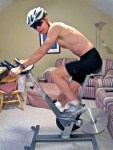
Cycling. See my Christmas present to myself below. Now when the rain or snow is blowing sideways I kick on ESPN and laugh at Mother Nature. Oh, the seven? That’s my Lance Pharmstrong impersonation for Lance. Notice the blurred feet, serious power.

Today’s numbers, off a run, 849calories, 219 watts avg., 28.8k in 1:05. 30m warm up followed by 4 on, 3 off. One benefit of the new bike, I can now be a watts geek.

L, G, and I entered a lottery for an epic ride/race that’s not in Washington State. We entered in that order. I may not know until mid-August if signing up was the result of positive or negative peer pressure.

Running. Taught all day Saturday most of the month so my posse is in more disarray than the Democrats. Missed the Saturday 10-milers. Solid week-day routine though, about 25m/week.

Balance

Imagine writing eighteen single-spaced pages about your job performance? I’ve spent the better part of the last three weeks writing a 10,732 word self-assessment for promotion to Professor.

The very lucky 17% of higher education faculty in tenured track positions typically begin as Assistants, become Associates at tenure, and then eventually when their hair is mostly gray and their vision is shot, become Professors. Most faculty spend about seven years at each level. Unless you’re the rare all-star that gets recruited by another institution, promotion is the only way to improve your salary.

“Like a lawyer” I had to “make an argument” for myself in light of the University’s criteria for promotion. I embedded the criteria in the first two sentences.

“Through this self-assessment, the letters of colleagues and former students, and the accompanying artifacts, I aim to demonstrate that I am deserving of promotion to Professor. This is due to my record and reputation as an excellent teacher, continual growth in scholarship, and distinct academic influence and leadership.”

I’ll spare you the remaining 10,700 words. I should note though that after reading all 10,732 words my wonderful mother said if she could she’d award me promotion in a “New York Minute”.

Reminds of a classic moment in modern American film. Carl Spackler in Caddyshack, “So we finish the eighteenth and the Dalai Lama’s gonna stiff me. And I say, ‘Hey, Lama, hey, how about a little something, you know, for the effort, you know.’ And he says, ‘Oh, uh, there won’t be any money, but when you die, on your deathbed, you will receive total consciousness.’ So I got that goin’ for me, which is nice.”

So I got that goin’ for me, my mom in my corner, which is real, real nice.

Since no one is perfect, I would have preferred writing about what I’ve done well and what I haven’t done as well. But that’s not what the Rank & Tenure Committee expects.

So after three weeks of writing almost exclusively about what I do well, it’s time to restore some balance in my life and the cosmos by coming clean about my myriad shortcomings to a proxy for the Rank & Tenure Community. . . you.

1. I can be an impatient listener.

2. On more than one occasion, I’ve been wearing a towel when my daughter’s friends come to the house. My “man skirt” or “utility kilt” embarrasses her unnecessarily.

3. I sometimes mistake the family dinner table for a lockerroom.

4. I am indescribably inept at Christmas lights, home repair, laundry, and pruning.

5. I sometimes don’t act immediately on emails, necessitating multiple readings.

6. I regularly cut through the Denny’s parking lot on Pacific and Hwy 512.

7. When it comes to food and drink, I can be too disciplined. My own beloved mother recently said to me, “Sometimes you have to live a little.”

8. My frugality can take completely irrational forms.

9. I received cable for free for a long time and didn’t report myself.

10. When in “writing at home” mode, I can wear the same pair of pants and t-shirt for a long time (purposely vague).

That’s a Lettermanesque start. I feel better. Thanks for listening.

Please don’t forward this link to anyone on the Rank & Tenure Committee.