If you haven’t read Ta-Nehesi Coates yet do yourself a favor and read this recent essay of his from the Atlantic titled The Littlest Schoolhouse. Of special interest to anyone interested in education reform, technology integration, and/or the achievement gap.
Category Archives: Education
300th Post
Quite a few don’t you think. Thanks for reading and sometimes commenting whether online or in person.
You’ve probably noticed I’ve been switching templates lately. The problem is the best designs have the smallest, least legible fonts. Within wordpress, to get a larger, more readable font, you have to sacrifice on the design front. I’d like to customize things, but need someone more tech savvy than me to volunteer to help. Yeah, yeah, I know, why specify “more tech savvy” when that’s most everyone.
As always, I’m open to suggestions.
As I think about the topics I’ve written about, I’m struck by how wide-ranging my interests are. I’m sure blog consultants would say too wide-ranging. I could TRY to narrow my focus, but that would mean posting less often. Right now at least, I’m more inclined to accept the limitations of my decidedly generalist orientation.
Speaking of consulting, I would like to do more going forward and would appreciate any leads you might have. Primarily lectures and/or workshops on: 1) reinventing high school teaching and learning; 2) the high school to college transition; 3A) internationalizing curriculum; and 3B) teaching about globalization. In April, I enjoyed helping a university faculty at an Iowa college (on 3A&B) and I am looking forward to speaking at a college in Illinois next spring (3A).
I’m looking forward to being on sabbatical during the 2011-2012 academic year, although I may need to tweak that in light of other departmental colleagues on the same timeframe. I intend on using my sabbatical, whenever it occurs, to prep for and seek out more consulting opportunities.
Another Great Headline
On a colleague’s office door—Bad Spellers of the World, UNTIE!
Guns and Bombs
From the Wall Street Journal, 6/21/10. World governments are spending more on guns and bombs than ever. Global military expenditures in 2009 topped $1.53 trillion—2.7% of global GDP, up 6% in real terms from 2008 and 49% since 2000. The U.S. spent $661 billion—4.3% of GDP, accounting for 43% of the world total. China followed with an estimated $100 billion—2% of GDP and 217% more than 2000.
Just under 5% of the world’s pop and 43% of the world’s military expenditures.
And the China stat of recent days. Every six hours China exports more than it did in all of 1978 (Marginal Revolution-blog).
Weekend Notes
U.S. OPEN
• I was off Friday and spent some of the day prepping for 17’s Graduation Open House and some fantasizing about being at Pebble Beach. As great as the visuals were, listening to Chris Berman do the U.S. Open is excruciating. I’m sure he’d be a fun guy to play poker or watch football with, but he obviously did not grow up playing golf. I can take “We’re all just Dustin’ in the Wind Johnson” but I can’t take the “He shot a 9” and “That’s the second snowman there of the day!” and the “back, back, back” urging of a short putt. No one shoots anything on an individual hole. One MAKES a nine. And pros occasionally make eights, not snowmen. This is a MAJOR, not the Bristol Municipal Club Championship. Listening to Dick Vitale is soothing by comparison.
• Also on Friday, very interesting ruling involving Paul Casey’s chip on 14. Brutal uphill chip with zero margin of error. Casey hits it a tad chubby and in frustration hits/repairs the divot a few times. In the ensuing ten-fifteen seconds, the ball backs all the way off the green, eventually to almost the exact spot. Viewers alert the rules officials that Casey has improved his lie. Penalty? Rules officials huddle with Casey after the round, review the particulars of the two shots, and ask him whether he hit/repaired the divot in order to improve his lie in case the ball returned to the exact same spot. Based upon his body language they didn’t think so, and so they weren’t surprised when Casey confirmed that. There really was no way Casey could have known the ball would return to exact same spot. The rule is it’s a penalty if there’s intent is to improve one’s lie. I hereby declare that before wives rip husbands and daughters ban fathers from speaking in public that they adjust for intent.
WORLD CUP
• After reading the comments about my “it’s poor form to complain about officiating” post, I’ve changed my mind. Merty’s comment in particular reminded me of the NBA/FBI/Tim Donaghy fiasco. I’m sure there’s far more $ coursing through World Cup matches than NBA games. Maybe the Malian ref who blew the call at the end of US/Slovenia is cut from Donaghy cloth. So here’s my revised axiom. Whenever athletes are amateurs, it’s poor form to complain about officiating. The corollary is “The younger the athletes, the poorer the form.”
SCHOOLING
• I understand it’s sociocultural/historical roots, but I’m still amazed at how prevalent individualism is in our schools especially when future success will inevitably hinge on interpersonal intelligence. The OHS awards assembly and graduation (where the same award winners were feted a second time) reminded me of that. Why is it that teamwork and groups are only emphasized in extracurricular activities? Our success in solving pressing social, economic, and environmental challenges hinge mostly on team/group work. Sarason’s concept of the “regularities of schooling” comes to mind. A “regularity of schooling” is some feature of teaching and learning that we no longer question, it’s just accepted as the natural order. For example, we always assign grades to each individual student and we only award individual student achievement. This also calls to mind Sarason’s “ocean storm” metaphor in the Predictable Failure of Education Reform. Lots of wind, waves, tumult on the surface during an ocean storm, but no change in water chemistry, temperature, etc, on the ocean floor. The ocean floor is the teacher-student relationship. How would teaching and learning change if we tempered our individualism and focused at least some of our assessment efforts on small group academic achievement?
• During his grad speech, the OHS principal honored the top ten students. A slide of the students flashed above. He said, “good job girls” with no sense of irony or urgency. I’m in the middle of a related article in the most recent Atlantic magazine titled “The End of Men”. Highly recommended.
• Byrnes Postulate (be sure to credit me). The more meaningful the curricular objective and related classroom activity, the more difficult to assess the associated student learning. Granted seems obvious, but I suggest that postulate informs more of what’s wrong with the “standards movement” than is first apparent.
WORLD POLITICS
• Heard an interview with the author of this book. He persuasively argued that no single nation can singlehandedly solve the immigration challenge. Made perfect sense, but it doesn’t seem as if anyone is acknowledging that. In fact, it’s true of most global issues today, but there are at least two serious impediments to thinking more globally and acting more in concert with other people in other nations to address pressing global issues like global poverty, environmental crises, and terrorism/war. First, the U.N. has a lot of negative baggage associated with it and there are wonderful NGOs, but few truly global alternatives. And secondly, no country/region (in the case of the EU) really wants to be take the lead in compromising their relative sovereignty.
FITNESS MALISE
• It’s 12:56p Sunday, we’re on the cusp of the summer equinox, and I’m sitting at my desk in half a cycling kit, staring at a cold, wet, dark gray landscape with 57 miles on the odometer for the week. Pathetic. I started down the street at 9:50a only to turn around when it started to rain. Mother Nature is testing all cyclists’ mental health this June. Look for some to start snapping. I was supposed to be Lance’s domestique on Mount Saint Helens today and then opted for a 10a club ride. Now I’ve performed the rare “double wuss”. My problem is I have nothing I HAVE to train for, not a single event on the calendar. I don’t even think I’ll do our local Oly triathlon in September. I’m 280th on the RAMROD waiting list. This is a desperate cry for help. Someone tell me what event should I do next and why? To add insult to injury, 14 informed me that if I had stayed in bed, her sister and her would have made me a “Dad’s Day” breakfast.

Viral Seatbelt PSA
Thanks to one of Positive Momentum’s biggest fans, a new “wear your seatbelt” public service announcement airing in the UK. Submitted by a lad not hired to do it, now it’s gone “viral”. Brilliant. The democratization of advertising.
No Sense of Urgency
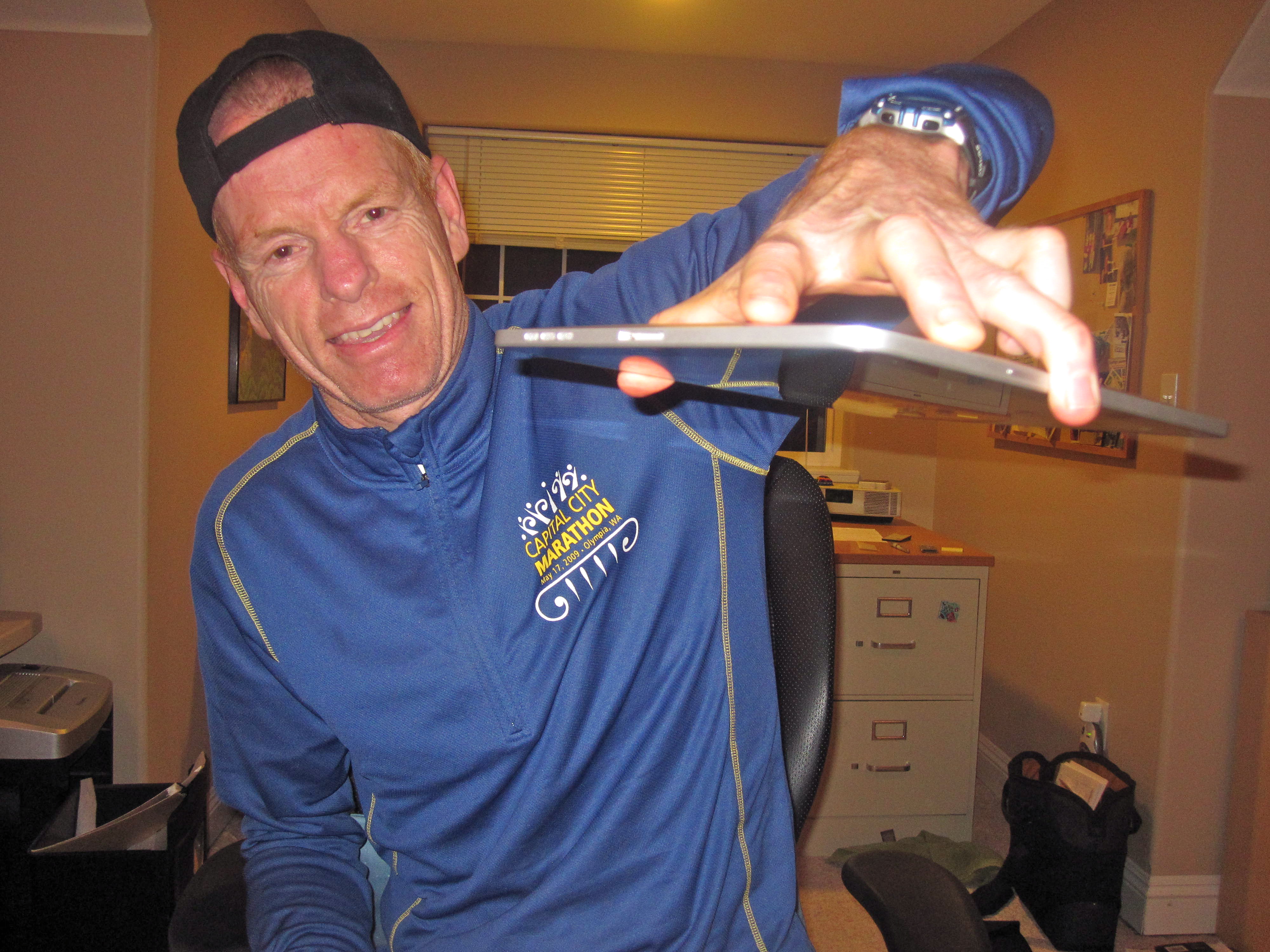
Friday, June 10th, 11:30a.m. Sitting up high in the stands in the Olympia High gymnasium. Awards assembly. Surrounded by fellow parents of seniors. Make contact with fourteen on the other side of the gym and hold my iPad up and taunt her with it which she and her friends find entertaining. This early adopting stuff is kinda fun, but it would be awfully embarrassing if an administrator confiscated it.
But I digress. 11:50a.m. and we’ve gone from 165 students with a 3.5 gpa to 80 with something higher to the top 20 gpaers.
Nineteen young women.
Why aren’t parents, educators, ordinary citizens of all types more concerned with the growing gender gap in academic achievement?
Where’s the urgency?
iPad Review
In the Steve Ballmer-desk-top computers will continue to thrive v. Steve Jobs-desk-tops will become like a truck that you use sporadically for a few specific tasks, I’m putting ALL my money on Jobs.
And I will be in the vanguard. I have been blown away by my Pad and am frustrated I haven’t had more time to set it up and learn the ins and outs. Two things are conspiring against Pad-time, a heavy June teaching schedule and a light fourteen year old.
Just how great a handheld computer is it? Eventually women will find an alternative word for their feminine product. At the store, “Do you have any pads?” “Wi-fi or 3G?” The first night I went to bed at 10 p.m. and by 6 a.m. the next morning five new apps appeared out of thin air including the bible and an especially riveting one where you poke plastic bubble wrap. The highlight so far has been showing fourteen how to lock it in either horizontal or vertical mode.
Let’s get my least favorite feature out of the way so I can return to positive product pimping. The homepage photograph is a beautiful coastline at dusk with white wisps across the sky, remnants of shooting stars maybe? The problem is they look exactly like ruinous scratches. They still give me heart palpitations six days later. Don’t know that I’ll ever get used to them.
As every other reviewer has explained, typing on the screen keyboard is okay for a few sentences at a time. I bought a separate keyboard and mouse so that I can go long on it. Lack of printing is an issue, but no doubt a temporary one.
Here’s one way it’s changed my life already. Yes, that was tongue in check. My wife is of the anti-television persuasion. I wear the pants in the family nearly all the time (I should confirm that with her), but I have not mustered the courage to defy her “no television in the bedroom” edict. With this bad boy, I mean pad boy, what she doesn’t know won’t hurt her. Case in point, the other night I surreptitiously watched an episode of Scrubs on ABC’s app. I know what you’re thinking. Let’s just say it will be ON if she even suggests a “no Pad in the bedroom” policy.
Admittedly, this may be the most incomplete, least technical, least insightful, least helpful iPad review written to this point. But how many of those other fanboys can do this?
The Negative Utility of Losses
At present I’m privileged to be working with twenty-eight hard working people who just completed a year-long teaching internship. Beginning teachers typically fall into a common psychological trap. Hell, what am I saying, I still do it too and I’ve been at it for a quarter century. All but the most callused teachers fall into the trap of letting a few negative student encounters shade one’s thinking about an entire class or course.
For example, when I think about my sixteen writing students last semester, I know at least twelve learned a lot, improved, and had a positive experience. One to four, probably not so much. One of my current students is the mother of one of my first year spring semester writing students. She confided in me that her daughter said, “He doesn’t like the way I write.” Insert knife. Twist. I really work hard to help students develop more positive attitudes towards writing and to develop self confidence so that really bummed me out. Then my thought process becomes, “Nevermind loser that the majority of the class had a positive experience, a few didn’t.”
Why is it that you can have a neutral or positive working relationship with nine students, but the negative one with the tenth takes away from the entire teaching and learning experience?
I was wondering this while reading The Investor’s Manifesto by William Bernstein, page 108 specifically. He writes, “It makes little sense that we should care about a bad day or a bad year in the stock market if it provides us with good long-term returns. But because of the importance of our limbic systems, we care—very, very much—about short term losses. We cannot help it: That is the way we are hardwired. Behavioral studies show that, in emotional terms, a loss of $1 approximately offsets a gain of $2; in the unlovely language of economics, the negative utility of losses is twice that of the positive utility of gains.”
Or five or ten times that depending on how negative the teacher-student relationship.
Conceptual convergence. I love the phrase “the negative utility of losses” because it helps me better describe the abstract psychological (or actually biological) phenomenon that plagues most teachers.
My natural tendency would be to strategize on how to combat negative utility of loss thinking, but if it’s biological is it inevitable? Is resistance futile?
Teaching Writing
I’m in the middle of reading my sixteen writing students’ final papers for this semester. In general, I think the predominant 20th century model of higher education—students gathering in one location at a designated time to listen to a lecture—is hopelessly obsolete. When I was an undergrad I had the good fortune of having several professors who inspired me to read, think, write, and in the end learn more than I ever would have on my own. Despite that admission, I did my most important studying and learning in the Powell or Undergraduate library stacks. Head buried in book, analyzing others’ ideas, noting patterns, grappling with abstract concepts, mulling over papers I’d later write on a typewriter.
My first class, on the first Monday in October 1980, was memorable. Dude, I said to myself since I didn’t know anyone, that’s Kenny Fields (Milwaukee Bucks). And Don Rogers (Cleveland Browns before he overdosed) and Kevin Nelson (USFL). The best first year bball player and two of the best football players in my small writing seminar, what are the odds? Coolest full-length mink coats I’d ever seen. Wait a minute, did she say “Remedial Composition?”
I had been a mediocre high school student and I figured someone in admissions had made a mistake by accepting me, but damn, “Remedial Composition?”
Long story short, I had a great teacher, a no-nonsense, hands-on editor who taught me to write succinctly. Through hard work and a healthy fear of failure, I made genuine strides in just ten weeks. I wrote lots of papers throughout my first year since I was in a three-course Western Civ sequence. I was catching up to my peers pretty quickly. Early in my second year, in a 150-200 student Latin American History class the prof, who was pretty famous for getting under Ronald Reagan’s skin on the U.S.’s Latin American policy, read my name aloud for writing one of the most outstanding papers during one unit. In terms of my confidence, that was more significant than anyone could have realized.
But I digress. The class size at my university for writing seminars is about fifteen students too large. Teaching writing requires intensive one-on-one work. In their last paper, the students were asked to summarize what they learned about the course theme (Teaching’s Challenges and Rewards) and to describe the ways in which their writing did or didn’t improve. Most improved a lot and became more confident. I was disappointed when one admitted to me he was less confident. When I probed why he said because he had never had anyone read his work as closely as I had, and as a result, he learned he had a lot more work to do than he had previously realized. I can live with that.
Unfortunately, I learned too late in another students’ final paper that, despite always concluding with three strengths and three next steps, my careful reading and extensive commenting overwhelmed her and left her discouraged. I feel as if I failed her. She earned her best grade on that paper because it was an authentic, courageous, semi-subtle skewering of her professor.
We need more hybrid higher education models where students spend some of time interacting and learning on-line and some interacting and working on group projects in person. Writing is a process that will prove exceptionally difficult to teach on-line at virtual universities. It requires a student and what the Brits refer to as a tutor sitting shoulder to shoulder, reading, editing, talking, revising, and repeating, over and over.