Don’t Write This Way

Positive writing models are the most helpful, but sometimes negative examples of what not to do are so glaring they just can’t be ignored.

From a lefty on Twitter, “I don’t want to be alarmist, but a GOP source just told me this: “Trump’s condition is serious. He can go either way. . . . ”

Writing at its worst. What’s more alarmist than “He can go either way”?

Own your ideas. One could write, “At the risk of being alarmist, . . . “, but if you truly don’t want to be alarmist, delete it all. Silence is often a great option.

Weekend Required Reading

1. Nice. At 5’4″ Canadian Leylah Annie Fernandez is about to prove me wrong about women’s professional tennis.

2. A young, supe-smart data scientist on why he’s moving on from the ‘rona and the best models to follow.

3. What Blair Braverman’s sled dogs taught her about planning for the unknown. Dig the blingy booties.

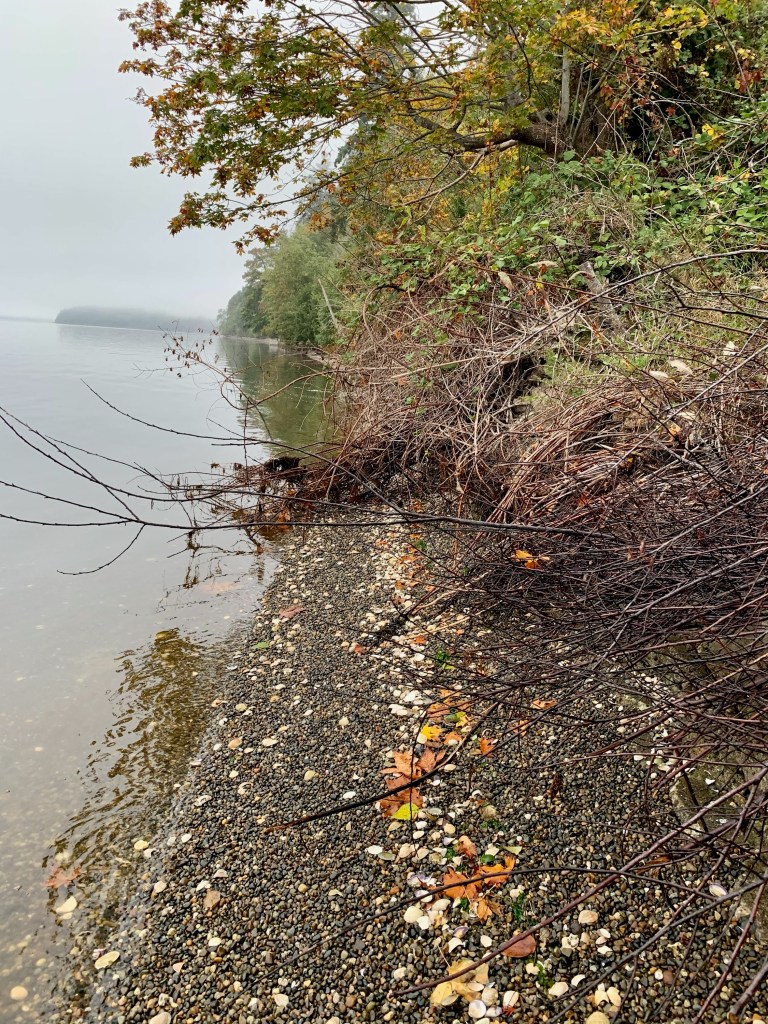
A sore Achilles tendon means I’ve temporarily traded running in for walking. I enjoyed a particularly nice one this morning. Until getting here. Nothing prepared me for high tide. Well, except for the “Tides Near Me” app on my pocket computer. 

Wednesday’s Ride

Blanca is back from the hospital. Travis invited me to loop Mount Rainier. My schedule opened up. In the fourth and final hour of our ride, leg muscles I didn’t even know I had took turns cramping like dominos. But thanks to Travis shepherding me up Skate Creek like George Hincappie used to do for What’s His Name with all the faux TdF titles, somehow I made it.

IMG_1129

How Long Will We Slight The Social-Emotional Costs Of On-Line Learning?

Thursday, First Year Writing, The Morken Building 131, the first in-person class of the academic year. Students take turns summarizing their first papers about whether one needs, as a Stoic philosopher we read argues, a coherent philosophy of life and a “grand goal of living” to avoid squandering one’s life. They’re smart, so they push back at the suggestion one can neatly plan their life. They talk about some things being outside of our control, like viruses.

If not a coherent philosophy of life, what about guiding principles I wonder. And if so, which ones? They’re not quite ready for subtly, nuance, ambiguity, complexity. That’s why college is four years long. For now at least, I keep those thoughts to myself and just listen.

One student says her mother died in February. Not expecting that, I loose track of what follows, wondering how she died and what would it be like to lose your mom at 17 or 18. She says doing well in school doesn’t matter as much as it did previously.

The students, many who say they struggle with anxiety, have never enjoyed going to class more. Not because of the doofus facilitating things, because they’re famished for friendship. Flat out famished. They linger afterwards, partly to disinfect the tables, but mostly to extend our shared sense of normalcy as long as possible.

The student whose mother died walks up to the front to talk to me. Through my mask I thank her for having the courage to share that news and gently inquire about her mother’s passing. She tells me her mother chose “Death With Dignity” after a lifetime of being severely disabled. And she wanted me to know the paper was really challenging to write, but my sense was, not in a bad way, in an important way. I think it caused her to grieve her mother in a way she hadn’t. She ended up writing her mother a letter and using parts of it to begin her paper.

For those few moments, as her classmates slowly filed out of the room in small groups, she and I shared a human connection that superseded our teacher-student identities. I saw her and heard her in a way that’s utterly impossible on-line.

I am all in on the scientific consensus regarding masks, social distancing, maximizing time outdoors, and washing hands. I am comfortable enough returning to the classroom because my university has done an excellent job preparing for as safe as possible a return to in-person classes. I will not help politicize this public health crisis.

What follows is a non-partisan question, my reference point is the social-emotional health of young people.

If we don’t begin implementing “blended” or “hybrid” teaching methods soon, with at least some in-person instruction, what are the social and emotional costs to friendless students who are not being seen or heard in any kind of meaningful way?

“Teaching” On-Line: A Report From The Front Lines

Midway through week 3. In three words, a roller coaster.

Last night the graduate Sociology of Education seminar was a case study of incompetence. When exiting breakout groups I disconnected everyone from everything so we had to scramble to reconnect. For good measure, I added in some pedagogical incompetence by talking too much. One other student saw my blabbing and raised it, and I didn’t know what to do as his classmates, like dominoes, tuned him out one after another.

After class, I retraced my steps and realized the errors of my ways. And so today I was an online teaching rock star, turning off the waiting room, screen sharing, moving between small groups and large with aplomb. I damn well better win the prestigious “Most Improved Zoomer” award, Boomer Division.

I just unplugged from the First Year writers. I forgot to tell them they could jet after they were done peer editing, so they all returned to “office hours”. And they just wanted to hang out, which was cool. They’re a fun subset of the bad luck Covid Class, those 18-19 year olds who missed their high school graduations and have had to start college with electronic teaching hacks like me.

One of them had hilarious background images repeatedly rotating behind him last session. Today, another student did. How long until I lose complete control?

But their daring to be different provided much need levity. They’re not just funny, but resilient, still in good spirits despite “the invisible enemy which no one could’ve seen coming”. After shooting the breeze a bit, I had to tell them it was 72 degrees outside and sunny for one of the last times in a long time. I pleaded with them to “go outside and toss a frisbee.”

Thursday, we’re meeting in-person for the first time. Glory hallelujah.