What Excellent Teachers Do

Last Saturday morning, as I prepared to lap swim, I couldn’t help but notice the tumult in the lane next to me. A college-aged swim instructor held a red-faced, frantic three year old who was crying uncontrollably. The three-year old’s exasperated dad squatted like a catcher at the edge of the pool and attempted to explain to the instructor everything that had gone wrong in recent lessons.

Maybe you’ve seen That Dad. I was That Dad.

As I did my best Michael Phelps impersonation, I couldn’t help but have flashbacks to my eldest daughters introduction to swimming. The more I wanted her to put her head in the water, the more she resisted. Fast forward to today. She’s in Fort Lauderdale, Florida. On a Winter training trip with her college swim team. Her head completely in the water four hours a day. Co-captain of the team. And worst of all—faster than her dad.

The best teachers look at their sometimes immature and frustrating young students and see their best future selves. Peace Corp volunteers and program directors. Therapists. Farmers. Speech pathologists. School teachers, nurses, and artists. Loving parents. Mechanics. Authors. Carpenters. Docs. Citizens making their communities better places.

Similarly, when the best youth coaches look at their sometimes clueless and hapless athletes they don’t see future college or professional athletes, they see responsible, resilient, mindful adults.

Likewise, when enlightened parents watch their children struggle in and/or out of school, they know “This too shall pass.” They offer love, encouragement, and care. They convey confidence in their children’s abilities and see their best future selves. They know, some day soon, they’ll put their heads in the water and swim like there’s no tomorrow.

Can Schooling Be Reinvented?

What a privilege to work with my first year writers and graduate pre-service teachers this semester. Both groups embraced the course content and my discussion-based approach.

Some of my grad students were especially appreciative of the opportunity to think about competing purposes of schooling, educational inequities, and the challenges of education reform.

Consider an email message from one such student, S:

I got to thinking about your response during our discussion about alternatives to the current education system. You mentioned alternatives for individuals (un-schooling, for example), but what about for the entire public education system? How unrealistic is it to envision a transformation in the public education system itself? Do you think that it will ever be possible to overhaul the system and completely refashion some of what is most central to it? Things like students progressing through school year by year with their grade level, dividing education into various subject matters, having education happen primarily in designated schools? I love public education. I LOVE that it is accessible to everyone in our country. I do not want to work at a private school or home school my own children. But I’m a dreamer and an idealist and I am wondering if it is reasonable to dream of a new ideal for public education. In your professional opinion, is it worth it to dream the big dreams? I know I’m asking that question in a way that begs a “yes” response, but I’m actually hoping you’ll say “no” so I can focus on what’s in front of me now instead of spacing out whenever education reform is mentioned and getting lost in imaginary ideas.

S’s reference to age-based grade levels, traditional academic subjects, and existing school buildings are “regularities of schooling”, educational practices so engrained in our thinking that we no longer question their value or consider alternatives. We could add the nine-month school calendar, letter grades, and teachers working independently in separate classrooms.

Sometimes teachers-to-be say, “I’ll be content if I can’t just touch one student’s life.” Really? If you’re the least bit caring and conscientious you should be able to check that box off a month into your career. A second level of impact is becoming a teacher that improves some students’ life prospects every school year. S may be after even more than that though, a third level of impact, providing enlightened school or district leadership. Is a fourth level, contributing to a complete reinvention of K-12 public schooling as we know it, possible?

I would love S and some of her fellow graduate students to prove me wrong, but even if I live another forty years, I do not expect my great grandchildren’s schools to look significantly different than those of today. My descendants and their teachers will use new and improved technologies, but teachers will still do most of the talking and students will often wonder, “Why do we need to know this?” I base this prediction on the incredible stability of schooling over the last one hundred years; the fact that each generation of parents feels their school experience was perfectly adequate; and the fact that teachers are kept far too busy to seriously reconsider the regularities of schooling on a local, let alone, grand scale.

So what’s S to do? There are lots of possibilities for intelligent, inquisitive, progressive teachers like her. Being a teacher that improves students’ life prospects will prove immensely challenging and rewarding. Another option is to become a caring and conscientious school or district administrator that improves teachers’ work lives, and by extension, helps large numbers of students. A related option is to take the baton from me in five or ten years and become a teacher educator who helps beginning teachers flourish, and by extension, large numbers of students.

Another option is to team together with like-minded teachers to create innovative, alternative public schools. There have always been innovative, alternative public school schools that challenge the educational status quo. The problem has been replicating their practices on a large scale. “Scaling up” proven reforms is the illusive holy grail. Maybe S’s generation will be the first to solve that puzzle. If not, accomplished classroom teaching, enlightened administrative leadership, and/or excellent teacher education service are all socially redeeming, career worthy pursuits.

Postscript—daring to disagree, a preeminent ed reformer predicts the end of schooling

2013 iPad Air

While it’s impossible to top John Gruber’s written review, or Walt Mossberg’s video review, or Farhad Manjoo’s written/video review, I’m adding my initial impressions into the all-star tech punditry mix.

If my Father-in-law, who I had great respect for, had read one or more of those reviews he wouldn’t have ruined his life with his Google/Nexus tablet purchase. He was always so rational and all for a few “C-notes”. Father-in-law’s grade, F.

My 32GB wireless/cellular Air was pricey, especially since the GalPal wanted my old one. I already had an inquiry from a Craigslist reader for it when I said to LALOA, the Latest Adapting Luddite Of All, “You don’t want my old iPad do you?” When she said “yes,” I thought I was hearing things. Add in the smart cover for $39 and the WaterField iPad Smart Case for $69 and I may be going back to full time work next academic year.

The best word for it is sleek. So damn light and thin. A sensuous wafer of electronic goodness. The rock skipper in me wants to just grab it by the corner with my thumb and index finger and fling it across Ward Lake, just to see how many times I could get it to skip. But then I remember what I paid for it. Note to Jonathan Ive, make the next gen waterproof.

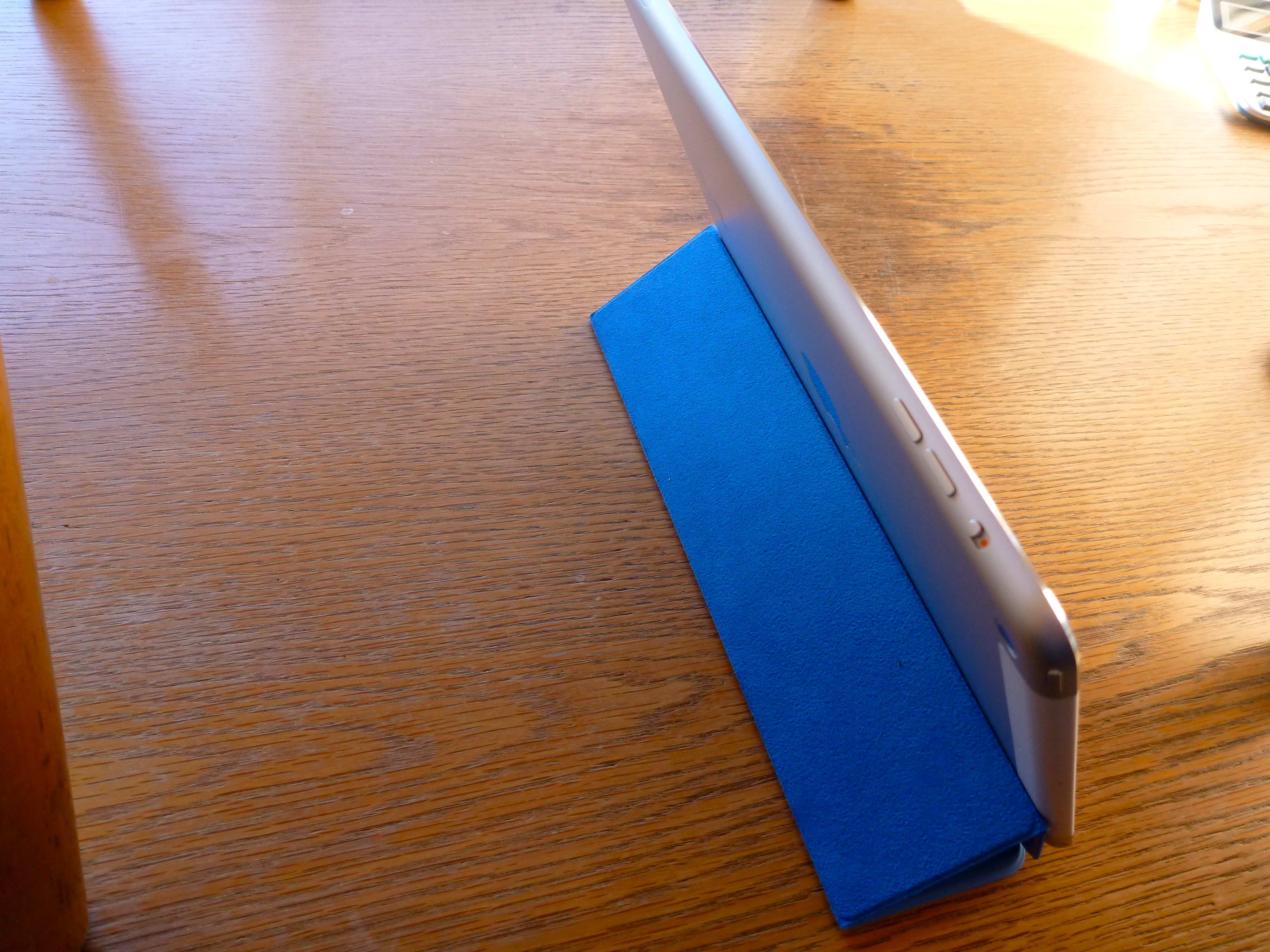
I have mixed feelings about the Apple smart cover. When using it as a stand, the pad is a wee bit vertical for my taste. Also light and sleek, it’s definitely in keeping with my minimalist design preferences, but my old wooden stand (carved by a Canadian entrepreneur) had two settings both which provided more tilt. Also, it could be user error, but when folded for typing purposes, meaning nearly flat, I have to reverse the Pad altogether and toggle it to get the top and bottom oriented correctly. On the plus side, I discovered the flannel-like back of the smart cover adheres to my blue jeans. So when I’m sitting on the floor against our couch with my knees up, I can set it on my rippling quads and it stays there, in perfect reading position. Apple smart cover grade, B+.

Granted, maybe the Waterfield Smart Case is overkill, but given the investment, it will earn its keep when I take it on the road. Note that I didn’t coordinate the colors. Another reason why, if you’re of the male persuasion, it’s dangerous to cybershop alone. Waterfield smart cover grade, A. My personal color faux pas adjusted final grade, B.

The retina screen resolution is stupendous as is the speed, the camera, the video camera, and the battery life. My life is way better now. And remember, just because I’m an AAPL shareholder, it doesn’t mean I’m biased. Go buy one. Or two. iPad Air grade, A.

I went white because one of my nicknames is Wonderbread

I went white because one of my nicknames is Wonderbread

Color coordination fail

Color coordination fail

I keep a dust cloth handy for when my editor gets a little overzealous and licks my screen

I keep a dust cloth handy for when my editor gets a little overzealous and licks my screen

A few more angles of tilt por favor

A few more angles of tilt por favor

Too cool for school

Too cool for school

My editor watching intently

My editor

Follow the Leaders

Jordan Spieth, a 20 year-old, made $3,879,820 playing golf this year. Two mil more than Rory Mcilroy. Spieth’s coach, Cameron McCormick, recently gave an interview that anyone that wants to get a job, or wants to get better at their job, should read.

McCormick says: A job came open at a private club, Dallas Country Club, one of the best clubs in town. I started teaching a lot at Dallas C.C. I’d do 40 hours a week in the shop and another 15 to 25 hours a week teaching. It was a quick trial by fire on what works and what doesn’t work and do I like to do this? And I did. I got some good word of mouth and some good results. I was there three and a half years. Brook Hollow, a similar club a few miles down the road, was hiring an assistant-in the fall of 2003, I became a full-time teaching pro. When I turned 30, I wrote renowned teachers in golf and asked, “Would you mind if I came and watched you work?” I wrote Butch Harmon and David Leadbetter and Randy Smith and others. Over the course of six months, I traveled around the country and observed these great coaches and gained an appreciation of what makes them great.

The “secrets” to McCormick’s considerable success: 1) When starting out, he worked 55-65 hours a week; 2) He actively sought out better opportunities; 3) He sought out respected people with much more extensive experience and spent six months traveling around the country studying the “secrets” to their success.

McCormick elaborates: I sent (letters) out to the top 75 coaches in the country and I got 25 or 30 responses. Out of those 25 or 30 responses, I got 10 or 15 affirmatives that you can come watch, with stipulations. Some of them respectfully declined, which I totally understood. The most surprising was Butch (Harmon). He said, “Absolutely, come on down, spend a couple of days,” and I did. He was fantastic.

This week I observed an excellent Spanish teacher at Lincoln High School in Tacoma, WA. After describing her teaching repertoire to the The Good Wife over dinner, she decided to carve out a day and drive 60 miles roundtrip to watch her teach. The Good Wife is already a very good Spanish teacher, but she wants to get better.

What do you want to get better at? Being a school principal, a nurse, a social worker, a swim coach, a fourth grade teacher, a pastor, a web designer? Make a list of more experienced and accomplished people in your field of choice, contact them, and carve out time to visit those willing to lift the curtain on their day-to-day work. 

Gordo Byrn is a cerebral triathlon coach whose writing I often like because it’s more philosophical than normal. I like how Byrn seeks out mentors for his personal life. For example, a relatively new father, Byrn has been intentional about sitting down with more experienced parents whose examples he greatly respects. He doesn’t observe them as intensively as McCormick did other coaches, but he asks them questions and listens carefully as they share parenting insights.

Byrn has carved out a great approach to life-long learning. Granted, it’s one that requires humility because it rests on the admission that other people have greater experience and are more skilled and insightful about what excellence entails. Byrn has taken the same approach to learning more about how to be a better husband; how to manage money better; how in the end, to be a better human being.

Follow McCormick’s and Byrn’s lead. Seek out mentors willing to share the secrets of their “success” whether in your public or private lives.


Write Like Lincoln

Like all writers, my writing students struggle with vagueness and wordiness. Inevitably, wordiness is built into our initial drafts because they reflect our speech, and when we speak, we routinely spin our wheels.

As we eliminate written words that don’t contribute to phrases, phrases that don’t contribute to sentences, sentences that don’t contribute to paragraphs, and paragraphs that don’t contribute to the whole, our ideas get traction, and readers better understand what we’re communicating.

In the Gettysburg Address, Abraham Lincoln, in ways that people still marvel at, only needed 270 words and just over two minutes to reiterate the principles of human equality espoused in the Declaration of Independence, proclaim the Civil War as a struggle for the preservation of the Union, and espouse the principle of human equality for all citizens.

Wordiness is a by-product of laziness. Seven score and ten years ago, it would have been far easier and quicker for Lincoln to write a longer address.

If one of the greatest speeches in U.S. history is the length of this post*, why do I routinely take two or three times as many words to communicate much less lofty things? Because I don’t always make time to, as one Kalispell Montana high school English teacher puts it, “put every word on trial.”

Word limits, whether imposed by one’s self or others, are one of the best ways to learn to write more concisely. Once we learn to write more concisely, we can turn our attention to vagueness. I’d elaborate on that challenge, but I’m out of words.

* a tribute to Lincoln’s Gettysburg Address, this post is exactly 270 words

School Security That Works

Recently, a middle school teacher that I know returned from a faculty meeting about his Catholic school’s beefed up security. A police officer explained that when they respond to an incident they do so with “overwhelming force”. He assured the faculty that thanks to their proximity to downtown, they’d have “150 officers at the school within five minutes.” He also explained why visitors will have to pass through additional security checks and why they have to teach with their classroom doors closed.

Credit Columbine and Sandy Hook for the “schools as fortresses” movement. It parallels our post 9/11 airport experience. A rural Colorado school district is allowing teachers to carry concealed weapons. A USA Today reporter tells the story of Wisconsin teachers that were “being trained to urge kids to keep a can of soup in their desks to throw at a gunman who might enter their classroom.” I’m sure that won’t contribute to a further uptick in childhood anxiety disorders. Maybe we should start putting cans of soup in our carry-on baggage.

Few people are aware that despite the recent spate of tragic, high-profile shootings etched in the public’s mind, schools are safer than they’ve ever been. Some statistics:

• Since 1992, the rate of “victimization,” which includes violent crimes such as assault and rape as well as non-violent crimes such as robbery, purse snatching and pickpocketing, has plummeted, from 181.5 incidents per 1,000 students to 49.2 per 1,000 in 2011.

• Overall, the number of reported “non-fatal victimizations” has dropped by 71%, from 4.3 million in 1992 to 1.2 million in 2011.

• During the 2009-2010 school year, researchers found 1,396 homicides with victims ages 5 to 18. Of those, only 19 took place at school. During the 2010 calendar year, only three of the reported 1,456 youth suicides took place at school.

• Though rare, homicides, suicides and deaths involving intervention by police at school or on the way to or from school dropped 46%, from 57 in the 1992-1993 school year to 31 in the 2010-2011 school year. Over 19 years, researchers counted 863 deaths, or about 45 per year. (Federal data don’t yet include 2011-2012 or 2012-13, when 27 died in the Sandy Hook shooting, including gunman Adam Lanza.)

“Things are better,” a school safety experts concludes, “but they’re not fine.”

So what’s working? Researchers attribute the decline in school violence to a handful of measures:

•Heightened awareness of a school’s culture, including how safe students feel there and how well they get along with teachers and classmates.

•A renewed focus on bullying and mental health issues, with teachers trained to spot troubled kids and intervene before bullying incidents get out of hand.

•Simple security steps such as locking exterior school doors, requiring all visitors to check in at the front office and offering students easy, anonymous ways to report classmates’ threats.

After Sandy Hook, a national school safety leader said, “It’s a huge struggle trying to bring people’s focus back from emotion.” My friend’s faculty meeting is evidence of that. “The enduring lesson of Sandy Hook,” another school safety leader added, “may be the importance of having a well-conceived — and well-rehearsed — emergency response plan. Sandy Hook really reinforced that. By all accounts, the staff really responded well, and they really saved lives.”

Sandy Hook parents, like Nicole Hockley, whose son Dylan was among the 26 victims, are pushing to expand mental health and wellness services for troubled or isolated kids. Hockley says, “We’re much more focused on, ‘Let’s reach out to the kids who are inside the school and prevent the violence from ever happening in the first place.'”

Ten years ago, American film critic Roger Ebert offered another idea that would also help. Post Columbine, he was asked by a major news network if television and film violence were contributing factors to school violence. Ebert turned the tables on the unsuspecting reporter:

Events like this if they are influenced by anything, are influenced by news programs like your own. When an unbalanced kid walks into a school and starts shooting, it becomes a major media event. Cable news drops ordinary programming and goes around the clock with it. The story is assigned a logo and a theme song; these two kids were packaged as the Trench Coat Mafia. The message is clear to other disturbed kids around the country: If I shoot up my school, I can be famous. The TV will talk about nothing else but me. Experts will try to figure out what I was thinking. The kids and teachers at school will see they shouldn’t have messed with me. I’ll go out in a blaze of glory.

Here’s hoping Hockley and Ebert-like common sense prevails over concealed guns and soup cans.

On The Challenges of Groupwork

I doubt anyone is terribly interested in what goes on behind the scenes at my workplace. I share this abbreviated story in the hope that you’ll apply it to your own life. The basic question is this: how does a medium or large sized group of people—a school faculty, a church council, a local government, a non-profit organization, any work team really—reinvent their work?

My colleagues and I are redesigning our university’s undergraduate teacher education program again. Instead of annual incremental tweaks to individual courses, we wait until dissatisfaction builds to a breaking point. Then, instead of identifying and building upon existing strengths, we commit to a complete overhaul. We repeat the process every five to seven years.

The problem is whole scale curriculum redesign is very difficult to pull off. I’ve lived through multiple attempts at two institutions. This time, despite different people in leadership, we’re following a nearly identical path as all our previous efforts. In our last meeting I felt like Bill Murray in Groundhog Day.

We never improve the process because no one makes the time to carefully consider alternatives. That’s the point of this exercise in self-efficacy.

The basic challenge is to improve the preparation of our teacher candidates by: 1) eliminating curricular redundancies; 2) filling in curricular gaps; 3) reversing “credit creep” by reducing the total number of semester hours needed to complete the program; and 4) updating the curriculum to address changes in K-12 education, changes like the Common Core State Standards Initiative.

Things always start positively with creative and invigorating whole group discussion about “essential elements” or “themes” that everyone wants included in the new and improved program. Then we add in additional content determined by professional standards and (jargon alert) a new high stakes performance based student teacher assessment (otherwise known as a student teaching test). Next, advocates for specific curricular interests—technology integration, special education, reading instruction, etc.—remind everyone of just how important all of that content is. Then we try to pinpoint what will be taught when. That’s when enthusiasm wanes and things inevitably bog down.

We struggle at this work for many reasons. Two in particular. First, we’re much, much better at adding content than we are removing it. And second, it’s nearly impossible to do the careful type of deep thinking, tentative and creative sketching, and initial draft writing that program redesign requires in large group meetings.

We would make more progress in less time if we did three things:

• First, take whatever time is necessary to reach a consensus that it’s impossible to include everything our candidates might need to succeed in their first few years of teaching. Come up with a written statement to that effect and communicate it to the students at different points throughout the program. Our inability to embrace our limits is like a misaligned brake rubbing against a bicycle rim, no matter how hard we pedal, we tire before making ample forward progress.

• Second, delegate the drafting of a new program outline to one or a few people. This means trusting they have the students’ and all of the faculty’s best interests at heart. Ask that person or those people to talk with individual faculty members about what they like most about the existing program and what they’re most intent on changing. Count their curriculum redesign work both as service to the department and as scholarship of teaching.

• Third, use large group meetings primarily to receive suggestions on how to improve the most recent program outline draft, and in the end, to reach consensus on a final draft.

Choosing Debt

Something’s wrong.

I just finished reading a batch of student essays about whether money is important or not and what recent social scientific research suggests about money and happiness.

Some of my students’ families struggle financially. Those students touched upon their parents’ debt and the negative consequences that have resulted from it, strained relationships marked by stress and unrelenting tension. Being well-to-do is more important to them than to my students who take their family’s financial stability for granted.

Many of these students describe the loans they decided to take out. “You have to spend money,” one explained, “to make money.” They are desperately in need of adults who model financial self discipline.

At age eighteen, they are eerily comfortable with five figure debt. And if statistics are any guide, their precarious family foundations make graduating less likely. Even if they graduate, there’s no guarantee they’ll find work that pays enough for them to dig out of their debt.

It’s great they want to continue their education, and I like having them in class, but someone has to wake them from their slumber and tell them there are much less expensive paths to getting a good education. In particular, community colleges and public universities.

Their fallacies overlap and multiply. The first is that loans are a logical solution to financial problems. The second is that attending an expensive university leads to higher paying jobs.

Universities absolve themselves of this problem, saying it’s up to the lenders themselves to assess peoples’ ability to repay loans.

I don’t know what to do. If I tell the “loaners” that there are much less expensive paths, they’ll probably conclude that I don’t think they can cut it at our pricey, private university. And if I follow my university’s lead and simply close my eyes when I know the train is about to jump the track, the students will continue down a very treacherous path.

What College Writing Students Get Wrong

Recently, I did a mid-semester check of how things are going in the first year writing seminars. I asked my students to complete the following phrases: I like. . . . I’ve learned. . . . I wish. . . . Things seemed to be going well, so it was nice that most of their feedback was positive.

About one-fifth of them said something to the effect of “I wish it was clearer what you want”. My syllabus is detailed, and I think, quite clear. The writing prompts too. And I teach what my colleagues and I hope to see in student writing. But sometimes I also say, “There’s more than one way to do well on this paper.” And this annoys some of them who want me to cut to the chase and tell them the one way to be successful. You’ve heard of “paint by numbers”, some students want to “write by numbers”.

The students most disappointed with what they earned on their first two papers are the ones most prone to say,”Just tell me what you want so I can give it to you.” The irony is, by thinking that it’s far less likely they’ll succeed on future papers. Why? Because excellent student writers embrace complexity and delve into the subtleties, nuances, and ambiguity inherent in most every topic.

I wish every high school teacher in the country taught writing by plastering this equation all over their rooms and schools—subtleties+nuances+ambiguity=complexity. The more complex one’s ideas, the more imperative it is that they communicate them clearly. So the challenge for writers is two-fold—1) to embrace subtleties, nuances, and ambiguity to the point that interesting insights bubble up, and 2) to clearly communicate those complex insights in writing.

The first of those challenges requires repeated close readings of other writers who embrace complexity. Discussing ideas with others equally or slightly more adept at critical thinking helps immensely too. The second challenge requires learning how to illustrate complex insights with specific examples.

Every first year college student struggles with both of these intellectual challenges to widely varying degrees. Some get it very early in the semester, others struggle with both until the semester’s very end. Those who struggle the most think the second challenge is most important and they’re convinced they’d turn their “C’s” into “B’s” if their professors would just describe the required formulas more explicitly.

In actuality though, the first challenge is most important. Until students learn to embrace complexity and communicate complex insights clearly, there’s not an explicit writing formula in the world that will help them engage, inform, or move readers.

“Rip Your Hair Out” Pressure

That’s a Los Angeles, California Harvard-Westlake high schooler describing her Advanced Placement heavy course load. HW is L.A.’s preeminent private high school.

A recent article in the LA Times described it as a place “. . . where some families view anything short of an Ivy League admission as failure.” Next week in my graduate sociology of education course, we’re watching a documentary titled “The American Dream at Groton”. Groton is the East Coast version of HW. Check out the tuition at Groton.

HW thrives because even very wealthy parents suffer from economic anxiety. Consequently, they’re desperate to extend their privilege to their children. They think HW = highly selective college = a high paying job = a comfortable life. But not necessarily a meaningful one. Parents don’t send their children to HW to ponder what makes life most meaningful.

But to HW’s credit, apparently students sometimes end up doing just that in classes like “Ethics: Philosophical Traditions and Everyday Morality”. After fourteen students dropped out two years ago citing depression—some at the school have “pulled back”.

Like Matt LaCour, the baseball coach. Recently a player of LaCour’s told him he wanted to try out for the school play, “Hairspray.” Lacour encouraged him to saying, “I’ve got to allow a kid to find himself in high school.”

Theater arts instructor, Ted Walch, said he would like to see more time for his students “to be bored and to daydream and to be kids.” “We are a powerful enough school,” he explained, “that if we pull back just a bit it’s not going to hurt anyone’s chances to get into Harvard, Yale, or Brown.”

The school is planning a workload study this year to determine whether demands on students have become excessive. HW limits homework to three hours per subject per week—more time than most college students spend studying in a typical week. The school’s new president, who was at Groton previously, has identified “academic pressure and stress” as a recurring theme and tension needing more attention.

Private elite schools always do a better job preparing students for selective colleges than the larger, much more economically and intellectually diverse world. But HW, and the new president in particular, deserve credit for recognizing that, in his words, “The great challenge. . . in schools where excellence is a value is to simultaneously have balance as a value.”

It’s important to have some ambition, the problem is when students become hyper-competitive and sacrifice their integrity and health in pursuit of especially ambitious goals. To razzle-dazzle college admission committees, many high schoolers think they must push themselves endlessly, and in the process they often end up cheating and ignoring mental and physical warning signs.

We need to rethink and redefine ambition as fulfilling one’s potential to effect positive change in some small corner of the world. Instead of striving to do well in school in order to graduate with honors, earn lots of money, and gain social status, do well to become the very best nurse, social worker, businessperson, teacher, writer, plumber, and citizen as possible.

Schools should define ambition more broadly and encourage alternative, healthier, more selfless forms of it. Don’t just single out the National Merit scholarship winners and those accepted at Ivy League schools. Pay equal attention to students who serve others on or off campus. And those who show improvement or demonstrate excellence in the whole gamut of extracurricular activities—including the arts and minor sports.

That’s one way to keep students from ripping their hair out.