College Tuition Inflation

“Dear Parents” started the letter that arrived today from Eighteen’s college president. “To assist you in your planning, I am writing to provide you with information about fees for the coming year.”

Thanks.

A few short paragraphs in the prez pats himself on the back. “The comprehensive fee increase for the coming year (3.97%) is the second-lowest in a decade.” That makes me feel a lot better, except inflation, in 2010 in the U.S., was 2.3%. Why not just write, “We’ve hosed families worse than this in eight of the previous ten years.”

“In the months ahead,” he added, “we will continue to explore routes to reduce operational expenses while preserving the academic excellence for which Exorbitantly Priced College is justly known.” A promising sentence that deserves another like this, “I will write again during the summer to update you on the outcome of those discussions and exactly how we are going to reduce operational expenses while preserving academic excellence.”

Continue to explore. Classic higher ed speak.

One wonders, when it comes to comprehensive fees at private liberal arts colleges, is there a tipping point?

Suburban Life(r) Postscript

Since waxing philosophic on the downsides of suburbia, I’ve been beating myself up for a lack of contentment. Guess I need to learn the art of self compassion.

Home shopping on the Northwest Multiple Listing Service helps me appreciate three things about our home including:

1) High ceilings. We’re a tall people and so it’s really nice to have extra headroom. And you never know when you’ll be overcome with the urge to work on your golf swing. Still not sure how I once managed to get smoothie remnants on the kitchen ceiling. Note to self, don’t stick the wooden spoon in too far when at full throttle.

2) Considerably more natural light than most homes. After the last five months, all I can say is, damn this weather. Sorry bro.

3) Best of all, the woods behind our house that were supposed to be developed before the 2008 economic meltdown. Everyday, and usually stark naked, I stare into the woods and think, what a beautiful, positive consequence of the terrible recession. Just the trees and me naturally. Somewhere the people who almost ended up living where our woods are located are thinking, “Not having to see Ron in the buff, what a beautiful, positive consequence.”

Looking ahead. Friday’s post—March Madness and the Miami Heat.

iPad 2

I’m an AAPL investor and admitted fanboy, but the most concise and sober review I heard Wednesday (didn’t catch the BBC tech reporter’s name) went as follows:

“Not that impressed. It’s faster, but no-one has complained about the speed. It’s thinner, but no one has complained it’s too thick. It takes pictures, but cell phones have been doing that for years. It comes in black and white.”

The most obvious sign it’s an incremental improvement—some of the most closely listened to reviewers are most impressed with the “Smart Cover”.

AAPL marketing is a sight to behold though. If they wanted to, they could get me elected president of the U.S. They make it sound as if we should measure time in pre and post-iPad terms. You think it’s 2011 A.D. when in actuality it’s 2 iPad.

I’m a little hurt they haven’t capitalized on my story yet. My iPad use varies depending upon whether I’m reading an e-book on it and or not. Normally, when I’m not, I use it between 5:30 and 5:35a.m. to check the weather, local news headlines, blog stats, and email before popping in the contacts and pounding the pavement.

Slick and convenient. Hardly life changing.


Forego College?

Consider the recent higher ed news. Absent remediation, most high school graduates are unlikely to succeed in college. Too many college students aren’t learning much. Tuition inflation continues at a faster pace than even healthcare insurance and total student debt now exceeds credit card debt.

At the risk of simplifying things, there are two types of eighteen year olds (and people more generally): risk-averse single hitters who plan on working for someone else and entrepreneurial power hitters not afraid of starting a biz and possibly whiffing.

Neither group is inherently better than the other, but a college degree makes more sense for the first group since most livable wage paying organizations and businesses require at least one. One hopes the single hitters understand a college degree doesn’t guarantee nearly as much as it did a few decades ago. Like a miler standing stationary at the firing of a starter’s gun, they’re paying considerable money up front to increase their odds of future employment success as illustrated by this dramatic graphic.

Of course there are many intangible benefits to a good college education—such as greater independence and self understanding—but those things aren’t necessarily exclusive to those populating leafy college campuses.

Given the escalating costs of higher education and the unprecedented internet-based accessibility to knowledge and people around the world, why aren’t more ambitious, talented, smart, hardworking, risk-oriented, entrepreneurial eighteen year olds using the time right after high school to refine their knowledge and skills on their own in order to create new niches within the economy? Why isn’t there more of an Abraham Lincoln or Mark Cuban-like autodidacticism at work today?

Is it because everyone is afraid to go college-less first, or because parents fear their childrens’ short-term business failures and long-term economic vulnerability, or is something else at work?

Two Worlds

One world is inhabited by 73-year-old Richard Stoker, his wife Jane, his dogs, and his new neighbors in their Miami, FL luxury condominium development.

Stoker was featured in a recent  WSJ article on an increasing number of investors purchasing homes with cash in the belief prices have bottomed out.

“The prices were just irresistible,” Stoker said. “Florida’s been hit pretty hard.”

The article continues:

To pay the $1.8 million, $1.2 million and $1 million prices on the condos, Mr. Stoker and his wife, Jane, cashed out of some financial investments and sold a Roy Lichtenstein painting and an Alexander Calder mobile. Since mid-October, Canyon Ranch in Miami Beach, the development Mr. Stoker bought into, has sold 35 units, with a third of the buyers from overseas and many others retiring from the Northeast. . . . The Stokers have a home in Potomac, Md., but spend most of the year in Florida. Mr. Stoker doesn’t plan to rent out any of his new properties, saying he and his wife will live in one with two dogs, his son might live in another and the third will house an older dog and guests.

What are we to make of Stoker and his world? We don’t have many details, but in 2011 America, here’s what I think I’m supposed to conclude. “Good on you. Probably worked hard your whole life and played by the rules. Enjoy the spoils of your labors.” Besides, who knows, maybe he’s an inspiring philanthropist who has given similar amounts of money to good causes.

But I’m tired of the status quo, so instead of giving him a pass and congratulating him, I have some questions.

What kind of person agrees to participate in an article like that under their own free will? What kind of person admits to the world that they bought a $1m condo for their dog? Why are there only two socially acceptable responses to conspicuous consumption in the U.S.—laissez faire nonchalance or awe? Why aren’t we embarrassed for the Stokers of the world when they publicly flaunt their wealth? Why don’t we freeze them out?

Costco’s Math Smoke and Mirrors

203435b.jpg (300×300)

Time to come clean. I’m addicted to these.

It started innocently enough in Chengdu, China in 2003. Each week while grocery shopping I was intrigued with all the Chinese women who would gather around the giant pistachio bin and fill their plastic bags with the very best one or two hundred. After spectating for a few weeks, I joined in. This brought furtive glances and embarrassed smiles.

How was I supposed to know real men don’t pistachio shop? Upon returning Stateside (love using that term, makes me feel cosmopolitan), imagine my delight when I learned Costco had picked them out and packaged them for me.

I can be too frugal for my own good. Given that, it’s nice there are at least two products for which I’d spend almost anything—iPads and iPistachios.

This theory has been tested lately as Costco’s California pistachios have skyrocketed in price. $14.99 for 4lbs, who cares, toss em’ in. $15.99, $16.99, $19.99. Yikes, now they’re just taking advantage of a helpless addict. The price increases have probably had little to do with supply and demand. More likely, they’re a Schwarzenegger state budget screw up surtax.

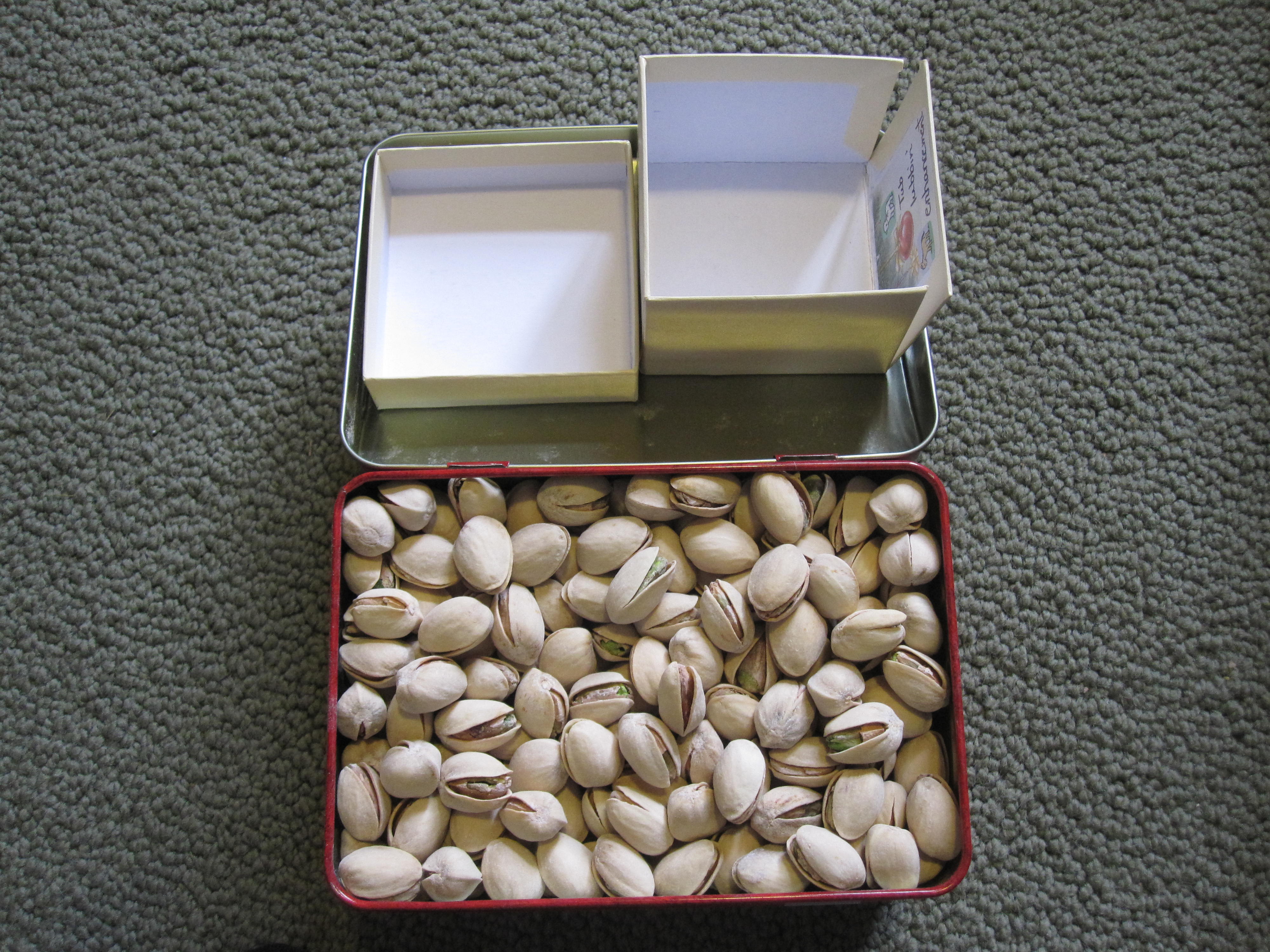
When I glanced and grabbed last week, I did a double-take. What?! $14.99?! Sweet! The last time they were $14.99 the President had stolen the election. Then, a second later, “What the hell, that’s a 3 pounder!”

Here’s how I imagine it going down at Costco headquarters in Issaquah, WA. Executive Meeting. Agenda item: Pricing limits of California pistachios. A suit does a quick PowerPoint presentation showing a precipitous decline in sales of California pistachios at the $19.99 pricepoint. What to do? Discussion ensues. The consensus, instead of selling 4 pounds for $19.99, let’s sell 3 pounds for $14.99, and hope people don’t really notice the math smoke and mirrors. Brilliant. A collective sense of accomplishment descends and the meeting is adjourned.”

It might just work. No, it will work on whomever lacks numeracy. And on addicts like me.

Bonus picture. What a minimalist, who asked for nothing, received for Christmas.

Perfect Christmas

How to Refresh and Keep Going

In response to my “Causes of Burnout” post, an ace PressingPause reader wrote that the question is how to refresh and keep going.

Nine suggestions:

1) Resist deficit thinking by being intentional about students’ strengths. When I taught high school, I always made a conscious effort to attend student art exhibits, plays, sporting events. And I always left thinking, “What talent, dedication, effort, and academic potential if I tap into those things.”

2) Save notes of appreciation, thank you cards, whatever positive mementos you can. And journal about especially positive interactions and experiences. Sporadically revisit the notes, cards, and journal entries as a reminder of your effectiveness and the importance of your work.

3) Subvert zero-sum thinking about teaching excellence (e.g., your success takes away from mine) by consciously affirming your colleague’s efforts and acknowledging what they do particularly well. Help create positive faculty culture momentum.

4) If a colleague has traveled too far down the deficit thinking road, steer clear. If surrounded by goners, attend local teacher workshops and seminars in order to find and build relationships with more hopeful, supportive colleagues from other schools. Also join professional association’s list serves and blog discussions like this one.

5) Do whatever helps you create energy on a regular basis—spend time outdoors, walk, row, run, cycle, swim, practice yoga, pray or meditate, volunteer, cook healthy meals and prioritize family dinners, read something non-work related, pursue a non-work-related hobby.

6) Be vulnerable with whomever you’re closest to, share your successes/failures and hopes/dreams. Lean on them and let them support you.

7) Be intentional about scheduling events to look forward to, whether a Friday after school get together with with a few colleagues, a Saturday night dinner with a significant other, or a monthly weekend hike.

8) Unplug earlier in the evening, make like the Japanese and take a hot bath, and sleep as many hours as you know you need to be completely rested.

9) Create positive teacher-student professional momentum by continually improving your plans, your methods, and your assessment of student work.

Suggestions for number 10?

2011 Resolution

Resist manic materialism.

I have no one really to blame because I chose to watch MSNBC while preparing for the 2011 cycling season one morning last week.  It was the morning after 20 inches of snow fell throughout the Northeastern U.S. Business analysts worried “How will the conditions affect retailers since post Christmas shoppers will stay home?”

Does everything always have to be interpreted through the lens of economics?

I should have switched to the Zen Cable Network, a mythical creation of mine where a slow, beautiful, non-narrated slideshow with acoustic guitar accompaniment was looping. Slow moving shots of young people up and down the seaboard sledding and having snowball fights while parents sipped coffee and talked against the backdrop of translucent, oddly beautiful cities.

Manic materialism is the increasingly common practice of defining as many life activities and events as possible in economic terms. How does this—a winter snow storm, schooling, an art form, food, healthcare—make people more or less wealthy? It’s the result of our collective idolatry, and as a result, it’s our unofficial national religion. No activity is immune from its influence. Every life activity and event is reduced to whether it generates wealth.

And make no mistake about it, wealth is defined one way—materially. How much money do you have, how big is your house, how nice is it on the inside, how luxurious is your car, where do you vacation?

Schooling provides a poignant example. Why are U.S. opinion and business leaders over involved in reform efforts today? For one reason—our international economic competitiveness is slipping. As a result, our relative wealth is declining. That’s why math and science content is routinely privileged at the expense of humanities and social studies education. The business leaders at the education reform table are in essence asking, “How in the hell is an affinity for literature or history going to translate into more money for more people?”

Maybe I errored in using the phrase “our collective idolatry” a few paragraphs ago. Maybe all of us are exceptions, a fringe minority that believes we’re more social, emotional, dare I even say spiritual beings, than economic ones.

In prioritizing close interpersonal relationships, maintaining work-life balance, and consciously living below our means, we provide a viable alternative to manic materialism and threaten the status quo.

What else can and should we do in 2011 to provide a social-emotional-spiritual alternative to manic materialism?

Seniority-based Teacher Layoffs

Thanks T for this article, “UW study questions seniority-based teacher layoffs“.

Should school districts facing serious budget shortfalls lay teachers off based on relative seniority? Tough one.

Rather than riff on the costs and benefits of seniority-based teacher layoffs, I want to highlight two underlying issues that education policy makers are ignoring.

First, what does it say about the state of teacher professional development and the profession more generally that many of the youngest teachers are the most effective? Learning to teach well is a challenging and complex process, the same is true I suspect for learning to be an excellent pastor, lawyer, accountant, or legislator. When we choose a surgeon for a complicated procedure we want to know how many times she’s performed it.

At what age do teachers do their best work? I suspect it’s about four to five years in which often means late twenties. This is an indictment on the poor quality of most teacher professional development and the profession. For most teachers there tends to be a dramatic, challenging, and rewarding learning curve over the first four to five years; followed by a plateauing; and then sometimes, a fatigue-based tailing off.

National Board Teacher Certification was intended to address this problem by rewarding the very best teachers with added responsibilities and challenges like mentoring new teachers, teaching methods in local schools of education, and creating exemplary curriculum for others. It’s been partially successful at best. School districts are incredibly conservative and consequently loathe to rewrite National Board teachers’ contracts.

Second, and this may surprise, but with a few important caveats, I’m more open than union leaders to efforts to compare and contrast teachers’ relative effectiveness. A recent front-page article in the New York Times about the Gates Foundation’s efforts to evaluate teachers influenced my thinking. I liked that the system doesn’t rest exclusively on students’ standardized test scores, but on video-tapes, student surveys of their teachers’ class environments, and other variables. Also important, it doesn’t appear to pit teachers against one another. Not perfect, but much better than traditional merit-based teacher evaluation pay plans.

But what Gates and other policy makers aren’t thinking nearly enough about is whether or not their video-tape/value-added-based teacher evaluation proposal is going to convince more outstanding undergraduates to commit to K-12 teaching careers.

Historically, teachers have understood the profession’s primary trade-off—less money, more job security; however, the story of the recent past is one of steadily increasing teacher accountability and decreasing job security. Meanwhile, compensation remains unchanged. Granted these are tough economic times. Numerous states have to make serious budget cuts. Still the fact remains, few of the best undergrads even consider teaching as a career. I hope I’m wrong, but I don’t expect the Gates Foundation’s current work to change that.

Especially strong undergrads who are considering teaching are less concerned about rigorous teacher evaluation systems than they are their modest salaries. And that’s the problem, the Gates Foundation offers no ideas on how to improve all teachers’ compensation.

Housing Prices

The conversation turned to real estate on a recent Saturday run when I shared my opinion that many sellers in our community were slow to grasp the correction as evidenced by their overpriced houses languishing on the market for six months to a few years.

You would have thought I suggested we extend our 10 miler another 16.2 just for the fun of it. The right wing nutters immediately jumped on me for assuming I knew more about free markets and home values than the actual homeowners themselves. And more importantly, who did I think I was, homeowners have the right to price their houses however they want.

Of course they do just like they have the right to be irrational and waste money more generally. Check out this chart:

credit—Jodi Ashline Newsletter

In the end, the average “priced right” and “priced reduced” home sell for the same price, but the “price reduced” home is on the market an extra 162 days. If “price reduced” homeowner has $100k in equity, and that equity was invested for 162 days @ 5%, they passed on earning $2,219. That’s the cost of exercising your constitutional right to overprice your home.

Around here at least, it appears that the larger and more expensive the home the greater the tendency to overprice it. That’s counterintuitive if one assumes, on average, the most well-to-do homeowners are the most business savvy, but I digress. We can also assume a much smaller pool of prospective buyers (I know it only takes one) and therefore the “average days on market” I suspect is far greater than 197, but for consistency sake we’ll stick with that.

Let’s consider a waterfront home that is four times the average at $1,317,392. Ultimately, after 197 days, overpriced sellers have to reduce their price $251,008 ($62,752 x 4). Let’s compensate for the too short “average days on market” by assuming that our waterfront sellers own their home outright. If “expensive price reduced” homeowner has $1,066,384 (the final sale price) in equity and had invested that for the too short 162 days @ 5%, they passed on earning $23,665.

To which the nutters might say, “That’s waterfront sellers right.” Which again, of course is right, just irrational.

Since I’m on math fire, and the nutters are down for the count again, one related thought. One oft repeated housing axiom is that housing corrections don’t matter if you’re buying and selling into the same down market. That’s only true in one of three possible scenarios—buying and selling similar priced homes. It doesn’t hold for buying a more or less expensive home than sold.

For example, consider the case of buying a more expensive home. Imagine you could sell your existing home for $300k or $100k less than its peak 2007 valuation. You buy a home for $1m or $250k less than its peak 2007 valuation. Had you made that move in 2007, it would have cost $1,250,000-$400,000 or $850,000. Today, the equation is $1m-$300,000 or $700,000 for a savings of $150k.

The opposite is also true. As a result of the correction, it’s more expensive to move down. Imagine you could sell your existing home for $600k or $200k less than its peak 2007 valuation. You buy a home for $300k or $100k less than its peak 2007 valuation. Had you made the move in 2007, you would have pocketed $400k, $800k sale price-$400k purchase price. Making that move today you would only pocket $300k, $600k sale price-$300k purchase price.

So assuming one has the resources, it makes more sense to move up in down markets and down in up markets.

School’s out nutters. Do they give out Economics Nobels for this stuff?