Grizzly President

I found the 2005 documentary, Grizzly Man, the story of a dude intent on befriending bears in Alaska, riveting. Spoiler alert: It ends with him getting eaten.

I still remember walking out of the Capital Theater thinking, “That was the most intimate portrayal of mental illness I’ve ever seen.” Up close and personal with someone in serious need of help.

Fast forward to this morning. Hit Masters swimming hard. Then recovery in the form of coffee and oatmeal. With apples, raisins, avocados, eggs, and pumpkin seed goodness mixed in. Grabbed the coffee and Mount Oatmeal and headed upstairs to eat in front of the t.v. Oh, the market’s up. Oh, the Lakers are winning. Oh, damn, the President is riffing on “having predicted everything”.

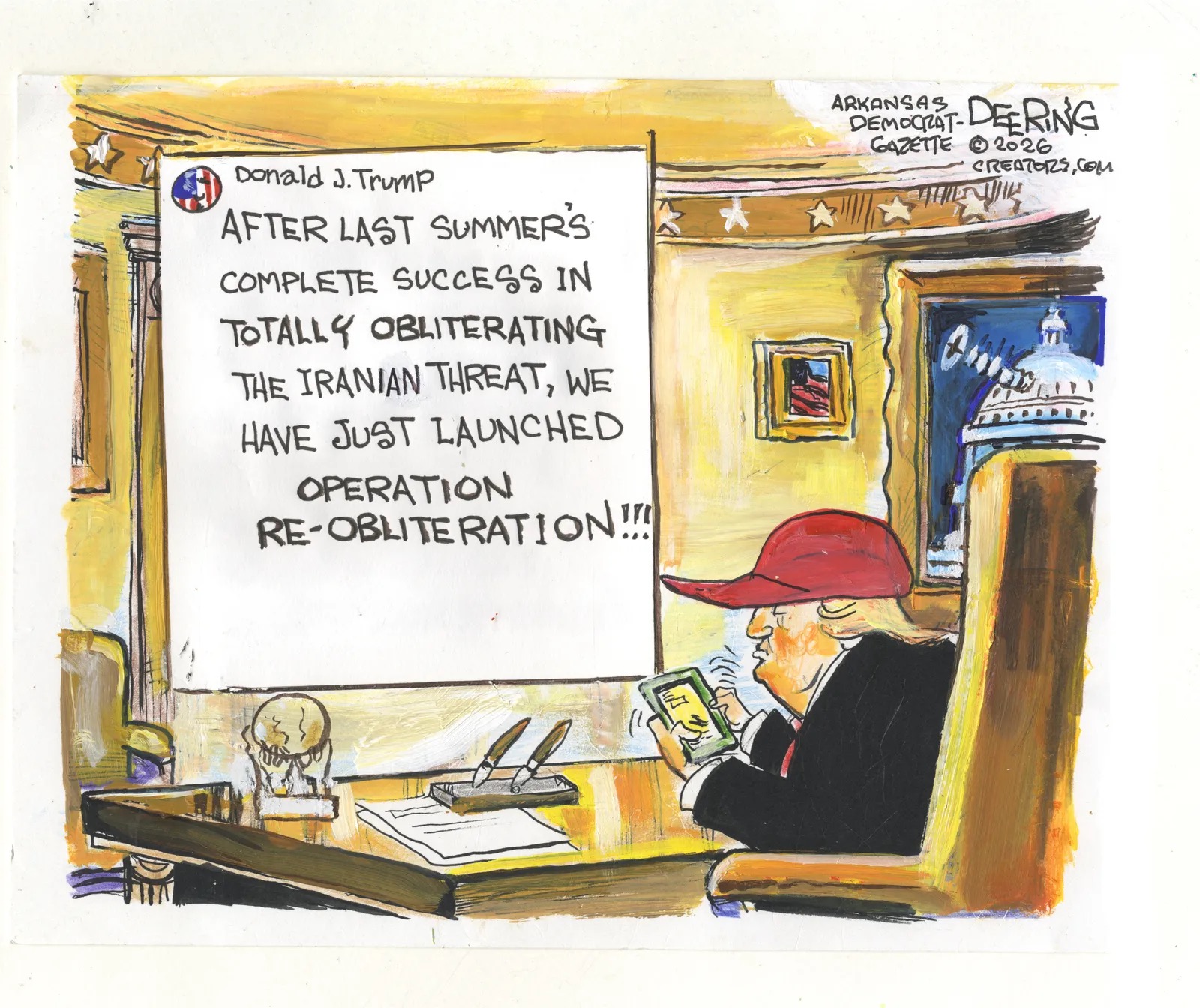
It’s no coincidence that a few days ago the Paper of Record wrote that the President was caught completely off guard by the closing of the Strait of Hormuz. He said he not only predicted that the Strait of Hormuz would be closed, but also that Osama bin Laden was going to knock down the World Trade Center a year before it happened. And not just that, but he predicted “everything”.

Several assassinations, schoolchildren are killed in mass along with many other civilians, US servicemen and women are injured and killed, energy prices tank European economies, longstanding allies are further alienated. And the President’s primary concern is to bolster himself.

It’s impossible to exaggerate the level of insecurity. Something that, I suspect, we’d have to trace back 75 years to understand even a little.

This is Grizzly Man level mental illness. But this dude isn’t sleeping in a tent surrounded by bears in the Alaskan wilderness. He’s the Commander-in-Chief. This story will not end well either.
Question Of The Day

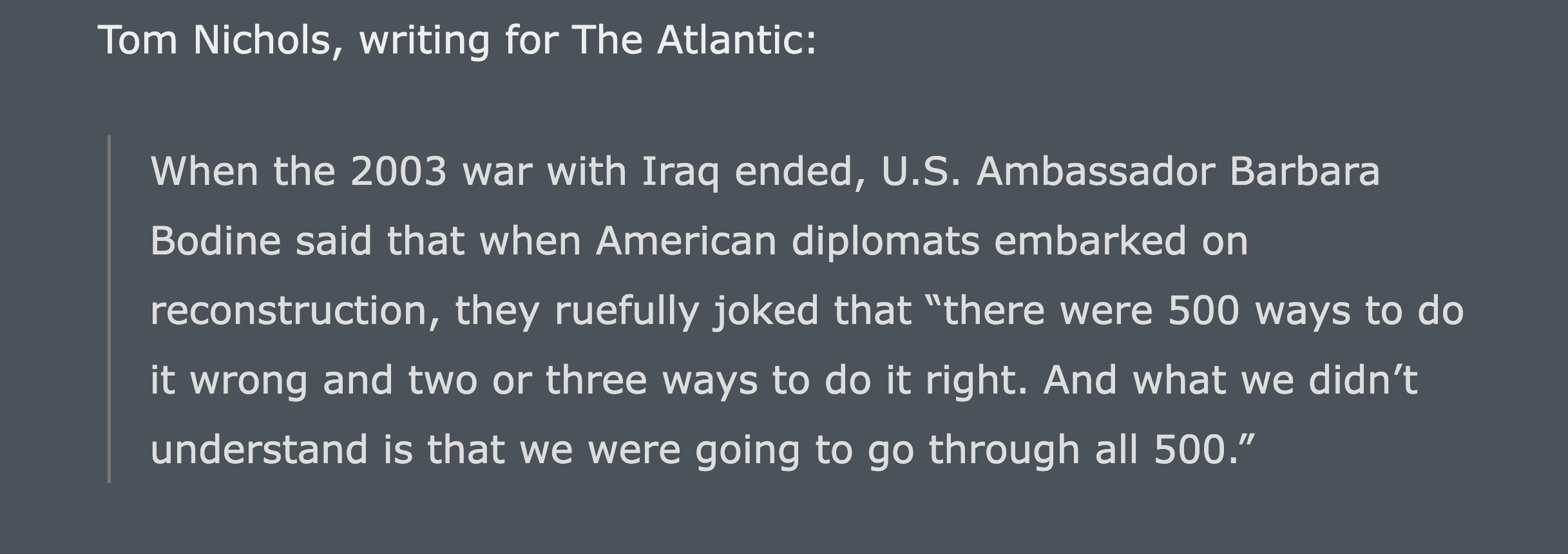
Has there ever been a time when less competent people have taken more consequential action?

Tomorrow’s question if you like to get your homework done early . . . How long until the assassination boomerang returns with such force not even the Secret Service can catch it?

Ghandi, “An eye for an eye will only make the whole world blind.”

Paragraph To Ponder

Meanwhile, back at home, the War President declares the affordability crisis is over.

Jessica Grose writing in the New York Times:

“On Thursday, a woman named Sharon from Minnesota called into C-SPAN’s ‘open forum’ to express her despair about the cost of living. ‘I’m 65 years old. I’m legally blind. I’m on disability. I went to my doc, and I lost 28 pounds in the last year. I did not need to lose 28 pounds. I did not try to lose 28 pounds. I lost the 28 pounds because I cannot afford to eat anymore,’ Sharon explained, speaking clearly even though she sounded near tears. Because of Trump administration cuts to the Supplemental Nutrition Assistance Program, and the high cost of groceries, gas and electricity, Sharon only allows herself $65 a month for food.”

Our Teetering Separation of Powers

I am conflicted. Should I be thankful that two-thirds of SCOTUS remains committed to the separation of powers or dismayed that one-third does not?

Since POTUS is such a stable genius with the best reading comprehension skills of any President ever, except maybe Lincoln, we must conclude he was never introduced to the concept at the New York Military Academy or the University of Pennsylvania. Shame on those institutions for the oversight.

Sign-Holding As Therapy

Everyone once in awhile, a reader enlightens me. This especially poignant example is from Richie, who I had the privilege of teaching and playing noon basketball with in Greensboro, NC back in the day. If Richie was just a little taller he would’ve been an NBA point guard instead of a distinguished social scientist/author.

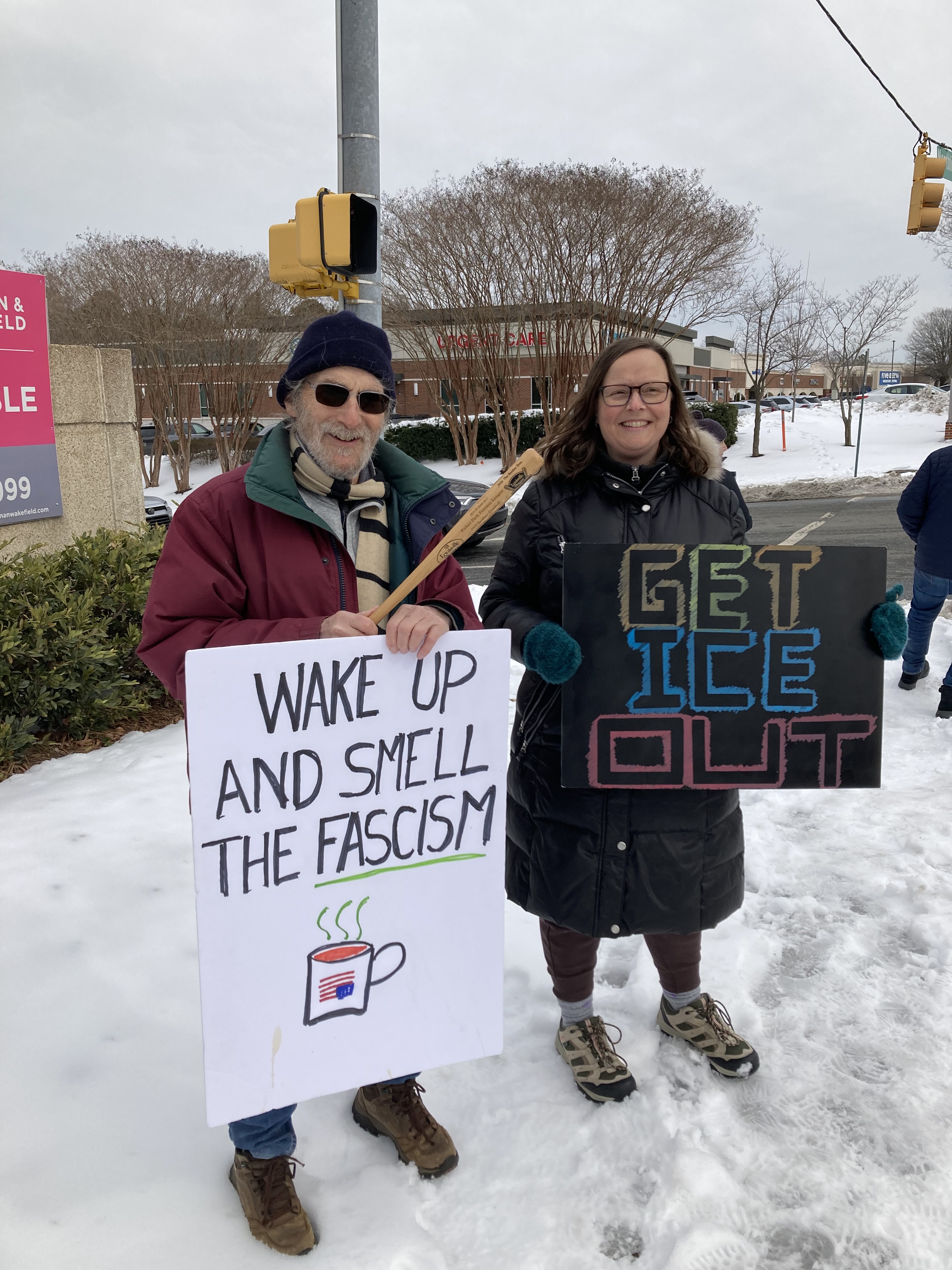
“I have gone to the big protests (Hands Off, No Kings, with casts of thousands), and now for many months I have been spending Tuesdays, from 12-1, with a group of 20-30 protesters, at an intersection in Friendly Shopping Center, outside Senator Thom Tillis’ Greensboro office.  We all hold signs, some of which are easily read as people drive by, especially when they have to stop for the light, and some of which may not be so easy to read depending on how much text there is, and how fast the car or truck is going.    On a typical day,  many drivers honk their horns in support, many give thumbs up, and some roll down their windows and thank us for being there.  For every 20-25 such indications of support, there will be one person who gives us the finger, or thumbs  down, or yells at us to “get a life” (at which point I usually remark to whoever is standing near me that they used to yell ” get a haircut”j.

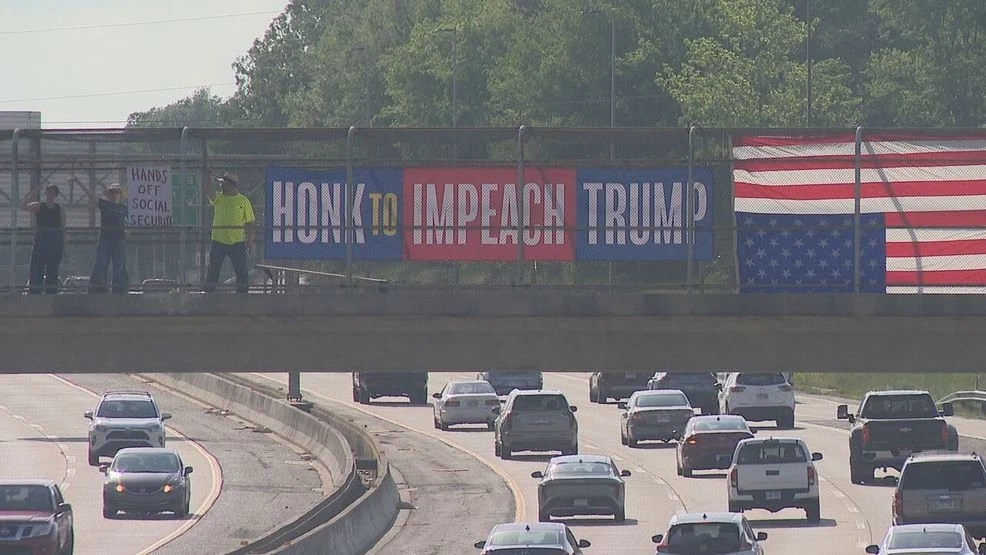
     Some of my fellow protesters — mostly but not all, older, mostly white — go to another protest on Thursdays, on Wendover, on a bridge over the road,  where it is probably harder to read the signs, and no one stops to converse.

     I doubt that the weekly protests, or even the big Hands Off or No Kings protests, change people’s minds.  Rather I think they remind people,  including politicians, that many Americans (and, today, people attending the Olympics)  are outraged by what is going on.  They remind people who do not like what is happening that they are not alone, even in the reddest of states.  For me personally, I rarely think I am changing anyone’s mind.  Mainly I consider it a form of therapy.  It.makes me feel better, that I am not just phoning our awful Senators and congresspeople (which I sometimes do), or giving money to causes that I support, but doing something that might in a small way contribute to the extensive evidence that people are horrified at who we have become.”

Maybe We’re All Sign-Holders

What do you think when you pass under political, sign-holding people on freeway overpasses? Of either variety, bright red or dark blue?

My internal dialogue. “Apart from posting on Facebook, I don’t think anyone could choose a less effective form of political persuasion. Has anyone ever, in world history, said, ‘You know, I was driving south on the I-5 when I looked up and saw an outstretched sign that said ‘X’. Until that moment, I really believed ‘Y’. But now, I realize how misguided I have been and I’ve completely come around to ‘X’.”

At 65 mph, the outstretched sign advert might last 1-2 seconds. That’s not even subliminal.

The sign holders are careful to keep a safe distance from their opponents they’re hoping to somehow convert. Their method is a metaphor for our modern age. We’re all steadily improving at keeping a safe distance from one another. Getting better and better at reducing the inconvenience and unpredictability of direct, interpersonal contact.

Abrupt shift. You may be wondering how I’m doing. Lots of people appreciated the “rawness” with which I described Lynn’s final chapter. Now though, I feel like the humble blog is completely inadequate for telling my story. Of how I’m doing.

I suppose, like the sign holders, I’m afraid too. Afraid to “keep it real” in way too impersonal a format.

So what to do? I don’t know.

So Unfair

College athletes have a portal, but not me. Nowadays, college athletes are switching schools annually in some cases.

Where’s my portal window? I want to relocate a few hours north. Still awaiting offers from Victoria, Vancouver, Penticton. Beam me up. Please.

Localism Is The Answer

Increasingly, it’s obvious that the more “plugged in” to the news, the more “on-line” one is, the worse their physical/mental/spiritual well-being because media algorithms know that outrage is the surest way to attract and keep eyeballs, and thereby sell advertising. As a result, outlandish opinions dominate. And once you and I are sufficiently outraged, we can’t unplug.

So if you and I want to maintain whatever sanity we have, we should intentionally tune out the news. Learn to leave our phones behind on occasion. Step away from our keyboards. Not watch as much t.v., or more likely, stream television clips.

Ignorance may in fact be bliss, but it also empowers those in power, because the more uninformed people are, and the more apathetic, the more free elected officials are to do as they please.

So what are we to do? Localism is the answer. Or a variation of the popular phrase that you no doubt remember, “Think globally, act locally.” Instead, maybe we should, “Think locally and act locally.” I’m advocating for a type of grassroots accountability, starting with ourselves and then branching out to where we live, trusting that if we do right by those we’re in closest relationship with, our county, state, country, and world will be okay in the long run.

So, in this way of thinking, we don’t get embroiled in fighting about national policies or current events. Instead, we recognize that our attention and energy are finite; consequently, we focus on being better partners, parents, and friends to those we live with, next to, and near. We go to the farmers’ market and initiate conversations with those closest to us.

Recently, someone, on-line ironically, asked a great question that gets to the heart of localism. They asked, “Do you know the name of the person that delivers your mail?”

I don’t. Why? Because I’m usually on my computer when she visits each morning.

Clearly, I have a ways to go.