What People Get Wrong About the NBA and Corona Del Mar High School

Alternative title: Why We Stereotype. Subtitle: Because our pea brains can’t handle complexity.

A sports-minded friend of mine likes soccer; Washington State Cougar football; and this time of year; the Stanley Cup playoffs. But don’t try talking professional basketball with him. He despises The Association because he decided a long time ago that the inmates are running the asylum.

College educated, and a successful professional, he’s like a lot of people who have negative preconceived notions about the league’s players. That because the minority of knuckleheads dominate the news. In fact, there’s greatness in the league, Exhibit A is Kevin Durant’s Most Valuable Player Award speech that you can watch here. Here’s a two-part challenge. Watch the first 4 minutes and then skip to the 22:50 mark and watch the last few. Try not to cry and try not to generalize about NBA players being brash, arrogant, everything that’s supposedly wrong with contemporary culture.

A Los Angeles Times story is titled “‘Prom draft’ reflects Newport Beach Culture, ex-official says“. Here’s the sordid heart of the article:

In 2009, the American Civil Liberties Union sued the school, alleging that the campus fostered a sexist and homophobic atmosphere. The civil rights suit stemmed from an incident in which three male athletes at the school posted a video on Facebook in which they allegedly used homophobic slurs, “outed” a student and threatened to rape and kill a female student.

Nearly a dozen students were expelled this year after it was discovered that a tutor who worked with some of the students accessed school computers and changed their grades.

Newport-Mesa Unified School District officials declined to comment on the prom controversy but in an email to parents, Corona del Mar High Principal Kathy Scott said she’d heard about an ongoing “prom draft” and that it appeared there was a similar draft last year.

“I need your help. I urge you to talk with your student(s) and discuss the seriousness of this type of activity,” Scott wrote. “I do not believe this is intended to be harmful, but this is not behavior that is consistent with our school’s outstanding reputation.”

Jane Garland, head of discipline for Newport Mesa Unified School District until she resigned this year, said some students there live up to stereotypes tied to Newport Beach. “There’s definitely issues at that school with certain students feeling entitled,” Garland told The Times. “The culture in Newport Beach is ridiculous and CDM personifies it.”

Garland should have stopped after saying some students feel entitled. Why? Because some CDM students may not be super wealthy and some who are may actually be mindful of their privilege. When addressing the school’s larger context, she could have said, “Newport Beach’s culture can be ridiculous as illustrated at times by some students at CDM.”

Based on his acceptance speech, Kevin Durant may be a better human being than he is a basketball player. Part of his likability is he doesn’t seek attention for his on or off-court accomplishments. ESPN is much quicker to detail the legal failures of the league’s knuckleheads than it is to describe players’ community service. Similarly, the LA Times is much quicker to detail the moral failings of some Southern California high schoolers than it is to tell the story of appreciative, selfless, ethical young people.

If it bleeds it leads. The end result? We succumb to the media’s knucklehead bias, a phenomenon that hardens our negative preconceived thoughts about people seemingly different than us.

I’ve never been on CDM’s campus, but here’s what I know to be true about it. Its students reflect the good and the bad of their parents. If Garland is right and Newport Beach’s culture can be ridiculous, then no one should be surprised by the aforementioned crises.

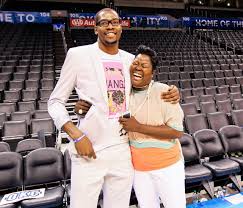
For better or worse, young people follow the lead of their parents. Kevin Durant is worthy of admiration because his mother has been for thirty years. Some CDM parents deserve scorn for a litany of parenting failures. Inevitably though, other CDM parents have more in common with Wanda Pratt, Kevin Durant’s mother, pictured below.

We struggle with nuance, subtleties, and ambiguity. In my alternative version of A Few Good Men, Jack Nicholson shouts at all of us, “You can’t handle complexity!”

imgres

The Most Valuable Person with the leagues best player for 2013-2014


Calling Bullshit on the “Ban Bossy” Campaign

Here’s their website and starting point.

When a little boy asserts himself, he’s called a “leader.” Yet when a little girl does the same, she risks being branded “bossy.” Words like bossy send a message: don’t raise your hand or speak up. By middle school, girls are less interested in leading than boys—a trend that continues into adulthood. Together we can encourage girls to lead.

Sheryl Sandberg and company report that “Between elementary and high school, girls’ self–esteem drops 3.5 times more than boys’.” I need Sheryl or Beyonce or Jane Lynch to explain to me how they measure self-esteem. Until I understand their methodology, I’m calling bullshit on their statistic and their campaign.

I’m committed to gender equality, but fired up about the “Ban Bossy” campaign because the young women I teach are flat out running circles around their male classmates. I’ve written about it before. Others have documented the same thing. Sixty percent of bachelors degrees go to women. Not only are there more female college students than male, they also tend to be more purposeful in their studies, they’re studying abroad at greater rates, and they’re enrolling in graduate schools in greater numbers.

In many of my classes, the gap is glaring. In a class of 30 students, 17 or 18 will be female and 12 or 13 male. Typically, six of the top eight students who are most engaged, most hard working, and most successful, are female. Class after class, semester after semester, year after year. There are purposeful, hard working, outstanding male students; they’re just outnumbered by their female counterparts. Despite young women’s alleged lack of self esteem, some universities are relaxing admission criteria for men.

Arne Duncan no doubt enjoyed making the vid with Beyonce and company. His line, “We have to convince them that it’s okay to be ambitious”. Arne, put down the basketball and spend some time on a college campus. Then you’ll understand why we have to convince young men it’s okay to be as ambitious as young women.

Ultimately, I don’t believe Sheryl Sandberg. If she proves me wrong, self esteem isn’t as integral to academic achievement as commonly thought.

Apart from the higher education realities the campaign strangely ignores, there’s something perverse about “if only girls were treated more like boys” thinking. In the last decade or so, “leadership” has been redefined to include “soft skills” like questioning, listening, and team building. Many boys struggle with those things because, to put it most simply, they’re bossy. It makes no sense to emulate a flawed male ideal. Instead parents, grandparents, teachers, coaches, youth group leaders, anyone that works with children should be cultivating 21st Century leadership skills. That just happen to be gender neutral.

I should start a campaign to ban thinking about gender attributes as a zero-sum game. Ban “boys versus girls thinking” or something like that. A movement to help all young people fulfill their potential for the betterment of society. I should gather some of my celeb friends to make a YouTube vid. And leverage social media. And call in some favors with my friends in the national media.

If only I had more ambition.

* some of the above is adapted from the previous post I linked to, this self plagiarizing is also known as Rick Reillying one’s self

My Turn to Crime

It’s not my fault. I’ve fallen in with some bad dudes. It started a few years ago when The Sopranos drew me in. Then The Wire. Then Breaking Bad. Now The House of Cards. I should be eligible for a mail order degree in Abnormal Psychology.

What is it about Tony Soprano, Avon Barksdale, Walt, and F.U. that makes it so hard to look away as they leave ruined lives and dead bodies in their wake?

My theory rests on the assumption that I’m a part of the 99% that has a social conscience, but sometimes still wrestles with doing the right thing. At 2a.m., with the streets deserted, we still wait for the red light to turn, but not before imagining going. We get frustrated with people all the time, even irate at times, but we successfully suppress our violent tendencies. We get used to the tension between our better and worse-r selves. And fortunately for society, our better selves almost always win out.

Tony, Avon, Walt, and Frank are the 1% that effortlessly give in to their worse-r selves. Their lives are not complicated by other people’s feelings. Once off the rails, they have zero regrets. On second thought, scratch Tony from that foursome, his earnest therapy sessions with Melfi disqualify him from the truly pathological.

In large part, I think I find these dramas so compelling because I can’t fathom what it would be like to live completely unencumbered by doing the right thing. To not give a single thought to authority, social convention, and the social contract we enter into as drivers while running the light. To not care whether someone lives or not.

There’s another important variable in the equation. For me the gruesome violence is usually just palatable enough because I know they’re fictional dramas. After watching The Wire, I can reason, “That teen drug runner didn’t really die at the hands of the other teen drug runner, because they’re acting.” LIke when watching a play or reading a novel, it helps to know it’s imaginary. In Breaking Bad the innocent kid on the bike in the New Mexico dessert didn’t really die. He’s probably a popular eighth grader somewhere in SoCal.

Could the time I’ve spent with the Mount Rushmore of television criminals have a deleterious effect on my normal, law-abiding self? That’s doubtful because the Good Wife makes me take a powerful antidote to these intense crime dramas every Sunday night. Downton Abbey.

Postscript—Watch this 60 Minutes segment (13:40) on Wolfgang Beltracchi (13:40). Beltracchi, as evidenced by the final exchange which begins at 13:28, has Mount Rushmore criminal potential.


How College Changed Me For the Better

I guess it makes sense given tuition inflation, but today, nearly every “is college worth it” discussion revolves around one consideration—roi—or “return on investment”. More and more people worry whether a college education will lead to more secure, higher paying jobs.

In the last week I’ve been changed for the better by a movie and two books that I probably wouldn’t have seen or read if my curiosity hadn’t been jumpstarted during college.

The movie, Wadja, was an engrossing window into what it’s like to be a woman in Saudi Arabia. Wadja has grossed $1,346,851 as of January 17th. That means few people are curious about what it’s like to be a woman in Saudi Arabia. Had I not attended college, where I learned to like learning about other people, places, and time periods, I doubt I would have sought out Wadja. I’m a more informed global citizen as a result of having watched Wadja.

The books were Wild: From Lost to Found on the Pacific Crest Trail and The Unwinding: An Inner History of the New America. Together, Cheryl Strayed and George Packer challenge my assumption that privileged people like me will never truly grasp what it’s like to teeter on the edge of economic destitution. Thanks to their story telling genius I have a much better feel for why some people struggle to feed, shelter, and clothe themselves. And more empathy, an attribute in shorty supply these days, for poor individuals and families.

I may not have been curious enough about the people’s lives in those books if three decades ago I hadn’t studied history in college and became keenly interested in other people, places, and time periods. Thanks to excellent professors, challenging readings, constant writing, and discussions with classmates and roommates, I became more curious, insightful, and empathetic.

How does one place a dollar value on that?

When Nationality Binds and Blinds

You know the story. A former NBA player recruits a team of retired professional basketball players to play an exhibition game in front of Kim Jong Un on his birthday. Obviously, the players haven’t spent any of their post NBA lives learning anything about life in North Korea. The whole trip, especially the players clapping adoringly while the team leader serenaded Kim Jong Un with “Happy Birthday”, was almost too surreal to process.

Understandably, the media was quick to criticize the player and his friends. But the national-centric nature of the media’s criticism warrants criticism. And as far as I’m aware, there hasn’t been any. Never mind that 1m North Koreans died during famines in the 90s, that hunger is still a daily reality for most North Koreans, or that state prison camps have doubled in size since Kim Jong Un’s ascension two years ago. Learn more here.

The media’s criticism has focused on only one thing, American missionary Kenneth Bae, whose story is tragic. Bae, who is in declining health, is being held against his will for allegedly cataloging the extent of hunger among North Koreans under the guise of Christian missionary work. Bae’s story deserves media attention, but not at the expense of tens of millions of ordinary North Koreans whose daily lives have always been a living hell.

Our passivity about the plight of ordinary North Koreans explains the myopic media coverage we’ve been subjected to. Interestingly, Bae was born in South Korea and moved to California when he was 17 or 18 years old. Overtime he not only gained citizenship, he secured the one thing that seems to make him far more important than all the North Koreans combined, a U.S. passport.

Our passivity about our media’s national-centrism is an embarrassment. The North Korean media spotlight is in actuality a sporadic lighting of dim, fast burning individual match sticks. Given that, it’s especially important that our first instinct is always to honor the humanity of everyone held captive in North Korea irrespective of their nationality.

What Baby Boomers Get Wrong

The “Get Wrong” series is so popular, the Good Wife recently asked when I’m going to post on what she gets wrong. Since she’s a card carrying Baby Boomer, here’s some of what she gets wrong.

First, some context. Whether you’re aware of it or not, there’s a full-fledged generational cage match going on and the Millennials bring it via YouTube!

At first glance the vid appears to be light-hearted entertainment. In actuality, it’s poignant, hard-hitting social criticism. When it comes to generation gaps, Baby Boomers like me (I’m a tail ender) make two mistakes over and over and over.

Mistake 1—Based upon a few negative encounters with Millennials, we get so worked up, our brains shut down; consequently, we overgeneralize about all young adults. Here’s an idea Boomers, let’s stop starting sentences with “Millennials”. Any sentence that begins with the word “Millennials” is likely to be a gross and inaccurate generalization. Unless, of course, it’s “Millennials make some damn good videos.”

Mistake 2—Baby Boomers are lightening quick to say Millennials suck, and yet, take no responsibility for their alleged shortcomings. That’s the brilliance of the vid. Their flaws are the direct result of our parenting, teaching, coaching. Millennials didn’t suddenly appear out of the ether like the first invertebrates. Here’s another idea Boomers, let’s stop ripping the Millennials without explaining our culpability.

Minimize End-of-Life Regrets

Writing faculty at my university get to choose their own seminar themes. When I chose “The Art of Living” for my first year writing seminar a few years ago, I wasn’t sure how it would go. Was I crazy to think that eighteen and nineteen year olds might find Epicurus, Seneca, and Stoicism almost as interesting as me?

I knew very few of their K-12 teachers had asked them to think about what they most want out of life. And psychologists say they have a sense of immortality. Why bother with how to live if you’re going to live forever?

One month in, I’m happy to report, they’re actively engaging with the reading material (primarily William Irvine’s The Guide to the Good Life and Roman Krznaric’s The Wonderbox) and one another. I love how comfortable they are disagreeing with our authors and one another. My greatest challenge is staying out of their way.

Some have experienced loss—one’s mother died a few years ago from breast cancer, another’s from a heart attack, and still another travelled to Winnipeg last week to attend her aunt’s funeral.

The first unit was on “philosophies of life”. More specifically, I asked the students to agree or disagree with Irvine’s thesis that to avoid major end-of-life regrets, everyone needs to have a grand goal of living and specific strategies to achieve the goal. Irvine argues most people have regrets at the end of their life because their primary pursuits—wealth, social status, and pleasure—are in the end, unfulfilling. His grand goal of living is to maximize tranquility and joy by reviving Stoicism for the modern era. Few people experience much tranquility, Irvine argues, because materialism, social status, and pleasure conspire against it.

The larger question we’ve grappled with is how intentional should we be in our day-to-day lives? What role, if any, should spontaneity and serendipity play? What’s the right balance?

The students fell evenly across the “intentionality/spontaneity” continuum, some quite certain that people need life goals, and associated philosophies with specific strategies for achieving them. Others pushed back saying, “Are you kidding? How can anyone expect people with our limited life experience to put forward grand goals for living let alone specific strategies for achieving them?” They thoughtfully argued that life would present unforeseen struggles and opportunities. For example, one said she never would’ve have fallen in love with French if she had been correctly placed in the middle or high school Spanish class for which she had actually registered.

When some of them argued for intentionality, I couldn’t help but think they’d have to recalibrate their specific goals and strategies (for example, to have a large loving family) if and when they commit to a life a partner with their somewhat different visions of the future.

What about your life? According to Irvine, your life is most likely an argument for spontaneity because our culture offers us an “endless stream of distractions” that keeps us from clearly identifying, and planning how to accomplish, what we most want out of life.

Be less distracted this week, and thanks, as always, for reading.

The Inevitability of Military Conflict

Most of the time I believe the “human condition is improving” side of the ledger trumps the “life is worsening” side.

Right now at least, after watching an excellent documentary about Egypt’s civil war, reading about Syria’s three-pronged civil war, and following the BBC’s up close coverage of the terror attack in Kenya, plus the one in Pakistan, I’m less certain of that.

The lesson of those conflicts and most others from the last 50 years is this: the victor’s brutality—whether in civil wars or international ones—sows the seeds of future conflicts. Devastated and humiliated, losers vow revenge; as a result, violence continues unabated.

“An eye for an eye,” Ghandi said, “makes the whole world blind.” No side ever truly wins a war because the underlying causes of the conflict—poverty, greed, ethnic hatred, religious fundamentalism, nationalism, desperation—are exacerbated by the military excesses of the seeming victors. Diplomacy loses, moderates are radicalized, children resolve to avenge their dead parents’ lives. What appears to be an absence of war is just an interlude in the back-and-forth between suicide bombers, anonymous drone missile strikes, and ground combat.

My government doesn’t appear to be learning the lessons of war. Our diplomatic efforts are not increasingly wise or effective. As evidence of that, despite representing 4% of the world’s population, we continue to account for 50% of the world’s military spending.

Our only hope may be running out of money. Someday maybe, we’ll realize we can’t rebuild our infrastructure, pay teachers adequately, provide affordable medical care, compete in the global economy, and invest more in our military while providing security for other governments (see Japan among others).

Like Conservative Republican Southern governors who are backtracking on mandatory prison sentence laws because they can’t afford their incarcerated populations, maybe the day is coming when the State Department will have to step up its game to compensate for a leaner military.

In the meantime, I don’t expect to see meaningful peace in Syria in my lifetime or democracy in Egypt. I hope I’m wrong and Isaiah is right. Chapter two, verse four:

He will judge between the nations and will settle disputes for many peoples. They will beat their swords into plowshares and their spears into pruning hooks. Nation will not take up sword against nation, nor will they train for war anymore.

Teaching Teamwork

In May, 2011, Atul Gawande gave an insightful commencement address to Harvard’s Medical School graduates.

He reminded the graduates that the practice of medicine had changed markedly, and that increasingly, the best docs are members of teams.

Gawande pointed out that, “The doctors of former generations lament what medicine has become.”

I’m having my graduate-level teacher certification students read the address. On the copy I’m providing them, I’ve lined out “doctors” and “medicine” and written in “teachers” and “education”.

Here’s Gawande’s primary point:

The core structure of medicine—how health care is organized and practiced—emerged in an era when doctors could hold all the key information patients needed in their heads and manage everything required themselves. One needed only an ethic of hard work, a prescription pad, a secretary, and a hospital willing to serve as one’s workshop, loaning a bed and nurses for a patient’s convalescence, maybe an operating room with a few basic tools. We were craftsmen. We could set the fracture, spin the blood, plate the cultures, administer the antiserum. The nature of the knowledge lent itself to prizing autonomy, independence, and self-sufficiency among our highest values, and to designing medicine accordingly. But you can’t hold all the information in your head any longer, and you can’t master all the skills. No one person can work up a patient’s back pain, run the immunoassay, do the physical therapy, protocol the MRI, and direct the treatment of the unexpected cancer found growing in the spine. I don’t even know what it means to “protocol” the MRI.

Today, isn’t it a workplace truism for nearly everyone that “. . . you can’t hold all the information in your head. . . and you can’t master all the skills”?

Gawande adds:

The public’s experience is that we have amazing clinicians and technologies but little consistent sense that they come together to provide an actual system of care, from start to finish, for people. We train, hire, and pay doctors to be cowboys. But it’s pit crews people need.

On my students’ copies, I’ve lined out “doctors” and “people” and substituted “teachers” and “students”.

Gawande acknowledges that medical education fails to teach docs to function like pit crews for patients. The same is true for teacher education.

Too often nursing, medical school, and teacher education faculty wrongly assume that novice nurses, docs, and teachers will naturally, through osmosis, form knowledgeable, skilled, interdependent work teams. Absent intentional team-building curricula, in which case studies would be an integral component, professional apprentices depend upon the modeling of their veteran colleagues, often out-of-step ones pining for old school independence and autonomy.

When in comes to intentionally teaching teamwork, what can and should professional preparation programs do to shift the balance from cowboys to pitcrews? More generally, what can employers do to teach teamwork?

They shouldn’t assume it’s something someone is either born with or not. Effective teamwork can be taught through case studies that illuminate what the best teams do and what commonly trips up most others. And by proactively providing pre-professional students positive examples of excellent teams during their fieldwork.

A Land of (Still Imperfect) Opportunity

Watching an ESPN documentary about Mary Decker Slaney, and The Wire, and the Netflix original series “Orange is the New Black“, has me thinking about the American Presidency, Martin Luther King’s “I Have a Dream” speech, and how illusive equal opportunity still is.

Without a doubt, U.S. citizens have greater opportunity to improve their lives than the average world citizen. And U.S. citizens have more opportunity today than fifty years ago when King and others marched on Washington. Those two points are inarguable, but too many U.S. citizens extrapolate from them to argue that everyone in the United States—young, old, female, disabled, dark, poor, heterosexual, non-English speaking—has equal opportunity to succeed. Thinking that we’ve achieved equal opportunity for all may be the most pernicious myth we tell about ourselves.

I was shocked by a scene from the middle of the Slaney documentary. In one of her best performances ever, she won the 3k at the 1985 World Championship in Helsinki, Finland. Amazingly, there wasn’t a single East African in the race. Today, nine or ten of the fastest ten middle distance women runners in the world are Ethiopian or Kenyan. They have only had the opportunity to demonstrate their excellence on the international scene for a few decades. Now, the international track is a level playing field.

Watching the Wire and Orange is the New Black back-to-back is eye-opening. They remind the viewer just how white and middle class most television is. And the incredible amount of acting talent that resides in every ethnic group. The Wire, about Baltimore’s inner city, had a mostly African-American cast. Orange, set in a women’s prison, has a culturally diverse, predominantly female cast. The writing, acting, and producing on both shows is remarkable.

It makes one wonder how many other just as talented culturally diverse writers, actors, and producers are trying desperately to get their feet in Hollywood’s mostly monocultural door. For every actor we see on a small or large screen there are at least another hundred who are equally talented. The only difference is they lack connections and opportunity. Give black, hispanic, asian, and female actors equal opportunity and they will do memorable, award winning work.

And if that’s true in athletics and the arts, why wouldn’t it also be true in education, business, medicine, politics and every aspect of modern life? It’s laughable that we maintain the myth of equal opportunity in the U.S. when we’ve had 44 in a row male presidents.

We should celebrate the slow but steady extension of opportunity in the United States, but not kid ourselves with claims of equal opportunity writ large. Everyday, some in our communities are told by others that they’re too young, too old, too female, too disabled, too dark, too poor, too queer, too foreign. Refusing to see that doesn’t change reality.