You May Now Unplug the Treadmill

The hedonic treadmill, also known as hedonic adaptation, is the tendency of humans to quickly return to a relatively stable level of happiness despite major positive (or negative) life changes. According to this theory, as a person makes more money, expectations and desires rise in tandem, which results in no permanent gain in happiness. For example, a person excitedly drives a new car home from a lot. They’re marginally happier. But a few weeks later it’s dirty and the driver has adapted to the improved interior, handling, and quietness. The loving feeling dissipates.

Now that you’re an expert on the hedonic treadmill, you’re ready for a March Madness story about our tendency to think the grass is usually greener on the other side. Let’s title the story “Why is contentment so elusive?”

UCLA, my team, got schooled in the opening round. A few days later, the coach got whacked. The backstory to why is an interesting case study in leadership, but that’s peripheral to our story.

Along with many others, Mark Few (Gonzaga) and Brad Stevens (Butler) have been mentioned as possibile replacements. Because of a new Pac-12 conference television deal, UCLA can triple or quadruple their current “small market” salaries. Both coaches, young and very successful, have been sought after by other schools in recent years.

Here’s what an Indiana reporter recently wrote about Stevens and UCLA.

UCLA just spent $138 million renovating Pauley Pavilion. Stevens is going to be able to negotiate, not just a top salary, but also facility upgrades (the Bruins need a practice facility), length on the contract, security on that contract (Howland got a buyout for the remaining four years on his deal), and assurances that this coach can run the program as he sees fit.

You give Stevens all of that, coupled with the lifestyle that living in Beverly Hills (just a long jump shot from the UCLA campus) brings, and all of sudden Butler fans have a very legitimate reason to be nervous.

I don’t question Stevens’ love of Butler in any way. I love my alma mater, as well. But when he visits the UCLA campus and tours a renovated Pauley Pavilion, visits the private school where his children will attend in Beverly Hills, eats lunch and plays golf at Bel-Air Country Club (just across Sunset Blvd. from the campus), takes Tracy and the kids shopping along Rodeo Drive, and has them (second) home-shop in Hermosa or Manhattan Beach, where they’ll spend their weekends, I can’t fathom that Stevens doesn’t give pause before waving it off.

The same reporter acknowledges:

There is no doubt, Stevens’ love of raising his family in Indiana, his love of Hinkle Fieldhouse, his love of his players, coaches and administration, his affection for everything about his position at Butler, is going to be tested if the UCLA Athletic Director calls.

Finally, he writes:

Stevens has always said “No, thanks” to job offers. And perhaps he will again. But an opportunity to coach UCLA is different. I told him he’d be crazy to turn it down.

I fully expect Stevens to say “thanks, but no thanks” again. And while he’d be a great coach, I’m actually rooting for him to stay off the treadmill. The writer is projecting his desire to live large in some place like Los Angeles onto Stevens. I suspect Stevens knows money changes you. Sending your kids to a Beverly Hills private school will definitely change them and probably not for the better. And if Stevens wanted a second house twenty miles from his primary residence, he would have probably jumped on the elite program coaching treadmill already.

Few’s the same way. Prefers Spokane, Washington over West Los Angeles. Some people are like moths, attracted to the bright lights of big, celebrity filled cities, but both Few and Stevens are reported to be “intensely private” and know there’s a cost to lost anonymity. Nearly everyone thinks they’d be a lot happier if they made a lot more money. A preternatural minority knows that’s not the case.

I applaud Few’s and Stevens’ self-understanding, wisdom, and willingness to not just say “no” to a lot more money once, but repeated times. Here’s hoping they keep daring to be different.

Ask yourself "What would Nike do?" and then do the opposite. Just don't do it.

Ask yourself “What would Nike do?” and then do the opposite. Just don’t do it.

Good and Bad News—Your Life Experience is Unique

No one has followed your exact path. No one has grown up in the same family, attended the same schools at the same time, read the same books, worked the same jobs, traveled to the same destinations, settled in the same place. Ever. Your unique life path is a wonderful strength. As a result of it, you “get” the specific people you grew up with and you’re an insider at the places you’re most familiar.

But your unique life path is a serious limiter too. One that inevitably handicaps you at times. It’s the reason you struggle to understand people and places with which you’re unfamiliar. Clearly, seeing the world from other people’s points of view does not come naturally. More specifically, we routinely fail to adjust for other people’s different life paths. Which is why there’s so much interpersonal and intergroup conflict.

A close friend attended a mostly white, mostly upper middle class liberal arts college. By most conventional measures, she received an excellent education. But in some ways she was ill-prepared for an increasingly diverse world. At one of her first teaching jobs she had a militant African-American colleague who routinely ruffled her feathers. Deeply frustrated, she complained to me, “He’s racist!”

In college she had few opportunities to interact with African-Americans and never with militant ones. If she took the time to learn more about his life path she would have been much more sympathetic to his radical critique of the dominant culture of which she was a part. And consequently, she wouldn’t have taken his anti-white diatribes quite so personally.

Can you supersede your life path? Can I? Partially.

How? By purposefully seeking out unfamiliar people and places through literature, the arts, and travel whether near or far. And when interacting with unfamiliar people, substituting curiosity for negative preconceived notions. Asking, for example, why do you believe what you do? And then listening patiently.

Feminism and Church Patriarchy

I was too young during the Civil Rights movement to appreciate the participants’ sacrifices and accomplishments firsthand. We’re in the midst of another, admittedly more subtle, radical social transformation.

The U.S. is tilting left, in large part because younger voters are more liberal on a host of social issues including gay marriage, women’s rights, immigration, gun control, and legalizing marijuana.  As one especially illuminating example of this transformation, read not-so-young Republican Senator Rob Portman’s explanation of why he now supports gay marriage.

The key word in the previous paragraph was “tilting” as in 55%. There’s still a Grand Canyon-like partisan divide on social issues. Case in point, Portman is getting ripped by the Right for abandoning conservative biblical principles and by the Left for a too little too late conversion.

This is what I was thinking about in church Sunday when Melinda, our twenty-something year-old intern, started her sermon, a history of St. Patrick, and what his life might mean for our church today. It was excellent. I drifted as always, but more purposefully. I was fast forwarding, thinking about how bright her pastoral future is. I was picturing her taking future calls and serving a series of churches extremely well. A life spent modeling the gospel; providing spiritual counseling; teaching and preaching; rallying people to serve those in need; thoughtfully baptizing, marrying, and burying the young and old; and the community and larger Church, being better for it.

And then I thought about a religious organization that’s been in the news a lot lately as a result of a change in leadership. And how, despite accelerating social change in the U.S., that religious organization is passing on thousands of Melinda’s the world over every year. How, I wonder, does any institution in the 21st Century take a pass on the leadership potential of half its members?

Also listening to Melinda was our district’s congressman who flies home every weekend to see his wife. Looking at him made me wonder, what if Congress passed on the leadership of half the population? What if schools of medicine did? Or your workplace? What if (fill in the group or institution of your choice) did?

How do my feminist friends, both male and female deal with the church’s patriarchy? That’s only one of my many questions about the Church in the news. My friends would undoubtedly say that’s just one of a long list of unresolved challenges facing the Church. They oppose the Church’s official stands on a litany of issues, but remain committed to it.

How does that work? Does religious tradition trump discordant hearts and minds? How does it hold together?

The Problem with the Simple Living Movement

The high priests and priestesses of minimalism don’t know it, but they have a problem. They’re seriously disliked by the majority of people who are struggling to get by. Ordinary people deeply resent the “voluntary” nature of most high-profile minimalists who write about the joys of downsizing on their numerous blogs, or for the New York Times, or Sunset Magazine.

Take for example how Graham Hill starts his New York Times essay titled “Living With Less. A Lot Less.” 

I LIVE in a 420-square-foot studio. I sleep in a bed that folds down from the wall. I have six dress shirts. I have 10 shallow bowls that I use for salads and main dishes. When people come over for dinner, I pull out my extendable dining room table. I don’t have a single CD or DVD and I have 10 percent of the books I once did.

I have come a long way from the life I had in the late ’90s, when, flush with cash from an Internet start-up sale, I had a giant house crammed with stuff — electronics and cars and appliances and gadgets.

Somehow this stuff ended up running my life, or a lot of it; the things I consumed ended up consuming me. My circumstances are unusual (not everyone gets an Internet windfall before turning 30), but my relationship with material things isn’t.

Half way into Hill’s story, I started to guess at the vibe of the 329 comments already posted. As David Brooks can confirm, New York Times readers are an unhappy bunch. Hill probably wanted praise, but I’ve seen this car crash enough times to know how it transpires. A lot of readers tore into him. Like Michelle from Chicago:

There is a big difference between choosing minimalism and minimalism being a harsh aspect of daily life. At any moment, Mr. Hill could choose to buy more things. If one of his 6 dress shirts rips, he can simply buy a new one. It’s a far cry from a minimum wage worker who has this lifestyle by default, because there isn’t money to rent a larger apartment or money to replace a torn shirt.

The sad fact of the matter is the gap between the “haves” and “have nots” is so great the “have nots” are unable to give any credit to the “haves” for living below their considerable means. I believe Hill and others like him deserve credit for their thoughtful and principled simplicity, but it’s naive for him, for me, for anyone to expect those trying to live month-to-month to cheer well-to-do minimalists for critiquing conspicuous consumption.

I was mindful of this dynamic when commenting on a blog recently. I was responding to a post about the recent highs in the stock market. I wrote that many people are starting to invest in stocks which means it might be a good time to take some profits. And then consciously added, “for those fortunate enough to have them.” If I hadn’t added that phrase, my comment would’ve prompted other replies of the “who has profits these days” variety.

Where does this leave Hill, myself, and many other minimalists who recommend voluntary simplicity? Can it be done without offending? Probably not. Which makes me think maybe we should stop writing about it altogether. Maybe we should just live it and wait to see if anyone asks, “What gives? Why do you live the way you do? Why such a small apartment? Why so few possessions? Why don’t you ever check bags when flying?”

Someone now leave the obvious comment. Nevermind, I’ll do it myself. “What the hell Ron, why do you assume people can afford to fly?”

The High Cost of Win-At-All Cost

In 1972, when I was the scrawniest ten year old swimmer in the Midwest portion of the United States, I competed in a big YMCA swim meet somewhere in Ohio. According to the buzz on the deck, one guy I had to swim against was the top ranked ten year old in the state. I can’t remember the stroke or distance. All I can remember is his psycho mother hovering behind the blocks prompting him to swim fast enough to hop out, towel off, and throw some clothes on. In her twisted mind, posting the fast time wasn’t enough, he had to belittle his competition. He executed her maniacal plan to perfection. Having lost the mother lottery, odds are his adult life didn’t turn out too well.

Oscar Pistorius, a.k.a., ” The Blade Runner”, has me thinking again about athletic competition and character.

File:Oscar_Pistorius_2_Daegu_2011

Conventional wisdom is that athletic competition enhances character. But when win-at-all cost thinking prevails, conventional wisdom is dead wrong. Athletes shouldn’t bare all the blame for “win-at-all cost” approaches to sport. Among others, corporate sponsors, insecure parents, and rabid fans are all co-conspirators.

I recently read a book and watched a television series that powerfully illustrate the high cost of win-at-all cost thinking. The book, Billy Lynn’s Long Halftime Walk by Ben Fountain. The television series, House of Cards, a Netflix original program.

On the Pad, Billy Lynn’s Long Halftime Walk was 307 pages. The first 57 were decent, the last 250 truly outstanding. Billy Lynn is an 18-19 year-old Iraq war soldier. His Bravo troop is touring the United States following a widely reported and celebrated fire-fight with Al-Qaeda enemy combatants. Apart from a few flashbacks, the story encompasses about 48 hours, one day at a Dallas Cowboy game at Dallas Stadium and one day at Billy’s small-town Texas home.

Sometimes, when reading especially good fiction, I can’t help but stop and marvel at the artistry. Franzen’s Freedom was the last book that repeatedly stopped me in my tracks. The same with Fountain. “How did he do that?” I kept asking myself. Sometimes by “that” I mean how did he write a particularly beautiful sentence. More generally, I mean, how did he weave together details of soliders’ lives, the realities of modern warfare, the violence of professional football, class differences, family dysfunction, free-market economics, evangelical Christianity, and popular culture into a cogent anti-war argument? All of those sub-topics interest me, and I’m a dove, so it was as if Fountain set out to write a book for me, but if any of them interset you, I strongly recommend it.

ref=sib_dp_pt

imgres

Netflix spent $100m to make 26 episodes of House of Cards, loosely based on a critically acclaimed 1990 British t.v. miniseries of the same name. The first 13 episodes are available to U.S. viewers. Netflix streaming costs $8/month. Think of House of Cards as a cross between The Sopranos and The West Wing. Kevin Spacey, the main character, is a phenomenally immoral, Machiavellian political heavyweight. The question isn’t whether should you watch it, the question is whether you can watch just one episode at a time. Long story short, Spacey, Francis Underwood, or FU, is the House Majority Whip who helped a Democrat get elected President. Underwood mistakenly expects to be appointed Secretary of State in return. Sent reeling, his immoral politicking is riveting stuff. Again, highly recommended.

Win-at-all-cost thinking is corrupting on athletic fields, on battlefields, in business, in politics, and in personal relationships. In every sphere of life. But we’re loathe to admit it because we loose perspective all too easily and are part of the win-at-all-cost problem.

Be Less Lonely

By making time to read. Every day. And not just periodicals, blogs, email messages, Twitter feeds, and Facebook updates. Fiction and non-fiction books.

Bookish people are less lonely because they have an endless supply of friends. With the exception of some especially good long running series, television and film characters usually don’t rise to the same level of friendship as literary ones.

Cleo, an eighth grader at a middle school I’ve been helping out at this year, figured this out about eight years ago. She reads incessantly. Averaging about a book a day. Substantive books typically read by high schoolers. And then she reviews them on her blog, Cleo’s Literary Reviews. Apart from sometimes reading in classes she’s not supposed to, I have no idea how she does it.

Our negative preconceived notions of bookworms as socially stunted people ill-prepared for the “real world” are anachronistic. Cleo likes her school and gets along great with her classmates. She appears imminently happy and has a promising future in the “real world”. Cleo will impress with her vocabulary, imagination, and knowledge of the world.

But the longest lasting gift of reading doesn’t have anything to do with competing in the global economy. Most importantly, Cleo’s happiness won’t fluctuate as wildly with the vagaries of “real life” relationships because she’ll always be buffeted by a steady stream of interesting people, created by an endless army of imaginative authors.

What I Learned From a Forced Digital Sabbatical

Despite my charming personality, my university students have a very hard time unplugging from their phones and the internet for the length of a class session—one hour and forty-five minutes. I just did it for 100 hours. I know, total badass.

My digital sabbatical was forced in the sense that I didn’t volunteer to participate. Some families from church were going to Holden Village in Washington State’s Cascade mountains, a four hour car trip, seventy minute boat ride, and slow 11 mile uphill bus ride away. They asked if we wanted to join them. Betrothed wanted to go. Happy wife, happy life.

Actually, I dig Holden. We had been once before, about ten summers ago. Beautiful setting in a dramatic, heavily forested mountain valley. Simple living. Eat, hike, read, pray, socialize, repeat. This time there was 4-5 feet of snow.

Lessons learned:

1) It’s good for introverts to (interpersonally) stretch on occasion. As a card carrying introvert, I like solitude. At Holden I actually have to talk to other human beings at meals, on group hikes, at church services, and in the evenings. I enjoy socializing in moderation.

2) One can read mad amounts when unplugged. I took an unread novel on my iPad and decided to leave behind a hardcopy nonfiction book I’ve just started. Mistake. Thanks to some reading marathons, I blew through the 300 page novel and then scavenged for additional reading material including three sample chapters previously downloaded to the Pad and the cookbook that derailed my reading in the middle of last year. Then I found and read a recent issue of Sports Illustrated. I often wish I read more. All I have to do is step back from the laptop and television.

3) Group living is more exasperating, but ultimately, more enjoyable. One of our carpooling friends decided on the way to the boat to stop and visit her sister in Wenatchee on the way home. “Your kidding me,” I thought to myself. When we turned away from home for that detour I was running low on patience and wishing we had driven separately. But the visit was short and nice. The sister’s husband sells apples all over the world. He had just returned from Germany and Italy and explained how he had tried unsuccessfully to visit a large (10,000 boxes) new customer in Libya. The apple snack was delicious and the family was personable and interesting. I’m glad I met them even if we got home an hour later. We also would have lost out on a lot of joking and good conversation if we had driven separately.

4) While unplugged, the world will continue pretty much as is. In the summer, I think the boat runs daily, so there’s always a day-old New York Times in the village library, but last week there was only our Friday and Monday boat arrival and departure, so no new papers, causing a serious uptick in blood pressure. To make matters worse, our carpoolers drove all the way home without turning on National Public Radio. What if North Korea nuked the South I wondered? Did UCLA beat Stanford? Did Christine Gregoire get a new job in the Administration? Alas, the Russian asteroid and the South African para-athlete girlfriend’s shooting and death were still headline news. It was as if a global news gatekeeper was saying, “Okay, nothing to look at here, move along.”

5) Teenagers are prone to exaggeration. Everything was going fine until Saturday night Contra dancing. Shit, sounds like something Oliver North might have done in the mid-80s. The GalPal was a tad excited. After sticking a fork in my novel, I dragged myself to the dining hall where the tables had all been pushed aside. Betrothed and Seventeen were having a great time. After their dance, Seventeen made a bee-line for me and said, “You HAVE to dance with mom! It will MAKE her life!” “Nahhhh.” “No SERIOUSLY Dad, it will MAKE her life!” Well, who knew, it turns out I have mad Contra dancing skills. And now, apparently, Betrothed can die in peace. I will spare you the photo album and video library of the event.

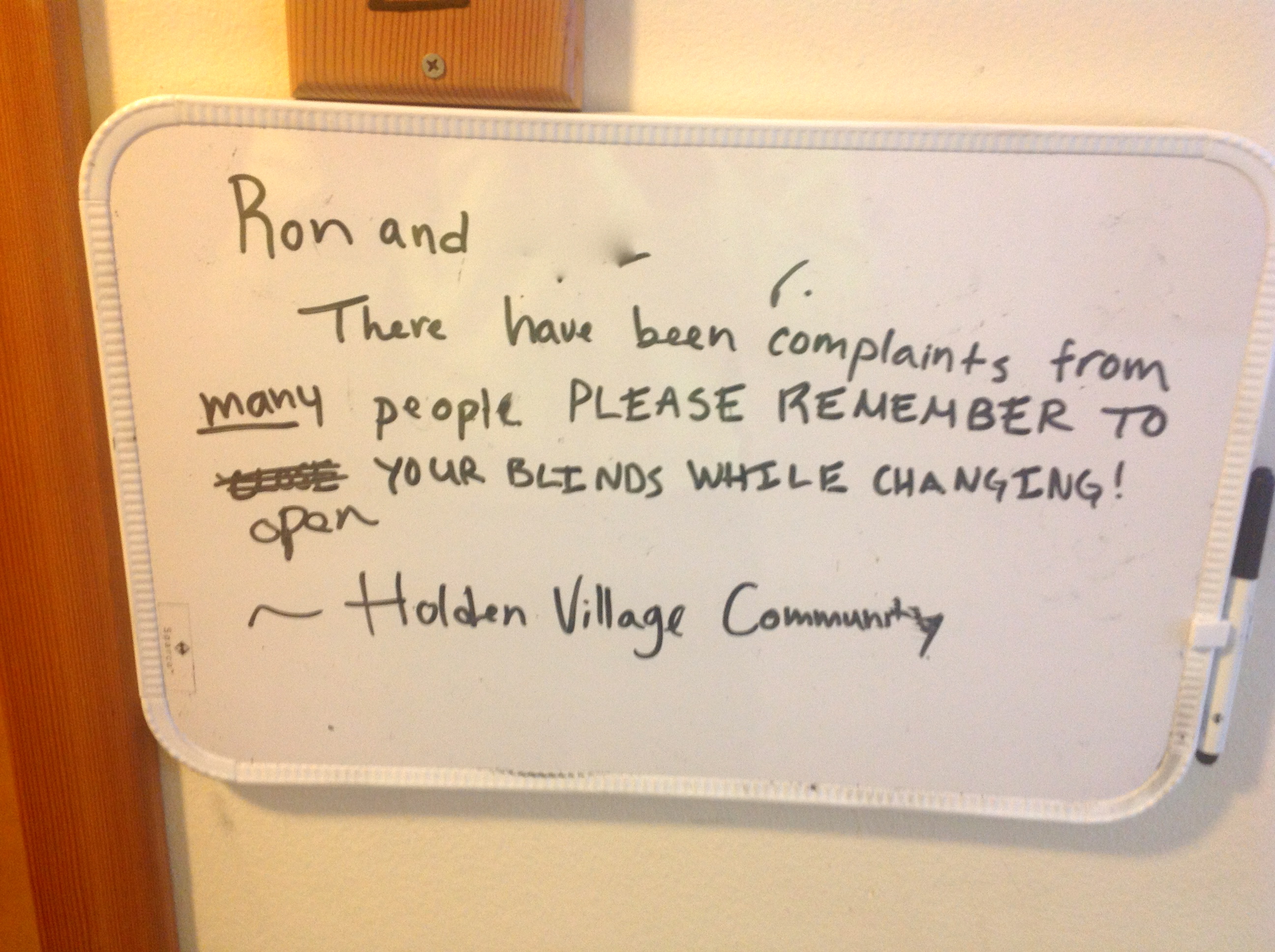
6) Teenagers aren’t just funny looking, they’re funny. I may have doctored the whiteboard next to the teen’s door. Shortly afterwards they returned serve with this salvo, which as you can see, I doctored.

Advantage twelfth graders.

Advantage twelfth graders.

7) In ping-pong, as in life, quit while you’re ahead. The first night I opened a can of whup ass on the GalPal. We rolled through 7-0 and it ended up something like 21-13. The second night, she also made a stirring comeback, but ultimately succumbed, 22-20. The third night, somehow, she couldn’t find me.

8) I’m a legend in my own mind. Despite turning a year older a week ago, I can still reverse slam dunk with a backpack on.

Mad hops

Mad hops

How long could you completely unplug? I’m guessing somewhere between 1 hour and forty-five minutes and 100 hours? Don’t hurt yourself trying to replicate my feat, but do consider a Holden Village get-away. It’s great for the soul. You don’t have to be Lutheran or even Christian, and you can decide how little or how much to participate in Village life. The lodging is rustic, but clean and comfortable enough for a few days or weeks. The food is mostly vegetarian, plentiful, and tasty. And don’t forget, if you volunteer to scoop ice-cream, you get a free serving afterwards.

A Minimalist Life

I’m easily distracted. In church on Sunday, I couldn’t help but think about minimalism. As one part of “Scout Sunday” the pastor asked past and present scouts to recite the scouts’ values. They did okay until about the ninth value. Twelve?! That’s about nine too many. And when I should have been concentrating on the sermon, I was thinking about this quote from a minimalist Londoner who just built a home.

People do comment on our tidiness, but I find it fascinating that they find it fascinating. If you have a thing of beauty, like a piece of architecture, and then you fill it up with things, then you somehow diminish it and you cannot really appreciate the space you live in. We have exposed the things we really love, like the photography and the books.

One group unnecessarily complicating things, one homeowner purposely and thoughtfully stripping things down to their bare minimum.

People associate minimalism with life simplifying projects, whether recycling old clothes, shredding unnecessary office papers, or decluttering a garage, but it can be a helpful organizing principle for all of one’s life.

Minimalism is about embracing limits that others mostly ignore. The starting point is the ultimate limit, one’s mortality. Minimalists are more mindful than most that their time is limited; as a result, they tend to be more interested in the quality of their life experiences than accumulating lots of money and possessions.

Minimalists believe stripping things down is liberating—whether electronic data, personal commitments, and friendships. Consider each.

Electronic minimalism. This one’s tough because digital clutter can be neatly contained within a smartphone, tablet, laptop, or desktop computer. If you’re like one of my offspring, your desktop may be proof of that. To practice electronic minimalism, create folders for loose documents, and use folders within folders. But first, delete as many unnecessary, out-of-date documents, bookmarks, and email messages as possible. I DIG that electronic wadding up and shredding of paper sound my MacBook Pro makes whenever I empty the trash. Like a Pavlov dog, I’m motivated to trash things just to hear the sound.

“Zero email inbox” is a futile, overly perfectionist goal, but if you typically have more than 20-40 messages in your inbox, delete more often and create and use more folders. Same with website bookmarks. Delete those you haven’t used in a long time and put the the remaining ones into folders. This makes it easier to avoid mindless web surfing. Same with applications. Some people have over a hundred apps. I find that odd because the fewer you use, the easier it is to quickly and easily access them. Maybe some mega app users would say they use folders and don’t have a problem, but most people probably use 10% of their apps 90% of the time. Why not just remove most of the 90%?

Electronic minimalism is based on the premise that fewer docs, email messages, website bookmarks, and applications makes it easier to find things, get one’s work done, and then enjoy life off-line.

Scheduling minimalism. As an introvert, and often to the GalPal’s regret, this one comes relatively easily for me. This is the countercultural practice of not committing to many activities—whether one’s own, or a partner’s, or one’s children’s. It’s saying to oneself, “I’d like to attend that event, participate in that weekly activity, or go on that trip, but I’m okay missing out on that fun because the busyness trade-off isn’t worth it.” Obviously, “too busy” is a subjective concept. The key is to know your particular physical and social limits and to intentionally err on the side of underscheduling.

Interpersonal minimalism. This is the related, countercultural practice of purposely focusing on a limited number of close friendships. I’ve written about the quality versus quantity of friendships conundrum before here. Young people’s embrace of social media has made this type of minimalism especially rare. Many high school and college aged young adults have a thousand plus Facebook “friends”. Interpersonal minimalism means focusing most of your friendship activity on people who you interact with face-to-face on a weekly basis.

Stripping down activities creates momentum which leads to additional ideas for simplifying not just one’s garage, but one’s life. In what other aspects of your life has less proven more?

[My favorite book on minimalism—Francine Jay’s The Joy of Less, A Minimalist Living Guide]

Tired

I used to be more like Bill Gates, my sister, Jon Kitna, and my wife. I wanted to help people improve their lives. Volunteer time in my community. Change the world for the better.

Now, Stoic sensibilities make it unlikely you’ll see me in a street protest near you. When I read essays like Gates’ recent one titled “My Plan to Fix the World’s Biggest Problems,” I marvel at his ambition. Twenty years ago I could have written a decent essay with that same title, but not now.

Saving any subset of the world requires endless teaming with others. Which makes me wonder. Or makes me worry. Being an introvert, and having taught for three decades, am I bumping up against my optimal number of lifetime interpersonal interactions?

Just because my gray-bearded self is less activist than my younger self, it doesn’t necessarily mean I’m more selfish. I still care about teaching well. And I’ve enjoyed helping other teachers refine their craft this academic year. And I hope this blog occasionally entertains, informs, or enlightens. And I vote (in most elections), try to encourage my family and friends, help old ladies across the street, and never litter.

I don’t begrudge the World Changers anything, I just don’t feel as much camaraderie with them as in the past. This isn’t flattering to write at all, but compared to the past, I’m more accepting of many of my community’s, country’s, or world’s long-standing problems. More content to study and try to understand the root causes of problems. When I try to tap some sense of righteous indignation, all I get is Buddhist detachment. More honest and authentic. Less a role model.

No, I was not the male lead in Silver Lining Playbook, but I can understand your confusion.

No, I was not the male lead in Silver Lining Playbook, but I can understand your confusion.

What Lance Armstrong Can Say to Oprah to Make Things Right

Nothing.

Apart from a simple “sorry for the long-standing deception,” Lance doesn’t owe me, or any professional cycling fan, anything.

Why do we continually delude ourselves to think we know the entertainers, athletes, and politicians we follow? That we’re in some sort of relationship with them? That when their moral failings become painfully evident, that they let us down?

Remember Tiger Woods awkward, post-rehab, public confessional in some Florida hotel conference room? The one with his mom in the front row. The one where he said he “kinda got away from his Buddhism (one of my favorite understatements of all-time)?” What was that all about? Tiger didn’t pledge to be faithful to me or you or even his corporate sponsors.

The bright light public confessional is all about limiting the damage to one’s personal brand, and by extension, earning potential. To reset as a human being, Tiger would have been far better off listing all the people he had hurt and then seeking each person’s forgiveness outside the media spotlight.

At 41, Lance is in trouble if he needs advice on how to reset as a human being. I’m offering it anyways. He won’t follow it because he doesn’t read this blog regularly enough, and like all of us, he’s highly skilled at rationalizing his behavior. He tells himself, “If it wasn’t for my success, Hamilton, Landis, Andreu’s wife, and even my masseuse and others involved with the sport wouldn’t have made nearly as much money.” In his mind, his accusers are indebted to him.

Forget Oprah Lance. And forget your athletic career (triathlon has a long ways to go before it reaches “fringe sport” consideration). Resolve to be a more kind, empathetic, and truthful person. Take time to make a detailed list of everyone that you’ve directly hurt as a result of your words, actions, and privilege. People who you repeatedly lied to. People you bullied on and off the bike. People whose reputations you trashed. People whose businesses you ruined. Then come clean in a written mea culpa, a no holds barred confession. In it, take complete responsibility for hurting those people as a result of their truthfulness.

Send it to the New York Times. Then buy however many plane tickets necessary and travel to see everyone on the list. No matter how much it cuts into your triathlon training. Seek their forgiveness as personally and privately as possible.

Do that and the tide of public opinion will begin to turn. But don’t do it for that reason. Don’t even do it for your children or your legacy. Do it to reset as a human being, for the sake of human decency, to live the second half of your life in a more kind, empathetic, and truthful manner.

imgres