Saturday Long Run Press Conference

CNN reporter: Strava shows you ran 9.6 miles in 1:17 for an average of 8:02/mile. What would you say to the American people who are afraid that you’re getting old and slow, now nothing more than a sad “hobby jogger”?

Me: I say that you’re a terrible reporter, that’s what I say. I think that’s a very nasty question and I think it’s a very bad signal that you’re putting out to the American people that I’m older and slower. The American people are looking for answers and they’re looking for hope. And you’re doing sensationalism and the same with NBC and Concast. I don’t call it Comcast, I call it ‘Concast.’ That’s really bad reporting, you ought to get back to reporting instead of sensationalism.

OANN reporter: How do you run so far, so fast?

Me: I love whoever you’re with. Because that’s such a nice question. I think you write fairly and do very fair reports. A lot of people always ask me, how do you run so far, so fast? I tell them I don’t know, I guess I just have a natural ability.

NBC reporter: How would you assess today’s performance?

Me: When you hear the number of miles I’m running and the pace, it’s incredible. And I’ve heard a lot of governors say the same thing. People are saying I’m doing a great job, the best job anyone’s ever done.

FOX reporter: What makes you such an incredible runner?

Me: Really lots of things, but what no one gives me credit for is when I first heard we were running, I immediately jumped on the stationary bike and got the blood flowing against many people’s advice. No one reports that. But I did, I got right on the stationary bike. Many exercise scientists—and I’ve read, many, many exercise scientists—can’t believe the great job that I’m doing.IMG_5669.jpg


Talking About Sexual Stuff On The Phone

We routinely get loose with language. Take “phone sex” for example*. I write a family friendly blog, so it’s not like I have any experience with it, but isn’t it a bit presumptuous to label talking about sexual stuff with another person as “sex”? Granted, “talking about sexual stuff on the phone” is uber-wordy, but far more accurate.

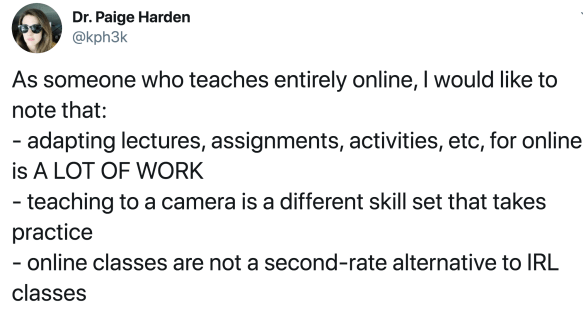
Similarly, as everyone does these days, it’s presumptuous to label “on-line teaching” as teaching. Take Dr. Paige Harden for example:

Screen Shot 2020-03-11 at 9.59.06 AM.pngHarden has an informative twitter thread on how to “teach on-line” and you can see her and a colleague in action here:**

Everyone refers to “teaching on-line”, but Harden’s specific phrase “teaching to a camera” highlights the fallacy of the phrase.

You can present to a camera, but you cannot teach to one. “Okay Boomer” alert. . . the word “teaching” should be preserved for IRL settings. The “on-liners” can go as crazy as they want with “presenting”.

Teaching encompasses more layered relationships with students than presenting. Teaching interactions involve direct eye contact, silences, nonverbal communication, occasional emotion, and one-on-one conversations outside of class where each of those are even more integral. Teaching, at least in the humanities and social sciences, entails learning your students’ stories, tweaking your plans according to those stories, and being spontaneous and authentic in ways that are difficult in a separate studio. Teaching is messy for the same reasons all interpersonal relationships are—because everyone enters into the conversation with different worldviews shaped by contrasting gender identities, class backgrounds, ethnic backgrounds, and political beliefs. And then, for good measure, add in status and power imbalances.

Teachers have a more immediate sense of how a course is going than presenters because technology-mediated feedback is harder to interpret. When I lecture in an auditorium, I can assess audience engagement based upon several subtleties including eye contact, head nods, facial expressions, and the number (and quality) of questions asked afterwards. The technologist will argue they can do the same sort of thing on-line, but I’m skeptical because teaching entails a dynamism that I don’t believe exists in on-line presenting. My “in real life” students routinely alter my lectures, discussions, and activities with unpredictable questions, or comments directed to me or their classmates, whose responses cannot be anticipated either. Again, technologist will say their presenting is similarly organic, but again, everything is relative.

So let me correct the record. As the nation’s professors and students turn to cameras, microphones, screens, and keyboards, some truth-in-advertising is in order. The country’s colleges are not moving to on-line teaching, they’re moving to on-line presenting.

*since no one talks on phones anymore, “sexting” is probably a more relevant frame of reference, another modern phenom I know nothing about

**Apple thanks you for the commercial


Book of the Week—Geezerball

I’m on a nice little reading roll, meaning a book a week. This week I cheated though when I subbed in a fun, short read, for a long, dryish, academic one that I was plodding through.

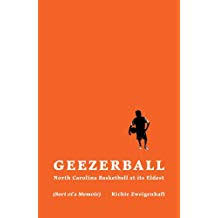
Geezerball: North Carolina Basketball at its Eldest (Sort of a Memoir) by Richie Zweigenhaft tells the story of the Guilford College noon pickup basketball game that I played in between 1993-1998 when I taught at the “small Quaker college”. The game is 44 years old and counting and some of the participants have been playing most or all of those years. One of the game’s mottos is “You don’t stop playing because you grow old; you grow old because you stop playing.”

Richie, also known as “The Commissioner” is an accomplished author of several books on diversity in the American power structure. Now 75 years young, he’s the glue that’s held the game together over the decades.

Geezerball prompted a lot of reminiscing about those years and reflection on what’s most important in life. I remember 11 of the 29 players on the current geezer email list which is pretty remarkable given how bad I am with names. It also speaks to the game’s stability and what demographers have been telling us for awhile—that Americans aren’t moving nearly as much as in the past.

The game combines two of the very few things upon which most medical doctors and social scientists respectively agree—the importance of exercise to our physical health and the importance of close interpersonal relationships to our mental health.

“My wife says she expects to get a call one day saying I’ve died on the basketball court,” one geezer writes in the book. “If that happens, she’ll know I died happy.” In actuality, the game is probably extending the life of the participants. Even more importantly, it’s adding tremendously to the quality of their lives. Their friendships, and the humor that marks their interactions, are testaments to the power of community.

Among other remarkable aspects of the game is the fact that nearly all the participants are men. As a runner, I can’t help but notice more women running together; like the geezers, strengthening their bodies, their hearts, and their minds simultaneously. Same with the Gal Pal and her girlfriends who go on long walks every Saturday morning while catching up on the week’s events. I don’t know if it’s true, but it seems like men are more prone than women to prioritize their work lives, often to their own detriment. Given that, I find it inspiring that a dozen men in Greensboro, NC have been defying that norm every Monday, Wednesday, and Friday for 44 years.

The sort of memoir reminded me of exactly how cool of an addendum the game is to the participants’ lives. But now, upon further thought, I can’t help but wonder if when those men near the end of their lives, they’ll think of the game as one of the most essential parts of their lives, and their work as more of an addendum. Meaning, what if we all have it backwards? What if the GalPal’s Saturday morning walks, my Saturday morning group runs, my Tuesday and Thursday night group rides are the core and everything else is the periphery?

This line of thinking may be just one more example of my economic privilege at work, but I can’t help but wonder what would happen if we organized our lives around Geezerball-like communities, where we prioritized movement and friendship over material wealth and status? Put another way, how much is enough? When it comes to work hours and money, there’s always a point of diminishing returns. At a certain point, more work means more impoverished relationships with family and friends.

In contrast, when it comes to walking, running, cycling, swimming, surfing, or playing basketball or golf with friends, there is no point of diminishing returns. Our physical and mental health just keep improving. Our entire well-being. That’s the lesson of Geezerball.

download.jpg

The Proper Way To Begin The New Year

That’s what I’m talkin’ about Kerry Elson. Elson wrote this before reading yesterday’s post, but major props to her for the perfect follow up.

“Totally legitimate reasons that I can’t go for a run.”

My fav:

“I’m supposed to meet a friend in six hours. If I go for a run, I might enjoy it so much that I end up running for the full six hours. I’m a good friend and I don’t want to be late, so even though I would love to go for a run I will not.”

Two Very Good ‘Los Angeles’ Sentences

From Margaret Talbot’s “Dancing with HAIM” in The New Yorker.

Talbot doesn’t drive. Sentence one.

“In high school and afterward, I was often a passenger, and, though I’ve always enjoyed riding in cars as much as any golden retriever with its head hung out the window, I also walked and took buses a lot.”

Slowing down has it’s advantages, in particular, noticing the details of one’s surroundings. Sentence two.

“I got to know the particular topography of pedestrian L.A.: muffler shops and taquerias and strip-mall doughnut shops run by Cambodian immigrants; bougainvillea and birds-of-paradise that grow opportunistically in cracked sidewalks; abandoned shopping carts and outdoor newsstands and faded courtyard apartment buildings with grand names; the scintillation of sunshine on passing rivers of traffic, telephone-pole flyers advertising suspicious-sounding opportunities in the entertainment business, and freeway underpasses and their homeless encampments.”


The Divinely Perfect Destiny of Brilliant Donald Trump

I’m reading a biography of Kim Jong Un who Donald Trump seems to admire. One thing that fascinates me about North Korea is how an army of government apparatchiks use language (and song and art and media) to create as comprehensive a cult of personality as the world has ever seen.

What intrigues me seemingly inspires The Republican Congress and Donald Trump.

In an article titled “How the Kim cult of personality came to dominate North Korean life,” Fyodor Tertitskiy shares the most extensive title he has ever seen published in the Rodong Sinmun in December 1972, when Kim Jong Un’s grandfather was elected president for the first time. In one sentence, he was referred to as:

Peerless patriot, National Hero, Ever-Victorious Iron-Willed Brilliant Commander, One of the Outstanding leaders of the International Communist and Workers’ Movement, the Great Leader of our Party and of our people respected comrade Kim Il Sung, who founded the Marxist-Leninist Party – the Workers’ Party of Korea and the true state of workers and farmers – the Democratic People’s Republic of Korea and steadily leads our Revolution on the way of victories.”

How long until Trump’s Republican backers “borrow” from the North Koreans minus the references to communism and begin addressing him along these lines:

“Dear Leader Trump Peerless patriot, National Hero, Ever-Victorious Iron-Willed Brilliant Commander, One of the Outstanding leaders of the World, the Great Leader of the United States and our people who resuscitated the Republican Party, made America Great Again, and leads our Revolution on the way of victories.”

Would that earn a retweet or is it insufficiently flattering?