Palinism

A few Friday nights ago, David Brooks no doubt scored serious points with NewsHour listeners when he said, “Every second we spend talking about Sarah Palin is a second of our lives we’ll never get back.”

Catchy soundbite, but he was wrong.

We need to talk more about what her parochial, nostalgic, oddly vague and exclusionary worldview means for not just our national politics, but education reform.

Palinism the ideology—a set of conservative political beliefs that rests upon a parochial, nostalgic, vague, exclusionary interpretation of U.S. history—is far more pernicious than her easy to make fun of media personality.

Palinism is a litmus test. If we continue to think of students first and foremost as future workers and consumers, and not citizens, its influence will spread and some of its adherents will win elections. Absent a nuanced sense of our nation’s unblemished history and an appreciation for what a vibrant democracy requires of its citizens, our young people will increasingly opt for glossy, symbolic style at the expense of gritty, grounded substance.

Recently, just for David Brooks and you, I sacrificed 197 seconds of my life watching SarahPac, a brilliant marketing video of Sarah’s bus tour of the U.S. Actually, now I’ve sacrificed over 15 minutes since I’ve watched it five times.

It’s fascinating on several levels. Exercise your citizenship and watch it.

Notice the following:

• In the midst of the hundreds of people that appear in the commercial, there’s one black veteran. Palinism borrows from a recent Modern Family sketch, “White is right.”

• The phrases “restore what’s right,” “restore the good,” and “we need a fundamental restoration” repeat throughout.

• “Founding” and “foundation” also repeat throughout. It’s like a news station repeating the phrase “fair and balanced” over and over. Maybe, if the populace is half asleep, hypnosis works.

• Painfully vague catch phrases are sprinkled throughout including, “be in touch with our nation’s history,” “so we can learn from it,” “move forward,” “all that is good about America,” “effect positive change,” and “America is the exceptional nation.” The classic hallmark of a really bad first year college essay.

Absent a critical nuanced understanding of U.S. history, government, and foreign policy, the videos sophisticated mix of traditional American symbols, music, and vague repetitive narrative would probably work wonders on large percentages of today’s secondary school students.

An older woman near the end gushes about Palin’s “courage and strength” and concludes, “she has it all.”

If we continue to preach the math and science gospel and mindlessly apply business principles to schooling, our youth might conclude the next Sarah Palin and the one after her have it all.

In which case Palin’s videographers might just win the battle of ideas.

Somethingotherverted

I’m neither introverted nor extroverted. I’m somethingotherverted. Someone on the outside looking in would probably label me introverted.

I prefer solitude to crowds. Give me a quiet dock on a still lake over a Disneyland pass any day of the week. On a Friday night, I’ll pass on the concert in the park for popcorn, the NewsHour, and something interesting to read. The apple doesn’t fall far from the tree. The stories motherdear could tell about my dad’s propensity for quiet nights at home.

Long story short, I lack social energy. But the ironic thing is, when cajoled to attend the concert in the park, I almost always enjoy myself. And often I see people I know and rally, asking questions, catching up, making people chuckle. If you were to eavesdrop on me at the concert in the park, you might even conclude I’m extroverted. That’s why the conventional sociability continuum doesn’t quite cut it.

Some of my close friends are surprised when I half-jokingly describe myself as anti-social because my socialness is most evident in small groups. I greatly prefer dinner parties with a few close friends to large fiestas where I don’t know many people. At fiesta gigante the GalPal, a conventional extrovert, will walk right up to you and introduce herself. Especially if you look like you might not know anyone else. In contrast, when I’m looking at you I’m thinking, “What a sadsack.” That’s okay though because once she ditches me, you’ll be thinking the same thing about me. Kharma.

My somethingothervertedness is evident in my professional life too. I’m guilty of keeping a very low profile in the office and on campus, but I’m alive in the classroom, enjoying my interactions with students very much.

I’m fortunate the GalPal sometimes nudges me out of my self-imposed solitude. She used to try to drag me to events which often caused me to be even more resistant. She’s become more understanding, meaning more sensitive and subtle.

Then again, our 25th anniversary is around the corner. A quarter-century should be long enough to figure out our extrovertedness and somethingothervertedness.

What are you?

I Promise

If elected President to give up golf for the length of my term(s). Presidents deserve and need downtime, but symbolism matters, and playing golf is about as bad as it gets. At least for Democratic Presidents. People want leaders that are more like them, than different. Just practice your putting stroke and invite Boehner over to watch the US Open on television.

If elected to Congress to keep my privates private.

If elected Governor of New Jersey, to drive, not helicopter, to my children’s events.

If elected to Congress, not to advocate for abstinence education and then have an affair with one of my staffers.

If given a Nobel Prize and Oscar for my work publicizing the threat of global warming, to keep my monthly electricity bill under $1,200/month.

If running for the Republican nomination for President, not to call for a crackdown on illegal immigration and then use undocumented Guatemalans to tend to my lawn and tennis court.

If elected to Congress, as hard as it may be, to refrain from tickle fights with my male staffers.

If elected to Congress, to refrain from emailing photos of my shirtless self to any women I might meet on Craigslist.

Until then, however, I can’t promise any of those things.

Sentence to Ponder

Since its founding, Father’s Day has always been the beta holiday—created as an analog to Mother’s Day, and never celebrated with as much fanfare, attention, or money.

From Annie Lowery in Slate.com. In 2011, Lowery reports, consumers planned on spending $106.49 on Father’s Day gifts and $140.73 on Mother’s day gifts.

That’s just wrong. Where’s the rage for parent equity?

Sunday will mark my eighteenth Father’s Day. Eighteen times $35 equals $630.

Dear daughters, a $736 ($106 + $630) gift is all it will take to close the parent gap.

Let’s Fix or Stop Requiring Senior Culminating Projects

A steadily increasing number of American high schools are requiring students to complete independent culminating projects during their senior year. One student commits to private singing instruction and sings a solo at a culminating recital, another learns to train dogs, another how to Irish Dance. In theory, they’re supposed to prevent advanced senioritis.

In practice though, they typically don’t. Most students view them as just another hoop to jump through.

The problems are three-fold.

First, students quickly pick up on the fact that faculty and staff view them as “add-ons”. Meaning usually there’s too few intermediary deadlines and too little adult investment in guiding students.

Second, too many students are unaccustomed to working independently and so they throw something together in the final week. Faculty are pressured to pass students whether the projects meet the stated criteria or not. Otherwise they don’t graduate, causing lots of different headaches.

Third, even nicely done projects don’t contribute to, or inform, the students’ classroom-based learning. How on earth can we expect faculty to integrate them into their classes when most of them aren’t even aware of what the majority of seniors are doing.

Faculty should agree not to “half-ass” it anymore. Each school’s faculty should have an honest discussion about the quality of recently completed projects and their value to the curriculum writ large. Then cast an up or down vote on investing more time and energy into better guiding students, holding them accountable for more rigorous work, and truly integrating them into the curriculum.

More specifically, faculty need to decide whether they’re up to 1) guiding students in selecting personally meaningful and intellectually challenging projects by providing examples, contacts, and feedback on proposals; 2) saying no to projects that are not intellectually challenging; and 3) instituting intermediary deadlines and implementing legit consequences for missing them.

Ultimately, senior culminating projects are a litmus test of sorts. Are our K-11 efforts producing increasingly independent learners? Right now, I’m inclined to answer no. Most seniors need more guidance in the form of help on proposals and truly rigorous expectations. Faculty need to decide whether they want to invest their finite time and energy in revamping flawed senior culminating project requirements.

I see lots of untapped potential in the requirement, but open and honest faculty “no” votes would be preferable to uneven mediocrity and continued fence-sitting.

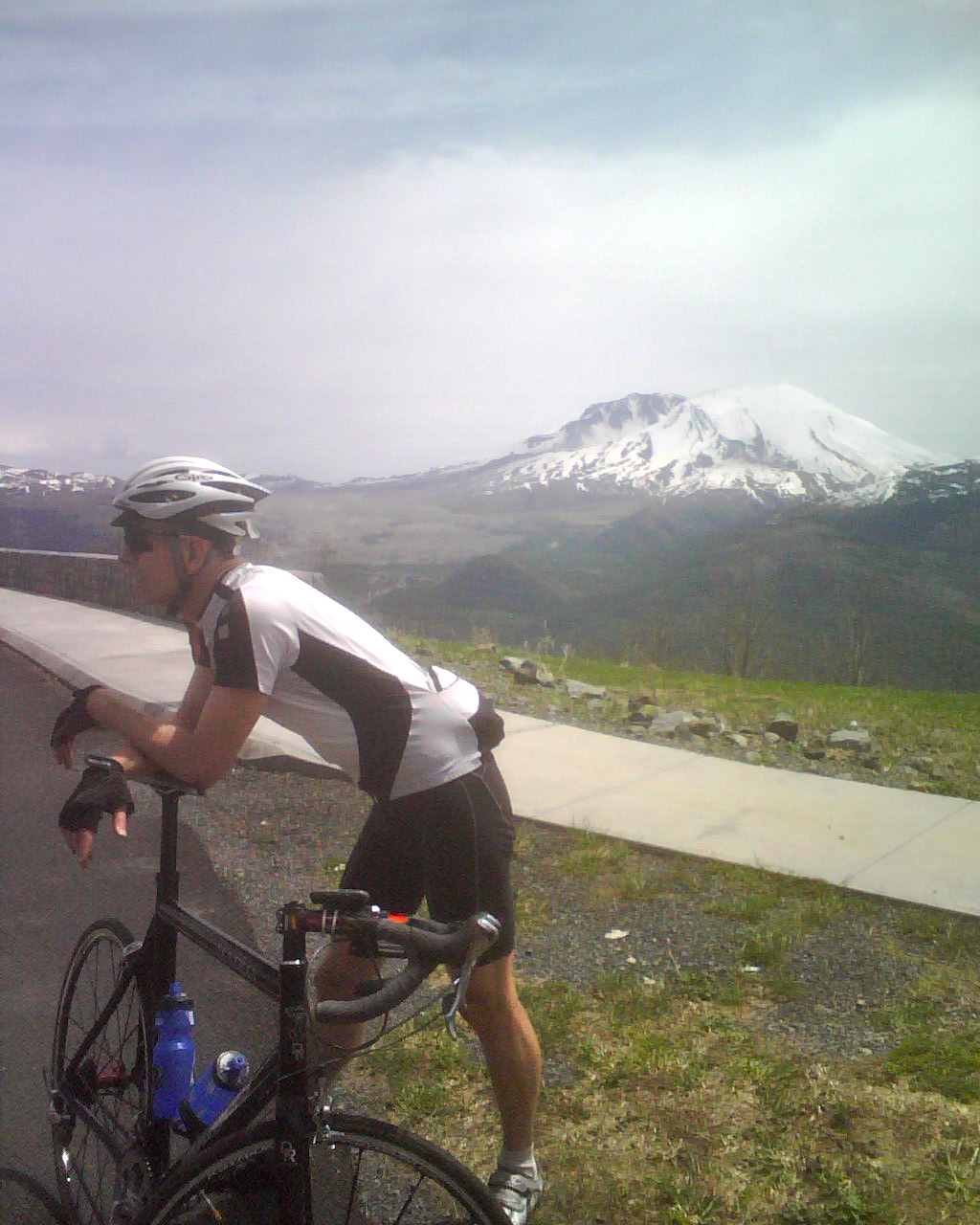
Mount St Helen’s Climb

Last Sunday. Six other riders. I was the youngest, average age, 56-57. Seems like in my circle of friends, 60 is the new 40. 74 miles, 6,500+’ of elevation. Twenty two relentless miles at 6-7%, followed by a screaming 7-8 mile descent, followed by the final 7-8 mile climb to the Johnston Ridge Observatory. It’s a bit harder enjoying the screaming descent (max 42 mph) when you know you’ll be climbing up the other side of the road in relatively short order.

Jamie and I separated from the other five halfway up. Then it was mano y mano. At the beginning of the final ascent, at mile 30, he gapped me. I sat 5-15 seconds back until the final half mile when I overtook him for the mountain top stage victory. Max heart rate. Time to the top, 2:38. Time down, 1:50. Average speed, 16+.

I enjoy going “mod-hard” over medium to medium-long distances. When climbing for miles or running long distances for time I enjoy the challenge of getting into a sustainable rhythm and then sitting right on the edge for an hour, two, or three.

I celebrated the ascent by carefully crafting and then eating a nearly life-size mint chocolate chip replica of the volcano.

Small Group Cooperative Learning

Too many teachers throw students into small groups and expect meaningful learning to ensue.

They don’t discuss or teach small group interpersonal skills. They may not think through how best to group students of different interests and abilities. They may not clearly communicate or model their expectations. And they may not check to see that the students truly understand what to do before telling them to begin working.

So instead of getting right to work, students end up talking about what they think they’re supposed to do. And because the expectations and steps aren’t posted anywhere, the teach frantically runs from group to group answering clarifying questions. One or two of the students do the bulk of the group work while the others passively coast.

Then the teach doesn’t make time to challenge students to reflect on and identify what they did and didn’t do well within their small groups. Too many teachers wrongly assume that small group cooperative learning skills are intuitive; consequently, they don’t have to teach them. As a result, most groups are dysfunctional, the sum rarely if ever equals more than the individual parts, and students develop negative associations with small group cooperative learning.

They end up carrying around invisible backpacks filled with negative group experiences. “Not group work again.” Often in high schools, it’s easy to detect a pervading sense of small group doom and gloom which teachers often mistakenly chalk up to “laziness” or “immaturity”.

Teachers aren’t alone. Coaches sometimes refer to team chemistry, but rarely if ever teach how to be a good teammate. Again, they assume the requisite interpersonal skills—listening, encouraging, and problem solving for example are built-in, even though there’s ample evidence they’re not. Orchestra conductors, youth pastors, drama teachers, employers, and parents often fail to teach young people how to prepare for and contribute more positively to their inside and outside of school small groups.

To the detriment of meaningful learning, we focus on work products at the expense of work processes.

The Teacher Appreciation Deficit

Thursday night, as I settled into my seat at Olympia High School’s end-of-the-year orchestra concert, my thoughts drifted back to earlier in the day when my thirty-four Masters Teaching Certification candidates discussed whether, as year-long interns, they felt sufficiently appreciated.

No surprise that most of them did not. Instead of partnering with them, they lamented that too many of their students’ parents ceded seemingly total responsibility for their  children’s education. I suggested that tough economic times seem to be bringing out the worse in an increasing number of people who seemingly view teachers—with their relative job security, solid health care benefits and retirement plans, and shorter than average work year—with antipathy and derision.

My doctoral dissertation was the story of a Global Studies high school in Southern California. Before putting pen to paper, I sat in on four classrooms for a few months. One dark fall morning, while I was interviewing one of the Global Studies teachers whose classroom I studied, he stopped me cold and said, “You’re the first person in twenty-three years who truly understands what I do.”

Most teachers do exceptionally good work in near total obscurity. Often, their administrators and colleagues don’t even have a feel for what they accomplish on a daily basis, let alone students’ parents or the public more generally. Ignorance breeds contempt.

Coaches, theater educators, and music educators are exceptions to the rule because their students sporadically perform in public. Typically, afterwards, the public praises their performances and applauds, sometimes as in the case of the Olympia High School end-of-the-year orchestra concert, lustily.

Absent audio tracks from their concert, there’s no way I can convey the brilliance of Olympia High’s orchestra program. It probably helps that I’m not a connoisseur of classical music, but at every concert I marvel anew at the excellence. Excellence that rests on parents like the GalPal who decided early on that our daughters were going to have every opportunity to excel at the violin, a network of outstanding private instructors, and Chip Freakin’ Schooler, the best orchestra teacher and conductor in at least this galaxy.

Of course privilege comes into play, but what better use of financial resources than artistic excellence? In fact, increasingly I wonder if beautiful music, dance, literature, design, painting, photography and related art forms are all that matter. Maybe we have it exactly backwards, cutting arts education in the interest of economic utilitarianism and consumerism.

CFS deserves his own post, but for now, suffice to say he embodies a critical ingredient to reforming education and improving teaching—off the charts subject matter expertise. A couple of tweaks to his life journey and I suspect he’d be conducting a major U.S. symphony right now.

Instead, he’s working tirelessly with fourth and fifth graders and middle schoolers at several different schools preparing them for the high school orchestras. His work ethic rivals his musicality, so much so it takes most of the summer at his family’s Lake Cour d’ Alene cabin to decompress.

I feel deeply indebted to CFS for the educational experience he’s provided Fifteen and Eighteen. At the end of the concert, each senior gave him a bag of chips, then took turns reading a touching poem to him, then gave him flowers, then new rosin rags, then a special tuning fork set to 2011 megahertz. Craziness, teenagers being touching.

CFS balanced appreciation for his students’ affection with selfless and pragmatic attention to wrapping up the concert. Pride in the students’ accomplishments, without the personal ego one might expect.

It’s the end of the school year. Tell a Chip Schooler in your community why you appreciate them.

What’s a Sport?

Email exchange with Eighteen from Liberal Arts College. Context. I give her a hard time about a lack of school sport spirit:

Her. The top Men’s Ultimate frisbee team just won nationals!! Best frisbee team in the nation! And guess what I watched most of the game. Yeah. I watched a sports game. Live. And I didn’t have to.

Me. Ultimate frisbee isn’t a sport. It’s how hippies take breaks from studying.

Her. FALSE. Just because you can’t do it doesn’t mean it’s not a sport.

Note a few things about this give and take.

Not sure why, but her generation is just exclamation point happy! And I’m sorry to report it’s spreading to other age groups! Soon everyone will be shouting everything!

Sometime during middle school she learned that the best defense is a good offense. If only her mother responded to my teasing with equal aplomb.

Lastly, when I was her age, much to my dad’s dismay, I was becoming a frisbee legend in my own mind on the beaches of Southern Cal. My signature move was hucking the disc way out and over the shore break, waiting for it to catch the onshore wind, and then catching it to the delight of millions of beachgoers. It was an amazing display of power, feel, and hand-eye coordination. No doubt, had I chosen to take breaks from studying by playing Ultimate, I would have become the Lionel Messi of Ultimate.

But back to the central questions: Is Ultimate a sport? And what is a sport?

For an activity to be a sport, one must answer the following eight questions in the affirmative:

1) Are over involved parents present who think their child is the best and the coaches don’t know what the hell they’re doing?

2) Does the activity produce at least as many statistics as the Congressional Budget Office?

3) Is there the potential to someday turn pro at said activity?

4) Do highlights from the national championship game or event appear on ESPN’s SportCenter?

5) Are there occasional labor conflicts, lockouts, and shortened seasons?

6) Do young children have posters of the best players in their bedroom?

7) Do some participants engaged in the activity cut corners on the rules and/or run afoul of the law?

8) Do participants in the activity and their fans place more importance on the final outcome of competitions than objective rational observers would expect?

How does Ultimate hold up in the context of our eight-point litmus test? I submit to you the answers are: no, no, no, no, no, no, no, no!