US professor suspended for bizarre, profanity-laden ‘welcome’ video to students. There are no words. Takes him awhile to catch his stride.

US professor suspended for bizarre, profanity-laden ‘welcome’ video to students. There are no words. Takes him awhile to catch his stride.
A blip in the spring of 2020 aside, U.S. markets have steadily risen for 12 years*. So a lot of younger investors are panicking this week because they’re totally unaccustomed to market volatility. History tells us many of these investors will sell at the exact wrong time. Actually, history tells us many investors of all ages and experience will sell at the exact wrong time. Instead, right now investors should be buying low cost index funds with all the coins they can find under their sofa cushions.
Vanguard has an excellent forum of savvy investors who help one another with investing decisions and with staying the course. It’s a model on-line forum because it’s moderated so well. You don’t have to be a Vanguard client to lurk (like me) or even participate.
This morning on the forum participants are reminding one another of the best way to deal with market volatility and downturns more specifically—turn off the t.v., stop reading the business news, and only check investment balances one or two times a year.
Solid advice, that I don’t follow, even remotely. As per usual, I’m consuming a lot of business news this week and I check my investment balances every Friday**. And yet, despite all the noise I consciously subject myself to, it has no effect on my “buy and hold” self discipline. Why is that?
Maybe it’s because I have devised a mind game that enables me to blunt the general panic of others. Here’s how it works. Let’s say we have $500k saved for retirement, and that $500k is equally divided between stocks and bonds. When I look at the stock side of my net worth statement, I don’t see $250k. Instead, I pre-plan for a 50% correction in the stock market. Put differently, I build it in in advance, so instead of seeing the actual $250k, I see a range of $125k to $250k. Since bonds rarely loose more than a few percentage points any given year, I don’t engage in the same mental gymnastics on that side of things.
So given our hypothetical starting point, I would think of my net worth as somewhere between $375k (assuming a 50% correction in stocks) and $500k. Like an athlete, I visualize the possible, no make that probable downturn of the market, so that when it happens, I roll with it. Despite actively watching investors panic.
As it turns out, the stock market roller coaster is rising today, so the S&P 500 is down all of 5+% for the year. So in our scenario, our current net worth is approximately $487k (250k – 5+% = 237k in stocks + 250k in bonds). $487k looks and feels pretty darn good give our $375k floor. Removing any need for panic selling.
My advice to newer investors is to know that the correction could get A LOT worse. My suggestion, do both/and, tune out the noise and mentally prep for a real, live, sustained bear market.
*in large part, thanks to the Federal Reserve
**I aspire to do it monthly
The Making of Cooper Kupp. More love stories like this please.
Woman’s diary goes viral as lockdown in China forces her to stay with blind date. Proof that your experience of ‘rona could be worse. A lot worse.
Inside Jerry Falwell Jr.’s Unlikely Rise and Precipitous Fall At Liberty University. Heaven forbid, if you understand Falwell’s family history, his public pathologies start to make a little sense.
Buy Things, Not Experiences. The exact opposite of positive psychology’s conventional wisdom.
Meet the auto repair professor pivoting to EVs. Imagine a (dis)United States with genuine vocational education options like EV Auto Repair and Battery Restoration in high schools.
What’s your favorite golf podcast? Hard to narrow it down? Mine is “The Drop Zone” with co-hosts Sean Zak and Dylan Dethier.
The roots of my Zak and Dethier bromances are at least threefold. First, they have an endearing friendship. Second, their content is always smart and socially conscious and often humorous. Third, Dethier completed the best gap year of all time at the end of which he wrote a book titled “18 in America: A Young Golfer’s Epic Journey To Find The Essence Of The Game” which I still have to read. The book is described this way:
“Shortly before his freshman year of college was set to begin, seventeen-year-old Dylan Dethier—hungry for an adventure beyond his small town—deferred his admission and, “like Jack Kerouac and Ken Kesey before him, packed his used car and meager life savings and set off to see and write about America” (ABC News/ Yahoo). His goal: play a round of golf in each of the lower forty-eight states.
From a gritty municipal course in Flint, Michigan, to rubbing elbows with Phil Mickelson at Quail Hollow, Dylan would spend a remarkable year exploring the astonishing variety of the nation’s golf courses—and its people. Over one year, thirty-five thousand miles, and countless nights alone in his dusty Subaru, Dylan showered at truck stops, slept with an ax under his seat, and lost his virginity, traveling “wherever the road took him, with golf as a vehicle for understanding America” (The New York Times).”
Man, what I would give to have had an 18 year-old Dethier in one of my First Year writing seminars.
The content of this fresh-off-the-press piece by Dethier, “How would a scratch golfer fare against LPGA pros? Now we know: not well.” which garnered about a third of today’s 36 minute podcast, kept me company on my chilly morning run to Priest Point Park and back. It exemplifies what makes “The Drop Zone” such a good listen. It’s a smart, funny, and wonderfully feminist take on just how good women professional golfers are these days.
So if you’ve been wondering what’s missing in your life, and you think it may be the lack of a truly excellent golf podcast, given Zak and Dethier a whirl the next time you’re practicing your chipping and putting.
As a writer, there are some impossible assignments. Where the degree of difficulty is just too great to put pen to paper.
You can’t write anything sympathetic to Republicanism in The New York Times, just as you can’t write anything sympathetic to the Left in The Washington Times.
If you identify as male, you can’t write about the “female experience”. If you are rich, you can’t write about the poor. If you’ve never had kids, you can’t write about parenting.
I mean, you can, there’s a First Amendment after all, but good luck to you.
And if you’re on “the tenure track”, or a tenured professor, you can’t complain about anything higher education-related without understandably unleashing the growing army of adjuncts who struggle to feed themselves and make rent. They. Aren’t. Having. It.
Unless you were an adjunct before you landed your tenure-track position? And you acknowledge your good fortune. More than once. Then, just maybe, you can pull off the rarest of feats.*
Cue Sarah Emanuel’s essay, “The Deflating Reality Of Life On The Tenure Track” with the provocative subtitle—”Walking dogs helps me make rent.”
Props to Emanuel for her hustle and her risk taking as a writer. And her good humor.
Historical footnote. The Good Wife and I started our journey in a one-bedroom Venice apartment.
*I haven’t read the comments yet. Kinda afraid to.
It’s greed. That’s the headline of this powerful six and a half minute long New York Times documentary. I concede, given the Gray Lady’s size and stature, it’s important to read and/or view her with a certain skepticism, but as this short video illustrates, the “paper of record” continues to produce a lot of outstanding journalism.
When it comes to the New York Times, I am in the habit of reading the top “reader picks” comments. At present, this video has generated 1,562 comments. Here’s a portion of the top rated one, from someone living outside the (dis)United States:
“Hey, your politicians passed and signed federal law 9 years ago to allow private equity (wall street) to buy and own healthcare systems and physician groups. Prior to that it was illegal. Now private equity is the largest employer of emergency room physicians in America and as owners of healthcare system employees many many doctors and nurses of all specialties. Private equity is buy a company reduce costs increase profit and sell it in 5-7 years. That is who owns many of your doctors and hospitals. Federal law was changed to allow that to happen and where was the objection from the people. My guess probably almost no one knew. How funny to watch your media avoid these topics when they happen and fill it with the latest on the celebrity politicians over there.”
The nurses in the video confirm that our fetishization of corporations is the root cause of their untenable work conditions. And the reason people admitted to U.S. hospitals often receive poor care.
It reminds me of how powerfully later seasons of “Orange Is The New Black” depicts the negative consequences of private prisons.
Because we’re complexity adverse, we don’t connect dots, like our “avoid taxes at all costs” myopia and our near religious beliefs in “free” markets. Those neoliberal pillars are as solid as they’ve ever been. To question them is to be labelled a “socialist”.
In the end, we have the public health system we deserve. A public health system that an increasing percentage of nurses don’t want anything to do with.
John Deere breaks new ground with self-driving tractors you can control from a phone. What will they do with all their spare time, fly around their farms on Jetson Ones?
. . . read headlines. Recently, I’ve been diagnosed with “CEFS” or Current Events Fatigue Syndrome.
Some recent headlines are funny enough that I don’t even have to read the article. My spirit is already lifted.
I Became Extremely Hot In The Pandemic. My Husband Did Not.
Okay, so maybe I didn’t read it because I was afraid the Good Wife wrote it.
Some recent headlines are so cringe-worthy I can’t bring myself to read the article. This is CEFS in action. In increasing order of cringe:
Misinformation Is A Pandemic That Doesn’t Have A Headline
Tie for First. . .
Election Offices And School Board Meetings Could Become Weapons-free Zones In Washington
Report: World’s 10 Richest Men Doubled Their Wealth During COVID Pandemic
And sometimes since I know how the story is going to turn out, it’s unnecessary to read on.
Help! My Husband Throws Away My Things Without Asking In The Name of “Minimalism.”
Dude’s wife divorces him. He moves into an apartment a few steps below the one he lived in during college. Can’t afford any real furniture to speak of, any art, anything. Shortly thereafter, dies from loneliness in his minimalist “paradise”.
Okay, so maybe I didn’t read that because I was afraid the Gal Pal may have authored it as well.
He hangs up on Steve Inskeep once he realizes Inskeep isn’t even close to buying what he’s selling. One more reason to donate to NPR.
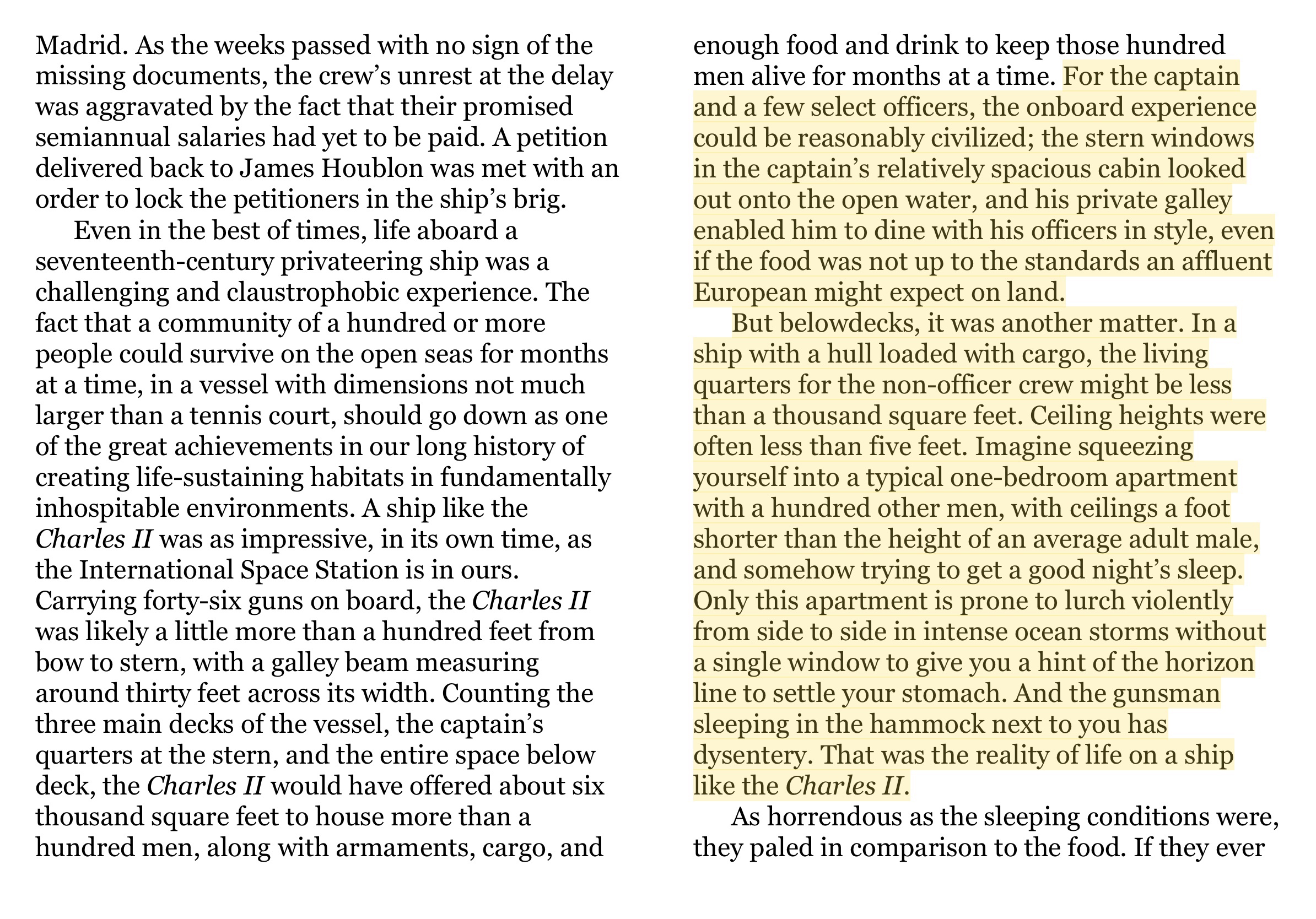
From my current read, “Enemy of All Mankind: A True Story of Piracy, Power, and History’s First Global Manhunt” by Steven Johnson.
I don’t want to imagine. I don’t do well on open water, I’m tallish, and I crave solitude. My absolute worst nightmare.
 Pressing Pause